Category: News

Add your news
You can add news from your networks or groups through the website by becoming an author. Simply register as a member of the Generator, and then email Giovanni asking to become an author. He will then work with you to integrate your content into the site as effectively as possible.
Listen to the Generator News online

 
The Generator news service publishes articles on sustainable development, agriculture and energy as well as observations on current affairs. The news service is used on the weekly radio show, The Generator, as well as by a number of monthly and quarterly magazines. A podcast of the Generator news is also available.
As well as Giovanni’s articles it picks up the most pertinent articles from a range of other news services. You can publish the news feed on your website using RSS, free of charge.
 

  • Developing countries urge G8 to impose 40% emissions cut by 2020

    Developing countries urge G8 to impose 40% emissions cut by 2020


    Diplomat says developing nations ‘will commit once they have certainty that developed countries are commiting themselves’


    Developing nations are prepared to make concessions on climate change targets if the G8 fulfils its side of the bargain in the run-up to the climate change talks in Copenhagen in December, a key negotiator told the Guardian today.


    The developing countries want the G8 nations to sign up to a 40% cut by 2020, but that figure is off the radar of the EU and, given the unwieldy legislation laboriously passing through the senate, not a possibility for the US.


    In important forward steps this week, the G8 agreed to cut its emissions by 80% by 2050 and said worldwide emissions should fall 50% by the same date.


    However, the value of this pledge has been reduced by the lack of an agreed start date from which the emission cuts should be measured, making it a distant promise.


    Luis Alfonso de Alba, the lead co-ordinator on climate change for the developing countries at the G8, told the Guardian that their call for a 25-40%cut in developed nations’ emissions by 2020 was based on what UN climate change scientists had recommended.


    The Mexican diplomat gave some ground, saying: “It does not have to be a specific target of 40%.


    “That is what we hope to achieve, but this is a process of negotiation.”


    He said a G8 commitment to a 2020 target was “fundamental”, adding: “It is logical that developing countries will commit once they have certainty that developed countries are commiting themselves.


    “We need to see the mid-term targets go much higher, and we want to see all the developed countries, including the US, move at the same pace.


    “We still need to see numbers. We respect the internal debate in the US, but it is important for the US to understand that this is a global issue and a multilateral negotiation.”


    He said developing nations could not “just sit and wait to see what the internal debate in the US resolves”. He insisted the meeting chaired by Barack Obama under the aegis of the Major Economies Forum this week had made progress in accepting common responsibility for the crisis and for the need for carbon emissions to peak.


    “Climate change is no longer seen as a north-south issue,” he said. “It is no longer a donor recipient relationship.


    “The most important message is that assuming individual responsibilities to fight climate change can start immediately, and by doing it immediately it will be easier to reach an ambitious agreement at Copenhagen.”


    De Alba said Mexico had already come up with its own carbon reduction programme, and he expected other developing nations to do the same over the coming months.


    It was acknowledged at the summit that science dictates world temperatures must not rise more than 2C degrees above pre-industrial levels.


    The negotiators hope this acknowledgement will drive the coming negotiations in the run-up to Copenhagen.


    The talks include three UN sponsored meetings in Bonn, Bangkok and Barcelona as well as another meeting of the G20 in September.
  • G8’s $25bn plan to aid poor farmers


    G8’s $25bn plan to aid poor farmers


    Correspondents in L’Aquila, Italy | July 11, 2009


    Article from:  The Australian


    BARACK Obama and other leaders of wealthy nations unveiled a $US20 billion ($25.7bn) fund to help feed the developing world yesterday as they were urged to help the poor survive the global economic downturn.


    On the last day of the G8 summit in Italy, the US President and his peers tried to answer criticism that they had turned their backs on those most vulnerable to the global economic crisis and held talks with African leaders.


    As Mr Obama prepared to embark on his first visit to sub-Saharan Africa, delegates said he played a key role in persuading about 30 wealthier countries to bankroll a fund aimed at helping smallholder farmers to increase crop yields.


    It was initially expected the fund would total $15bn, but Mr Obama said that figure had now reached $20bn.


    The US will reportedly stump up about $US3.5bn of the cash, and Japan and the European Union between will put in between $US3bn and $US4bn each.


    “We have committed to investing $20bn in food security, and agricultural development programs to help fight world hunger. This is in addition to the aid we provide,” Mr Obama said.


    “Going into the meeting, we had agreed to $US15bn. We exceeded that mark, and obtained an additional $US5bn of hard commitments.”


    The fund signifies a shift in focus by the rich nations away from food aid to giving practical help for local agriculture.


    “We believe the purpose of aid must be to create the conditions where it’s no longer needed to help people become self-sufficient, provide for their families and lift their standards of living,” Mr Obama said.


    The head of UN agricultural agency IFAD, Kanayo Nwanze, was among those who welcomed the plan, saying it represented a “shift from food aid — which is like providing medication after the child is ill — to providing assistance to help the countries … produce food by themselves”.


    British Prime Minister Gordon Brown said there was an urgent need for action to combat the hunger “that is now gripping over a billion people” worldwide.


    “It’s unacceptable that today people should go hungry in a climate as fertile as ours,” he said as he welcomed the fund.


    Aid agency Oxfam had initially criticised the amount of time devoted to Africa at the summit but later changed its tune, saying the G8 and other leaders had “upped their game today”.


    “Much of this funding is recycled, but the new money makes a downpayment on eliminating hunger,” said Oxfam spokesman Gawain Kripke.


    Irish pop star Bono, a long-time Africa aid campaigner, hailed Mr Obama’s contribution.


    “Of all the enemies of civilisation, hunger is the dumbest, the most mocking of all we hold true,” said the U2 frontman.


    “We are delighted President Obama has returned to this, the most fundamental of rights, with a stimulus package for the agricultural sector that is smart and innovative,” he said. “But he can’t do it alone.”


    At the talks between the African leaders and the G8, veteran Egyptian President Hosni Mubarak called for a freeze on the repayments of loans by African countries to help them weather the downturn.


    Mr Obama, whose father was Kenyan, and his wife, Michelle, a descendant of African slaves, were to leave for Ghana late last night on the first visit to sub-Saharan Africa by a black US president.


    But before he left Italy, he last night had his first audience with Pope Benedict XVI at the Vatican.


    Earlier, hundreds of Italian carabinieri police were deployed along the route of a march by anti-globalisation protesters towards the G8 summit venue.


    About 3000 anti-globalisation protesters and local residents set off from Paganica, where one of dozens of tented camps have been set up to house victims of the devastating April 6 earthquake.


    The three-day summit, which wrapped up yesterday, was dominated by the global downturn and disagreements over how to meet greenhouse gas emissions targets.


    On Thursday, Mr Obama said the world’s biggest economies had reached a “historic consensus” on cutting pollution, saying rich nations had a duty to set an example, as the leaders agreed to shun protectionism.


    AFP

  • Solar-powered blimp set to fly across channel

    Solar-powered blimp set to fly across Channel


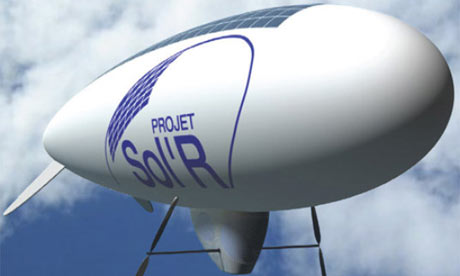
    The blimp was designed and built by French students and its first flight will prove that CO2-free air travel is now a reality. From Inhabitat, part of the Guardian Environment Network 


    Nephelios, the solar-powered helium blimp by Sol'R

    Nephelios is set to fly across English channel at the end of this summer. Photograph: Sol’R


    Perhaps propelled by the recent dawn of solar powered airplanes, this stunning solar powered blimp is poised to take flight by harnessing sunlight for fuel. Dubbed Nephelios, the solar-powered helium blimp was designed and built by high school engineering students in France. The history making blimp will begin test flights in the next 2 weeks, and by summer’s end the designers hope to fly Nephelios across the English Channel, “just to show that it’s possible.” Nephelios will be the first manned solar airship in existence, and its inaugural flight will prove that CO2-free air travel is now a reality.
    Part of the Sol’R Project, Nephelios consists of a lightweight aluminum frame with an outer wrap of nylon and polyethylene, which is filled with helium (He, atomic #2, and a noble gas, just in case you forgot). Stretched out on top of the blimp are flexible solar panels that collect energy from the sun and convert it to power a small motor, which turns two large red propellers. The solar panels are capable of generating 2.4 kW of power and provide enough energy to propel the 18 foot in diameter blimp at 25 mph.


    In June, Nephelios debuted at the French Air Show in Le Bourget, where it was well received and commended for resurrecting the airship. As previously mentioned, within the next two weeks, the student group will be testing the blimp for the first time, and by the end of the summer the students hope to fly it across the English Channel at the Strait of Dover, which is the shortest span of ocean between the two continents. They expect the flight to take a little less than an hour. When they succeed, this will be the first flight of a solar powered airship, and we eagerly await the landing of Nephelios in the UK.


    • This article was shared by our content partner Inhabitat, part of the Guardian Environment Network

  • G8 summit: Barack Obama says world can close the carbon emissions

    G8 summit: Barack Obama says world can close the carbon emissions


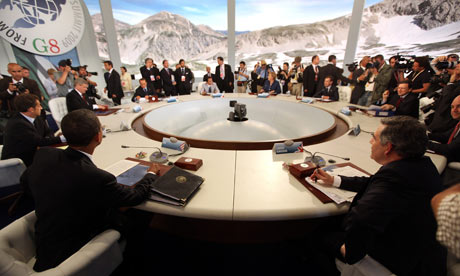
    World leaders from the G8 group of nations attend a round-table discussion in L'Aquila, Italy.

    World leaders from the G8 group of nations attend a round-table discussion during their summit in L’Aquila, Italy. Photograph: Oli Scarff/Getty Images


    Barack Obama said today there was still time to overcome cynicism and close the gap with developing powers on climate change, after slow progress towards an agreement on how to cut carbon emissions across the planet.


    World leaders are racing to meet a deadline of December when the UN climate talks in Copenhagen are due to conclude a crucial deal designed to set a carbon cutting framework to cover 2012-2050. At a meeting in L’Aquila, the G5 group of emerging economies – Brazil, India, China, Mexico and South Africa – refused to back a specific target for developing countries to cut emissions.


    In a small step forward yesterday 17 industrialised and developing countries, which account for about 80% of global emissions, agreed to set an aspiration that world temperatures should not rise by more than 2C on pre-industrial levels. It is the first time India, China and the US have agreed to such a goal.


    Obama said: “We have made a good start, but I am the first to admit that progress is not going to be easy … every nation in this planet is at risk, but just as more than one nation is responsible for climate change no one nation can solve it alone.


    “Developing nations want to make sure they do not have to sacrifice their aspirations for development and higher living standards, yet with most of the projected growth in emissions coming from these countries their active participation is a prerequisite to a solution.


    “Developed countries like mine have a historic responsibility to take the lead with our much larger carbon footprint per capita. I know that in the past the US has sometimes failed to meet its responsibilities so let me make it clear those days are over.”


    Ed Miliband, the climate change secretary, said: “Now we have the 2C goal, that can act as a yardstick to drive up ambition, which is what we need to do over the next six months.”


    But Ban Ki-moon, the UN secretary general, criticised all sides for not being more ambitious. The world had to agree a long-term target, a cut of at least 50% by 2050, he said. “But more importantly, the leaders of industrialised countries should agree on a mid-term target.”


    On Wednesday the G8 industrialised nations committed to cutting emissions by 80% by 2050, the first time the US, Canada and Russia had agreed to such an ambitious target. But the G8 balked at setting interim targets for 2020, partly because of Obama’s belief that he would undermine support in the US Congress for his climate change bill if he went for tough short term targets.


    Obama hit another obstacle yesterday when Democratic leaders in the Senate, under criticism from Republicans for trying to rush through sweeping reforms, abandoned plans to produce a first draft of the bill before the summer recess in August.

  • World Bank Outlines Priorities for Sustainable Hydro Development

    July 9, 2009

    World Bank Outlines Priorities for Sustainable Hydro Development


    by John Braden, Senior Associate Editor, Hydro Group

    Washington, D.C. United States [RenewableEnergyWorld.com]

    Acknowledging a sharp change in direction from the 1990s, the World Bank is emphasizing a growing role for sustainable hydropower to bring both energy and water resources benefits to the developing world.


    The World Bank report said total economically feasible potential hydro capacity in developing countries exceeds 1,900,000 MW, 70 percent of which, 1,330,000 MW, is not exploited.


    In “Directions in Hydropower,” a newly issued exposition of the World Bank Group’s views on the value of hydropower, the bank said hydropower now is viewed as an integral factor in addressing energy security, climate change, water security and regional cooperation.


    World Bank lending for hydropower bottomed out in 1999 due to growing opposition from environmental and other non-governmental organizations.

    “There are risks inherent in development and operation of hydropower, many of which were the focus of passionate debate in the 1990s,” the bank said. “These risks cross the range of financial, geological, engineering and market concerns, with particular attention to environmental protection, resettlement, social inclusion and sharing of the benefits of development across all stakeholders.”

    Triple Bottom-line Policy: Social, Environmental, Economic

    As a consequence, the bank said, the definition of acceptable hydropower has shifted to one that recognizes core principles of sustainable development with attention to social and environmental, as well as economic “bottom lines.” It said the shift has been supported by a decade of better understanding and of developing best practices, safeguards and self-assessment measures from players including the World Bank, Equator Banks, International Hydropower Association, International Energy Agency, the World Commission on Dams and the United Nations Environment Program.

    “The priority is shifting towards development ‘done right’ and comprehensive environmental management and benefits sharing,” the bank said.

    In a stark change from a decade ago, World Bank lending now reflects a Water Resources Sector Strategy approved in 2003 that says significant levels of investment in water infrastructure are required throughout the developing world.

    New lending for hydropower increased significantly, from less than US $250 million per year from 2002-2004, to US $500 million per year from 2005-2007. In fiscal year 2008, new lending for hydro exceeded US $1 billion.

    The bank said 67 hydropower projects have been approved since fiscal year 2003, amounting to US $3.7 billion in World Bank Group contributions to support a total of US $8.5 billion and nearly 9,700 MW in project investments. Within those numbers, the bank noted, is money for rehabilitation of existing capacity at the 350-MW Inga 1 and 1,424-MW Inga 2 hydro projects in the Democratic Republic of Congo (HydroWorld 4/20/09) and of hydro plants totaling 1,338 MW in Niger. (HydroWorld 2/11/09)

    Bank Sees Pipeline of US $2 Billion in Projects

    Major hydro projects have been approved in Africa and Asia, as well as several rehabilitation projects in Eastern Europe. The bank said a range of new projects is under discussion in India, Vietnam, the Nile Equatorial Lakes Region, Ethiopia, Guinea, Brazil, Romania, Turkey, Georgia and Tajikistan. Bank-backed carbon finance projects are under discussion in Russia, Sri Lanka and Madagascar.

    The bank’s two-track strategy of investment lending, and energy and water sector strengthening, has only just begun. The bank said it has identified a “promising pipeline” of US $2 billion in projects under preparation for the next several years, not including projects that are only under preliminary discussion with clients.

    The World Bank report said total economically feasible potential hydro capacity in developing countries exceeds 1,900,000 MW, 70 percent of which, 1,330,000 MW, is not exploited. That is four times the current installed hydro capacity of Europe and North America and nearly double the 740,000 MW installed worldwide. It said significant additional amounts of energy and capacity are available from rehabilitation of existing hydropower and water resources assets.

    “Directions in Hydropower” may be obtained from the World Bank’s Internet site or by clicking here http://siteresources.worldbank.org/INTWAT/Resources/Directions_in_Hydropower_FINAL.pdf.


    John Braden is senior associate editor, Hydro Group, with PennWell Corporation. He has been covering hydro news for more than 20 years.


    This article was reprinted with permission from the Hydro Group as part of the PennWell Corporation Renewable Energy World Network and may not be reproduced without express written permission from the publisher.


    Image Gallery (1)


  • Rees tries to take carbon credit

    Rees tries to take carbon credit   ( Source NSW Greens Media)

    “The bread and circuses approach to running the State has reached a new
    low with Premier Rees announcing a ban on bottled water in Government
    departments. As Minister for Water, Nathan Rees didn’t bat an eyelid
    when the community at Peat’s Ridge objected to Coca Cola/Amatil
    extracting 66 million litres of water from Mangrove Mountain. The
    company paid the NSW Goverment $200 for a water extraction licence and
    are now selling it in plastic bottles for more than $10 million a year.


    “We’ve sold a public asset, for a token amount and now the Premier
    has made a token gesture in response –  and it’s the public who has to
    pay for the mess, mostly through council rates. By jumping on the
    bandwagon being drawn by the sensible people of Bundanoon, Premier Rees
    is trying to score an environmental point – it would be funny if he
    wasn’t in such negative carbon credit,”
    “The Premier has responded – with about one minute’s thought –
    to the real public concern about the damage that drink bottles are doing
    to the environment and about the mountains of unnecessary waste.
    Australians spend roughly $385 million on 250 million litres of bottled
    water year and only a third of these get recycled. Every five bottles
    takes one litre of crude oil to make.”
    “Less than a month ago, both the Labor Government and the Opposition
    voted to oppose my Private Member’s Bill that would have given NSW a
    complete container recycling scheme – for all drink bottles and
    recyclable containers along the lines of South Australia’s scheme.”

    “The Government threw away a $33.8 million dollar income stream from
    the recycling market. They voted against reducing in fossil fuel
    consumption, substantially reducing rubbish on our streets, beaches and
    parks, slashing council rates, providing consumers with an easy
    incentive to recycle, and creating hundreds of green jobs.”


     “The Bill was a no-brainer for popular appeal and an easy fix for
    the environment. Consumers would get a 10 cent return on their
    containers. The Bundanoon ban shows that people are crying out for
    action on waste.”

    “We are five years away from the proposed NSW Waste Recovery target
    for a 66% increase in recycling by 2014. From 2002 -2008 in NSW it
    increased by only 2%. In South Australia the recycling rate is over 80%
    compared with the NSW rate of less than 40%.”
     
    “Premier Rees’ attention grabbing gesture makes a mockery of the
    people of Bundanoon who have taken decisive action against environmental
    degradation. As we can see from his recent actions, the Premier is not
    doing anything serious about water and waste or to curb the excesses of
    the bottling industry and their lobbyists.”