NEVILLE GILLMORE retweeted
 Reporting Climate
 “Global climate on verge of multi-decadal change due to Atlantic says study ” http://ow.ly/PSAPk
Add your news
You can add news from your networks or groups through the website by becoming an author. Simply register as a member of the Generator, and then email Giovanni asking to become an author. He will then work with you to integrate your content into the site as effectively as possible.
Listen to the Generator News online
The Generator news service publishes articles on sustainable development, agriculture and energy as well as observations on current affairs. The news service is used on the weekly radio show, The Generator, as well as by a number of monthly and quarterly magazines. A podcast of the Generator news is also available.
As well as Giovanni’s articles it picks up the most pertinent articles from a range of other news services. You can publish the news feed on your website using RSS, free of charge.
NEVILLE GILLMORE retweeted
“Global climate on verge of multi-decadal change due to Atlantic says study ” http://ow.ly/PSAPk
1 of 36
| Inbox | x |
|
4:14 PM (0 minutes ago) |
The John James Newsletter 71
25 July 2015 – Antilly, France
If you don’t know history, then you don’t know anything. You are a leaf that doesn’t know it is part of a tree Michael Crichton The most effective way to destroy people is to deny and obliterate their understanding of their own history George Orwell
In Israel, Jewish ‘Sanhedrin’ Set to Try Pope Francis for Recognizing PalestineIsraeli Sanhedrin is to put Pope Francis on trial unless he retracts his statement that the Jews have no right to the land of Israel or to Jerusalem. The Sanhedrin has no legal status yet it is comprised of some of the greatest rabbis of the nation.http://www.breakingisraelnews.com/44759/pope-francis-tried-sanhedrin-jewish-world/ The Pope Francis Encyclical And Its Economicsa series of quotations to illustrate portions of the Pope’s forceful arguments. http://steadystate.org/the-pope-francis-encyclical-and-its-economics/
The Firesale BeginsWarren Buffett to buy the Greek island of Agios Thomas for 15 milion euro.http://www.thedailysheeple.com/the-firesale-begins-tsipras-agrees-to-sell-greek-assets_072015
Ocean Temperatures At Record HighOf all the excess heat that results from people’s emissions, 93.4% goes into oceans. http://arctic-news.blogspot.fr/2015/07/ocean-temperatures-at-record-high.html World Breaks Temperature Record as Climate Summit Nears:http://www.bloomberg.com/news/articles/2015-07-21/world-breaks-temperature-record-as-climate-summit-nears
These are not absolute temperatures, but anomalies: Temperatures different to the norm.
The Square Kilometre Array: radio silence in Western Australia for most powerful telescope in historyThe biggest science project of the next 20 years: a radio telescope capable of picking out something like an airport radar on a planet in another solar system. http://www.theguardian.com/science/2015/jul/17/the-square-kilometre-array-radio-silence-in-western-australia-for-most-powerful-telescope-in-history?CMP=ema_632
UN says Ebola outbreak not yet finishedAbout 30 people are still getting infected with Ebola virus each week in West Africa, http://www.aljazeera.com/news/2015/07/ebola-outbreak-finished-150713095921610.html
Oz Energy ministers to factor in carbon emissions, push storagein the ACT Corbell has implemented ambitious plans to have 90% renewables by 2020, and slash emissions by 40%.http://reneweconomy.com.au/2015/corbell-gets-energy-ministers-to-factor-in-carbon-emissions-push-storage-81752
Radioactive water from Fukushima plant again escapesThe operator of the crippled Fukushima nuclear plant found radioactive water overflowing into the sea. http://nuclear-news.net/2015/07/16/radioactive-water-from-fukushima-plant-escapes-1100-becquerels-of-beta-ray-emitting-radioactive-substances/
Welcome to IceworldStunning first hi-definition image of Pluto reveals huge 11,000 foot mountains made of water ice and a geologically active surface http://www.dailymail.co.uk/sciencetech/article-3162894/11-000-foot-high-mountains-ice-geologically-active-surface-Stunning-image-surface-Pluto-revealed.html When Andromeda and our galaxy collideStunning videohttp://www.dailymail.co.uk/sciencetech/article-3151458/
Mass Migration Threatens European Civilisation, Says Hungary PM“Mass migration could change the face of Europe’s civilisation. It is irreversible, There is no way back from a multicultural Europe. Neither to a Christian Europe, nor to the world of national cultures,. If we make a mistake now, it will be forever,”http://news.yahoo.com/migration-threatens-european-civilisation-hungary-pm-134049945.html Italians Torch Beds to Block ‘Migrant’ Arrivalshttp://news.yahoo.com/italy-residents-set-fire-beds-anti-migrant-protest-002603521.html Fences rise in The Middle East and North AfricaNow the most walled region in the world, and range from fences inside cities to anti-migrant barriers.http://www.smh.com.au/world/fences-rise-across-middle-east-as-jihadi-threat-rattles-leaders-20150724-gijgdv.html#ixzz3gmRA1pHH
Are China and the US Doomed to Conflict?The former prime minister of Australia, Kevin Rudd is also a longtime student of China, with a unique vantage point to watch its power rise in the past few decades. http://www.ted.com/talks/kevin_rudd_are_china_and_the_us_doomed_to_conflict
Earth’s Most Famous Climate Scientist Issues Bombshell Sea Level Warning:The study-concludes that glaciers in Greenland and Antarctica will melt 10 times faster than previous consensus estimates, resulting in sea level rise of at least 10 feet in as little as 50 years.http://www.slate.com/blogs/the_slatest/2015/07/20/sea_level_study_james_hansen_issues_dire_climate_warning.html
India’s grand solar plans ruin Abbott’s coal export strategyInvestment in solar alone will outstrip that of coal generation, with a significant impact on coal imports. http://reneweconomy.com.au/2015/indias-grand-solar-plans-ruin-abbotts-coal-export-strategy-77514
One year on from the carbon price experiment, the rebound in emissions is clear Emissions intensity, which was increasing until shortly before June 2012, fell continuously for the two years to June 2014. Since then, it has increased consistently.http://theconversation.com/one-year-on-from-the-carbon-price-experiment-the-rebound-in-emissions-is-clear-44782
Behind the scenes of Iran’s nuclear dealThe scramble for Iran is on. Germany’s vice chancellor was the first to visit with the French next week, with an eye to doing deals. But it’s about more than money: are alliances already being redrawn?http://www.france24.com/en/2015-07-21-the-debate-inside-the-iran-deal-france-24-goes-behind-the-scenes-in-vienna Iran eyes $185 billion in post-sanctions oil and gas projectshttp://www.haaretz.com/news/middle-east/1.667455 Welcome to the Iran erahttp://www.aljazeera.com/news/2015/07/analysis-iran-era-150722071521187.html
The power of propaganda to defame realityAlmost half of Israelis would support a unilateral strike to prevent Iran obtaining the atomic bomb. Nearly three-quarters thought the agreement would accelerate Iran’s development of a nuclear weapon, not prevent it.http://news.yahoo.com/47-israelis-back-unilateral-iran-strike-poll-093113859.html
Armed Insecurity in the Age of Endless War and Mass ShootingsAs a society, we’re armed and dangerous – and always at war, both collectively and individually. We’re endlessly declaring bad guys and endlessly protecting ourselves from them, in the process guaranteeing that the violence continues. And the parallels between “them” and “us” are unnerving.http://www.commondreams.org/views/2015/07/23/armed-insecurity-age-endless-war-and-mass-shootings
|
|||
More
1 of 36
| Inbox | x |
|
3:23 PM (0 minutes ago) |
The John James Newsletter 70
25 July 2015 – Antilly, France
Grand strategy and the long-term agendas of nations fascinate me. I devote this issue to a profound analysis of the great shift away from the dollar into the Eurasian heartland of Russia, China, India and Iran. Whichever way this drama unfolds it represents new world alignments that will utterly change our ways of living and perceiving the world.
The Eurasian Big Bang
How China and Russia Are Running Rings Around Washington
By Pepe Escobar
July 23, 2015 “Information Clearing House” – Let’s start with the geopolitical Big Bang you know nothing about, the one that occurred just two weeks ago. Here are its results: from now on, any possible future attack on Iran threatened by the Pentagon (in conjunction with NATO) would essentially be an assault on the planning of an interlocking set of organizations — the BRICS nations (Brazil, Russia, India, China, and South Africa), the SCO (Shanghai Cooperation Organization), the EEU (Eurasian Economic Union), the AIIB (the new Chinese-founded Asian Infrastructure Investment Bank), and the NDB (the BRICS’ New Development Bank) — whose acronyms you’re unlikely to recognize either. Still, they represent an emerging new order in Eurasia.Tehran, Beijing, Moscow, Islamabad, and New Delhi have been actively establishing interlocking security guarantees. They have been simultaneously calling the Atlanticist bluff when it comes to the endless drumbeat of attention given to the flimsy meme of Iran’s “nuclear weapons program.” And a few days before the Vienna nuclear negotiations finally culminated in an agreement, all of this came together at a twin BRICS/SCO summit in Ufa, Russia — a place you’ve undoubtedly never heard of and a meeting that got next to no attention in the U.S. And yet sooner or later, these developments will ensure that the War Party in Washington and assorted neocons (as well as neoliberalcons) already breathing hard over the Iran deal will sweat bullets as their narratives about how the world works crumble.The Eurasian Silk RoadWith the Vienna deal, whose interminable build-up I had the dubious pleasure of following closely, Iranian Foreign Minister Javad Zarif and his diplomatic team have pulled the near-impossible out of an extremely crumpled magician’s hat: an agreement that might actually end sanctions against their country from an asymmetric, largely manufactured conflict.Think of that meeting in Ufa, the capital of Russia’s Bashkortostan, as a preamble to the long-delayed agreement in Vienna. It caught the new dynamics of the Eurasian continent and signaled the future geopolitical Big Bangness of it all. At Ufa, from July 8th to 10th, the 7th BRICS summit and the 15th Shanghai Cooperation Organization summit overlapped just as a possible Vienna deal was devouring one deadline after another.Consider it a diplomatic masterstroke of Vladmir Putin’s Russia to have merged those two summits with an informal meeting of the Eurasian Economic Union (EEU). Call it a soft power declaration of war against Washington’s imperial logic, one that would highlight the breadth and depth of an evolving Sino-Russian strategic partnership. Putting all those heads of state attending each of the meetings under one roof, Moscow offered a vision of an emerging, coordinated geopolitical structure anchored in Eurasian integration. Thus, the importance of Iran: no matter what happens post-Vienna, Iran will be a vital hub/node/crossroads in Eurasia for this new structure.If you read the declaration that came out of the BRICS summit, one detail should strike you: the austerity-ridden European Union (EU) is barely mentioned. And that’s not an oversight. From the point of view of the leaders of key BRICS nations, they are offering a new approach to Eurasia, the very opposite of the language of sanctions.Here are just a few examples of the dizzying activity that took place at Ufa, all of it ignored by the American mainstream media. In their meetings, President Putin, China’s President Xi Jinping, and Indian Prime Minister Narendra Modi worked in a practical way to advance what is essentially a Chinese vision of a future Eurasia knit together by a series of interlocking “new Silk Roads.” Modi approved more Chinese investment in his country, while Xi and Modi together pledged to work to solve the joint border issues that have dogged their countries and, in at least one case, led to war.The NDB, the BRICS’ response to the World Bank, was officially launched with $50 billion in start-up capital. Focused on funding major infrastructure projects in the BRICS nations, it is capable of accumulating as much as $400 billion in capital, according to its president, Kundapur Vaman Kamath. Later, it plans to focus on funding such ventures in other developing nations across the Global South — all in their own currencies, which means bypassing the U.S. dollar. Given its membership, the NDB’s money will clearly be closely linked to the new Silk Roads. As Brazilian Development Bank President Luciano Coutinho stressed, in the near future it may also assist European non-EU member states like Serbia and Macedonia. Think of this as the NDB’s attempt to break a Brussels monopoly on Greater Europe. Kamath even advanced the possibility of someday aiding in the reconstruction of Syria.You won’t be surprised to learn that both the new Asian Infrastructure Investment Bank and the NDB are headquartered in China and will work to complement each other’s efforts. At the same time, Russia’s foreign investment arm, the Direct Investment Fund (RDIF), signed a memorandum of understanding with funds from other BRICS countries and so launched an informal investment consortium in which China’s Silk Road Fund and India’s Infrastructure Development Finance Company will be key partners.Full Spectrum Transportation DominanceOn the ground level, this should be thought of as part of the New Great Game in Eurasia. Its flip side is the Trans-Pacific Partnership in the Pacific and the Atlantic version of the same, the Transatlantic Trade and Investment Partnership, both of which Washington is trying to advance to maintain U.S. global economic dominance. The question these conflicting plans raise is how to integrate trade and commerce across that vast region. From the Chinese and Russian perspectives, Eurasia is to be integrated via a complex network of superhighways, high-speed rail lines, ports, airports, pipelines, and fiber optic cables. By land, sea, and air, the resulting New Silk Roads are meant to create an economic version of the Pentagon’s doctrine of “Full Spectrum Dominance” — a vision that already has Chinese corporate executives crisscrossing Eurasia sealing infrastructure deals.For Beijing — back to a 7% growth rate in the second quarter of 2015 despite a recent near-panic on the country’s stock markets — it makes perfect economic sense: as labor costs rise, production will be relocated from the country’s Eastern seaboard to its cheaper Western reaches, while the natural outlets for the production of just about everything will be those parallel and interlocking “belts” of the new Silk Roads.Meanwhile, Russia is pushing to modernize and diversify its energy-exploitation-dependent economy. Among other things, its leaders hope that the mix of those developing Silk Roads and the tying together of the Eurasian Economic Union — Russia, Armenia, Belarus, Kazakhstan, and Kyrgyzstan — will translate into myriad transportation and construction projects for which the country’s industrial and engineering know-how will prove crucial.As the EEU has begun establishing free trade zones with India, Iran, Vietnam, Egypt, and Latin America’s Mercosur bloc (Argentina, Brazil, Paraguay, Uruguay, and Venezuela), the initial stages of this integration process already reach beyond Eurasia. Meanwhile, the SCO, which began as little more than a security forum, is expanding and moving into the field of economic cooperation. Its countries, especially four Central Asian “stans” (Kazakhstan, Kyrgyzstan, Uzbekistan, and Tajikistan) will rely ever more on the Chinese-driven Asia Infrastructure Investment Bank (AIIB) and the NDB. At Ufa, India and Pakistan finalized an upgrading process in which they have moved from observers to members of the SCO. This makes it an alternative G8.In the meantime, when it comes to embattled Afghanistan, the BRICS nations and the SCO have now called upon “the armed opposition to disarm, accept the Constitution of Afghanistan, and cut ties with Al-Qaeda, ISIS, and other terrorist organizations.” Translation: within the framework of Afghan national unity, the organization would accept the Taliban as part of a future government. Their hopes, with the integration of the region in mind, would be for a future stable Afghanistan able to absorb more Chinese, Russian, Indian, and Iranian investment, and the construction — finally! — of a long-planned, $10 billion, 1,420-kilometer-long Turkmenistan-Afghanistan-Pakistan-India (TAPI) gas pipeline that would benefit those energy-hungry new SCO members, Pakistan and India. (They would each receive 42% of the gas, the remaining 16% going to Afghanistan.)Central Asia is, at the moment, geographic ground zero for the convergence of the economic urges of China, Russia, and India. It was no happenstance that, on his way to Ufa, Prime Minister Modi stopped off in Central Asia. Like the Chinese leadership in Beijing, Moscow looks forward (as a recent document puts it) to the “interpenetration and integration of the EEU and the Silk Road Economic Belt” into a “Greater Eurasia” and a “steady, developing, safe common neighborhood” for both Russia and China.And don’t forget Iran. In early 2016, once economic sanctions are fully lifted, it is expected to join the SCO, turning it into a G9. As its foreign minister, Javad Zarif, made clear recently to Russia’s Channel 1 television, Tehran considers the two countries strategic partners. “Russia,” he said, “has been the most important participant in Iran’s nuclear program and it will continue under the current agreement to be Iran’s major nuclear partner.” The same will, he added, be true when it comes to “oil and gas cooperation,” given the shared interest of those two energy-rich nations in “maintaining stability in global market prices.”Got Corridor, Will TravelAcross Eurasia, BRICS nations are moving on integration projects. A developing Bangladesh-China-India-Myanmar economic corridor is a typical example. It is now being reconfigured as a multilane highway between India and China. Meanwhile, Iran and Russia are developing a transportation corridor from the Persian Gulf and the Gulf of Oman to the Caspian Sea and the Volga River. Azerbaijan will be connected to the Caspian part of this corridor, while India is planning to use Iran’s southern ports to improve its access to Russia and Central Asia. Now, add in a maritime corridor that will stretch from the Indian city of Mumbai to the Iranian port of Bandar Abbas and then on to the southern Russian city of Astrakhan. And this just scratches the surface of the planning underway.Years ago, Vladimir Putin suggested that there could be a “Greater Europe” stretching from Lisbon, Portugal, on the Atlantic to the Russian city of Vladivostok on the Pacific. The EU, under Washington’s thumb, ignored him. Then the Chinese started dreaming about and planning new Silk Roads that would, in reverse Marco Polo fashion, extend from Shanghai to Venice (and then on to Berlin).Thanks to a set of cross-pollinating political institutions, investment funds, development banks, financial systems, and infrastructure projects that, to date, remain largely under Washington’s radar, a free-trade Eurasian heartland is being born. It will someday link China and Russia to Europe, Southwest Asia, and even Africa. It promises to be an astounding development. Keep your eyes, if you can, on the accumulating facts on the ground, even if they are rarely covered in the American media. They represent the New Great — emphasis on that word — Game in Eurasia.Location, Location, LocationTehran is now deeply invested in strengthening its connections to this new Eurasia and the man to watch on this score is Ali Akbar Velayati. He is the head of Iran’s Center for Strategic Research and senior foreign policy adviser to Supreme Leader Ayatollah Khamenei. Velayati stresses that security in Asia, the Middle East, North Africa, Central Asia, and the Caucasus hinges on the further enhancement of a Beijing-Moscow-Tehran triple entente.As he knows, geo-strategically Iran is all about location, location, location. That country offers the best access to open seas in the region apart from Russia and is the only obvious east-west/north-south crossroads for trade from the Central Asian “stans.” Little wonder then that Iran will soon be an SCO member, even as its “partnership” with Russia is certain to evolve. Its energy resources are already crucial to and considered a matter of national security for China and, in the thinking of that country’s leadership, Iran also fulfills a key role as a hub in those Silk Roads they are planning.That growing web of literal roads, rail lines, and energy pipelines, as TomDispatch has previously reported, represents Beijing’s response to the Obama administration’s announced “pivot to Asia” and the U.S. Navy’s urge to meddle in the South China Sea. Beijing is choosing to project power via a vast set of infrastructure projects, especially high-speed rail lines that will reach from its eastern seaboard deep into Eurasia. In this fashion, the Chinese-built railway from Urumqi in Xinjiang Province to Almaty in Kazakhstan will undoubtedly someday be extended to Iran and traverse that country on its way to the Persian Gulf.A New World for Pentagon PlannersAt the St. Petersburg International Economic Forum last month, Vladimir Putin told PBS’s Charlie Rose that Moscow and Beijing had always wanted a genuine partnership with the United States, but were spurned by Washington. Hats off, then, to the “leadership” of the Obama administration. Somehow, it has managed to bring together two former geopolitical rivals, while solidifying their pan-Eurasian grand strategy.Even the recent deal with Iran in Vienna is unlikely — especially given the war hawks in Congress — to truly end Washington’s 36-year-long Great Wall of Mistrust with Iran. Instead, the odds are that Iran, freed from sanctions, will indeed be absorbed into the Sino-Russian project to integrate Eurasia, which leads us to the spectacle of Washington’s warriors, unable to act effectively, yet screaming like banshees.NATO’s supreme commander Dr. Strangelove, sorry, American General Philip Breedlove, insists that the West must create a rapid-reaction force — online — to counteract Russia’s “false narratives.” Secretary of Defense Ashton Carter claims to be seriously considering unilaterally redeploying nuclear-capable missiles in Europe. The nominee to head the Joint Chiefs of Staff, Marine Commandant Joseph Dunford, recently directly labeled Russia America’s true “existential threat”; Air Force General Paul Selva, nominated to be the new vice chairman of the Joint Chiefs, seconded that assessment, using the same phrase and putting Russia, China and Iran, in that order, as more threatening than the Islamic State (ISIS). In the meantime, Republican presidential candidates and a bevy of congressional war hawks simply shout and fume when it comes to both the Iranian deal and the Russians.In response to the Ukrainian situation and the “threat” of a resurgent Russia (behind which stands a resurgent China), a Washington-centric militarization of Europe is proceeding apace. NATO is now reportedly obsessed with what’s being called “strategy rethink” — as in drawing up detailed futuristic war scenarios on European soil. As economist Michael Hudson has pointed out, even financial politics are becoming militarized and linked to NATO’s new Cold War 2.0.In its latest National Military Strategy, the Pentagon suggests that the risk of an American war with another nation (as opposed to terror outfits), while low, is “growing” and identifies four nations as “threats”: North Korea, a case apart, and predictably the three nations that form the new Eurasian core: Russia, China, and Iran. They are depicted in the document as “revisionist states,” openly defying what the Pentagon identifies as “international security and stability”; that is, the distinctly un-level playing field created by globalized, exclusionary, turbo-charged casino capitalism and Washington’s brand of militarism.The Pentagon, of course, does not do diplomacy. Seemingly unaware of the Vienna negotiations, it continued to accuse Iran of pursuing nuclear weapons. And that “military option” against Iran is never off the table.So consider it the Mother of All Blockbusters to watch how the Pentagon and the war hawks in Congress will react to the post-Vienna and — though it was barely noticed in Washington — the post-Ufa environment, especially under a new White House tenant in 2017.It will be a spectacle. Count on it. Will the next version of Washington try to make it up to “lost” Russia or send in the troops? Will it contain China or the “caliphate” of ISIS? Will it work with Iran to fight ISIS or spurn it? Will it truly pivot to Asia for good and ditch the Middle East or vice-versa? Or might it try to contain Russia, China, and Iran simultaneously or find some way to play them against each other?In the end, whatever Washington may do, it will certainly reflect a fear of the increasing strategic depth Russia and China are developing economically, a reality now becoming visible across Eurasia. At Ufa, Putin told Xi on the record: “Combining efforts, no doubt we [Russia and China] will overcome all the problems before us.”Read “efforts” as new Silk Roads, that Eurasian Economic Union, the growing BRICS block, the expanding Shanghai Cooperation Organization, those China-based banks, and all the rest of what adds up to the beginning of a new integration of significant parts of the Eurasian land mass. As for Washington, fly like an eagle? Try instead: scream like a banshee.Pepe Escobar is the roving correspondent for Asia Times, an analyst for RT and Sputnik, and a TomDispatch regular. His latest book is Empire of Chaos.
|
|||

When Colin and Jenny Burgess moved to their ‘little stone cottage in the bush’ they knew they wanted to install their own energy storage.
And with a quote of around $240,000 to connect their property to the electricity grid, the couple’s choice was justified and they started designing an off-grid solar system to suit their energy needs.
“When we started building over 20 years ago, the cottage was to be a weekender, but by the time we had a roof, doors and windows there had been quite a few changes; we were grandparents and just the two of us in the family home,” Col Burgess says.
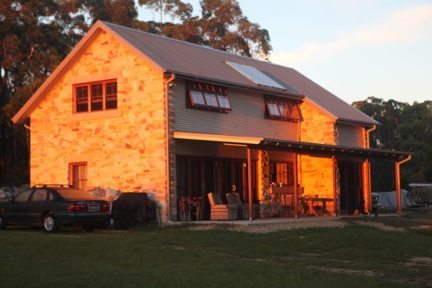
“Our little cottage was better than originally envisaged and we had watched too many sunsets through the bloodwoods to be occasional visitors.
“Grid power was out because of the estimated cost of connection, but also due to our location; it would have taken negotiation, costs of acquiring land and clearing an easement through thick bush to the nearest power line over three kilometres away.”
While the couple considered other options for their bush sanctuary, solar, with a back-up generator, proved to be the best option.
“Diesel power was possible but there would be the continuing cost of fuel and, although we could isolate the generator to some extent, there would also be noise.”
Their standalone solar system was installed and commissioned in July 2012, designed to meet their energy needs to run appliances such as a dishwasher, washing machine, sound system, desk and laptop computers.
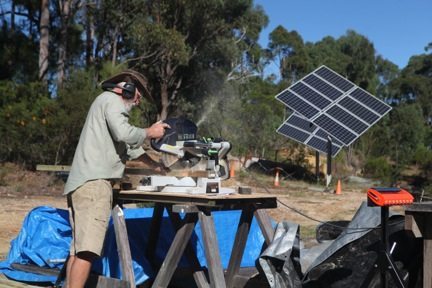
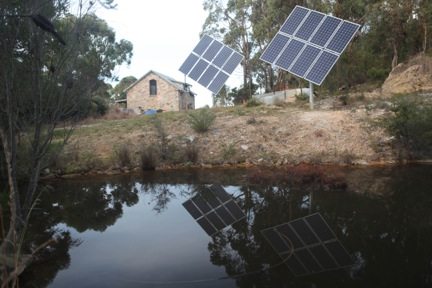
“We have sixteen solar panels that make up a 3.2 kilowatt system and which are mounted on two tracking towers that wake up to face the rising sun each morning and follow its passage at 15 minute intervals until sunset,” Col Burgess says,
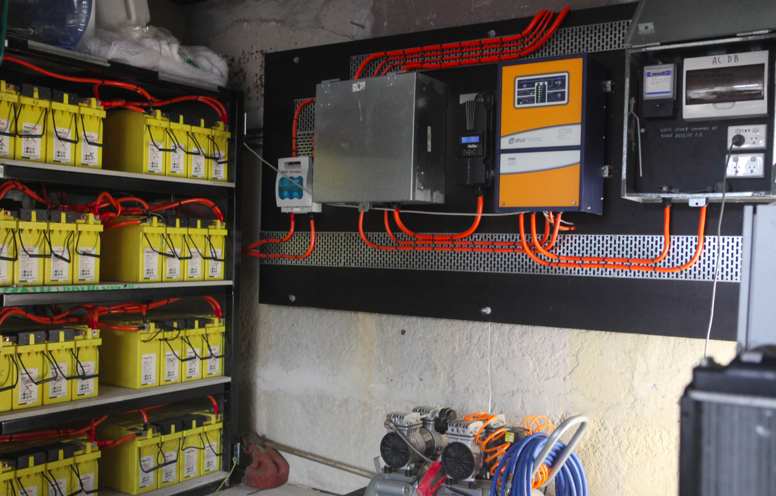
“It’s claimed that tracking the sun improves energy generating efficiency by up to 30%. Whatever the figures, the batteries are fully re-charged by midday most sunny days. In simple terms, computer smarts built into the system mean that once charged, demand is met directly from the panels during the day and excess power is dumped, helping to extend battery life.
“The cost of going off-grid was substantial, but the result has been excellent. We use gas for cooking and the hot water comes from a gas-boosted solar system.
“Our system could support limited air conditioning in summer and any welding I do is made possible by tapping directly into the 9.5KVA back-up generator. A smaller generator may have been sufficient back up for the batteries but the requirement was the ability to weld.

“All lights in the main living areas are five to ten watt LEDs and in the bedrooms and bathrooms there’s a variety of quartz, fluorescent and low voltage globes. We are probably more self-conscious about turning off unnecessary lights than we were in our days on-grid, but as empty-nesters we don’t have to worry about teenagers leaving lights on around the clock!”
Outside, Col uses an automatic pump to provide pressurised water to the house from an in-ground tank, while another high-pressure pump, used for fire fighting, delivers dam water. A third pump transfers waste from the septic tanks to an absorption trench.
The couple said that despite a few minor annoyances, their off-grid lifestyle has been the right one for them.
“A small problem is remembering to start the back-up generator at regular intervals to keep it in good operating condition. That’s really only needed once or twice a year to produce power.”
“The battery bank will last ten years, but we’re optimistic that battery costs will have come down by the time they need replacing. There’s reason too to be optimistic that over the 20-year life of the solar panels, the cost penalty of a little stone house in the bush won’t be bad at all.”
“But it’s satisfying to turn on a light or power tool and know the energy was generated only a few metres away. Sometimes the power tools run in sight of the energy source.”
“It’s a feel-good experience of independence from the grid and those nasty quarterly bills, pure and simple.”
|
Inbox
|
x |

|
1:10 PM (1 hour ago)
 |
|
|||
|
1 of 30
|
Inbox
|
x |

|
5:28 PM (2 minutes ago)
|
|
|||
Today the Australian Labor Party announced it will take a new target of 50% renewable energy by 2030 to the next Federal Election. After months of policy devastation, solar is back in the game.
It’s a mighty fine feeling to wake up to such good news, especially when we’ve all worked so hard for it. In April this year we set out to spark a race to the top on solar and renewables policy in Australia with the launch of Stand Up For Solar. Since then, thousands of Solar Citizens from across the country have taken action, with the first step to call on their local Labor MPs to Stand Up For Solar and endorse our plan for at least 50% renewables by 2030.
And it’s paid off! With today’s announcement Labor has set a new bar for a visionary and ambitious debate on solar and renewables in the lead up to the next Federal Election.
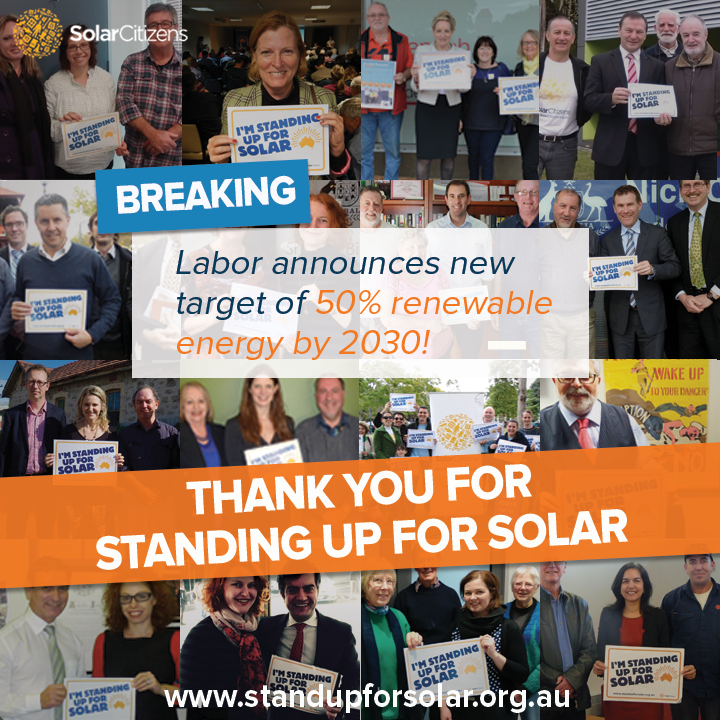
Don’t have Facebook? Email or call your local Labor MP and thank them for Standing Up For Solar. You can look up their details here.
We’re much closer to winning a sun-powered future for Australia, and it’s in no small part thanks to the efforts of Solar Citizens like you. Thousands of you turned up to launch Stand Up For Solar at events across the nation. You’ve signed the pledge, emailed and called your local MPs, and even met with them face-to-face. Now, just as Solar Citizens across Australia are coming together for our Solar Shindig week of action, we finally have something to celebrate!
Today’s win is a huge step in the right direction, but there’s still loads to do. In the coming months we’ll be working hard to urge the Abbott Government to follow Labor’s shining example, and continuing our push for fair treatment for solar owners and a national plan to help more people go solar. There’ll be plenty more ways to get involved, so watch this space.
For now, let’s take some time to celebrate and consolidate this win. Click here to thank all the MPs who took the pledge to Stand Up For Solar in the comments of our Facebook post.
I want to thank each and every one of you for being part of this. Together, we’re an unstoppable force for a sun-powered future and we’re gaining momentum every single day.
In sunny celebration,
Claire O’Rourke,
National Director, Solar Citizens
P.S. Can you chip in to keep Stand Up For Solar going strong? Here at Solar Citizens we don’t accept any government funding. Instead, we rely on the generous support of people like you to keep us punching above our weight. Click here to donate.