The revelations concerning the National Rental Affordability Scheme are an example of how migration driven population growth undermines government efforts to solve social problems and meet infrastructure needs.
On the webpage “Updating the Climate Science: What Path is the Real World Following?”, Drs. Makiko Sato and James Hansen update figures in the book Storms of My Grandchildren (see LA Times review) and present updated graphs and discussion of key quantities that help provide understanding of how climate change is developing and how effective or ineffective global actions are in affecting climate forcings and future climate change. A few errata in Storms are also provided.
Apr. 15 (Tues): “Can We Avert the Unfolding Climate Crisis?” to the wide MIT community (in the afternoon/early evening)
Apr. 16 (Wed): “Ice Sheet Melt, Sea Level and Storms” to MIT Earth, Atmospheric, and Planetary Science Department, 4 p.m.
Recent Communications
Dr. Hansen periodically posts commentary on his recent papers and presentations and on other topics of interest to an e-mail list. To receive announcements of new postings, please click here.
Feb. 26, 2014: Beijing Charts: Charts shown at Symposium on a New Type of Major Power Relationship, organized by the Counsellors’ Office of the State Council of the People’s Republic of China and the Kissinger Institute on China and the United States.
February 2014: Symposium on a New Type of Major Power Relationship: Presentation given at Counsellors Office of the State Council, Beijin, China on Feb. 24.
+ Download PDF (3.5 MB)
December 2013: Minimizing Irreversible Impacts of Human-Made Climate Change: Presentation given at AGU Fall Meeting on Dec. 12.
+ Download PDF (4.3 MB)
September 2012: A New Age of Risk: Presentation given at Columbia University on Sep. 22.
+ Download PDF (2.1 MB)
+ Download PPT (2.5 MB)
Ms María Santos Domínguez’s husband and son came to her rescue but were also attacked. Her son lost his ear following a blow with a machete. The activist and her family have faced death threats on many occasions. She is the co-ordinator of the Organización del Consejo Indígena del Río Blanco y del Sector Norte de Intibucá (Indigenous Coucil of Río Blanco and the North of Intibucá) and an emblematic leader in the struggle for the defence of the local Gualcarque river and the indigenous Lenca territory.
Honduras is one of the most dangerous countries in the world to be a human rights defender, owing to threats, defamation, judicial harassment, physical attacks and killings.
Friends of the Earth International roundly condemns the attempt on the life of human rights defender María Santos Domínguez, as well as the attack on her husband and son. Friends of the Earth International considers the attack to be directly related to the peaceful and legitimate work of María Santos Domínguez and the Organización del Consejo Indígena del Río Blanco y del Sector Norte de Intibucá.
Aaron Packard – 350.org Australia aaron@350.org Unsubscribe
5:42 PM (16 minutes ago)
to me
Dear friend,
Breaking news: Today religious leaders have been arrested at Maules Creek, for blocking access to the mine site. We need to tell their story – please take a moment to share the images below on social media, and forward this email to friends and family.
When Bill McKibben toured Australia last year, he frequently reflected that one of the most heartening aspects of the massive civil disobedience to stop the Keystone XL pipeline in the United States was that it wasn’t just young people leading it. He saw ‘elders acting like elders’ and religious leaders, stepping up to protect the future of their grandchildren and the planet.
Today, we have seen this here in Australia. Religious leaders – four Uniting Church Ministers, two Priests, one Catholic and one Buddhist, and a number of lay people – made the long trip to Maules Creek in northwest New South Wales to hold a prayer vigil at the gates to Whitehaven Coal’s mine construction site. They’ve added their voices to those of the traditional owners of the land — the Gomeroi people — who believe their sacred sites in the Leard Forest are being destroyed, to call for the mine to be stopped.
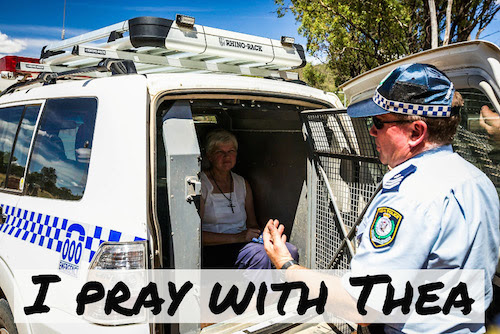
Following the vigil, some of the religious leaders joined locals and supporters to block the entrance to the mine site, turning away trucks and heavy equipment. Several of those religious leaders were then arrested and detained by Police. One of those people was Thea Ormerod, head of the Australian Religious Response to Climate Change and grandmother of six. Thea has written an amazing op-ed in the Sydney Morning Herald, which has just gone live in the last hour. In that she said:
“You may ask how such a group could endorse anything so radical, but this is a well-worn path for people of faith….The movement to wind down coal-mining in Australia may be counter-cultural but it is the truly conservative one. Its aim is to keep the Earth’s ecosystems more or less intact for those who suffer the impact of climate change in developing countries, for our own young people here and for future generations. Not a radical position at all.”
Today’s events acknowledge that every legitimate avenue to stop the open-cut coal mine near Maules Creek has failed. Even though not one of the 212 submissions from the community supported the mine, the mine has been approved. And with climate policy being slashed by the Government, there comes a time where we have to make personal sacrifices to protect our future. That time has come.
Can you take a moment to tell your networks, family and friends why you stand with Thea, and share the courageous action that she and the other people of faith took today?
Click on the image above or here to share on Facebook. And for those that don’t pray, but are ready to stand with Thea, here’s an alternative image, captioned “I stand with Thea”.
The 350.org Australia team is heading to Maules Creek this weekend to join the Leard blockade protest. We hope you might be able to consider making it out there soon too!
In solidarity,
Aaron, Blair, Charlie, Josh, Phil, and many others
A fossil-fuelled power plant in Italy’s north – part owned by GDF Suez, the ultimate owner of Victoria’s Hazelwood brown coal generator – has been ordered to shut down two of its coal-fired generation units after a court ruled they were responsible for hundreds of human deaths and thousands of cases of heart and lung disease.
Italian news site Rai News reported on Tuesday that a judge directed police to take control of the Vado Ligure plant in the northern district of Savona, after finding in favor of prosecutors in the case.
Francantonio Granero, Savona’s chief prosecutor, had argued that emissions from the plant, owned by Tirreno Power, were responsible for more than 400 premature deaths between 2000 and 2007, and 2,000 cases of heart and lung disease.
The Vado Ligure plant in northern Italy consists of a combined-cycle unit powered by natural gas with a capacity of 800 megawatts and two coal-fired units, each with a capacity of 330 MW that date back to 1971.
“They have shut down the two coal units, while the combined-cycle one is not affected by the measure,” a spokesman for Tirreno Power told Reuters on Tuesday, adding the ruling seemed to be related to a violation of environmental requirements. “We do not understand the rational for this decision.”
The ruling could provide a timely heads up for GDF Suez, though, a subsidiary of which also owns a majority stake in, and operates, the Hazelwood coal plant and mine in Victoria’s La Trobe Valley, where a month-long fire has now become the subject of an independent inquiry.
The inquiry will investigate how the blaze started, the emergency response and whether the regulatory requirements for the mine were stringent enough. Health and environmental responses will also be investigated, although the terms of reference have not yet been finalised.
In the nearby La Trobe Valley community of Morwell, where residents have been badly affected by smoke and coal dust from the fire, the local Council has been given a $50,000 state government grant towards a recovery program, which it has kicked off by purchasing 24 special vacuum cleaners capable of filtering fine particles, as well as air-purifiers.
The University of NSW has exploded the myth that renewables can’t do 24-hour base load. Dr Mark Diesendorf reports.
Clean, renewable energy.
THE FUTURE of civilisation and much biodiversity hangs to a large degree on whether we can replace fossil fuels — coal, oil and gas — with clean, safe and affordable energy within several decades. The good news is that renewable energy technologies and energy efficiency measures have advanced with extraordinary speed over the past decade.
Energy efficient buildings and appliances, solar hot water, on-shore wind, solar photovoltaic (PV) modules, concentrated solar thermal (CST) power with thermal storage and gas turbines burning a wide range of renewable liquid and gaseous fuels are commercially available on a large scale.
The costs of these technologies have declined substantially, especially those of solar PV. In 2012, despite the global financial crisis,global investment in these clean, safe and healthy technologies amounted to US $269 billion. Denmark, Scotland and Germany and several states/provinces around the world have official targets of around 100% renewable electricity and are implementing policies to achieve them.
The principal barrier is resistance from vested interests and their supporters in the big greenhouse gas polluting industries and from an unsafe, expensive, polluting, would-be competitor to a renewable energy future, nuclear power. These powerful interests are running a campaign of renewable energy denial that is almost as fierce as the long-running campaign of climate change denial. Both campaigns are particularly noisy in the Murdoch press.
So far the anti-renewables campaign, with its misinformation and gross exaggerations, has received little critical examination in the mainstream media.
The renewable energy deniers rehash, among others, the old myth that renewable energy is unreliable in supplying base load demand.
Renewable energy is reliable
In a previous article for The Conversation, I reported on the initial results of computer simulations by a research team at the University of New South Wales that busted the myth that renewable energy cannot supply base load demand. However at the time of the article, I was still under the misconception that some base load renewable energy supply may be needed to be part of the renewable energy mix.
Since then, Ben Elliston, Iain MacGill and I have performed thousands of computer simulations of 100% renewable electricity in the National Electricity Market (NEM), using actual hourly data on electricity demand, wind and solar power for 2010.
Our latest research, available here and reported here, finds that generating systems comprising a mix of different commercially available renewable energy technologies, located on geographically dispersed sites, do not need base load power stations to achieve the same reliability as fossil-fuelled systems.
The old myth was based on the incorrect assumption that base load demand can only be supplied by base load power stations; for example, coal in Australia and nuclear in France. However, the mix of renewable energy technologies in our computer model, which has no base load power stations, easily supplies base load demand.
Our optimal mix comprises wind 50-60%; solar PV 15-20%; concentrated solar thermal with 15 hours of thermal storage 15-20%; and the small remainder supplied by existing hydro and gas turbines burning renewable gases or liquids. (Contrary to some claims, concentrated solar with thermal storage does not behave as base load in winter; however, that doesn’t matter.)
The real challenge is to supply peaks in demand on calm winter evenings following overcast days. That’s when the peak-load power stations, that is, hydro and gas turbines, make vital contributions by filling gaps in wind and solar generation.
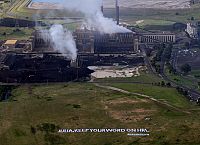
Dirty HRL power station in Victoria’s Latrobe Valley
We used the technology costs projected to 2030 in the conservative 2012 study by the Bureau of Resources and Energy Economics (BREE). (In my personal view, future solar PV and wind costs are likely to be lower than the BREE projections, and future fossil fuel and nuclear costs are likely to be higher.) Then, we did thousands of hourly simulations of supply and demand over 2010, until we found the mix of renewable energy sources that gave the minimum annual cost.
Under transparent assumptions, we found that the total annualised cost (including capital, operation, maintenance and fuel where relevant) of the least-cost renewable energy system is $7-10 billion per year higher than that of the “efficient” fossil scenario.
For comparison, the subsidies to the production and use of all fossil fuels in Australia are at least $10 billion per year. So, if governments shifted the fossil subsidies to renewable electricity, we could easily pay for the latter’s additional costs.
Thus 100% renewable electricity would be affordable under sensible government policy, busting another myth. All we need are effective policies to drive the transition.
(This article is an update published by RenewEconomy on 10 April 2013 of an earlier article published in The Conversation.)




 Add
Add