Category: Uncategorized

  • Your face in the news on ABC GET-UP

    2 of 37
    Why this ad?
    Need Legal Representationwww.hcdlaw.com.au – Ensure you are prepared for Court. Experienced lawyer for best outcome

    Your face in the news on ABC

    Inbox
    x
    GetUp!
    6:31 PM (1 hour ago)

    to me
    Page 2 of the Daily Telegraph, Page 6 of the Sydney Morning Herald, and a dozen other media appearances – your campaign to save the ABC is making headlines. Check it out below and, if you haven’t already, sign on or chip in.

    NEVILLE –

    Yesterday morning GetUp members unveiled our huge new billboard in Malcolm Turnbull’s electorate of Wentworth. Towering over an 8-lane commuter thoroughfare in Rushcutters Bay, the billboard will be seen by over a quarter of a million people.

    GetUp members donned their GetUp tees, made fantastic signs, and turned out in Minister Turnbull’s electorate. In a sea of orange, we stood under our enormous member-funded billboard, we smiled for the cameras, we chanted, we waved to the flowing commuter traffic on Bayswater Rd, and…

    The media loved it.

    https://www.getup.org.au/ourABC

    When Australians across the country opened their papers this morning, there we were: page 2 of the Daily Telegraph, page 6 of the Sydney Morning Herald. Then, articles in the Wentworth Courier, Prime 7, Yahoo!7 News, Sky News, Nine News, Mumbrella, the NT News, Junkee and the West Australian. We had radio interviews on 2GB and Triple Z Brisbane. The SMH even ran an opinion piece from Play School hero Benita Collings.

    This media frenzy was the latest in our ongoing ABC campaign, launched last December in response to attacks by right-wing politicians and commentators. It took just 72 hours for nearly 215,000 people to sign on to the campaign and, since then, almost 12,500 people have chipped in for two billboards in the heart of Prime Minister Abbott’s and Minister Turnbull’s electorates. Hundreds more have signed up for an on-the-ground effort.

    Today’s coverage could not have come at a better time, with attacks on our ABC coming thick and fast. Just yesterday the Abbott government launched an “efficiency study” into the ABC, setting the stage for funding cuts in the May budget.

    We’ll be in touch soon with the next phase of the campaign but, for now, it’s fair to say, GetUp members are turning the heat up on the Abbott Government to keep their hands off our ABC!

    Thanks for being a part of it,
    Sam, for the GetUp team

    PS – If you haven’t already, click to sign on or chip in to the campaign to save our ABC.


  • Dredged Up Monbiot

    1 of 37
    Why this ad?
    CreditWorldFee Free Banking – Australia’s only completely fee free everyday bank account.

    Monbiot.com

    Inbox
    x
    George Monbiot news@monbiot.com via google.com
    6:41 PM (1 hour ago)

    to me

    Monbiot.com


    Dredged Up

    Posted: 30 Jan 2014 11:12 AM PST

    Never mind the evidence, we’ll do something eye-catching.

    By George Monbiot, published on the Guardian’s website, 30th January 2014

    For a moment that rarest of beasts, common sense, poked a nose out of its burrow and sniffed the air. Assailed by angry farmers demanding dredging in the Somerset levels, the environment secretary, Owen Paterson broke with protocol and said something sensible.

    “Dredging is often not the best long term or economic solution and increased dredging of rivers on the Somerset Levels would not have prevented the recent widespread flooding.”

    He went on to suggest something I never thought I would hear from his lips: “also we need to do more to hold water back, way back in the hills.” Coming from the man who insisted in November that he would do what he could to help farmers keep the hills bare, this was an astonishing and welcome turnaround.

    It reflects what his advisers in the Environment Agency have been trying to say for years, before being sat on by ministers wanting instant answers to complex problems and then – as the government still plans – being sacked in droves. A presentation by the Agency, called To Dredge or Not to Dredge?, spells out the problems in terms that even ministers can understand.

    “The river channel is not large enough to contain extreme floods, even after dredging.  Dredging of river channels does NOT prevent flooding during extreme river flows … The concept of dredging to prevent extreme flooding is equivalent to trying to squeeze the volume of water held by a floodplain within the volume of water held in the river channel. Since the floodplain volume is usually many times larger than the channel volume, the concept becomes a major engineering project and a major environmental change.”

    Is that not bleeding obvious? A river’s capacity is tiny by comparison to the catchment from which it draws its water. You can increase the flow of a river by dredging, but that is likely to cause faster and more dangerous floods downstream when the water hits the nearest urban bridge (something the residents of towns like Taunton and Bridgwater should be worried about). If you cut it off from its floodplain by turning it into a deep trench, you might raise its capacity from – say – 2% of the water moving through the catchment to 4%. You will have solved nothing while creating a host of new problems.

    Among these problems, the Environment Agency points out, are:

    – Massive expense. Once you have started dredging, “it must be repeated after every extreme flood, as the river silts up again.”

    – More dangerous rivers: “Removing river bank vegetation such as trees and shrubs decreases bank stability and increases erosion and siltation.”

    – The destabilisation of bridges, weirs, culverts and river walls, whose foundations are undermined by deepening the channel. “If the river channels are dredged and structures are not realigned, ‘Pinch Points’ at structures would occur. This would increase the risk of flooding at the structure.” That means more expense and more danger.

    –  Destruction of the natural world. “Removing gravel from river beds by dredging leads to the loss of spawning grounds for fish, and can cause loss of some species. Removing river bank soils disturbs the habitat of river bank fauna such as otters and water voles.”

    As the Agency says, dredging is primarily a tool for improving navigation and, in some places, land drainage. It has been mistaken by people who ought to know better, including ministers, as a means of dealing with a different problem: flooding.

    If you want to stop rivers from ruining people’s lives, you should engage with the kind of issues that Paterson hinted at. That means, broadly speaking, the following:

    –          more trees and bogs in the uplands
    –          reconnecting rivers with their floodplains in places where it is safe to flood (and paying farmers to store water on their fields while the danger passes)
    –          making those floodplains rougher by planting trees and other deep vegetation to help hold back the water
    –          lowering the banks and de-canalising the upper reaches, allowing rivers once more to create meanders and braids and oxbow lakes. These trap the load they carry and sap much of their destructive energy.

    None of these produce instant results. But they are distinguished from dredging in one significant respect: they work.

    Within two days of Paterson’s subversive experiment with common sense, that shy beast was frightened back down its burrow and usual service resumed. In Parliament yesterday, David Cameron said:

    “We now need to move more rapidly to the issues like dredging, which I think will help to make a long-term difference. It is not currently safe to dredge in the Levels. But I can confirm that dredging will start as soon as it is practical, as soon as the waters have started to come down.”

    Paterson then repeated the sentiment. It didn’t take him long to forget his statement on Monday, that “increased dredging of rivers on the Somerset Levels would not have prevented the recent widespread flooding”.

    Cameron’s dredge pledge is like the badger cull. It is useless. It is counterproductive. But it keeps the farmers happy and allows the government to be seen to be doing something:  something decisive and muscular and visible. And that, in these dismal times, appears to be all that counts.

    www.monbiot.com

  • Update about the North West Rail Link

    1 of 41
    Why this ad?
    Kogan.comDeals from $1 – Save Up to 80% on Electronics. Browse TVs, Phones, Tablets, Cameras & More. Limited Time Only!

    Update about the North West Rail Link

    Inbox
    x
    Beecroft Cheltenham Civic Trust mail@change.org
    7:12 PM (59 minutes ago)

    to me

    The opposition to building the NWRL as a metro operations is gaining momentum. We have been busy handing out information to commuters outlining all of the negatives to commuters at railway stations between Epping and North Ryde. We have also done the same to the bus commuters who will be affected in Castle Hill and the city. The feedback from these commuters was very positive and many of them had no idea that the NWRL was now going to be an incompatible metro style service. Barry O’Farrell promised them a double-decker service to the city and not standing on a terminating metro service to Chatswood. Transport experts have warned the Minister for Transport and the Premier that their modelling has series flaws and it is not the service that the commuters want or need.
    Jacob Saulwick the SMH Transport Editor did an excellent article in Jan 30 SMH on this subject. Please use this link to access it.
    http://www.smh.com.au/nsw/warnings-on-northwest-rail-link-plan-ignored-20140129-31mvw.html

    This message was sent by Beecroft Cheltenham Civic Trust using the Change.org system. You received this email because you signed a petition started by Beecroft Cheltenham Civic Trust on Change.org: “No Metro ! – Construct the NWRL to suit a compatible double decker operation..” Change.org does not endorse the contents of this message.

    View the petition


  • Watch 60 Years Of Climate Change In 15 Seconds

    |
    1/30/2014 @ 1:29PM |539 views

    Watch 60 Years Of Climate Change In 15 Seconds

    0
    0
    0
    0
    0

    According to NASA, 2013 was tied (with 2009 and 2006) for seventh warmest year globally on record, dating back to 1880. NASA scientists have played a leading role in climate research in recent decades and the agency’s Goddard Institute for Space Studies (GISS) this month updated a report analyzing worldwide surface temperatures.

    “Long-term trends in surface temperatures are unusual and 2013 adds to the evidence for ongoing climate change,” GISS climatologist Gavin Schmidt said. “While one year or one season can be affected by random weather events, this analysis shows the necessity for continued, long-term monitoring.”

    The NASA data finds that with the exception of 1998, the 10 warmest years in the 134-year record have all come since the latest turn of the century, with 2010 and 2005 ranking as the warmest years on record.

    Climate Change NASA

    Global average temperatures for 2013 (Credit: NASA)

    To drive the point home, GISS created the below animation that shows the increase in temperatures worldwide over the past 60 years, compiled from data collected by over 1,000 meteorological stations around the globe.

    A release from NASA makes the case that the increase in temperatures over the long-term is more a social problem than a matter of eons-long natural climate patterns:

    Driven by increasing man-made emissions, the level of carbon dioxide in Earth’s atmosphere presently is higher than at any time in the last 800,000 years.

    This summer, NASA plans to launch the Orbiting Carbon Observatory with the goal of studying both natural and manmade sources of carbon dioxide, one of the gases believed to be largely to blame for climate change.

  • This is what Australia’s frontline fight against massive coal looks like

    1 of 4
    Why this ad?
    Vistaprint AU250 Free Business Cards – Get 250 Free Business Cards + Free Holder! Design in Minutes and Just Pay $7.79 for Delivery.

    This is what Australia’s frontline fight against massive coal looks like

    Inbox
    x
    Simon Copland – 350.org Australia simon@350.org
    4:45 PM (2 minutes ago)

    to me

    Dear friends,

    I have to tell you that as I write this email I am absolutely exhausted. I am that sort of tired where I am having trouble keeping my brain and fingers in line with each other as I try to type. I really would like to go to bed.

    But I am typing on. Because whilst I am overwhelmingly exhausted, my stronger feeling today is one of inspiration. And I have to share that inspiration with you. A couple of weeks ago we emailed you all about a mass convergence at Maules Creek – opposing the construction of the disastrous coal mine proposed in the region by the coal company Whitehaven. Well, I’ve just gotten back from the forest and I have to tell you about it.

    We’ve told you about this coal mine – the mine that will destroy the Leard State Forest which houses 34 threatened species. The mine that will spew the equivalent greenhouse gas emissions into the air as New Zealand’s entire energy system. The mine that will drain the water table, forcing farmers out of the region.

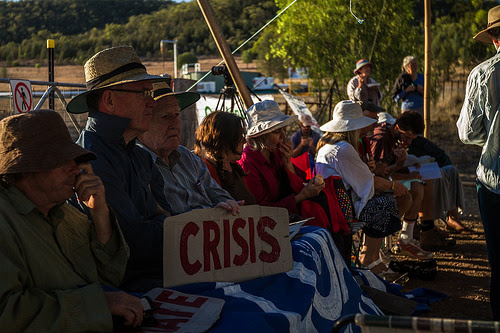
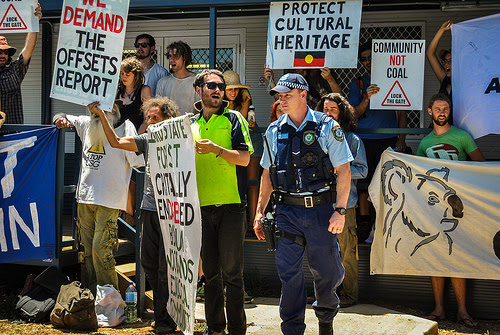
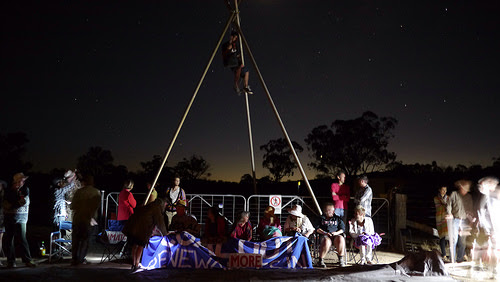
    Well, on Tuesday, over 150 people took to the Leard State Forest to blockade the construction of the mine. We had teams situated all around the mine site – four blocking the gates to forest, and three inside locking themselves onto equipment so Whitehaven couldn’t continue with their destruction of the forest. We held the company out for hours, seriously disrupting their work on the day.

    The crew were as diverse as you could think. We had seasoned campaigners in this fight, and those who had never been to a protest before. We had people coming from the local community members to cities as far away as Brisbane, Sydney, Canberra, Melbourne and even Adelaide! Our ages ranged dramatically – from those in their early twenties, to Bill Ryan, a 91 year old legally blind World War Two veteran who sat in front of the main gate determined to stay there and stop Whitehaven from entering the site.

    Each and every person was an inspiration to me – whether they were putting themselves in a place to get arrested, or staying back and looking after the camp to make sure we all had food when we got back from the long day.

    Tuesday was exciting. It was inspiring. Back home now in Brisbane I am tired, but ready and excited for more. I am ready and excited to step it up again and stop this destructive mine. And that is why we need your help. We have a series of information sessions coming up where you can find out about the Maules Creek Coal Mine Campaign – whether you want to head out to the forest, or help in the city.

    The first sessions are happening in Brisbane and Sydney tonight, whilst there are more on their way in Canberra, Melbourne, and other cities to be confirmed! We’d love to see you there. Click here to see the details.

    If you can’t make it, then please get in contact, and we’ll let you know about other ways you can get involved. If you want to host your own information session as well, then we’ll provide you the support to do that.

    This campaign is a line in the sand. It is the time where we all have to step up and say ‘enough is enough’. It is the time where we let the coal industry know that they will not get away with their destructive behaviour any more.

    I have been thoroughly inspired watching people doing this so far, but we need many more.

    Please come along and find out how you can help.

    For the climate, our land, our water and our community,
    Simon Copland and the rest of the 350.org team.

    P.S. For further information about how you can get involved in this or other Summer Heat activities, please visit joinsummerheat.org

    We rallied outside Whitehaven’s office

    We camped out into the night

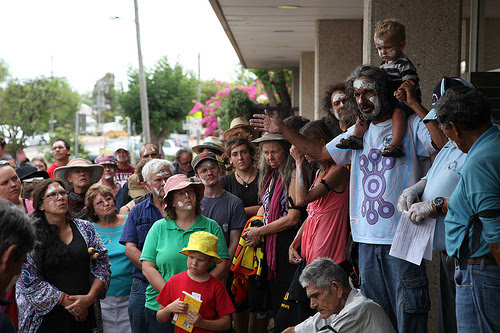
    We joined with Gomeroi Elders and Traditional Owners for a spiritual ceremony and a march in Gunnedah

    And we stopped Whitehaven from working. Join us and together we can

  • Robotic floats to detect ocean heatwaves, other changes in the Indian Ocean

    The Sydn

    Search smh:

    Search in:

    Robotic floats to detect ocean heatwaves, other changes in the Indian Ocean

    Date
    January 29, 2014
    Ocean heatwave 2011.Ocean heatwave 2011. Photo: CSIRO

    Australian and Indian scientists have teamed up to identify the causes and impacts of so-called marine heatwaves such as the devastating pulse of warm water that swept down the West Australian coastline in 2011.

    During that event, water temperatures soared to 5 degrees above long-term seasonal averages for a two-week period – and were more than 3 degrees higher for an extended time – triggering large-scale fish kills and coral bleaching.

    To study the interplay of biology and physics in the Indian Ocean, including how circulation is changing as the planet warms, CSIRO has joined India’s National Institute of Oceanography and the Indian National Centre for Ocean Information Services to launch 15 sophisticated robot floats in mid-2014.

    Coral bleaching can devastate reef life, as seen here off Queensland.Coral bleaching can devastate reef life, as seen here off Queensland. Photo: Supplied

    Australia and other nations already operate more than 3600 of the Argo floats to collect data on temperature and salinity in the world’s oceans. The pilot scheme, which has the potential to double in size, involves floats equipped with extra sensors to gather a wider range of information on levels of oxygen, chlorophyll and dissolved organic matter.

    Advertisement

    “We’ll probably have more data from these floats in a decade’s time than we have in the whole past century from ships,” said Tom Trull, a professor at the University of Tasmania and a senior principal research scientist at CSIRO.

    Oxygen changes will be one focus, with levels in the deep ocean apparently decreasing over the last century as temperatures rise and circulation alters. Regions off north-west India and in the Bay of Bengal have large patches of ocean with little or no oxygen.

    More than 3600 Argo buoys have been deployed globally.More than 3600 Argo buoys have been deployed globally.

    By adding oxygen sensors, “we can figure out what those changes in circulation mean for the health of the deep sea”, Professor Trull said.

    Other sensors will detect levels of phytoplankton, microscopic plants that form the basis of the aquatic food chain, and the zooplankton that feed on them.

    “It will probably give us an idea of which year, in which place, we’re likely to get strong amounts of fish production,” Professor Trull said.

    How Argo floats work.How Argo floats work. Photo: CSIRO

    Big influence

    Changes in sea-surface temperatures in the Indian Ocean, the world’s third-largest, can have a big influence on the Australia’s weather. Warmer-than-normal waters off north-western Australia, as seen last winter, typically trigger increased flows of moisture over the continent and above-average rains over south-eastern states.

    Australian scientists are keen to understand more about the “Ningaloo Nino”, named after the Ningaloo Reef off Coral Bay in WA, when waters in the region are unusually warm. It serves as a counterpart to the El Nino-Southern Oscillation – the main climate driver over the Pacific Ocean.

    While Australia’s wheat production can be correlated to an El Nino phase, which typically results in reduced rainfall over eastern Australia, relatively little is known about how ocean ecosystems including fisheries are affected by changing weather patterns, Professor Trull said.

    “We don’t understand what the links might be,” he said. “These kinds of sensors may get us that kind of data.”

    Each specially equipped Argo buoy costs about $50,000 and can collect data down to 2000 metres below the surface as they drift on the ocean currents. Depending on the task, the buoys surface between four times a day to once every 10 days to transmit information to satellites.

    Each “profile” sent costs about $50, far cheaper than ship surveys. Sending a vessel might take 100 readings in a month but cost $50,000-80,000 per day, Professor Trull said.

    Advertisement
    Featured advertisers
    Advertisement

    Skip

    Readers’ most viewed