Category: Uncategorized

  • Internet Apocalypse? AVAAZ

    Why this ad?
    Study Agrifood Systemswww.une.edu.au/Agrifood_Systems – Advance your career, study Agrifood Systems online with UNE, Feb 2014

    Internet Apocalypse?

    Inbox
    x
    Pascal V. – Avaaz.org
    8:07 AM (1 hour ago)

    to me
    Dear friends,

    The US and the EU are on the verge of giving rich corporations the right to control what we all see on the Internet. It’s the apocalypse of the Internet as we know it. But free speech advocates and web companies are fighting back. Click to join the largest call for a democratic and free Internet ever:

    SIGN THE PETITION

    The richest 1% could now control what we all see on the Internet forever. It’s the apocalypse of the Internet as we know it, and will erase the democratic promise of an information highway for everyone the founders of the world wide web imagined.

    Together, our community has built on that vision, using the web to fight corruption, save lives, and bring people-powered aid to countries in crisis. But the US and the EU are on the verge of giving the richest corporations the right to show content fast, while paywalling or slowing down everything else. Avaaz’s ability to show the world citizen journalist footage from Syria, or run campaigns to save our planet is under threat!

    Decisions on both sides of the Atlantic are being made now. But tech innovators, free speech advocates and the best web companies are fighting back. If millions of us join them now we can create the largest call for a democratic and free Internet ever. Sign up now and tell everyone:

    http://www.avaaz.org/en/internet_apocalypse_loc/?bhPqncb&v=34949

    Until now, any improvements in the speed and functioning of the Internet benefited all of us — if Rupert Murdoch’s ultra-conservative Fox News got a faster way to stream videos, it also benefitted independent media showing reality on the ground in Ukraine, Syria, or Palestine. Politicians called this “net neutrality” and laws protecting it used to exist in the United States until a court just struck them down. Now, the EU Parliament is threatening to pass regulation that give ISPs the right to carve up the web and control what we see, by slowing down or charging for sites that don’t pay.

    But we can stop this. First, we will show up with massive global numbers into this week’s public meeting in the United States to decide whether to reinstate Internet protections. Then we will unleash a high powered lobby team to target the EU Parliament to ensure its committees listen to the public. This will be the big first step we need to win these important battles over the next few months.

    Web providers like Verizon and Vodafone are lobbying hard for an Internet for the rich. And without a massive response from citizens, they could win, and put our whole community’s work at risk. Most of our Internet is located in the US and the EU so this affects us all. We don’t have any time to lose. Click below to join now:

    http://www.avaaz.org/en/internet_apocalypse_loc/?bhPqncb&v=34949

    When our community was less than half of the size it is now, we rallied and helped kill the ACTA treaty and stopped massive Internet censorship laws SOPA/PIPA. Today, we are more powerful than ever. Let’s now join together and ensure that what connects us all stays open.

    With hope,

    Pascal, Emma, Dalia, Luis, Emilie, Luca, Sayeeda and the whole Avaaz team

    SOURCES:

    On dangers of non-Network Neutrality (ABC news):
    http://abcnews.go.com/Business/major-ways-internet-change-net-neutrality/story?id=21541399

    Save the Internet
    http://savetheinternet.eu/en/

    EU telecoms market reforms threaten net neutrality and privacy (Wired)
    http://www.wired.co.uk/news/archive/2013-11/19/eu-telecoms-reform-concerns

    Federal court strikes down FCC net neutrality rules (The Verge)
    http://www.theverge.com/2014/1/14/5307650/federal-court-strikes-down-net-neutrality-rules

    Summary of BEREC positions on net neutrality (BEREC)
    http://berec.europa.eu/files/document_register_store/2012/

  • There’s a heatwave on its way, and in parts of NSW it’s going to be severe

    There’s a heatwave on its way, and in parts of NSW it’s going to be severe. Time to plan some heat beating strategy? pic.twitter.com/yGPnfh1yj1

    Embedded image permalink
  • With Arctic freezer door open, frigid air drains into USA and Eurasia, with Arctic unusually mild Climate Code Red

    1 of 16
    Why this ad?
    Compare Electricity Plansiselect.com.au/Electricity – Find a Range of Plans to Match Your Needs. You Could Save at iSelect.

    climate code red

    Inbox
    x
    Climate Code Red noreply@blogger.com via google.com
    8:18 PM (25 minutes ago)

    to me

    climate code red


    With Arctic freezer door open, frigid air drains into USA and Eurasia, with Arctic unusually mild

    Posted: 28 Jan 2014 06:12 PM PST

    by David Spratt

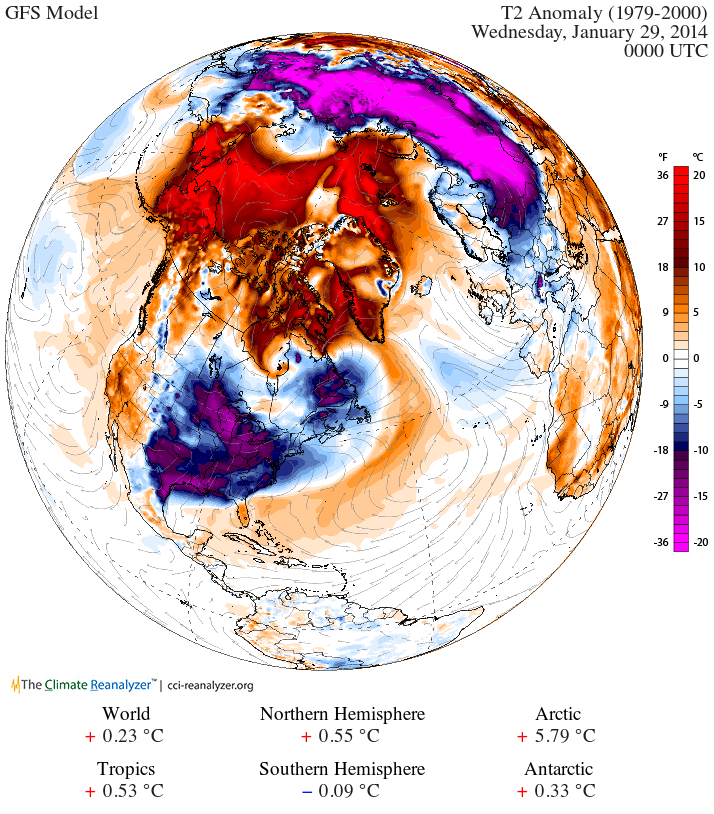
    It’s a cliche that a picture tells a story better than a thousand words, and it’s really true in the case of this extraordinary map of weather modelling of northern hemisphere temperature anomalies (variations from the expected values based on climate records) for 29 January 2014:

    Its shows swathes of North America and northern Eurasia with winter temperatures up to 20 degrees Celcius (20C) below the average for this time of the year (deep purple), whilst much of the Arctic is up to 20C warmer than usual (bright red).

    If the Arctic is the northern hemisphere’s refrigerator, then the freezer door has been opened wide, with frigid air draining into USA/Canada/Eurasia, and unusually warm air rushing into the Arctic.

    The reason is well understood and its climate-change-driven destabilisation of the Jet Stream. The Jet Stream is the river of high altitude air that works to separates Arctic weather from that of northern Europe, Russia and Canada, and which governs much northern hemisphere weather. Arctic summer sea-ice loss ice loss has added to ocean and atmospheric heat, pushing the Jet Stream into a more meandering, S-shape pattern, dragging down and stalling cold and wet conditions over Europe, and bringing extreme weather in its wake.

    There is evidence connecting sea-ice loss to the more severe and extreme weather patterns in Europe and North America, consistent with research from the US National Oceanic and Atmospheric Administration (NOAA). As Arctic melting and warming destabilize the jet stream and making it more “wavy”, it allows frigid air to plunge farther south. As the jet stream waves become larger, they slow down or even stall at times, leading to a significant increase in so-called blocking events, such as the current stalled cold front. These cause extreme weather simply because they lead to unusually prolonged conditions of one type or another.

    The  consequences are as diverse as the prolonged 2013 summer heatwave, drought and wildfires in the USA; the cool, dull and extremely wet first half of summer 2012  and subsequent extended winter in the UK and other parts of Eurasia; the current extreme cold in much of north America and Eurasia; record heat to the Arctic, as was dramatically experienced in Alaska; and unusual cold, heavy snowfall, record rain and hot spells  to much of northern Europe and North America. Following Superstorm Sandy’s battering of the US north-east coast in 2012, flooding in June across central Europe was the worst in 400 years. It’s not hard to connect the dots between Sandy and global warming as extreme weather becomes the new norm

    Professor Jennifer Francis, of Rutgers Institute of Coastal and Marine Science, says the Arctic-driven changes to the Jet Stream allows “the cold air from the Arctic to plunge much further south. The pattern can be slow to change because the [southern] wave of the jet stream is getting bigger…  so whatever weather you have now is going to stick around”.

    In March, new research found that “the severe loss of summertime Arctic sea ice — attributed to greenhouse warming — appears to enhance Northern Hemisphere jet stream meandering, intensify Arctic air mass invasions toward middle latitudes, and increase the frequency of atmospheric blocking events like the one that steered Hurricane Sandy west into the densely populated New York City area”.

    A recent study by Liu et al found that “the recent decline of Arctic sea ice has played a critical role in the recent cold and snowy winters” across the northern hemisphere, and Qiuhong Tang of the Chinese Academy of Sciences and colleagues from Beijing and the US report in Nature Climate Change that they have identified a link between declining snow and ice in the polar north, and catastrophic heat waves, droughts and floods in the mid-latitudes. They found a distinct set of patterns of circulation associated with the loss of snow and ice: the upper atmospheric winds in the north become weaker, and the jet stream shifts northwards, which means that weather systems become more stable. The longer a weather system stays in one location, the greater the probability that the conditions will become extreme.

  • Polar Vortex Causes Ice Melt Shortage

    Hello, Guest
    Login

    Polar Vortex Causes Ice Melt Shortage

    SafePaw ™ Ice Melt natural ingredients here to stay.

    Repost This

    Huntingdon Valley, PA — (SBWIRE) — 01/28/2014 — With record snow falls and plummeting temperatures nationwide, people have been hitting the stores to stock up on necessary items, especially ice melt. After years of mild winters, most ice melt companies decided not to over prepare and get stuck with extra product; causing a shortage across the country. SafePaw ™, the only 100% animal safe, salt-free natural ice melt on the market isn’t facing that problem. Most ice melt products do not have a long shelf life and will spoil if not used over the winter. The inconsistent summer weather makes storing ice melt unreliable over the months. Many ice melt companies lose a lot of money on spoiled product.

    Rock Salt is the most commonly used ingredient, supplies are sent from various manufacturers around the world. Ice melt products use blends of many chemicals and chlorides that are extremely harmful to pets as well as humans. With this current winter setting records, supplies are dwindling dangerously low and receiving new product presents many challenges to companies.

    Property owners are responsible for maintaining their land appropriately while providing a clean, safe walkway and environment for the public. Failure to do so can lead to lawsuits, injuries, and other problems. What are the options available? As far as ice melting goes, there is still one company that seems to be in the forefront, SafePaw ™ Ice Melt, a great product that doesn’t have a shelf life and can last for many years in storage. Because SafePaw ™ is a 100% natural, the product won’t damage surfaces, can be stored anywhere if kept away from moisture and won’t harm animals. This non-toxic, environmentally sound ice melt is producing at a high rate to make sure customer’s demands are met.

    The SafePaw ™ Ice Melt Company, Gaia Enterprises, Inc., has a special secret formula that other brands can’t copy. Where other brands have to rely on sourcing hard to find ingredients, SafePaw ™ has a steady supply of proprietary components.

    With old man winter showing no signs of mercy, resources are starting to run thin. Remember SafePaw ™ Ice Melt is here to stay.

    For information on where to find Safe Paw, check out www.safepaw.com.

    About SafePaw
    In 1996 SafePaw was created and designed to sell to the pet industry (retail consumers and veterinarians). Safe Paw benefits including:

    – Guaranteed safe for pets and children
    – Environmentally safe
    – Won’t harm decking of any kind
    – Safe on asphalt, concrete, and pavers
    – Safe on plants and shrubs
    – Proprietary traction agent (helps prevent slips and falls)

  • Managing “Jim Cantore” Risk: Why CPOs Should Have the Weather Channel On In Their Offices

    Managing “Jim Cantore” Risk: Why CPOs Should Have the Weather Channel On In Their Offices

    DSC00410

    Spend Matters welcomes another guest post from David C. Wyld of Southeastern Louisiana University.

    If your cable lineup is like the one at our house, CNBC is sandwiched between the Weather Channel and CNN. Perhaps that is very fitting, as today we have unprecedented coverage of natural disasters. We live in a remarkable age where we truly live in an interconnected world, where we can witness a tsunami hit Japan or a hurricane hit Miami live in HD. Yet, severe weather events have very real financial consequences, and as soon as a tornado hits a major metropolitan area or a tropical depression forms in the Gulf of Mexico, markets move.

    There is an entire segment of the financial industry that analyzes how weather impacts the energy, food and other markets, and even a weather futures market where companies can hedge the impact of mother nature on their financial performance. Thus, in an age where all forms of natural disasters can have a major impact on entire industries, it is entirely appropriate that many of us can click between breaking news coverage of severe weather and severe natural events and coverage of how investors are reacting to and companies are coping with these phenomena.

    With complex, global supply chains for companies having become the norm for industries ranging from automobiles and aircraft to technology products and retailing, natural disasters have to be on the radar of all CPOs and other procurement executives. Paul R. Kleindorfer and Germaine H. Saad wrote a classic article for Production and Operations Management on the subject, titled “Managing Disruption Risks in Supply Chains.” The two esteemed professors from the Wharton School of Business at the University of Pennsylvania stated that there are really two broad categories of supply chain risk:

    1. risks arising from the problems of coordinating supply and demand
    2. risks arising from disruptions to normal activities


    Up to a decade ago, while companies paid much attention to the former, the latter area of “disruptions” had been largely regarded as random occurrences that could not be planned for. In this category, while in the modern world there will always be risk arising out of political and economic instability (from strikes, political protests, terrorism, civil insurrections, and actual armed conflicts), by far the greatest source of “disruptions” is not man-made.

    The extent of the impact natural disasters can have on supply chains was brought home with the release of a major report on the global impact of natural disasters, both in human and economic terms. This month, Aon Benfield, a leading intermediary in the global reinsurance market and capital advisory service, released its Annual Global Climate and Catastrophe Report. According to the firm’s methodology, for a natural “event” to be classified as a natural disaster, the occurrence must at least result in an economic loss of $50 million U.S. dollars; an insured loss of $25 million; at least 10 fatalities; 50 or more injuries; and/or damage to at least 2,000 homes or structures.

    While 2013 was a below average year in terms of economic losses from natural disasters—the global estimated economic losses of “only” $192 billion being 4% below the yearly average of $200 billion over the past decade (see Table 1)—there was a significant uptick in the number of non man-made events that reached the severity to be termed natural disasters. In fact, last year there were 296 natural disasters, which was significantly higher than a “normal” year in which there would be 259 such occurrences. And unlike in past years, the vast majority of economic losses (84%) occurred outside the United States (see Table 2). However, please do note the vast gulf between the total economic losses and the insured losses, which speaks to how natural disasters, particularly those like Typhoon Haiyan in the Philippines, have a devastating and long-standing impact – sometimes decades and even generations – on places in the world both near and remote.

    Table 1: Top 10 Global Natural Disasters in Terms of Economic Loss – 2013

    Source: Aon Benfield (2014), Annual Global Climate and Catastrophe Report, p. 4.

    Source: Aon Benfield (2014), Annual Global Climate and Catastrophe Report, p. 4.

    Table 2: Top 5 Most Economically Significant U.S. Natural Disasters in 2013

    Source: Aon Benfield (2014), Annual Global Climate and Catastrophe Report, p. 25.

    Source: Aon Benfield (2014), Annual Global Climate and Catastrophe Report, p. 25.

    The majority of these events were weather driven, led by the two opposites of floods and drought conditions. While it may seem odd to talk about global warming at a time when much of the United States is in a deep freeze, the Aon Benfield researchers noted that severe weather events caused by higher water and atmospheric temperatures (tornadoes, hurricanes and cyclones, flooding, etc.) were only likely to increase in the future. They went into extensive detail analyzing the correlation of each category of weather-related natural disasters to rising temperatures and warned that 2013 was the fourth warmest year since land and ocean temperature records began to be recorded in 1880.

    And so what are CPOs to do with this knowledge that natural disasters borne from both above and below terra firma will undoubtedly impact the value chain for their company and more specifically, the supply chain that they are overseeing? Should they cower under their desks every time a severe weather alert is issued? Should they conclude that every time they see a cold reporter on the Weather Channel standing beside an Interstate Highway somewhere in the lower 48 states reporting on a serious accident that the trucks involved were heading for their distribution center? Should they surmise that every time they see a cable news story about a sink hole swallowing part of a warehouse in an industrial park or an earthquake collapsing part of a processing plant in California that the company was one of their suppliers?

    As one might take as a lesson from Freakonomics, even big, area-affecting events do not affect everyone. So, this analyst does think it wise for procurement executives – both themselves and those under them in the procurement hierarchy – to monitor the Weather Channel, CNN, and other sources for breaking news available on TV and on the Web and to keep in communication with their supplier and transport partners to see how weather and other natural phenomena may impact their operations and their ability to deliver critical goods and services to the organization. However, there is a caveat to be realistic in the amount of effort devoted to both monitoring activities and contingency planning. As the old adage goes, try as one might, you simply can’t plan for everything. And so, CPOs should try to strike a balance between being prepared and being obsessed.

    I would conclude with a rule borrowed from a radio show from Washington, DC that I listen to almost religiously. Tony Kornheiser, of PTI fame on ESPN, has what he calls the Jim Cantore rule. He is himself obsessed with weather and how it might impact his daily life and work, and thus, weather takes up a major portion of his local “sports” radio show on WTEM ESPN980 every weekday morning in Washington. Plainly stated, Kornheiser jokes that while severe weather is well worth paying attention to, you really should pay attention when the Weather Channel sends meteorologist Jim Cantore to report on a weather calamity on your block or in your city, because that means that they believe that the killer hurricane or blizzard has a bull’s eye on you!

    By then, yes, it’s really too late to plan, as it’s time to cope with immediate conditions and get ready for the aftermath of whatever is to come. However, if a CPO has monitored conditions and effectively planned for such an occurrence both internally and externally with partner firms in the supply network, he or she can have a critical 24, 48, or even 72 hour jump on what weather-related event is about to happen and lead his or her procurement operation in a coordinated, thoughtful manner. And sure, there are natural disasters of sky (tornadoes) and earth (earthquakes, sinkholes) that, while regional, are random in exactly who they will ultimately impact. For these, this management consultant would say be prudent and prepared.

  • Reef: let’s get talking GET-UP

    1 of 51
    Why this ad?
    Get 3 Solar Quotessolar-power-australia.com.au – Compare 3 Solar Installers. Save Time & Money Now!

    Reef: let’s get talking

    Inbox
    x
    GetUp!
    2:28 PM (2 hours ago)

    to me
    NEVILLE.

    You know our Reef’s in trouble. Thousands of other GetUp members, marine biologists and tourism operators know it too.

    But you know who may not have any idea? The millions of Australians who get their news from talkback radio.

    Let’s create a media storm those in power won’t be able to ignore, as we count down to a major decision about the future of the Reef. Click below to phone in a friendly call to your local talkback radio station – you’ll find all the info and details you need to get started.

    http://www.getup.org.au/voices-for-our-reef

    This Friday, the Great Barrier Reef Marine Park Authority must make their final decision on whether to approve the proposal to dump three million cubic metres of dredged seabed into Reef waters, creating a path for giant ships to traffic yet more coal out of Australia.

    The Reef Authority has been fielding tens of thousands of calls, emails and social media complaints from Australians concerned that instead of protecting the Reef, they’re about to let big mining inflict serious damage for short-term profits.

    But despite the controversy the project has created, far too many Australians still have little idea what’s going on, and probably won’t know until it’s too late.

    We’ve already shown the Reef Authority how we feel with an amazing campaigning effort. We’ve marched, we’ve called, we’ve run ads, we’ve emailed. We’ve done everything we can, now it’s time to bring the rest of Australia on board. Click here to get started.

    http://www.getup.org.au/voices-for-our-reef

    Talkback radio is a powerful political forum – providing live, saturated coverage of the issues of the moment. In metropolitan markets, hosts are highly-paid celebrities whose shows are syndicated to millions of people. In regional areas, they hold huge local influence, particularly with an audience of voters that are hard to reach in other ways. Talkback hosts have the power to get Ministers and Prime Ministers on the phone or into the studio for answers.

    So in the final moments we have to influence this decision, we want to ignite conversations on talkback stations nationwide. You don’t have to be an expert to phone in, and you’ll find everything you need on the page.

    Let’s show decision-makers they’ll have all of Australia to answer to if they make a bad call for our Reef.

    http://www.getup.org.au/voices-for-our-reef

    Thanks for speaking up,
    The GetUp team

    PS: We know the Marine Park Authority are under enormous pressure. Environment Minister, Greg Hunt wants this project approved. So does Gina Rinehart, and Indian mining company Adani – both of whom expect to profit handsomely from creating the largest coal port in the world just 50 kms north of the Whitsundays. But millions of us don’t want our Reef damaged. Click here to get Australia talking.


    GetUp is an independent, not-for-profit community campaigning group. We use new technology to empower Australians to have their say on important national issues. We receive no political party or government funding, and every campaign we run is entirely supported by voluntary donations. If you’d like to contribute to help fund GetUp’s work, please donate now! If you have trouble with any links in this email, please go directly to www.getup.org.au. GetUp has recently updated our Privacy Policy, to read the policy go