Map shows which countries are contributing the most to climate change pic.twitter.com/dUjpvvxpRl

 January 16, 2014, 9:11 am
Heatwaves in Australia are becoming more frequent, hotter and are lasting longer because of climate change, a report released today by the Climate Council says.
The interim findings of the report, titled Australian Heatwaves: Hotter, Longer, Earlier and More Often, come as southern Australia swelters through a heatwave, with the temperature in Adelaide today forecast to hit 46 degrees Celsius.
The report says heat records are now happening three times more often than cold records, and that the number of hot days across Australia has “more than doubled”.
It says the duration and frequency of heatwaves increased between 1971 and 2008, and the hottest days have become hotter.
And it predicts that future heatwaves will last up to three days longer on average, they will happen more often, and the highest temperatures will rise further.
“It is clear that climate change is making heatwaves more frequent and severe,” report co-author Professor Will Steffen said in a statement.
“Heatwaves have become hotter and longer and they are starting earlier in the season.”
After notching up two consecutive days over 40C, Melbourne is on track to record its second-longest heatwave since records began in the 1830s.
The temperature is expected to reach 41C today before increasing to 42C tomorrow.
The longest heatwave in Melbourne was in 1908, when there were five consecutive days over 40C.
Temperatures have also regularly surpassed 40C in South Australia and Western Australia recently.
Report co-author Dr Sarah Perkins says the change has occurred mostly in Australia’s south-east and west.
“So particularly areas around Adelaide and Perth that are currently experiencing heatwave conditions,” she said.
“They seem to be the hardest hit in terms of the number of heatwaves, they’ve increased, and also the intensity of heatwaves as well.”
Professor Steffen says the extreme weather patterns can be attributed to climate change, with the continued burning of fossil fuels trapping more heat in the lower atmosphere.
Professor Steffen says large population centres of south-east Australia stand out as being “at increased risk from many extreme weather events, including heatwaves”.
“The current heatwave follows on from a year of extreme heat, the hottest summer on record and the hottest year on record,” he said.
The latest temperatures have driven electricity demand to its highest level since the heatwave which preceded the Black Saturday bushfires five years ago.
Regulators say the predicted high temperatures for the rest of the week could see new records set for peak electricity demand in Victoria and South Australia.
About 10,000 homes in Melbourne were without power yesterday afternoon as electricity suppliers struggled with the demand.
The State Government has warned Victorians that up to 100,000 properties could be affected by outages over the next two days.
The South Australian Government has also flagged possible power cuts to ensure the grid copes under pressure, with Adelaide reaching 43.7C yesterday afternoon.
|
Why this ad?
 Torrens Uni. Australia – tua.edu.au/Master's_in_Education – Study Online at Torrens University. Request Information Right Now!
|
|
Inbox
|
x |

|
9:32 AM (16 minutes ago)
|
|
||
|
||||
New post on The Tally Room |
 |
 |
Tasmania 2014 – Franklinby Ben Raue |
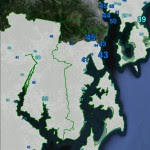 Franklin covers southern Tasmania, including the eastern suburbs of Hobart and the Huon Valley.
The seat produced a result of 3-2 in favour of the ALP at the 1998 election. In 2002, the Liberal Party lost one of their seats to the Greens, and the 3-1-1 split was repeated in 2006.
In 2010, the ALP lost their third seat to the Liberal Party.
The electorate is home to all three party leaders: Lara Giddings, Will Hodgman and Nick McKim. The electorate is also represented by the ALP’s David O’Byrne and Liberal MP Jacquie Petrusma.
Jan 14, 2014
In 2006, a “mega” tropical cyclone (or hurricane) cut a swathe of destruction across northern Australia. Cyclone Monica was one of the largest and most intense such cyclones ever tracked in the southern hemisphere, but because no one died and no towns were hit, it was largely ignored as a major climate event by the wider community. Yet the ecological consequences of this cyclone were profound.
We estimate that Cyclone Monica damaged or destroyed 140 million trees across a million hectares (2.5 million acres) of woodland savanna, the dominant biome of north Australia. This region experiences a wet-dry tropical climate, with a six-month dry season that results in fuel curing. We wanted to examine the impact that the massive increase in fuel load (vegetation debris) following Cyclone Monica would have on the region’s fire regime and resultant greenhouse-gas emissions.
Remote sensing, combined with previously published observations describing the cyclone’s wind field and tree damage extent, enabled us to map the damage zone. We then used remote-sensing data for six years prior to and six years following the cyclone (MODIS gross primary productivity and fire detection data) to discover the following.
Modelling suggests that the frequency of mega-cyclones may increase as a result of climate change, although there is much debate about this. While this trend is not evident in observational data to date, our research highlights the immediate importance of understanding how climate variability and disturbance affects savanna dynamics if landscapes in this region are to be used as enhanced carbon sinks in emission offset schemes.
The team reported their findings as part of the ERL Focus on Extreme Events and the Carbon Cycle.
Lindsay Hutley is a lecturer in environmental science at Charles Darwin University School of Environment, Australia. His research focuses on tropical savannas and how vegetation has adapted to the physical environment imposed by a wet-dry tropical climate as experienced in northern Australia. He works on carbon and water cycling in tropical and temperate Eucalypt-dominated ecosystems and, in particular, studies the impact of fire, grazing and weed invasion on these processes.
|
Why this ad?
Landscape Garden Edging – www.kwikkerb.net.au/Garden-Edging – Make Your Garden Look Amazing. Call Us For Free Onsite Quote!
|
|
Inbox
|
x |
|
2:34 PM (3 hours ago)
|
|
||
|
||||
 |
||||||||||||||||||||||||
|
||||||||||||||||||||||||
|
||||||||||||||||||||||||
|
||||||||||||||||||||||||
|
||||||||||||||||||||||||
|
||||||||||||||||||||||||
|
||||||||||||||||||||||||
|
||||||||||||||||||||||||
|
||||||||||||||||||||||||
|
|
Inbox
|
x |
|
1:29 PM (3 hours ago)
|
|
||
|
||||
|
Email not displaying correctly? View it in your browser.
|
|
Support for Young People
|
A post “Engineering and Science Experts Needed to Assist Young People” is available on my web site or here.
~Jim
14 January 2014