 |
||||||||||||||||||||||
|
||||||||||||||||||||||
|
|
|
||||||||||||||||||||
|
||||||||||||||||||||||
|
|
|||||||||||||||||||||
Category: Uncategorized
-
Global Chimneys in the Pacific
-
Heatwaves in Australia
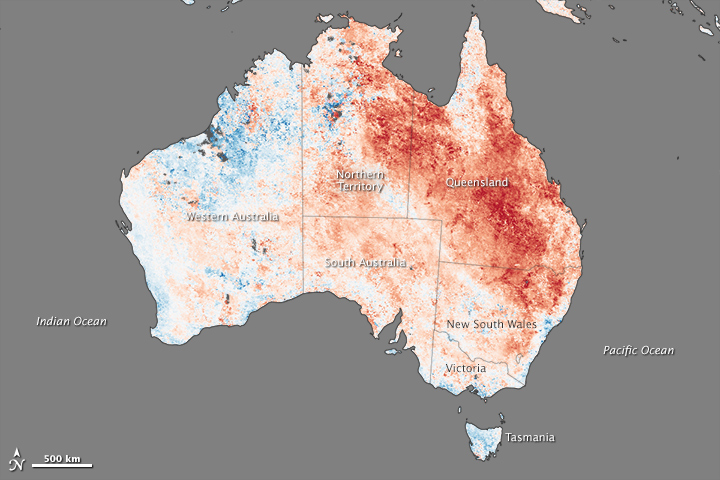 acquired December 27, 2013 – January 3, 2014
2013 turned out to be Australia’s hottest year on record. Fittingly, the year both started and ended with intense heatwaves. The most recent heatwave peaked between December 27, 2013, and January 4, 2014. It was much shorter than the heatwave that began 2013, though it was more intense. Nearly 9 percent of Australia experienced record-breaking temperatures between January 1–4, 2014.
The heat baked the earth, raising the land surface temperatures (LSTs) monitored by the Moderate Resolution Imaging Spectroradiometer (MODIS) on NASA’s Terra satellite. Dark red dominates this image, indicating that temperatures were significantly higher than average between December 27 and January 3, especially in Queensland and New South Wales. LSTs reflect how warm the ground would be to the touch, a measurement related to but not the same as more standard air temperatures.
The final day included in the image, January 3, was the hottest day of the heatwave for most places, with 10.2 percent of Queensland and 14.6 percent of New South Wales setting new heat records. The highest air temperature recorded during the week was in Moomba, Queensland, which reached 49.3 degrees Celsius (120.7 degrees Fahrenheit) on January 2. Temperatures reached 48 degrees Celsius (118 Fahrenheit) or higher at 12 locations throughout Australia during the heatwave.
-
Reference
- Australian Government Bureau of Meteorology (2013, January 6) Special climate statement 47 – an intense heatwave in central and eastern Australia. Accessed January 7, 2014.
NASA Earth Observatory image by Jesse Allen, using data from the Level 1 and Atmospheres Active Distribution System
-
-
Steam fog streaming from the Great Lakes
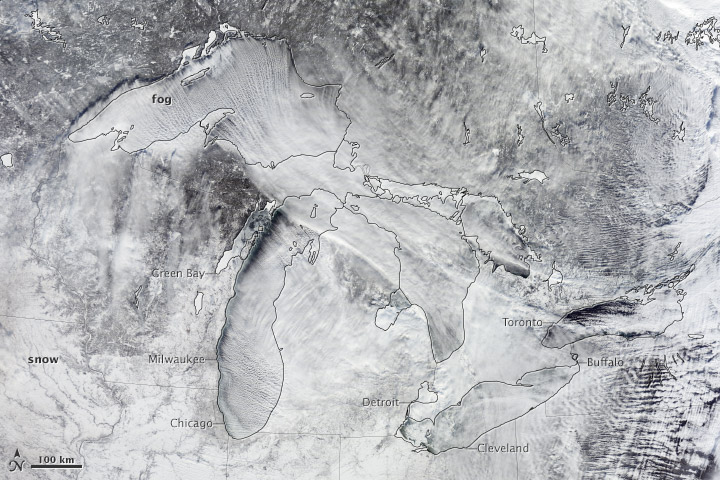 acquired January 6, 2014 download large image (5 MB, JPEG, 8000×6000)acquired January 6, 2014 download GeoTIFF file (69 MB, TIFF)
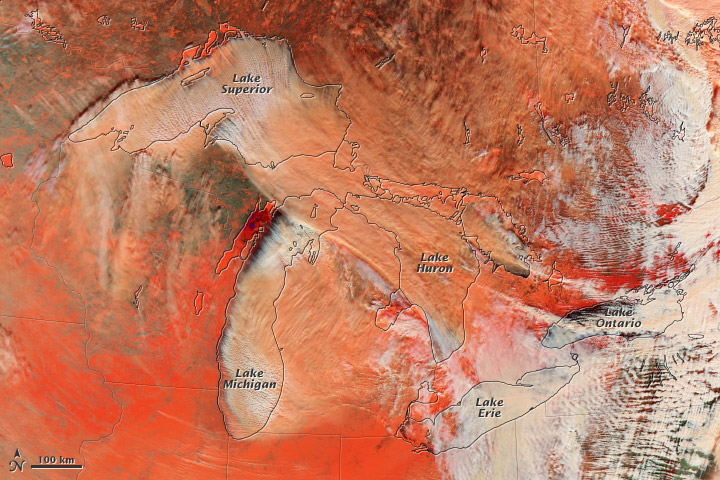 acquired January 6, 2014 download large image (2 MB, JPEG, 2002×1502)acquired January 6, 2014 download GeoTIFF file (6 MB, TIFF)
A swirling mass of Arctic air moved south into the continental United States in early January 2014. On January 3, the air mass began breaking off from the polar vortex, a semi-permanent low-pressure system with a center around Canada’s Baffin Island. The frigid air was pushed south into the Great Lakes region by the jet stream, bringing abnormally cold temperatures to many parts of Canada and the central and eastern United States.
When the cold air passed over the relatively warm waters of Lake Michigan and Lake Superior, the contrast in temperatures created a visual spectacle. As cold, dry air moved over the lakes, it mixed with warmer, moister air rising off the lake surfaces, transforming the water vapor into fog—a phenomenon known as steam fog.
On January 6, 2014, the Moderate Resolution Imaging Spectroradiometer MODIS on NASA’s Terra satellite captured this natural-color image (top) of fog forming over the lakes and streaming southeast with the wind. A false-color image (bottom) produced with data from the same instrument helps illustrate the difference between snow (bright orange), water clouds (white), and mixed clouds (peach). Water clouds are formed entirely by liquid water drops; mixed clouds contain both water droplets and ice crystals.
To see what the steam fog looked like from the ground, view the video clips included as part of this story in the Huffington Post.
-
References
- Weather Underground (2014, January 6) What’s a Polar Vortex?: The Science Behind Arctic Outbreaks. Accessed January 6, 2014.
- NOAA (2014, January 6) Types of Fog. Accessed January 6, 2014.
NASA Earth Observatory images by Jesse Allen and Robert Simmon, using data from LANCE/EOSDIS Rapid Response. Caption by Adam Voiland.
- Instrument:
-
-
New state fault maps show higher earthquake risks in Hollywood
imes.com/local/la-me-0109-hollywood-fault-20140109,0,5699276.story
latimes.com
New state fault maps show higher earthquake risks in Hollywood
Newly released data tracing the location of the active Hollywood fault will lead to additional curbs on development in the rapidly growing area.
By Rong-Gong Lin II, Rosanna Xia and Doug Smith
7:02 PM PST, January 8, 2014
Advertisement New state geological maps released Wednesday show several major developments planned in Hollywood are much closer to an active earthquake fault than Los Angeles city officials initially said.
The maps chart the course of the Hollywood fault, which runs from Atwater Village and Los Feliz, through central Hollywood and west along the Sunset Strip.
The state accelerated completion of the maps last fall amid controversy over the Los Angeles City Council approving a skyscraper development on or near the fault.
Interactive map: Do you live or work in the Hollywood fault zone?
The maps create a zone of generally 500 feet on both sides of the fault, and state law requires any new development within the zone to receive extensive underground seismic testing to determine whether the fault runs under it. The law prohibits building on top of faults.
The rules, which will take effect when the maps are finalized this summer, will restrict future development in two fast-growing areas: Hollywood north of Hollywood Boulevard and West Hollywood along Sunset Boulevard. Both areas have seen a surge in new development in the last decade, with more projects planned.
The state law has not been in force on the Hollywood fault because the state geologist had not completed the fault zone. A Times investigation last month found that Los Angeles approved at least 14 projects along the Hollywood and Santa Monica faults without ordering the kind of underground digging needed to determine exactly where the fissures run. Among those projects is a sprawling $200-million complex, known as Blvd6200, now under construction on Hollywood Boulevard.
Map: The Hollywood fault and developments
L.A. officials acknowledged in November they have been using outdated fault maps when reviewing projects. They didn’t realize their error until Times reporters pointed it out to them, and they have since begun using newer maps.
Luke Zamperini, a spokesman for the city Department of Building and Safety, said the agency is in the process of including Wednesday’s map in its automated permitting system. All new projects within the fault zone will require a full fault study, while previously approved projects that have not begun construction will be reviewed on a case-by-case basis, he said.
The state’s new map shows that three prominent Hollywood developments — the proposed Millennium Hollywood skyscraper project, the Blvd6200 development and a planned apartment complex on Yucca Street — are within the roughly 500-foot fault zone.
More coverage: L.A.’s Hidden Dangers
State geologist John Parrish said the state’s fault line goes underneath both Millennium and Blvd6200.
“We feel very confident about where we drew that line, within maybe a 50-foot accuracy back and forth. But we’re very confident it’s there,” Parrish told reporters at a downtown Los Angeles news conference. “Surface rupture is very dangerous. In fact, it’s calamitous to structures that are built across of the surface trace of an active fault.”
The only definitive way to determine if the fault is actually underneath the property is an intensive underground investigation, such as digging a trench, Parrish added.
Los Angeles officials did not order trenching for any of the three projects before the City Council approved those projects. The city later asked the developers of Millennium to dig an underground trench, but that work has not started yet.
Philip Aarons, one of the founders of Millennium Partners, said in a statement that the state’s map is not a substitute for underground investigation. Aarons said the geological tests performed so far at the site showed no evidence of an active earthquake fault on the property but he has agreed to complete the trenching work.
The Millennium project would bring 1 million square feet of retail, residential and office space to Hollywood, and 39- and 35-story towers flanking the Capitol Records tower. The new map shows the fault running under the historic tower.
Reports filed by the developers to the city for all three projects indicated the fault was much farther away than the new state map indicates. The developers of Millennium said the fault was about 0.4 miles away; Blvd6200 0.5 miles away; and the residential complex at 6230 Yucca St., 0.3 miles away.
David Jordon, owner of the Yucca Street project, emphasized that the state map is still a draft.
“Safety is of paramount importance to us. There will be further fault investigations on the site. We’re working with the city of Los Angeles to determine what those studies will be,” Jordon said.
The developers of Blvd6200 did not respond to a request for comment on Wednesday. But in the past, they have said they don’t believe the fault runs under the project and that a geologist on site during construction saw no evidence of the fault.
The release of the maps was highly anticipated, in part because of their potential impact on new development in the area.
Leron Gubler, the head of the Hollywood Chamber of Commerce, said he welcomed the state’s release of the map.
“It has eliminated a lot of the uncertainties in the last six months on where the Hollywood fault zone is,” Gubler said. “This is a positive development for Hollywood because this is now a zone defined.”
City councilman Mitch O’Farrell, who represents Hollywood, agreed, adding: “This information provides a clear map for development in the heart of Hollywood.”
California lawmakers banned construction over faults a year after the 1971 Sylmar earthquake, after homes on top of the San Fernando fault were ripped apart when one side of the fault slid past the other. That movement split the foundations of buildings in half, destroying them.
For two decades after the Sylmar quake, the state zoned numerous faults around California. But starting in the 1990s, budget cuts stalled new fault mapping — including the Hollywood fault. There are about 2,000 miles of faults still to zone.
Opponents of more Hollywood development said they were pleased the state produced the Hollywood fault zone.
“We feel completely vindicated by the state map,” said Robert P. Silverstein, attorney for community groups who have sued to block the Millennium project.
State officials also released a draft map of the Sierra Madre and Duarte fault zones in the foothill cities of Monrovia, Duarte, Azusa and Glendora in eastern Los Angeles County. Schools that are in or partially within the draft fault zones include Charles H. Lee Elementary School in Azusa and Citrus College in Glendora.
State geology officials will now begin a 90-day public comment period and hold a public hearing. A final map is expected to be published by July 8.
The next fault to be zoned is the Santa Monica fault and the western end of the Hollywood fault, but Parrish said his department only has enough funds to have one person work on the mapping for the first half of the year, and there are no funds after June 30. It’s unclear whether mapping the Santa Monica fault can be finished within that timeframe, Parrish said.
Some state lawmakers have urged the governor’s office to commit more funding to complete the zoning of earthquake faults. The governor’s office will release its proposed budget Friday.
-
Oceanographer Examines Pollutants in Antarctic Seal Milk

Oceanographer Examines Pollutants in Antarctic Seal Milk
Jan. 8, 2014 — An oceanographer from the University of Rhode Island is analyzing the milk from Antarctic fur seals to determine the type and quantity of pollutants the seals are accumulating and passing on to their pups.
Share This:Rainer Lohmann, a professor at the URI Graduate School of Oceanography, is collaborating with a researcher at the Southwest Fisheries Science Center in California to learn about the health and ecology of fur seals that winter in different locations in the South Pacific.
“What we’re trying to learn is where the pollutants come from and how those pollutants vary by where the seals feed,” said Lohmann, who has conducted studies of marine pollutants around the world. “Fur seals that have given birth have lower pollutant levels than those that have not, because they pass their pollutants on to their pups in their milk.”
All of the seals the researchers are studying breed on the South Shetland Islands of Antarctica, but some spend the winter off the coast of Argentina while others winter off Chile. The two groups are thought to be exposed to different pollutants in the food they eat at their wintering grounds.
Lohmann’s lab is analyzing 60 samples of seal milk collected between 2000 and 2010. He expects to find a wide variety of pollutants in the samples, including mercury, pesticides, flame retardants, PCBs, and other organic pollutants.
“These are all pollutants that degrade very slowly, so some may have been in the environment for decades while others, like flame retardants, are relatively new compounds that are still used by industry today,” Lohmann said.
Few studies of marine pollutants have been conducted in Antarctica, in part because there are greater concerns about pollutant levels in the northern hemisphere than in the southern hemisphere.
“The two hemispheres don’t mix very well, which is why the northern hemisphere is more contaminated than the southern — most of the pollutants have been released in the northern hemisphere and the air doesn’t flow to the south very often. So Antarctica is much cleaner,” Lohmann explained. “But we don’t know whether the pollutants down there are the result of a slow infiltration from the north or whether it’s a slower accumulation of pollutants used and released in the south.”
According to Lohmann, seal milk is about 50 percent fat, enabling young seals to grow rapidly. But it also means that if their mother’s milk is contaminated with pollutants, the pups will quickly accumulate pollutants in their bodies as well. And due to the pups’ smaller size, the researchers speculate that the young seals are more seriously effected by the pollutants than are older and larger seals.
“The seals can’t avoid the pollutants, so the best we can hope for is that the concentration of pollutants will decrease in their system over time, so that whatever harm there was is less harmful in the future,” Lohmann said. “But some data suggests that pollutant concentrations haven’t declined in the last ten years, even though most of the compounds were banned 40 years ago.”
Lohmann also speculates that some older pollutants that had been frozen in glaciers may be released again as the glaciers melt due to climate change.
“That could cause wildlife to be re-exposed to chemicals that previously were safely locked away in the ice,” he said.
Share
-
Ahoy! First Ocean Vesicles Spotted
Ahoy! First Ocean Vesicles Spotted
Jan. 9, 2014 — Marine cyanobacteria — tiny ocean plants that produce oxygen and make organic carbon using sunlight and CO2 — are primary engines of Earth’s biogeochemical and nutrient cycles. They nourish other organisms through the provision of oxygen and with their own body mass, which forms the base of the ocean food chain.
Share This:Now scientists at MIT have discovered another dimension of the outsized role played by these tiny cells: The cyanobacteria continually produce and release vesicles, spherical packages containing carbon and other nutrients that can serve as food parcels for marine organisms. The vesicles also contain DNA, likely providing a means of gene transfer within and among communities of similar bacteria, and they may even act as decoys for deflecting viruses.
In a paper published this week in Science, postdoc Steven Biller, Professor Sallie (Penny) Chisholm, and co-authors report the discovery of large numbers of extracellular vesicles associated with the two most abundant types of cyanobacteria, Prochlorococcus and Synechoccocus. The scientists found the vesicles (each about 100 nanometers in diameter) suspended in cultures of the cyanobacteria as well as in seawater samples taken from both the nutrient-rich coastal waters of New England and the nutrient-sparse waters of the Sargasso Sea.
Although extracellular vesicles were discovered in 1967 and have been studied in human-related bacteria, this is the first evidence of their existence in the ocean.
“The finding that vesicles are so abundant in the oceans really expands the context in which we need to understand these structures,” says Biller, first author on the Science paper. “Vesicles are a previously unrecognized and unexplored component of the dissolved organic carbon in marine ecosystems, and they could prove to be an important vehicle for genetic and biogeochemical exchange in the oceans.”
Billions and billions of vesicles
Biller’s metagenomic analysis of the vesicles taken from the seawater revealed DNA from a diverse array of bacteria, suggesting that vesicle production is common to many marine microbes. The researchers estimate the global production of vesicles by Prochlorococcus alone at a billion billion billion per day — representing a notable addition of carbon to the scarce nutrient pool of the open seas.
Lab experiments showed that the vesicles are stable, lasting two weeks or more, and that the organic carbon they contain provides enough nutrients to support the growth of nonphotosynthetic bacteria.
Given the dearth of nutrients in the open ocean, the daily release by an organism of a packet one-sixth the size of its own body is puzzling, Chisholm says. Prochlorococcus has lost the ability to neutralize certain chemicals and depends on nonphotosynthetic bacteria to break down chemicals that would otherwise act as toxins. It’s possible the vesicle “snack packets” help make this relationship mutually beneficial.
“Prochlorococcus is the smallest genome that can make organic carbon from sunlight and carbon dioxide and it’s packaging this carbon and releasing it into the seawater around it,” says Chisholm, the Lee and Geraldine Martin Professor of Environmental Studies in MIT’s Department of Civil and Environmental Engineering and Department of Biology, who is lead investigator of the study. “There must be an evolutionary advantage to doing this. Our challenge is to figure out what it is.”
Because the vesicles also contain DNA and RNA, the researchers surmise they could play a role in horizontal gene transfer, a means for developing genetic diversity and sharing ecologically useful genes among the Prochlorococcus metapopulation.
Marine decoy
But perhaps the most unusual potential role of the vesicles is as a decoy for predators: Electron microscopy shows phages (viruses that attack bacteria) attached to vesicles. When a phage injects its DNA into the vesicle (making it impossible for the phage to reproduce in a living cell), it renders the phage inactive, according to Biller, who says the vesicles could be acting like chaff released by a fighter jet to divert missile attacks. A phage attached to a vesicle is effectively taken out of the battle, providing a creative means of deterrence.
“Marine cyanobacteria of the genera Prochlorococcus and Synechoccocus are the two most abundant phototrophs,” says biologist David Scanlan, a professor at the University of Warwick who was not involved in this research. “By releasing extracellular vesicles these organisms shed new light on the importance of such particles in the largest ecosystem on Earth — the open ocean — with implications for marine carbon cycling, mechanisms of horizontal gene transfer, and as a defense against phage attack.”
The vesicles first came to Chisholm’s attention in 2008 when Anne Thompson, then a graduate student, noticed little “blebs” on the surface of Prochlorococcus cells while using electron microscopy. Neither she nor Chisholm nor other ocean biologists who saw the photo were able to identify the spheres. But Biller, who joined Chisholm’s lab in 2010 after completing his graduate studies on soil bacteria, recognized them as vesicles, and began the study resulting in the Science paper.
Share this story on Facebook, Twitter, and Google:




 Remote waters affect billions of people, shape climate and air chemistry worldwide
 Scientists working on the CONTRAST project will be in the field this month and next.


 Save
Save Email
Email Print
Print Share
Share