Category: Uncategorized

  • Climate change puts 40 percent more people at risk of absolute water scarcity: Study

    Climate change puts 40 percent more people at risk of absolute water scarcity: Study

    Posted By News On December 16, 2013 – 8:31pm

    Water scarcity impacts people’s lives in many countries already today. Future population growth will increase the demand for freshwater even further. Yet in addition to this, on the supply side, water resources will be affected by projected changes in rainfall and evaporation. Climate change due to unabated greenhouse-gas emissions within our century is likely to put 40 percent more people at risk of absolute water scarcity than would be without climate change, a new study shows by using an unprecedented number of impact models. The analysis is to be published in a special issue of the Proceedings of the National Academy of Sciences that assembles first results of the Inter-Sectoral Impact Model Intercomparison Project (ISI-MIP), a unique community-driven effort to bring research on climate change impacts to a new level.

    “The steepest increase of global water scarcity might happen between 2 and 3 degrees global warming above pre-industrial levels, and this is something to be experienced within the next few decades unless emissions get cut soon,” says lead-author Jacob Schewe of the Potsdam Institute for Climate Impact Research. “It is well-known that water scarcity increases, but our study is the first to quantify the relative share that climate change has in that, compared to – and adding to – the increase that is simply due to population growth.”


    From China to the US: Huge regional differences of future water availability

    Today, between one and two people out of a hundred live in countries with absolute water scarcity. Population growth and climate change combined would increase this to about ten in a hundred at roughly 3 degrees global warming. Absolute water scarcity is defined as less than 500 cubic meters available per year and person – a level requiring extremely efficient water use techniques and management in order to be sufficient, which in many countries are not in place. For a comparison, the global average water consumption per person and year is roughly 1200 cubic meters, and significantly more in many industrialized countries.

    As climate change is not uniform across the world, the regional differences of its impacts on water availability are huge. For example, the Mediterranean, Middle East, the southern USA, and southern China will very probably see a pronounced decrease of available water, according to the study. Southern India, western China and parts of Eastern Africa might see substantial increases.


    Food security depends on irrigation – farmers are main water users

    “Water scarcity is a major threat for human development, as for instance food security in many regions depends on irrigation – agriculture is the main water user worldwide,” says co-author Qiuhong Tang of the Chinese Academy of Sciences. “Still, an increase of precipitation is also challenging – the additional water may cause water logging, flooding, and malfunctioning or failure of water-related infrastructure. So the overall risks are growing.” Moreover, many industrial production processes require large amounts of water, so a lack thereof in some regions hampers economical development.

    This study is based on a comprehensive set of eleven global hydrological models, forced by five global climate models – a simulation ensemble of unprecedented size which was produced in collaboration by many research groups from around the world. Hence, the findings synthesize the current knowledge about climate change impacts on water availability. The cooperative ISI-MIP process systematically compares the results of the various computer simulations to see where they agree and where they don’t. The results quoted above represent the multi-model average. So some of the models indicated even greater increases of water scarcity.


    Unique multi-model assessment allows for risk-management perspective

    “The multi-model assessment is unique in that it gives us a good measure of uncertainties in future impacts of climate change – which in turn allows us to understand which findings are most robust,” says co-author Pavel Kabat of the International Institute for Applied Systems Analysis (IIASA). “From a risk management perspective, it becomes very clear that, if human-made climate change continues, we are putting at risk the very basis of life for millions of people, even according to the more optimistic scenarios and models.”

    However, he added, the job is far from being done. “We need to do additional research on how the water requirement portfolio will develop in the future in different sectors like agriculture, industry, and energy – and how, in addition to reducing greenhouse-gas emissions, the technological developments in the water sector may help alleviating water scarcity.”


  • We won!

    Why this ad?
    Low Deposit Home Loanmortgagehouse.com.au – Borrow Up To 99% Of Your Home With A Mortgage House Home Loan

    We won!

    Inbox
    x
    Naomi Clarke via Change.org <mail@change.org>
    5:09 PM (15 minutes ago)

    to me
    Change.org

    Meeting the Premier. Please 'enable images' to see this photo
    “Today I caught up with Naomi Clarke and her husband Paul… I’m pleased to say that we’ve found a way to help meet Naomi’s unique needs, and she’ll be able to keep living at home.”
    — Premier Weatherill

    NEVILLE —


    Today we awake after yesterday being such an emotional day trying to convince the powers of my worth — and we have the grand news to share that Paul & I get to remain together at home.

    Yesterday morning we met the Premier Jay Weatherill in person. As friends, family and supporters joined us to deliver the petition to his office, he left a cabinet meeting to come out and accept our petition. And he actually listened, committing to funding the home care we need going forward.

    I would like to thank each of you, your family and friends for supporting and believing in love and life despite disability. Though we should not have to go to such measures, today we can breath and know that we can make a difference and that each and every one of us matter.

    To receive 62,000 signatures through our change.org petition goes beyond anything that Paul & I could have ever hoped. It’s all been a bit of a whirlwind and shock — especially with our success being covered by so much media. Last night we were on Channel 7, 9, 10, ABC News and radio, in The Advertiser and lots more.

    If, like me, you’d like to say thanks to the Premier for actually listening — you can leave a message on his Facebook page right here.

    Once again, thank you so very much for everything you’ve done for Paul and myself. We will never forget it. 

    Kindest regards,

    Naomi & Paul Clarke

    P.S. My interview with Channel 10’s The Project last night is up online now — you can watch it by clicking here — I’d love it if you can share it with friends and family who you asked to sign the

  • Sea Level, Risk Of Flooding Rising Rapidly In Mid-Atlantic

    Environment

    Sea Level, Risk Of Flooding Rising Rapidly In Mid-Atlantic

    Andrew Freedman, Climate Central Published: Dec 14, 2013, 10:20 AM EST weather.com

    • Share
    • Tweet
    Play Video

    Overlay

    The Future of Sea Level Rise

    Autoplay
    On
    Off

    During the 20th century, sea levels along the highly populated U.S. Mid-Atlantic coastline between New York and Virginia rose faster than in any other century during the past 4,300 years, according to a new study.

    And as those sea levels continue to increase as a result of global warming and local land elevation changes, the risks of coastal flooding will dramatically escalate.

    The study, by geoscientists at Rutgers and Tufts Universities and published in the new journal “Earth’s Future,” took a comprehensive look at the history of sea level in the Mid-Atlantic, combining sediment records of prehistoric sea level with modern data, which includes readings from tide gauges and satellite instruments.

    The result is one of the most in-depth examinations of past, present, and future sea level rise of any region in the U.S.

    The study warns that regional planners will need to factor local rates of sea level rise when making decisions on building any long-lasting infrastructure, from water treatment facilities to Manhattan skyscrapers and Atlantic City casinos.

    For example, the study estimated that the New Jersey shore will likely see a sea level rise of about 1.5 feet by 2050, and about 3.5 feet by 2100, at least a foot higher than the average global sea level rise over the rest of the century.

    Master Sgt. Mark C. Olsen, New Jersey Air National Guard

    The amusement pier in Seaside Heights, N.J., was heavily damaged by Hurricane Sandy last October.

    Using a middle-range scenario for future sea level rise, the study found that by 2050, flooding caused by a 10-year storm, which has a 10 percent probability of occurring each year, would exceed all historic storms in Atlantic City.

    According to the study, relative sea levels in the Mid-Atlantic region rose at about 0.10 inches per year during the 19th century, and that rate accelerated to 0.15 inches per year during the 20th century. That may not sound like much, but it is already enough to make a major difference when storms strike.

    The impact from Hurricane Sandy clearly illustrates that. The study found that a 7.87-inch global sea level rise during the 20th century, which was largely driven by manmade global warming, caused Hurricane Sandy to flood an additional 27 square miles compared to what it would have if the storm had struck in 1880 when sea levels were lower.

    Using figures from Climate Central’s sea level rise database, the researchers (who were not affiliated with Climate Central) found that sea level rise exposed an additional 83,000 people to coastal flooding, with about 45,000 in New York City and the rest in New Jersey.

    While two factors largely control global average sea level — temperature and variations in the volume of the Earth’s ice sheets and mountain glaciers — local rates of relative sea level rise are more complicated.

    While the U.N. Intergovernmental Panel on Climate Change (IPCC) projected that global mean sea level rise for 2081-2100 will likely be between 10-to-32 inches, those numbers mean little to local policymakers, who must make decisions based on local sea level rise rates that often differ from the global average.

    Master Sgt. Mark C. Olsen, New Jersey Air National Guard

    Aerial views of the damage caused by Hurricane Sandy to the New Jersey coast taken during a search and rescue mission by 1-150 Assault Helicopter Battalion.

    Those differences are the result of several factors, including ocean currents that can cause faster or slower rates of sea level rise in some areas, groundwater depletion, which can result in sinking land, and gradual post-ice age adjustments of the land.

    In the Mid-Atlantic region, it turns out, all three of these factors are conspiring to accelerate sea level rise. Every part of the region saw the level rise at a faster rate than the global trend, the study found. In fact, that rate since the early 1900s was nearly double the global average.

    Locations that sit atop a coastal plain, such as the Jersey Shore, are seeing the fastest rates of sea level rise compared to those Mid-Atlantic coastal locations that are built on top of bedrock, such as New York City, since the geology of the coastal plain features more settling of the land from groundwater depletion and long-term sediment compaction.

    Other studies have also identified the Mid-Atlantic as a so-called “hot spot” of sea level rise, but the new research provides more statistical proof that modern sea level rise in this region is outpacing even periods from several thousand years ago.

    “The study highlights the importance of geological data when making predictions for coastal inundation during the 21st century and that it is important to take a regional approach,” Simon Engelhardt, a professor at the University of Rhode Island who was not involved in the new study, said in an email.

    To put recent rates of sea level rise into historical perspective, the study found there is at least a 95 percent probability that the rate of sea level rise in the Mid-Atlantic during the 20th century was faster than any century in the past 4,300 years, and a 67 percent probability that it was faster than any century in more than 6,600 years.

    “The sea level rise that we’re seeing now is very significant,” including in a “prehistoric context,” said study co-author Ben Horton of Rutgers University, in an interview.

    Miller et al. 2013

    Comparison of tide gauges along the coast with the Battery in Manhattan, showing sea levels are rising slightly faster along the coastal plain than in Manhattan. (The tide-gauge records are referenced to a synthetic 1900–1920 datum.)

    The study projects that lower Manhattan will see about 8.6 inches of sea level rise by 2030, 15.7 inches by 2050, and 38 inches, or just more than 3 feet, by 2100. The 15.7 inches of sea level rise by 2050 would be sufficient to transform what would be considered a moderate 10-year storm today to reach the same flood level as a 100-year storm would.

    The higher-end scenario considered in the study would bring 5.5 feet of sea level rise to Lower Manhattan by 2100. That would cause a 10-year storm event to bring flooding comparable to Hurricane Sandy, which brought the highest storm tide on record to Lower Manhattan.

    Every subway tunnel connecting Manhattan with Brooklyn and Queens flooded, along with transit stations in adjacent areas of New Jersey and all three of the city’s major airport hubs.

    A separate study published in 2012 found that similar increases in storm surge risk would occur at many other coastal locations in the U.S.

    Assuming continued groundwater extraction rates at coastal plain locations, those areas would see a greater amount of sea level rise, the study found. The study projected that those areas could be in for a rise of 9.8 inches by 2030, 1.5 feet by 2050, and about 3.5 feet, by 2100.

    While the study shows that the main component of future sea level rise will be from global sea level rise, local land elevation changes should be factored into development decisions, since they will influence the rate and extent of relative sea level rise at the local level.

    The study noted that there are currently limited tools for policymakers to use to factor in sea level rise to the planning process.

    Even the Federal Emergency Management Agency’s newest flood elevation data, released this year and used to help determine federal flood insurance requirements, failed to include sea level rise projections. “They are accordingly relevant to insuring against current risks but do not provide appropriate guidance for long-term planning,” the study said.

    Related Content from Climate Central

    MORE: Repeat Photography of Alaskan Glaciers Reveal Rapid Changes

    1 / 47

    Muir Glacier and Inlet (1895)

    Muir Glacier and Inlet (1895)

    In the photo above, the west shoreline of Muir Inlet in Alaska’s Glacier Bay National Park & Preserve is shown as it appeared in 1895. Notice the lack of vegetation on the slopes of the mountains, and the glacier that stands more than 300 feet high. See the glacier as it looked in

    • Northwestern Glacier (2005)
    • Northwestern Glacier (1909)
    • Northwestern Glacier (2004)

  • Update: ABC campaign

    Why this ad?
    UWS Agriculture courseswww.uws.edu.au/agriculture – $5,000 scholarships available to new Agriculture students at UWS.

    Update: ABC campaign

    Inbox
    x
    Benita from Play School
    5:19 PM (0 minutes ago)

    to me

    “I don’t want to imagine an Australia without the ABC.” -Benita Collings

    Benita

    From the GetUp team: Exciting news! More than 217,000 Australians have signed the GetUp “Save the ABC” petition and more than 6,000 GetUp ABC champions have already chipped in enough to run at least one high impact billboard in Tony Abbott’s electorate. It will run over the holiday period, turning up the public pressure to protect the ABC from cuts ahead of next year’s budget decisions. Read below for a message from Play School’s own Benita Collings ~

    Hi NEVILLE,

    Thanks for all that you’re doing to spread the word and protect the ABC.

    It’s so important that as many people as possible support the campaign now, before budget decisions (and potentially cuts) are made.

    The ABC is a treasured feature of the Australian mediascape for many reasons. It is the only station that is obligated by law to provide independent, balanced reporting, it’s free for all, it hosts uniquely Australian content and it provides kids with ad-free, educational programming.

    I don’t want to imagine an Australia without the ABC and it’s clear from the polling and the momentum of this campaign that the majority of Australians feel the same.

    If enough of us speak up now, we can demonstrate to our leaders that the ABC is here to stay.

    https://www.getup.org.au/protect-our-abc

    Let’s keep it going,

    Benita Collings, formerly of Play School

    —– Orignal email below —–

    Since it’s nearly Christmas, everyone who chips in $5 or more will receive the exclusive “Protect Our ABC” bumper sticker delivered to them: https://www.getup.org.au/protect-our-abc

    Dear NEVILLE,

    It’s gone bananas.

    In just 72 hours, the GetUp petition in response to the attack on the ABC was signed by nearly 215,000 Australians, and it’s still growing by the hour.

    That’s incredible. And the campaign is just getting started.

    Next move? Let’s put our message where it will have maximum impact.

    Right now, we’re on the phones with media buyers to secure prominent, high traffic, attention-getting billboards inside the electorates of Prime Minister Tony Abbott and Communications Minister Malcolm Turnbull. We’ll place them smack-bang on the roads where they, and the voters they answer to, live and work. Our message is clear: Australians want our ABC to remain free of ads, free from cuts, free to remain fair and balanced. They’ve secured some great last minute rates for us and are just waiting for the green light.

    Will you chip in to make it happen? Click here to see where your billboard will run: https://www.getup.org.au/protect-our-abc

    The recent government tirade against our ABC from inside the Coalition party room is not an isolated incident. Nor are the near daily slurs against the ABC published in hysterical columns of the Murdoch-owned press; or the motion passed just two weeks ago by the Victorian Liberal Party conference to sell off our nation’s public broadcaster. These attacks are simply the latest in the right wing’s long history of interference with the only broadcaster in our country that operates in the interest of the public, not profits.

    Why? Conservative forces both inside and outside our government – which have Mr Abbott’s ear – are sowing the seeds for funding cuts, or worse, well ahead of budget decisions early next year. They want to see how the public reacts, gauge how much it’d cost them politically.

    Let’s give them a taste. Will you donate to put up targeted billboards, run ads and facilitate a community visibility campaign over the Christmas break and months leading up to budget?

    https://www.getup.org.au/protect-our-abc

    Think this would never happen to such a widely popular public service? Think again.

    When Liberal Senator Cory Bernardi called our ABC a “taxpayer-funded behemoth” and suggested that “we could perhaps cut the ABC budget and allow the commercial media operators to compete” – he was only picking up where many in the Howard Government left off. Howard famously stacked the board with right-wing cronies and climate deniers, and starved the broadcaster of funds until GetUp members rallied with one of our first big campaigns ever, back in 2006.

    Now is the time to head-off the attack. As Mike Carlton wrote in Saturday’s Sydney Morning Herald:

    “The next move is bleedin’ obvious. In due course, Abbott will instigate an ‘inquiry’ into the ABC, with a suitable stooge to run it and the result predetermined. It will recommend a reworking of the ABC charter to bring the place to heel and, most important of all, to kybosh any activities attracting audiences that Rupert sees as rightfully his. Then they’ll slash the funding. Bring on the Murdochracy.”

    Not if we can help it.

    We know the Australian public deeply values our ABC, and we’re prepared to remind any politician who forgets that they answer to us. Will you help turn up the pressure?

    https://www.getup.org.au/protect-our-abc

    For a free and fair independent media,

    Sam Mclean, for the GetUp team

    PS. Want to help take the message to the streets? Or your local shop window, car, computer or bike? We’re sending out awesome ABC bumper stickers now to every person who donates $5 or more to this campaign. Will you help B1

  • Ice Sheets and Sea level: what past climate change tells us is likely


    SF Bay Area Indymedia indymedia
    About Contact Subscribe Calendar Publish Print Donate

    International | Peninsula | Environment & Forest Defense

    Ice Sheets and Sea level: what past climate change tells us is likely
    by Takver – Climate IMC
    Friday Dec 13th, 2013 10:31 PM

    Paleoclimate shows us that sea level rise could become catastrophic with rises of 3 feet per 20 years seen as possible. “We are still potentially underestimating the instability of the ice sheets” informs Stefen Rahmstorf, Professor of Physics of the oceans from Postdam University in a video interview. “The IPCC has greatly revised it’s estimates of how unstable the Greenland ice sheet was.”

    the_poles_are_getting_warmer.jpg
    the_poles_are_getting_war…

    The video by Peter Sinclair and the Yale Forum on Climate Change and the Media shows a number of climate scientists interviewed discussing sea level rise, ice sheet collapse and past examples in paleoclimate history.

    Climate scientist Dr Richard Alley from Penn State University in a graph illuminates us that on current CO2 levels we can expect sea level rise to impact 10 per cent of the Earth’s population, hundreds of millions of people. He says in the video that “Greenland is very tightly tied to temperature, and if it gets too hot, it goes away”.

    Research published in March 2012 showed that the Global Warming threshold for Greenland Ice Sheet collapse is about 1.6 degrees C, although we may be seeing the start right now. The researchers said “We estimate that the warming threshold leading to a monostable, essentially ice-free state is in the range of 0.8-3.2 °C, with a best estimate of 1.6 °C”.

    The lower end of that range is where we are now, and due to inertia in the climate system we have the same amount of warming in the pipeline. So we are probably aleady committed to disintegration of the Greenland Ice Sheet.

    “Too hot is not too many degrees from where we are now”, said Dr Alley.


    Arctic and Antarctic warming linked

    Down at the bottom of the world, Antarctica is also showing signs of big changes in ice mass loss. Michael Studinger from NASA Operation Ice Bridge says “The ice sheets, for example like Pine Island Glacier (PIG) are rapidly thinning. And the thinning is rapidly accelerating and it is spreading further and further inland.”

    In Antarctica warmer ocean currents appear to be a primary driving force for destabilizing ice sheets as they eat away at the ice shelves that restrain the large ice streams like the Thwaites, Pine Island Glaciers and other ice streams around the continent.

    Latest research published 11 December 2013 in Global and Planetary Change by S.Jevrejevaa et al in a paper titled Trends and acceleration in global and regional sea levels since 1807 shows that global sealevel rise is accelerating at rate of 0.02 ± 0.01 mm/yr (1807–2009) with the Fastest sea level rise in Arctic (3.8 mm / yr) and Antarctica (3.5 mm / yr).


    Paleoclimate shows how fast ice sheets can collapse raising sea levels

    James Hansen highlights that the last time atmospheric temperatures were 2 to 3 degrees warmer, sea levels were 25 metres higher. With great inertia in the earth’s climate system, We are stretching the elastic which will rebound to a new sea level with devastating consequences. Scientists have estimated that at slightly above current temperatures we are about 20 metres below what the sea level equilibrium should be.

    Two years ago in a press conference at the American Geophysical Union Fall meeting 2011 in San Fransisco climate scientists James Hansen, Ken Caldeira and Eelco Rohling explained that the climate sensitivity may be greater than previously thought with the paleoclimate record pointing towards potential rapid climate change.

    The data range on the rate of accelerating mass loss is still too short to determine whether ice sheet mass loss will follow a somewhat linear path, or an exponential path doubling every 10 years or shorter time period. If it’s the later, we may face massive sea level rises later this century, according to a December 2012 discussion paper by James Hansen


    Link between Arctic and Antarctic warming periods

    The East Antarctic Ice sheet which sits on a high plateau was also much smaller and probably contributed 10 metres to sea level rise. Lead researcher Carys Cook was interviewed in the Sinclair video. The research was published in Nature Geoscience in July 2013 as Dynamic behaviour of the East Antarctic ice sheet during Pliocene warmth (abstract). From the abstract:


    “The geochemical provenance of detrital material deposited during these warm intervals suggests active erosion of continental bedrock from within the Wilkes Subglacial Basin, an area today buried beneath the East Antarctic ice sheet. We interpret this erosion to be associated with retreat of the ice sheet margin several hundreds of kilometres inland and conclude that the East Antarctic ice sheet was sensitive to climatic warmth during the Pliocene.”

    Carys Cook described that the East Antarctic ice sheet must have retreated several hundred kilometres inland. She described the implications for sea level in the interview with Peter Sinclair:

    “There was no ice on Greenland and that accounts for about 5 metres of sea level. The West Antarctic Ice sheet as well was probably gone and that accounts for about 5 or 6 metres of global sea level. The retreat from the East Antarctic Ice sheet gave an extra 10 metres of global sea level. So in total we are looking at between 20 and 22 metres higher than they are today.”

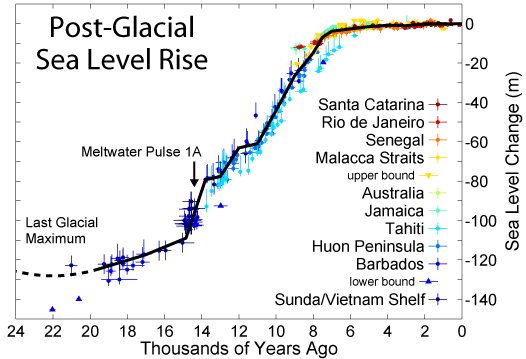
    Peter Sinclair also gives us a clip of James Hansen in 2009 explaining: “Now that wouldn’t happen instantly, but we could get several metres of sea level rise in one century. In fact the last time ice sheets disintegrated was 14,000 years ago when sea levels went up 20 metres in 400 years. So that is one metre every 20 years.”


    20131214-Post-Glacial_Sea_Level.png

    The Pliocene was also much warmer in the Arctic, with extreme warm periods, as Geology ProfessorJulie Brigham-Grette explains in the video. You can watch a July 2012 24 minute Youtube presentation by Brigham-Grette on Lake El’ gygytgyn Research in Siberia.

    These extreme warm periods in the Arctic also correspond with warm periods in Antarctica. Brigham-Grette, the lead U.S. scientist said in a media release July 2012:


    “What we see is astonishing. We had no idea that we’d find this. It’s astonishing to see so many intervals when the Arctic was really warm, enough so forests were growing where today we see tundra and permafrost. And the intensity of warming is completely unexpected. The other astounding thing is that we were able to determine that during many times when the West Antarctic ice sheet disappeared, we see a corresponding warm period following very quickly in the Arctic. Arctic warm periods cluster with periods when the Western Antarctic ice sheet is gone.”

    Brigham-Grette’s team examined in detail four warm phases; two of the oldest warm interglacials from about 1.1 million years ago and 400,000 years ago, and two of the youngest from 125,000 and about 12,000 years ago.

    Peter Sinclair’s video ends with a video interview with Brigham-Grette in which she says,


    “The value of our record is looking at the fact that the Arctic can become very quickly as warm, and that warmer environment is reaching a point where increasing melt of places like Greenland and the West Antarctic Ice Sheet are almost inevitable.”


    Creation stories remember significant sea level rise 14,000 to 12,000 years ago

    Here in Australia we have memories of that last significant rise in sea level between 14,000 and 12,000 years ago when the land bridge between mainland Australia and Tasmania was flooded along with areas of Port Philip.

    The memories are preserved in the oral and spiritual traditions of the Australian first peoples in the Kulin nation of southern Victoria. Oral history and creation stories from the Wada wurrung, Woiwurrung and Bun wurrung languages from around present day Melbourne describe the flooding of Hobsons Bay and Port Philip, once a productive kangaroo hunting ground. Creation stories describe how Bunjil was responsible for the formation of the bay, or the bay was flooded when the Yarra river was created (Yarra Creation Story.)

    While sea level rise is inevitable and now unstoppable, Federal and State Governments in Australia are withdrawing from co-ordinated coastal planning leaving this responsibility more and more to local municipal councils.

    What will our new stories say if sea level rises again at the rate of a metre every 20 years resulting in the wholesale dereliction and abandonment of coastal housing and infrastructure?

    How will we deal which the mass migrations of people? Will Prime Minister Tony Abbott’s slogan of Stop the Boats still be parroted?


    Sources

  • Government approves massive resource projects on Great Barrier Reef coast

    Government approves massive resource projects on Great Barrier Reef coast

    Dunk Island, on the Great Barrier Reef.Dunk Island, on the Great Barrier Reef.

    Several massive resource projects have been approved on the Great Barrier Reef coast by the federal government including the dredging and dumping of spoil near the reef and a new coal export terminal.

    Environmentalists have hit out at the decision, with the WWF and the Greens saying it further industrialises and threatens the world heritage protected icon.

    The projects approved by Environment Minister Greg Hunt late on Tuesday include the dredging of 3 million cubic metres of spoil – which will be dumped in the reef’s waters – for the development of three coal export terminals at Abbot Point.

    Mr Hunt also approved the building of a new coal terminal at Abbot Point by Indian mining giant Adani.

    Advertisement

    Approval was also given to a new processing plant for coal seam gas on Curtis Island, which includes 1.4 million cubic meters of dredging at Port Curtis and the mouth of the Calliope River near Gladstone. A pipeline to the plant – being proposed by Arrow Energy – was also approved.

    In making the decision Mr Hunt said he had imposed 148 strict environmental conditions on the Abbot Point and Curtis Island developments. That included conditions to ensure the water quality impact from the dumping of dredging spoil was offset. Mr Hunt said the offsets – which would stop sediments entering the Great Barrier Reef marine park from land sources such as farm runoff – would require an overall gain in water quality.

    “It is important to note that each of these sites is already heavily industrialised and that the processes were highly advanced at the change of government,” Mr Hunt said.

    “The conditions I have put in place for these projects will result in an improvement in water quality and strengthen the Australian Government’s approach to meeting the challenges confronting the Reef into the future”

    Water quality is a significant problem for the Great Barrier Reef with increasing pollutants and nutrients resulting in damage to corals, sea grass and other important marine habitats. There is also emerging evidence poor water quality can encourage populations of a damaging starfish know as crown-of-thorns that has plagued the reef.

    The World Heritage Committee has also been alarmed by increasing development on the reef’s coast – with a number of major resource projects approved in recent years – and will consider in 2014 whether it should be placed on an “in danger” list of world heritage sites.

    Richard Leck from WWF said Mr Hunt had failed the reef and had turned his back on scientific evidence of the damage dredging would cause.

    “Approving a massive amount of sediment to be dumped at a time when the reef’s health is so low, it really is against what the science tells us,” he said.

    Queensland Resources Council Chief Executive Michael Roche welcomed the decision and said it confirmed that industry could co-exist with the reef.

    Advertisement

    Environment News Video More video

    ‘Hurricane’ winds batter Europe

    Hurricane-force winds from a storm dubbed ‘Xaver’ have blasted toward