Category: Uncategorized

  • Is the Abbott Government in a Position to Request a Double Dissolution?

    Position to Request a Double Dissolution?

    Is the Abbott Government in a Position to Request a Double Dissolution?

    Posted in Uncategorized By Neville On July 4, 2014

    « Napthine Government Starts from Behind in Key Marginal Seats | Main

    July 04, 2014

    Is the Abbott Government in a Position to Request a Double Disslution?

    Several weeks ago Green’s Leader Senator Christine Milne announced that her party had delivered the Abbott government a trigger for a double dissolution by helping to block, for a second time, legislation to repeal the Clean Energy Finance Corporation.

    While it is true blocking the legislation created a double dissolution trigger, is is unlikely that the Prime Minister yet has constitutional justification to request double dissolution. That is assuming he was of a mind to do so.

    An overlooked aspect of calling a double dissolution, and an aspect that tripped up Malcolm Fraser in 1983, is that while possession of a trigger is necessary for calling a double dissolution, on its own a trigger is not a sufficient reason.

    This necessary but not sufficient condition relating to double dissolution triggers goes back to legal advice at the time of the first double dissolution one hundred years ago this month in 1914.

    June/July this year is not only the centenary of the path to the First World War. The same two months in 1914 saw the debate that led to the proroguing of the Parliament in 29 June 1914, followed by the proclamation of the parliament’s dissolution on 30 July 1914.

    The power of a Governor-General to dissolve both houses of the Commonwealth Parliament for an election is not one inherited from the British Crown. It is a power created by the deadlock provisions of the Constitution (Section 57) and is bound by interpretation of that section’s wording.

    When the Cook Liberal government was elected at the 1913 Commonwealth election, it had a one seat majority in the House (38-37) but was in a significant minority in the Senate (7-29). By May 1914 the government had created a trigger based on legislation blocked twice by the Senate, and in June announced that the Governor-General had agreed to a double dissolution, pending the passage of supply to carry on government until the new parliament could convene after the election.

    This supply issue meant that the calling of the first double dissolution received a thorough debate in the Parliament, with the Senate addressing the Governor-General on the matter and requesting that correspondence be released. The Governor-General did not respond, referring to the statement made to the House by the Prime Minister.

    With supply passed, both houses were prorogued on 29 June 1914, not long after a certain event took place on the other side of the world in Sarajevo. The proclamation of dissolution was issued on 30 July 1914. For unrelated reasons, five days later Britain and Australia were at war with Germany.

    Labor won the election on 5 September, but by then the political and international situation had changed dramatically from when former Prime Minister Cook had written to the Governor-General on 4 June requesting the double dissolution.

    On 8 October new Prime Minister Andrew Fisher released all correspondence between Prime Minister Cook and Governor-General Sir Ronald Munro-Ferguson. It set a precedent that has resulted in correspondence for all subsequent double dissolutions being made public.

    For this first first use of the novel double dissolution power, the Governor-General requested, with Prime Minister Cook’s consent, advice from Chief Justice of the High Court Sir Samuel Griffith on the use of the power granted to the Governor-General by Section 57.

    Griffith was in a unique position to offer advice, having attended the 1890s Constitutional Conventions and been one of the authors of the Constitution’s several drafts.

    In the released advice, Griffith advised Munro-Ferguson that the exercise of power under Section 57 was not automatic based on the existence of a trigger, but required the Governor-General to be personally satisfied of several conditions related to the trigger. To quote from the advice –

    An occasion for the exercise of the power of double dissolution under Section 57 formally exists … whenever the event specified in that Section has occurred, but it does not follow that the power can be regarded as an ordinary one which may properly be exercised whenever the occasion formally exists. It should, to the contrary, be regarded as an extraordinary power, to be exercised only in cases which the Governor-General is personally satisfied, after independent consideration of the case, either that the proposed law as to to which the Houses have differed in opinion is one of such public importance that it should be referred to the electors of the Commonwealth for immediate decision by means of a complete renewal of both Houses, or that there exists such a state of practical deadlock in legislation as can only be ended in that way. As to the existence of either condition he must form his own judgment. Although he cannot act except upon advice of his Ministers, he is not bound to follow their advice but is in the position of an independent arbiter.

    Since 1914 there have been five further double dissolutions, one in 1951, and four in 13 years in 1974, 1975, 1983 and 1987.

    As with the 1914 double dissolution, the 1951 request related to a single piece of legislation that the government argued had recently met the requirements of Section 57 of the Constitution. As with 1914, Menzies in 1951 also faced a Senate under control of the Opposition, 34-26.

    The 1974 request was different, resting on six pieces of legislation for which triggers had been built up over the previous 18 months. The 1974 double dissolution led to the only use of the second part of the deadlock provision, a joint sitting of the houses to deal with the disputed legislation. The process ran in parallel with a series of High Court cases that clarified the meaning of Section 57.

    One of the Justices who sat on those High Court cases in 1974 was Sir Ninian Stephen. In July 1982 he was appointed Governor-General, which meant he was particularly well informed on the operation of Section 57 when Malcolm Fraser made the next request for a double dissolution on 3 February 1983.

    The background to Fraser’s request was the political situation surrounding the Labor leadership that day. Labor’s National Executive was due to meet in Brisbane that morning, and an acrimonious debate was expected in defending Bill Hayden’s leadership against supporters of Bob Hawke.

    What Fraser did not know was that Bill Hayden had already made up his mind to stand aside in favour of Bob Hawke. What Labor did not know as they started their meeting was the Malcolm Fraser had headed out to the Governor-General’s residence with a request for a double dissolution. Such were the joys of politics before mobile phones and twitter.

    Embarrassingly for Fraser, Sir Ninian Stephen also did not know Fraser was on his way to Yarralumla. Fraser arrived with his listing of double dissolution triggers, but his advice lacked argument on the existence of practical deadlock. Knowing well the legal position related to Section 57, Stephen asked Fraser to provide further advice.

    Fraser had already called an unscheduled press conference for 12:30, at which he expected to announce a double dissolution. However, he had left the Governor-General no time to consider his request, especially as he was about to engage in an important diplomatic lunch with the Polish Ambassador. Fraser was forced to return to Parliament House, by which time knowledge of his request had leaked and Labor had resolved that Bob Hawke would be the new Labor leader.

    Through the afternoon Fraser provided further advice on the parliamentary situation to the Governor-General, and by evening had been granted his request for a double dissolution. But by then Bill Hayden had resigned, Labor had not imploded in acrimony, and Fraser had four weeks to try and destroy Bob Hawke’s Labor leadership. He failed.

    The relevance of this story is that while the Abbott government now has a double dissolution trigger on legislation to repeal the Clean Energy Finance Corporation, it has no grounds to argue that a situation of practical deadlock exists with the Senate.

    The trigger was achieved in a Senate that ceased to exist on 30 June. The new Senate’s term began in 1 July and new Senators will be sworn in next week.

    If in the highly unlikely situation that the Abbott government were to suddenly request a double dissolution based on this legislative trigger, the Governor-General would be entirely entitled to ask for evidence that a practical deadlock exists with the Senate. As the new Senate has yet to meet, and as the new Senate has not debated the legislation, the Governor-General would be entitled to say a practical deadlock does not exist.

    But beyond these constitutional issues, there are more practical issues about why we are not going to see a double dissolution election any time in the near future. These are

    • There is no way the Abbott government would call a double dissolution based on one part of the carbon legislation. It will build up triggers on all the different pieces of rejected carbon legislation before it even considers a double dissolution.
    • The government would also be keen to gather as many other legislative triggers, to have as many irons in the fire as it can before listing all as triggers for a double dissolution.
    • A double dissolution under the current electoral laws would be a farce. There will not be a double dissolution until the senate’s electoral system is changed.
    • The government would be wary of a double dissolution until it knows how it can work with the new balance of power Senators.
    • The government would want to know whether the Palmer United Party has a long term future, something that will take time and several state elections to assess.


    The option for a double dissolution is available until mid-May 2016. There is no reason to rush to a double dissolution early, especially before assessing the performance of the new Senate.

    Above all, those pining for an early double dissolution need to remember that while the Senate can put the bullets in the double dissolution gun, it is entirely the Prime Minister’s choice whether and when he fires the loaded gun.

    Overlooking the event of November 1975 (which as always is the exception to the rule), governments are never forced to a double dissolution. It is a government’s choice to call double dissolution, and it is the government’s choice to do so at a time most advantageous to its chances of re-election.

    Given the tough budget it introduced in May, the Abbott government shows little sign of firing the gun to start a double dissolution at any time in the near future.

    Posted by on July 04, 2014 at 04:25 PM in Double Dissolutions,

  • PUP-Pet-eer Mail out from Labor re Budget issue. Doctor’s submissions ETC

    1 of 47
    Why this ad?
    650% Investment Returnstodaysbestinvestments.com – Invest In Alternative Investments. Huge Profits. Free Top-Pick Guide!

    PUP-Pet-eer

    Inbox
    x

    Tony Burke via email.nationbuilder.com

    3:20 PM (10 minutes ago)

    to me
    .

    Neville,
    What a devastating end to the week. We all woke up on Friday to the tragedy of MH17. The bipartisan speeches from Prime Minister Tony Abbott and Opposition Leader Bill Shorten captured the sense of loss we all felt. While there are many things that divided us this week, on Friday the Parliament stood as one in grief at this tragedy of incomprehensible proportions.

    This was without a doubt the most powerful moment of the Parliament this week.

    Some of the others:

    BEST:

    1. If anyone wanted to question Labor’s commitment to acting on Climate Change, think again. Bill Shorten stood up in Parliament on Monday and made it absolutely clear Labor won’t be shifting on its commitment to limit pollution with an emissions trading scheme.

    2. The Government’s budget is a shambles. On Thursday Labor Ministers highlighted the absolute mess Joe Hockey is making of the budget and the hurt it’s causing on low and middle income Australians. Great speeches from Bill Shorten, Tanya Plibersek, Chris Bowen, Catherine King and Kate Ellis.

    3. Amidst all the chaos, Labor successfully moved several amendments to Government legislation in the Senate. As a result of one of Labor’s amendments, QANTAS will still call Australia home.

    4. A petition signed by 2,500 Australian GPs was handed into Parliament this week calling on the Government to scrap it’s unfair GP Tax. Some of the individual stories that GPs have provided in this petition aren’t easy reading, but it’s the reality of what this Government is doing.

    5. ARMAGEDDON! Tony Abbott said a leg of lamb was going to cost $100 and the town of Whyalla would be wiped off the map. Member for Charlton Pat Conroy helped win the argument with ridicule and a sense of humour this week.

    WORST:

    1. Tony Abbott and the Liberals believe in political games not science and on Thursday made Australia the first country in the world to stop taking action on climate change. Labor will taking meaningful and effective action to tackle climate change.

    2. Twice this week Richard Marles asked Minister for Immigration, Border Protection and Absolute Secrecy Scott Morrison about the 150 asylum seekers being held on a Customs vessel somewhere in or around the Indian Ocean. On both occasions Scott Morrison refused to answer the questions and just unloaded abuse.

    3. Each new law has its own question time called Consideration In Detail. It’s when MPs ask the responsible Minister what the impact of individual clauses of the Bill will be. Amazingly, when we got to this part of the debate on Peter Dutton’s bill to increase the cost of prescriptions, he didn’t bother turning up ‘til the end. When he eventually wandered in he refused to answer questions, including, disgracefully, refusing to state what the impact of the Bill will be on indigenous communities.

    4. House of Reps MP Clive Palmer left the House on Tuesday and walked across to the Senate to supervise the Finance Minister reading from a script Clive had insisted on. What was worse than the humiliation of seeing a PUP-Pet-eer control an Australian Minister was the outcome of this dodgy deal:  Less consumer protection and more red tape.

    5. If you thought the grumpy person formally known as Joe Hockey wasn’t listening, it’s actually far worse than that. On Wednesday morning he took to radio to tell Australians he’s realised Australians and the Parliament were rejecting his budget, his response… he’s now offering to make it harsher. Joe, I think you’ve missed the point.

    Additionally, forget the media statements from the Government proclaiming to be proud of this budget. On Wednesday when it was time for Parliament to start so the debate on the Budget could resume, Bronwyn Bishop walked into the Chamber, took the Chair, looked around and realised that not enough Government MPs had turned up for Parliament to start. She walked out, rang the Bells again and eventually they got just enough MPs for Parliament to kick-off – that’s a special kind of enthusiasm.

    After an extended Winter sitting period Parliament is now on break until late August.

    ‘til then.

    Tony

    PS: Song of the week this week is from iconic Australian singer song writer Paul Kelly and is dedicated to all the achievements of this Government so far.

  • Typhoon Haiyan, record-breaking CO2 levels, rising sea levels and more: five measures of the state of the climate in 2013

    RSS FEED

    Blog

    Typhoon Haiyan, record-breaking CO2 levels, rising sea levels and more: five measures of the state of the climate in 2013

    • 18 Jul 2014, 17:00
    • Ros Donald


    Atmospheric carbon dioxide levels broke modern records last year – and 2013 was one of the warmest years on record according to four major datasets. Sea levels continue to rise, and the oceans are getting warmer. The US National Oceanic and Atmospheric Administration’s State of the Climate, 2013 is a reminder of the many changes the world is experiencing.

    The State of the Climate report, published by the Bulletin of the American Meteorological Society, is a different beast to the Intergovernmental Panel on Climate Change’s (IPCC) fifth assessment report. Both reports assemble multiple datasets to give a picture of the changes the planet is experiencing, but NOAA’s annual climate checkup doesn’t try to answer why certain events have occurred. Instead, it focuses on building a detailed picture year on year, chronicling the shifting state of the physical climate system.

    NOAA has also created a summary that pulls out the report’s most striking results. We’ve picked five measures that help form this picture along with NOAA’s explanation of why they matter.

    Carbon dioxide levels 

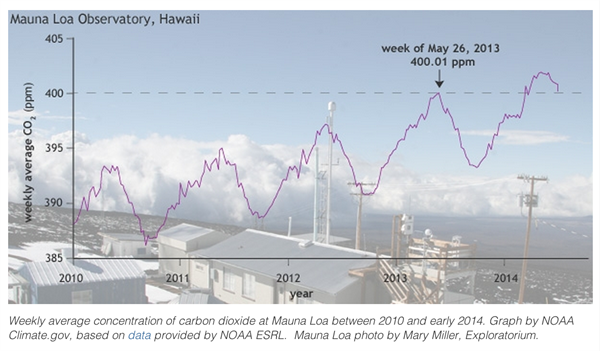
    Greenhouse gas levels in the atmosphere continued to rise in 2013. Atmospheric concentrations of carbon dioxide increased by 2.8 parts per million (ppm) last year, pushing the daily concentration of carbon dioxide measured at the Mauna Loa Observatory in Hawaii above 400 ppm on the 9th of May. Indeed, the average concentration for the month of June 2014 topped 400 ppm, as the graph below shows.Screenshot 2014-07-18 13.14.48

    The report points out that readings in the Arctic registered 400ppm as early as 2012, while the global concentration is catching up fast. Overall, the global average atmospheric carbon dioxide concentration for the year was 395.3ppm.

    The Mauna Loa reading is an important milestone for scientists. As NOAA points out, ice core records show carbon dioxide levels never exceeded 300 ppm during the last 800,000 years until the early 20th century. It says:

    “Now, having exceeded 400ppm, we are in uncharted territory.”

    Reacting back in 2013, for example, NASA’s Dr Erika Podest said the milestone is a “wake up call” that our actions in response to climate change must match the “persistent rise” in carbon dioxide.

    Rising sea levels 

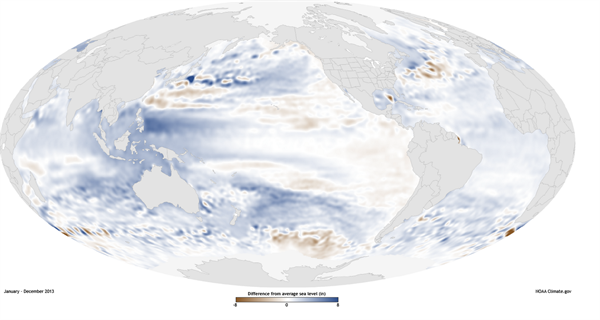
    Sea levels continued to rise. The blue areas on the map below show where average sea level in 2013 was above its long-term average. Sea level rose by as much as 20.32 centimetres above the 1993-2010 average – the dark blue areas. White areas show average levels, and places where sea level fell are brown.

    Screenshot 2014-07-18 13.46.07

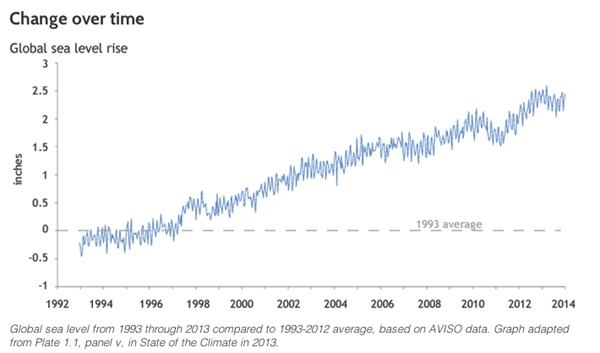
    Over the year, the changes reflect natural fluctuations, such as La Niña-like conditions in the tropical Pacific and Indian Ocean creating a pile-up of warm surface waters, as well as longer-term sea level rise as the oceans warm and expand, and land-based ice melts.

    In 2013, global average sea level was 3.8 centimetres above the 1993-2010 average, which is the highest yearly average since the satellite record began in 1993.Screenshot 2014-07-18 13.46.32

    Sea surface temperatures 

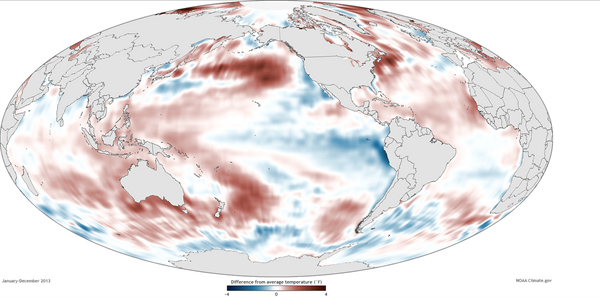
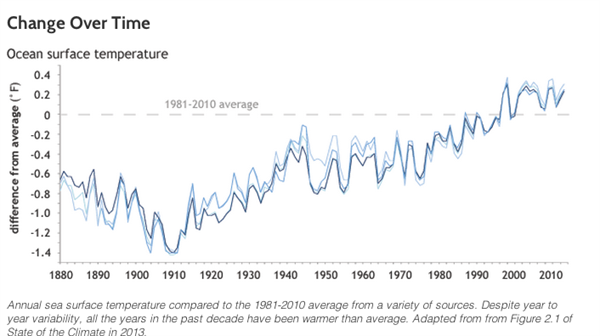
    Taking an average around the world, the report concludes that 2013 was one of the ten hottest years on record for sea surface temperatures. The north Pacific reached an historic high temperature, and there was substantial warming south of the Bering Strait and Gulf of Alaska, due to a persistent high-pressure system.

    Screenshot 2014-07-18 14.04.05

    Unlike the prevalence of a La Niña in 2011 and 2012, 2013 saw neutral El Niño conditions in the tropical Pacific ocean. But natural patterns like El Niño, which influence the climate on a yearly or decade-to decade basis “have occurred against a backdrop of warming that has been occurring over the long term”, the report says. The graph below shows the steady rise in ocean surface temperature over time.Screenshot 2014-07-18 14.16.25

    NOAA says sea surface temperatures play an important role in seasonal and yearly climate variations. Rising sea surface temperatures can make tropical cyclones and hurricanes more destructive, and have a huge effect on crucial ocean life like phytoplankton, which forms the basis of the ocean food web.

    The poles 

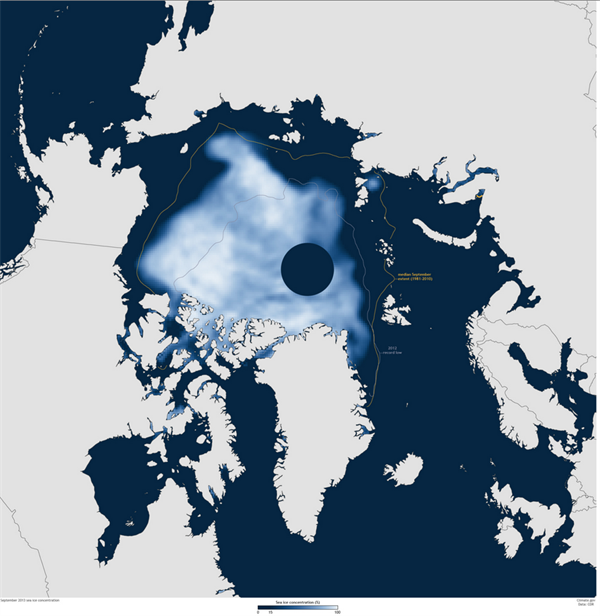
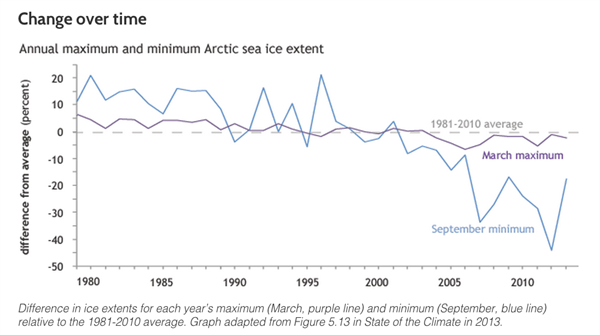
    In March last year – the end of the Arctic winter, when sea ice has been expanding – ice extent was three per cent below the long-term average. 80 per cent of the ice pack at the winter maximum level was new ice that had just formed over the winter, meaning that little ice is surviving year to year.

    At the peak of the melt season, ice extent shrank to 5.1 million square kilometers, 18 per cent below the 1981- 2010 average, but larger than 2012’s record low, NOAA says.

    Screenshot 2014-07-18 14.30.08

    Over time, the Arctic continues to be cold enough in winter for the ice pack to form, but it’s getting thinner and more delicate, making it more likely to melt in the coming summer, the report says.  Screenshot 2014-07-18 14.29.24

    The Arctic is crucial to maintaining the climate’s balance, NOAA says. As well as providing the cornerstone for unique animals’ hunting, breeding and migrating habits, the ice’s white surface helps to cool the climate by reflecting sunlight back into space.

    In Antarctica, temperature and pressure were above average across nearly the entire continent, and the ice sheet experienced its highest total surface melt during the austral summer of 2012-3 since 2004-5.

    Yet readings in Antarctica also recorded an above-average sea ice extent throughout the year. The report says:

    “A new daily maximum sea ice area of 19.57 million square kilometres was reached on 1 October 2013.”

    Extreme weather 

    2013 saw a range of extreme climate events, from record temperatures in Australia and Greenland to the UK’s coldest March and May since 1962 and 1996. But 2013 will be remembered for the devastation wrought in the Philippines by Typhoon Haiyan. The report says:

    “For most of 2013, it appeared that extreme heat and drought in Australia […] would be the singular and foremost climate story of the year. However, November saw the development, intensification and catastrophic landfall of super Typhoon Haiyan. Although Haiyan’s meteorological life cycle is measured in weeks, its impact on humanity within and beyond the region will be measured in generations.”

    Striking in the early hours on 8 November, scientists believe Haiyan may be the strongest tropical cyclone ever recorded at landfall, with one-minute sustained winds at 196 miles per hour.

    The graphic below shows tracks for the “thousands of Eastern Hemisphere tropical cyclones” documented between 1842 and 2012, NOAA says.

    Storms

    Historically high sea levels may have contributed to the storm’s destructive force, according to NOAA. It adds:

    “Higher sea levels contribute to increased coastal flooding and impact during storm surge events.”

    Climate checkup

    Climate change affects humans and our surroundings in complex, varied and interlinked ways. By pulling together the year’s climate data from sources around the world, NOAA’s climate health check provides a meticulous chronicle of the many trends of a warming planet.

  • ‘A Perfect Storm of Stupidity’: Scientists React To News The Carbon Tax Is Gone

    ‘A Perfect Storm of Stupidity’: Scientists React To News The Carbon Tax Is Gone

    Simon Thomsen Yesterday at 5:31 PM 504

    The Abbott Government delivered on its election promise to repeal the carbon tax today, 10 months after taking office, thanks to a new Senate line-up and the support of Clive Palmer’s party and some other crossbenchers.

    While Clive Palmer appeared with Nobel Prize winner and climate campaigner Al Gore three weeks ago to detail his views on addressing the issue, scrapping the tax was first and foremost on the mining magnate’s agenda.

    This morning the Senate voted 39-32 to repeal the tax.

    In contrast to Palmer’s wish for an emissions trading scheme, the Government’s plan, called Direct Action, doesn’t penalise the biggest carbon emitters and doesn’t have the support of the Palmer United Party.

    With the Senate rising at the end of the week, legislation for it can’t be tabled until late August, even if the Government could round up support for its plan.

    In the meantime, a range of expert scientists have spoken out again the scrapping of the two-year-old scheme, introduced by the former Gillard government, which placed a fixed price of $23 tonne on carbon before it was supposed to move to a “Cap and Trade” scheme in July 2015. They’re equally scathing of the Coalition’s Direct Action proposal.

    Professor Roger Jones, a Research Fellow at Victoria University’s Victoria Institute of Strategic Economic Studies didn’t mince words, calling today’s decision “the perfect storm of stupidity”.

    “It’s hard to imagine a more effective combination of poor reasoning and bad policy making”, and said it showed “a complete disregard of the science of climate change and its impacts.”

    He labelled the government’s Direct Action plan “bad economics” which didn’t trust market forces.

    He said it was “poor risk management to take what is effective and working, what can be readily adapted to more stringent targets, and replace it with a more expensive and unwieldy scheme that lacks the resources to meet its totally inadequate target of 5 per cent reductions by 2020,” he said.

    Dr Roger Dargaville, senior energy analyst at the University of Melbourne’s Energy Institute & School of Earth Sciences said CO2 production had fallen by 12% since carbon was priced, as energy producers shifted from brown coal to cleaner gas, wind and hydro power production.

    “The cost of this shift is carried primarily by the largest emitters who have seen their revenue slashed, which is exactly what the price on carbon was supposed to do,” he said.

    “The repeal of the price on carbon is a backwards step and a sad day for the global climate.”

    Dr Hugh Outhred, visiting fellow at the University of NSW’s School of Electrical Engineering and Telecommunications called scrapping a carbon price a “dereliction of duty”.

    He noted the $23 tonne price set under the ALP was too high, but dismissed both emissions trading schemes and Direct Action, adding the latter will also be a disaster for the budget.

    “The Coalition plan to replace a ‘polluter pays’ policy with a ‘pay the polluter’ policy will exacerbate the budget imbalance while being simply inadequate to the task, while emission trading schemes are too complex and too subject to gaming to earn public trust,” Dr Outhred said.

    “The centrepiece of a coherent policy framework to mitigate dangerous climate change should be a steadily increasing carbon tax with reinvestment of the proceeds in assisting our society to become more sustainable.”

    But perhaps the most telling comment came from Professor Peter Rayner at the University of Melbourne’s School of Earth Sciences, a carbon cycle scientist who monitors and predicts atmospheric CO2 levels.

    “As an Australian, I’m proud of how much we have contributed to that understanding, but today I’m embarrassed by how poor we are at putting that understanding into practice. We know we have to put Australia on a long road to a low-carbon future. Today we stepped off the road for a nap but that won’t make the road any shorter, we will just have to hurry more to catch up later,” he said.

    “I’m also mystified that a government which has thought and acted seriously for the long-term health of the federal budget can’t think beyond the previous election for the carbon budget.”

    Follow Business Insider Australia on Facebook, Twitter, and LinkedIn

  • Abbott bets house on coal, as price crashes. And Plan B is?


    Abbott bets house on coal, as price crashes. And Plan B is?

    By on 18 July 2014
    Print Friendly

    As Prime Minister Tony Abbott celebrated the promised axing of the carbon price and the re-focus of Australia’s economic future on the extraction of fossil fuels, the market price supporting his economic blueprint is in the process of collapsing.

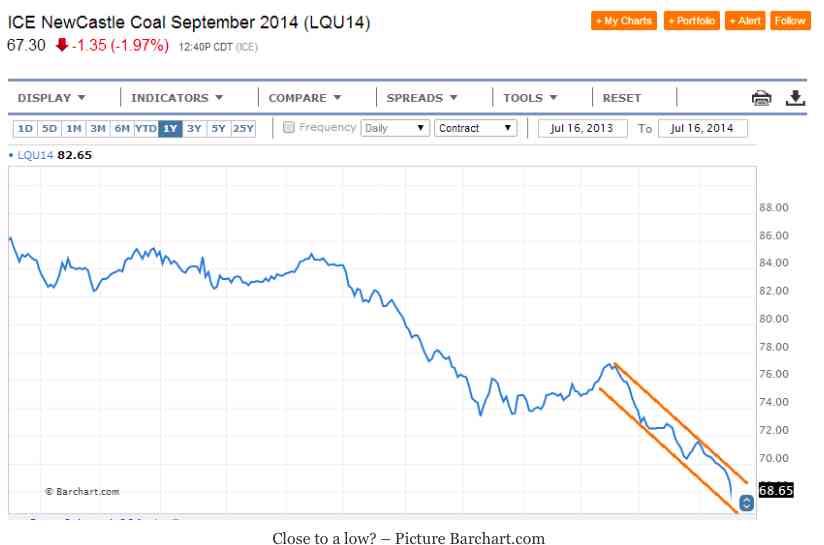
    The price for thermal coal has plunged more than 10 per cent in the last two months as the presumed major customers – China and India – make it clear that renewable energy is offering a competitive alternative to coal and gas.

    Abbott has made much of wanting Australia to be a global energy superpower, providing cheap energy to the growing markets in the Asia-Pacific region and beyond.

    But there are a couple of problems with this. One, the world does not want so much of Australia’s coal. China has dramatically cut its coal needs, and may cease importing in a few years, and India is now following.

    That means that the international market price for thermal coal is now becoming so cheap that Australian coal producers are unable to dig it out of the ground and ship it overseas without losing fistfuls of dollars.

    coal price

    This graph, from Business Insider, indicates how various factors – lower demand and increased production from producers desperate to sell – has caused the price of coal – Australia’s biggest export commodity – to plunge another 10 per cent in the last two months.

    Thermal coal is now sold below $70 on the spot market, well below the mark for Australian producers to make money, let alone get the finance for the massive new projects Abbott is hoping to encourage.

    Despite this, there are reports that India’s Adani has convinced South Korean group Posco to help build a $3 billion train line to flood the market with even more coal. Adani has still to explain how it will source another $10 billion to build an export terminal and the mine itself.

    Analysts are as gobsmacked about this news as they are about the carbon price removal. “This project requires a thermal coal price well in excess of US$100/t to be commercially viable – it is currently sitting at US$60/t- US$70/t,” says Tim Buckley,  IEEFA’s Director of Energy Finance Studies.

    He said flooding the market will push prices lower – around 20 per cent below current commodity analysts’ projections. “This must surely send a shiver down the spine of any investor who has their money in global coal debt or equity investments, and rightly so,” Buckley said.

    The one commodity that is in demand is LNG. But because that means that Australian gas will be used for export, local prices will now double – or perhaps triple – to meet export price parity (minus liquefaction and transport costs). This will see Australian energy prices soar.

    This was not the only fly in the ointment of Abbott’s grand economic and climate plan:

    In the same week that Australia became the first country to dump its carbon price ….

    The incoming president of the European Commission Jean-Claude Junker said he wanted Europe to lead at the upcoming climate change talks, and said he supported much more ambitious targets for emission reductions, energy efficiency and renewable energy.

    “We need to strengthen the share of renewable energies on our continent. This is not only a matter of a responsible climate change policy. It is, at the same time, an industrial policy imperative if we still want to have affordable energy at our disposal in the medium term. I strongly believe in the potential of green growth. I therefore want Europe’s Energy Union to become the world number one in renewable energies.”

    “I would also like to significantly enhance energy efficiency beyond the 2020 objective, notably when it comes to buildings, and I am in favour of an ambitious, binding target to this end that continues the current energy efficiency pathway. I want the European Union to lead the fight against global warming ahead of the United Nations Paris meeting in 2015 and beyond, in line with the objective of limiting any temperature increase to a maximum of 2 degrees Celsius.”

    The lead climate change negotiator for China, Xie Zhenhua, the vice chairman of China’s National Development and Reform Commission, said China would soon announce an overall cap on emissions, a key step towards its ambition to introduce an economy-wide emissions trading scheme. Zhenhua said China would announce “very ambitious” carbon dioxide goals.

    “We’re hoping the contribution can be announced in the first half of next year; perhaps in the first quarter. The capping year might be included in that statement and if there is a capping statement, I hope and believe that would be a very ambitious one.”

    In India, a budget that focused on solar technology – the building of “mega” capacity solar farms, off-grid solar pumps for irrigators, solar installations over canals, cuts in tariffs for solar components and a doubling of the tax on coal – has been followed by an announcement that the country will look to expand a “rent-a-roof” program from solar installations initially begun in Gujarat, the home state of new PM Narendra Modi, who has promised a “saffron revolution” of solar power.

    Tata Power, the energy offshoot of the country’s largest industrial group, also said it would provide “interest free” financing for up to $4,000 to help consumers install solar power. The scheme will be rolled out in 20 Indian cities before being expanded nationally.

    Bloomberg New Energy Finance last week predicted solar would beat coal plants on costs by 2020, resulting in high penetration of solar power in those nations’ rapidly growing grids, and much less coal-fired generation than presumed. AllianceBernstein has previously warned of “energy price deflation” as a result of the growing impact of solar, and the fact it was demonstrably cheaper than many fossil fuels in many countries.

    In the world of global finance, the market for climate bonds – financing linked to clean energy and other climate change solutions – is estimated to have reached more than $US500 billion, triple estimates of just two years ago. The actual “green bonds” market has jumped five-fold to $US35 billion in just 12 months.

    Sean Kidney, CEO of the Climate Bonds Initiative said:  “Investors are concerned about climate change. This report shows how they can invest in climate bonds without risk. The investment opportunities we find are safe and secure investment grade bonds. This is a Dull Green Market – just how pension funds and insurance funds like it.”

    As an illustration, US chemicals maker Albermarle launched a $6.2 billion bid for specialty chemicals and advanced materials company Rockwood Holdings, as it to build a market leading position in lithium and the rapidly emerging electric vehicle and home and network battery storage market. It is the largest such play in the clean energy market to date. As on industry analyst noted of the corporate play, as Australia killed its carbon price: “Money talks, bullsh*t walks”.

    Meanwhile, in Chile, a whole series of large scale plants have been announced. First Solar has just gotten a $230 million loan for a 141MW solar PV project, Acciona has begun construction of a 300MW solar project, Abengoa is building a 110MW solar thermal with storage project, SunPower is completing its 70MW Salvador project, while SunEdison has just obtained $190 million in financing for a 73MW solar project, to follow on from the 100MW and 50MW projects it has already completed.

    In Ghana, construction has begun on a 155MW solar plant that is expected to “change the way African governments think about the future of energy.” South Africa has installed more than 500MW of solar power already, and has signed contracts for a total of 64 projects 3,900MW of wind, solar PV and concentrating solar power to be built in coming years.

  • No carbon budget left to burn

    04 July 2014

    No carbon budget left to burn

    My presentation on “No carbon budget left to burn” at the opening session of the Breakthrough2014 climate conference is now available as audio plus slides. It is 18 minutes:

    No Carbon Budget Left to Burn from Breakthrough on Vimeo.

    LISTEN
    Listen to David’s carbon budget interview on Radio EcoShock
    RELATED POST
    The real budgetary emergency and the myth of “burnable carbon”

    RELATED POST
    Carbon budgets, climate sensitivity and the myth of “burnable carbon”

    Key slides

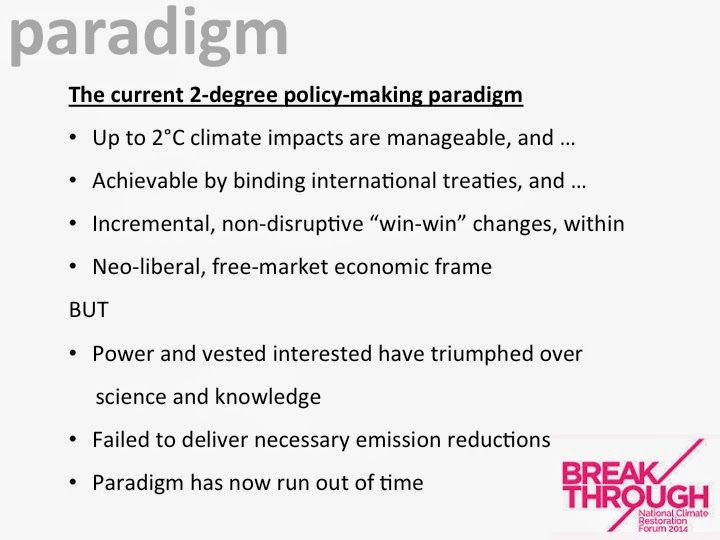
    The current policy-making paradigm has expired…

     We are conducting an experiment for which we do not know the result…

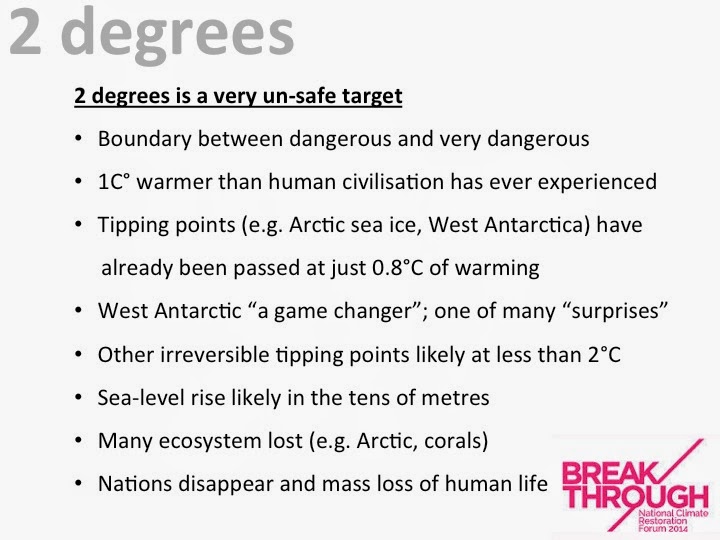
    2 degrees is a very unsafe target…

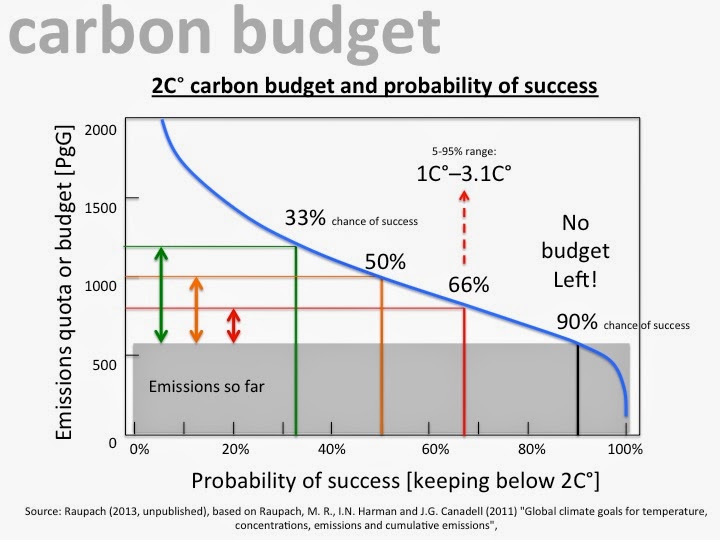
    For a low probability of failure the carbon budget has expired…

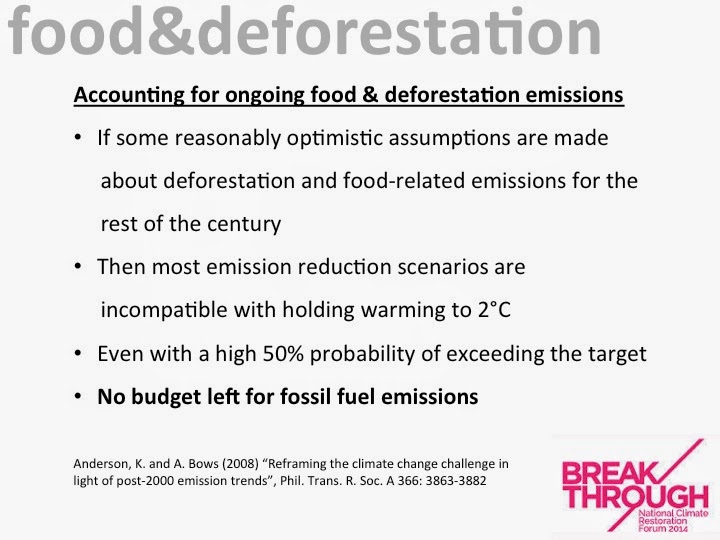
    Accounting for ongoing food and deforestation emissions, there is no carbon budget left for fossil fuels, even with a high likelihood of exceeding the target…

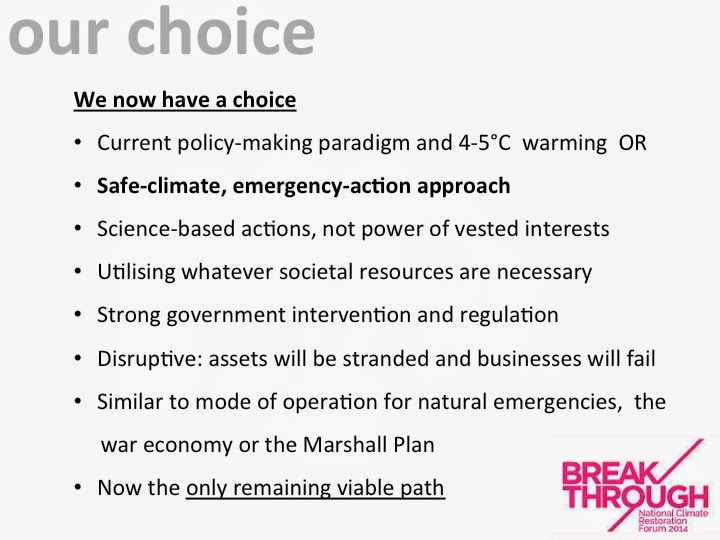
    Our real choice, now…

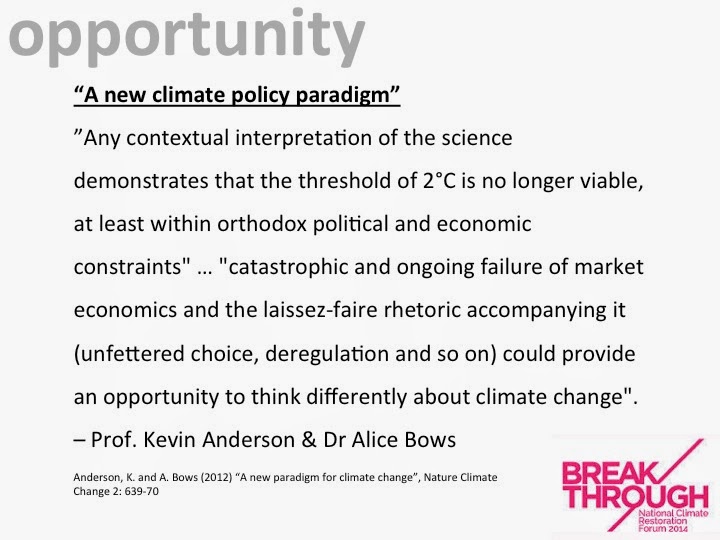
    A new climate policy paradigm…


    Watch the full presentation…
    No carbon left to burn (audio + slides, 17 minutes)

    LISTEN
    Listen to David’s carbon budget interview on Radio EcoShock
    RELATED POST
    The real budgetary emergency and the myth of “burnable carbon”

    RELATED POST
    Carbon budgets, climate sensitivity and the myth of “burnable carbon”