Category: Uncategorized

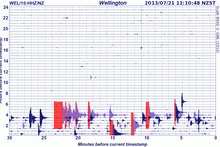
  • Swarm of earthquakes rattle central NZ

    (UPDATED TO 6.9 )

    Swarm of earthquakes rattle central NZ

    By Matthew Theunissen , Teuila Fuatai

    Send your quake related stories, photos or video to newsdesk@nzherald.co.nz 

    A swarm of earthquakes has rattled central New Zealand today.

    Expand
    A swarm of earthquakes has rattled central New Zealand today.

    Wellington and the top of the South Island have been hit by a 6.5 magnitude quake this afternoon.

    The quake, which was centred 30km east of Seddon, the site of all the seismic activity in the last couple of days, was 11km deep.

    Experts say it is unlikely the swarm of earthquakes which rattled central New Zealand today signals “the big one” could be on the way, but people should still be prepared.

    At least 30 earthquakes have struck since 5am, the largest being a magnitude 5.8 in the Cook Strait between Wellington and Seddon at 7.17am.

    There have been seven earthquakes measuring above magnitude 4 since 5am. Most have been centred in the strait off Seddon but there have been quakes further south off Kaikoura and as far north as Wanganui.

    It is the second time in three days a severe quake has struck near Seddon – a magnitude 5.7 quake shook the region on Friday – prompting fears an even larger earthquake could be on the way.

    But GNS Science seismologist Anna Kaiser said earthquakes of this magnitude were not unusual in the region.

    ”… When we get one of these events there will be increased seismicity in the region and there’s always the possibility of a larger event but it’s unlikely,” she said.

    However, she said people should be prepared for a large earthquake striking at any time.

    Lea Hayward from Blenheim was in bed when the largest of today’s earthquakes occurred.

    “I actually felt three this morning and they were all reasonable shakes,” said

    “I think people are [apprehensive], and I’ve been like that myself – is the big one going to come? I do know a few friends who are going to get their emergency supplies updated, and I myself need to do that.”

    Seddon Supervalue owner Kevin Kamat said some items were bounced off the shelves.

    “It was certainly quite a big one and quite scary, sure. It lasted a wee while and there were quite a few aftershocks. It seemed quite a bit bigger than the one on Friday.”

    Stores around Wellington said while the quakes were unnerving, there was no major damage.

    Grandslam Liquor store staff member Robert Henry was surprised nothing was broken at the Brooklyn store.

    “It felt kind of bad, but nothing fell down, miraculously.”

    The quake forced the temporary closure of Wellington’s rail network this morning with services replaced by buses while the tracks were inspected, KiwiRail said.

    Train services on the Kapiti Line, Hutt Valley and Johnsonville had since resumed but closures remained in place between Wellington, Waikanae and Masterton.

    Wellington City Council spokesman Richard MacLean said there had been no reports of damage to infrastructure .

    “We did some building checks on Friday after the first big shake.”

    Larger buildings such as the Town Hall may be inspected tomorrow.

    “Because the shakes are not getting to a size where they are causing obvious damage, we are just taking things slowly,” he said.

    “If the magnitude increases, then obviously we’ll jump into action this afternoon.”

    Twitter was full of comments about the quake this morning.

    “Oh damn that was scary. Crouched in the doorway still shaking,” said Laura Vincent.

    Rochelle Iti wrote after a magnitude 4.9 aftershock: “Excuse me while I move to Australia before #Wellington becomes the new Christchurch”.

    Tobias Brockie: “my parents, who live in chch, have both texted me with concern at first and then scornful dismissal in the wake of that quake.”

    Journalist Barry Soper said the quake was “fair rocking”.

    “15 floors up when the quake struck: Heather, let’s watch from the balcony. Barry: Let’s stand under a door jam, oh so boring but safe!”

    APNZ

    By Matthew Theunissen Email Matthew, Teuila Fuatai Email Teuila

  • The Arctic Methane Monster Stirs

    The Arctic Methane Monster Stirs

    The Arctic Methane Monster Stirs: NASA’s CARVE Finds Plumes as Large as 150 Kilometers Across Amidst Year of Troubling Spikes

    In late June and early July, Barrow Alaska showed two methane readings in excess of 1975 parts per billion. Sadly, this most recent methane spike is likely not to be an outlier.

    The Barrow spike came in conjunction with a number of other anomalously high methane readings in the Arctic region during 2013. Most notably, the Kara, Barents and Norwegian Seas all showed atmospheric methane levels spiking to as high as 1935 parts per billion during the first half of 2013.

    Averages in this and other regions around the Arctic are at new record highs even as atmospheric methane levels continue inexorably upward. For reference, Mauna Loa shows average global atmospheric methane levels are now at around 1830 parts per billion. These levels were around 700 parts per billion at the start of the industrial revolution before they rocketed upward, roughly alongside increasing CO2 concentrations, as fossil fuel based industry saw its dramatic expansion over the past couple of centuries.

    Now, human global warming is beginning to unlock a monstrous store of methane in the Arctic. A source that, in the worst case, could be many times the volume of the initial human emission. To this point, areas around the Arctic are now showing local methane levels above 1950 parts per billion with an ever-increasing frequency. The issue is of great concern to scientists, a number of which from NASA are now involved in an investigative study to unearth how large and damaging this methane beast is likely to become.

  • Is the Season for Climate Change Denial Finally Over?

    Dan Lashof

    Director, NRDC’s climate center

    GET UPDATES FROM Dan Lashof

    Is the Season for Climate Change Denial Finally Over?

    Posted: 07/18/2013 8:06 am


    99
    74
    3
    338
    Get Green Newsletters:

    Three years after the National Academy of Sciences, a grouping of our country’s top scientists, declared “Climate change is occurring, is caused largely by human activities, and poses significant risks,” it’s hard to believe that there are still Senators who call climate change a “hoax.”

    One year after a prominent climate skeptic, Berkeley Professor Richard Muller, took an independent look at all the data and wrote an op-ed in the New York Times declaring that global warming is real, and that “Humans are almost entirely the cause,” it is surprising to see editorial boards that still deny there is anything to worry about.

    Six months after the United States experienced the hottest year in our history and the arctic ice pack shrunk to the smallest extent ever recorded, it confounds logic that some captains of the fossil fuel industry still insist that there is no evidence that climatic changes are occurring due to the use of their products.

    And just months after the amount of heat-trapping carbon dioxide in the atmosphere passed 400 parts per million, a concentration higher than ever before seen in human history, it defies understanding why the U.S. Congress refuses to take steps to protect our health and our communities from the threat of climate change.

    But because the deniers persist, it’s good news that Sen. Barbara Boxer (D, Cal.) has called together a collection of scientists and other experts Thursday to testify before the Senate Environment Committee at a hearing aptly titled, “Climate Change: It’s happening now.”

    Only in Washington would that be a controversial proposition — 97 percent of climate scientists acknowledge that climate change is caused by human activity and 65 percent of the American people say it’s a serious problem. Sen. Boxer’s group of climatologists, oceanographers, meteorologists and economists will outline the current state of climate science.

    This much we know: seven of our 10 warmest years in the U.S. have occurred since 1998, and globally the 15 hottest years on record have all occurred since 1997. The American West has been steadily drying over recent decades, and last year wildfires burned 9.3 million acres of forests and fields.
    We are already paying high costs for the consequences of our changing climate. Last year, crop losses due to record drought, damage from storms and floods, wildfires and other disasters aggravated by climate change caused $140 billion in damage in the U.S. alone. New York City says it will need to spend $20 billion to protect itself from rising sea levels caused by climate change and to fortify its defenses against a repeat of the devastating sea surge from Superstorm Sandy.

    The time for denial is long over. Now is the time for action. That’s why President Obama last month promised to tackle the United States’ largest single source of heat-trapping carbon dioxide, our 1,500 existing power plants. They account for 40 percent of our national carbon footprint, yet there has until now been no federal limit on the amount of carbon pollution they can emit.

    The administration can act without waiting for Congress to pass a new law because the Clean Air Act already gives the Environmental Protection Agency the ability and the responsibility to reduce this pollution. At the president’s request, the EPA, taking input from the states, industry, scientists and the public, will devise cost-effective regulations, a task it has done for many other pollutants over the decades, nearly always at a cost far less than opponents initially claimed.

    Predictably, opponents once again cried that the president was killing jobs and hurting the economy, without even knowing what approach the EPA will take and what the plan will look like.

    The Natural Resources Defense Council studied the issue and came up with a plan that tailors pollution limits to the energy mix of each state, and gives electric utilities the flexibility to hit their targets in the most cost effective way. By relying heavily on ending energy waste and improving energy efficiency, our plan would slash power plant carbon pollution by 26 percent at a cost of only one percent of industry revenues. An analysis by independent economic experts shows that it would create over 200,000 jobs and save families money on their electric bills.

    We are already paying a high price for failing to confront the climate change threat. The longer we delay taking action, the more these expenses will rise, and the more our children and our grandchildren will suffer the impacts.

  • Solar farm to be built on land that goes under water

    Solar farm to be built on land that goes under water

    Comments (18) »

    An artist impression of the solar farm planned for Valdora.
    An artist impression of the solar farm planned for Valdora.

    SUNSHINE Coast council plans to build a $24.2 million solar farm on land that goes almost a metre under water every two years, and more than two metres under in a maximum flood event.

    However, council officers have recommended the site because of its size, closeness to a 33kV power grid, availability and price.

    Sunshine Coast councillors have been advised choices that fit the criteria are limited.

    According to official records, the land on Yandina-Coolum Rd goes 2.36m under water in a maximum flood event, is affected by flooding to a depth of 0.79m every two years, and is subject to minor flooding every wet season.

    Maximum flood levels could rise to 3.02m over time due to sea level rises associated with climate change.

    Deputy mayor Chris Thompson confirmed yesterday that an option had been taken up on the site.

    The execution of that option would be dependent on the outcome of expressions of interest, to be advertised today, from companies interested in supplying material for the project, building and operating it.

    When council officers in 2011 approved what was then a commercial venture for the 50ha property on Yandina-Coolum Rd it was noted that the site was heavily constrained by flooding which would result at times in workers being trapped by floodwaters.

    Councillors voted unanimously on June 29, 2011, in favour of Energy Parks Australia Pty Ltd’s application for a material change of use on the site despite 54 submissions opposing the project which also received 43 submissions of support.

    The heavily conditioned approval required that all structures would have to be built on pads at least 2.5m high to maintain floodwater clearance.

    Detailed design work still has to be done as has soil testing to determine the degree and cost of foundations.

    Financial analysis done to date suggests savings of $9.4 million can be achieved over 30 years by the council owning a 10kw power source.

    However the project would be a draw on council cash reserves for the first 11 years with no significant return before 2033.

    An additional $10 million economic benefit has also been factored in.

    Despite those estimated benefits it is understood that several councillors were taken by the surprise by Mayor Mark Jamieson’s announcement of the council’s involvement in the project.

    A final vote on whether to go ahead has still to be made.

  • Capturing Energy from Ocean Currents

    Capturing Energy from Ocean Currents

    Engineering student wins $15,000 grant from EPA competition for his idea to build device to take advantage of energy of ocean currents

    By on July 19, 2013

    Share this article:

    • E-mail this page to a friend
    • Share this page on Facebook!
    • Publicly recommend on Google!
    • Add this page to LinkedIn!
    • Share on Twitter!
    • Print this page
    Raul Delga Delgadillo stands in front of a flow tank.Raul Delga Delgadillo stands in front of the flow tank he will use in his research.

    RIVERSIDE, Calif. (www.ucr.edu) — A University of California, Riverside student recently learned he will receive a $15,000 grant from an EPA national sustainable design competition for his idea to capture energy from ocean currents.

    Raul Delga Delgadillo, who will be a senior this fall at the Bourns College of Engineering, plans to spend the upcoming school year building a small-scale turbine and buoy system and testing it in a flow tank to determine the best way to maximize energy extraction. He expects the system will provide as much energy as an average wind turbine.

    Delgadillo’s research comes shortly after the U.S. Department of Energy said wave and tidal energy, combined with other water-powered sources, could provide 15 percent of the United States’ electricity by 2030.

    “The ocean remains an untapped frontier as a renewable energy source,” Delgadillo said. “I’m hoping to change that.”

    Delgadillo, who grew up in Chula Vista, just south of San Diego, didn’t intend to go to college until he was encouraged to apply by friends during his senior year. At the time, he was living on his own, as his parents, who were divorced, had both moved to Texas for work.

    He was accepted and enrolled at UC Riverside in 2010 and decided to major in mechanical engineering because he had always been interested in how things work and he wanted to make stuff.

    The idea for the EPA P3: People, Prosperity and the Planet Student Design Competition for Sustainability entry came out of project for the Sustainable Product Design course taught by V. Sundararajan, an assistant professor of mechanical engineering.

    Delgadillo’s project proposes several innovative designs: the buoy, which will allow the device to move around until an optimum location is found, and the telescoping feature on the turbine, which allows it to vary in height and remain stationary if waves are present.

    Current proposals to harness energy from ocean currents require the turbine be anchored to the ocean floor using cables or rigid supports. This adds a significant cost, disrupts the environment because the ocean floor needs to excavated and limits the mobility of the turbine.

    Delgadillo expects several challenges, including varying flow rates from ocean currents due to seasonal fluctuations; the fact that depth and contours of ocean floors can affect ocean currents; and avoiding harming marine life.

    In the coming months, Delgadillo will perform experiments in a flow tank in the lab of Marco Princevac, an associate professor of mechanical engineering.

    He will then use the data he gathers to write a proposal for a second round of funding, for $90,000, from the EPA. He will find out in spring 2014 whether he receives that money, which would allow him to take the design to a real world application.

    Media Contact


    Tel: (951) 827-1287
    E-mail: sean.nealon@ucr.edu
    Twitter: seannealon

  • NASA Scientists Awakened by Potential Arctic Methane Release

    NASA Scientists Awakened by Potential Arctic Methane Release

    by on July 19, 2013 · 0 comments

    in Environment, Government, Politics

    climatechangeby Frank Thomas

    In my February 2013 writing, “Arctic Methane Release is a Near Term Potential Global Environment Disaster in the Making,” I tried my amateur best to alert people to the breakneck pace at which we are altering the Arctic permafrost environment by anthropogenic global warming (heat from the Earth’s surface) and its feedbacks … including melting of the Arctic sea ice, thus enabling more Arctic Ocean seawater to absorb – rather than reflect – solar energy.

    This in turn intensifies the ocean warming and melting of permafrost top soils under which a HUGE amount of carbon lurks.

    The ticking time bomb from this process is the release of potential massive amounts of the ultra-toxic, heat-trapping methane gas (CH4) into the atmosphere. In fact, CH4 levels in the lower atmosphere over Arctic regions are already showing alarming new elevations.

    In 2012, Dr. Semiletov reported plumes over the Siberian continental shelf up to 1 kilometer in diameter spewing CH4 into the atmosphere. Now that the Arctic permafrost is in a relatively rapid process of melting, the danger is that it will continue melting, resulting in an uncontrollable release of larger volumes of CH4 … and an irreversible tipping point. This would have a catastrophic global warming effect in combination with what fossil fuels are already contributing!

    globalwarming6When calculating 100-year global warming potential (GWP) figures, the Goddard Institute for Space Studies reports that, when aerosol-cloud interactions are included, the GWP of CH4 is 30-40% greater than scientists had previously thought.

    On a 100-year timescale, this means that 1 ton of CH4 has a 22 times more potent effect on the climate than 1 ton of C02 … and a 105 times more potent effect on the climate than C02 on a 22-year timescale.

    Much to my surprise, a NASA science team has recently come to the same conclusions that other Arctic scientists have reached (and noted in my prior writing on this earth threat) concerning the huge amounts of carbon trapped in the Arctic permafrost. In NASA’s words,

    “Is a Sleeping Climate Giant Stirring in the Arctic?” ….

    “Over hundreds of millennia, Arctic permafrost soils have accumulated vast stores of organic carbon – an estimated 1,400 to 1,850 petagrams (or 1,400 to 1,850 billion metric tons). That’s about half of all the estimated organic carbon stored in Earth’s soils. In comparison, about 350 petagrams (or 350 billion metric tons) of carbon have been emitted from all fossil-fuel combustion and human activities since 1850….

    As heat from the Earth’s surface penetrates into permafrost, it threatens to mobilize these organic carbon reservoirs and release them into the atmosphere as carbon dioxide and methane, upsetting the Arctic’s carbon balance and greatly exacerbating global warming….

    “Permafrost soils are warming even faster than Arctic air temperatures – as much as 2.7 to 4.5 degrees Fahrenheit (1.5 to 2.5 degrees Celsius) in just the past 30 years. (Above are words from NASA’s report and Charles Miller representing NASA’s Jet Propulsion Laboratory).

    globalwarming11Here we are today with C02 concentrations near 400 ppm and hoping we can contain this level to no more than a stabilized 450 ppm or a 2 degree Celsius increase by 2050. A rise to 500 ppm or 600 ppm would be a warming up of at least 3.5 to 4.0 degrees Celsius. This may seem small, but it would create Earth conditions not witnessed in millions of years!

    The UK Royal Society’s series on a 4 degree Celsius world concluded that a 3 degree Celsius warming entails a real risk of simply continuing on to a 4 degree Celsius warming if carbon-cycle feedbacks are strong (and the evidence suggests they are).

    At a 4 degree Celsius warming, the Royal Society’s series concluded that “The ecosystem services upon which human livelihoods depend would not be preserved.”

    What’s happening in the Arctic from the continuing rise in global C02 emissions and earth’s warming is downplayed by the media under pressure from their advertisers, lied about by the climate denial community and special interests and is purposely suppressed or not let on to the public by government agencies for fear it will create too much anxiety and strife.

    globalwarming2Result? Tentativeness or outright inaction! No multi-faceted aggressive, fast-track actions to transform at least 80% to a green energy environment by 2050.

    This is in sharp contrast to what California, Germany and Denmark are doing on schedule with federal-state-local energy programs that prioritize Conservation, Elimination of Coal, Phase Out of Nuclear Plants and Conversion to Alternate Energy Solar and Wind energy sources over the next 40 years – with a transition reliance on gas/oil as a bridge until 80% independence from fossils is achieved by 2050.

    Conclusion? Unless we unite fast on this planetary environmental threat , fossil fuels will win the short-term battle and we humans will lose our stable and friendly climate.

    by Frank Thomas, writing from The Netherlands