Category: Uncategorized

  • Controlling Climate Change: IEA Says It’s Not All About Carbon Dioxide

    Controlling Climate Change: IEA Says It’s Not All About Carbon Dioxide

    Like it?

    11
    Posted July 13, 2013
    5
    20
    2
    27

    World Temp Problems

    The International Energy Agency (IEA) has released a World Energy Outlook Special Report warning the world that current climate change policies are on track to far exceed the goal of limiting temperature rise to 2°C.  The special report, “Redrawing the Energy Climate Map,” released in June is a warning to the world that we should expect increasing severe weather, heat waves, and sea level rise as our climate is already showing the signs of increased greenhouse gases in the atmosphere.  The IEA’s outlook for climate change under currently implemented policies around the world is dismal, but even so, the agency asserts that it is still possible for the world to meet its 2°C goal, but it will take drastic action and international cooperation.

    The energy sector is particularly featured in the new report because it accounts for the majority of global greenhouse gas (GHG) emissions.  “Despite positive developments in some countries, global energy-related CO2 emissions increased by 1.4% to reach 31.6 gigatonnes (Gt) in 2012, a historic high,” the report states.  The IEA is pointing out that while emission reduction in countries such as the US are a positive step, there is little impact globally unless there is cooperation among more industrialized and developing countries.

    But all may not be lost.

    The IEA outlines four energy policies that can still give the world a chance at keeping global temperature rise at the 2°C target limit.  The list includes the reduction of methane emissions from the “upstream oil and gas industry.”  Natural gas, or methane, is the cleanest burning fossil fuel on the planet, but in its pure state methane is a powerful GHG that impacts the climate at several times the power of an equal amount of carbon dioxide (CO2).

    Methane is released into the atmosphere in the process of producing oil and natural gas.  The IEA reports that about 1.1 Gt (CO2 equivalent) of methane gas were released in 2010, and these emissions were related to the oil and gas industry.   Eliminating methane releases from venting and flaring natural gas during production would be an effective method of reducing greenhouse gases alongside CO2 reduction policies.  The EIA estimates that if methane emissions are minimized using currently available (and relatively inexpensive) technology, they could be cut in half by 2020.

    The report also lists reducing coal-fired power plants, increasing energy efficiency, and phasing out fossil fuel consumption as key factors that could allow the world to reach its 2°C goal.  But, with natural gas increasing in use as a lower pollution fuel (when burned) than coal or oil, it is clear that emissions must be slashed considerably during production in order to ensure it is, in fact, a cleaner fuel choice.  Curbing methane emissions would only account for about 18% of GHG reduction in the IEA’s scenario, but it is an important 18% to reduce.

    The methane that seeps into the atmosphere during upstream oil and gas production is natural gas that could be better used as fuel for industry and energy.  Tighter restriction on methane leakage is a critical component of responsible and sustainable development; especially as we continually develop energy resources.   The IEA warns in its new report of severe consequences related to climate change, and it will take drastic action to avoid such consequences.  Ensuring methane stays out of our atmosphere and in our fuel supply is one action that can help keep the world on track for climate change goals, and ensure less of our natural gas is needlessly lost.

    Photo Credit: World Temp Target/shutterstock

  • Jet stream

    July 12, 2013 10:21 am You are here:Home NEWS Jet stream
    2

    Jet stream

    Posted by on June 11, 2013

    Global Warming Web

    Jet stream

    Jet stream


    Jet stream is a band of high-velocity atmospheric current that encircles the Earth. This band of strong winds is typically found in the upper troposphere and lower stratosphere. In both the Northern and the Southern Hemisphere, there are two distinctive jet streams: one is located just outside the tropical latitudes, in the subtropics; the other is located at the boundary of the midlatitudes and the polar region. In these latitudes, the jet-stream winds are westerlies, blowing from west to east. The two jet streams are named, respectively, “the subtropical jet” and “the polar jet.” These jets shift locations seasonally.


    The rotation of the Earth around its own axis causes the air that surrounds the Earth to move as a result of the drag exerted by the Earth’s solid surface. This movement of air is called “wind.” Wind can blow in any direction, even though the Earth rotates from west to east. Two of the major forces in the atmosphere that determine wind direction are the pressure gradient force and the Coriolis effect. Because of differential solar heating between the tropics and a polar region, there is a strong tendency of the atmosphere to move outward from the warmer equator to the colder poles, distributing heat. Jet stream this tendency would cause winds to blow in the north-south directions in the Northern and Southern Hemispheres at different altitudes.


    Owing to the Earth’s rotation, these two major north-south circulations break up, forming several smaller cells of circulation. These smaller cells include the Hadley circulation, the Ferrel circulation, and the polar circulation, listing them from the equator to the poles in each hemisphere. At upper atmospheric levels, when air travels to the north in the Northern Hemisphere, the Coriolis effect turns this airstream to its right, turning a southerly wind into a westerly wind. Furthermore, because the Coriolis effect becomes stronger as air travels further north and the effect of Earth’s surface drag is smaller at upper atmospheric levels, these westerly winds become very strong. As a result, jet streams form outside of the tropics, toward high latitudes, at upper atmospheric levels.

  • July 14 transcript: Turnbull on the NBN

    July 14 transcript: Turnbull on the NBN
    PUBLISHED: 0 hour 20 MINUTES AGO | UPDATE: 0 hour 20 MINUTES AGO
    Share Links: email

    inShare
    submit submit to reddit

    print -font +font
    Reprints & permissions

    Deborah Knight: But first there are fresh revelations this morning on the campaign of the borad of the National Broadband Network to save director’s jobs, we can reveal that NBN co-chairman Siobhan McKenna has met with senior Canberra bureaucrats outside the communications sector to emphasise her own credentials and to try and cement her position ahead of the federal election.

    The NBN has also confirmed it has hired powerful lobby group Bespoke Approach to try to secure the support of coalition MPs.

    In a moment we will speak with shadow minister for communications Malcolm Turnbull but first a look at the NBN’s troubled legacy.

    Deborah Knight: And joining us this morning shadow minister for communications Malcolm Turnbull and Tony Boyd, Chanticleer columnist for the Fin Review, good morning to you both.

    Malcolm Turnbull you’ve been highly critical of NBN co and its board and they’re obviously expecting the worst under a coalition government. Who’s next to go, will Siobhan McKenna, will her head go under a coalition government?

    Malcolm Turnbull: Well we’re not making any comments about personalities.

    The only observation I’ve made is that it is remarkable that such a large board doesn’t have anyone with hands-on experience in building a telecommunications network or running one and if you were assembling a board, for a project of this kind, that’s the sort of experience you would want to have on it.

    So people can draw their own conclusions from that but I don’t want to make any personal observations about the prospects of one director or another in the event the coalition wins government.

    Deborah Knight: They’re obviously fearful of their positions though if they’re hiring a private lobby group, Bespoke, to be involved to try to secure their positions.

    Malcolm Turnbull: It raises a lot of questions. Bespoke is a very good firm, my old colleague Alexander Downer is one of the principals and I’ve got great respect for him so I make no criticism of Bespoke, they’re very capable.

    But you have to ask yourself why is the board, the chairman and the board, hiring a lobbying group to promote the qualities of the board – not the senior management? Apparently Mr Quigley knew nothing about this by the way. So this has been done by the chairman and the board and directors should only be spending the company’s money in good faith and in the best interest of the company.

    Now the question that Siobhan McKenna and the directors have to answer is whether this investment in Bespoke, to go out and lobby for the – promote the virtues and talents and accomplishments of the directors as distinct from the company, whether that is really rather more in the directors interest than it is in the interest of the company as a whole.

    And there’s been a lot of case law about this and I have to say as now pretty much a bush lawyer, I think it’s very questionable whether that should be an expense borne by the company. Maybe something the directors want to do, I struggle to see why it’s in the company’s interests.

    Tony Boyd: I wonder if we could ask Malcolm, do you think that the appointment of the new CEO should happen after the election because there’s actually the possibility that they might replace this person before there’s potentially a change of government.

    Malcolm Turnbull: Well I think it would be remarkable if they did that. The election is either 6 weeks or 12 weeks away, it’s not very far away. I don’t think you would find people of real quality that would be prepared to take the job up.

    Deborah Knight: Who would you recommend? Ziggy Switkowski, is he your top pick?

    Malcolm Turnbull: Well Ziggy Switkowski is a very capable telecomm executive, he’s more at this stage in his career in the non-executive director role, he’s chairman of Suncorp and other companies. He’s hugely capable person and very familiar with government business enterprises.

    But again, I don’t want to comment on- I mean, Ziggy Switkowski is the sort of person that should have been on the board frankly but I don’t want to comment on… I know the Fin Review has a lot of speculation about who might be the new CEO, I’ll leave that to you guys, to run the odds on that.

    Deborah Knight: Well so much for politics being kinder and gentler the Liberals have launched major attack ads this morning against Kevin Rudd.

    Advertisement: Last time Kevin Rudd was Prime Minister he left behind a trail of disaster. Kevin Rudd was borrowing $100 million every day and now we have a $254 billion debt. He wasted up to…

    Deborah Knight: You are spooked by Kevin Rudd aren’t you? And rightly so with the opinion polls it looks like Tony Abbott and the coalition, the Liberals are flat footed on this one.

    Malcolm Turnbull: That’s not right. All that ad is doing is reminding people of Kevin Rudd’s record.

    I mean Kevin is trying to persuade people that he is just sort of reappeared on the scene and all of the disasters of his first term as Prime Minister are in the far distant past.

    The failures of the Rudd-Gillard governments were either directly at the hands of Kevin Rudd or were policies – such as the NBN – that were mismanaged and misconceived by Kevin Rudd.

    If Kevin Rudd at the outset had done a proper cost benefit analysis – as he promised he would – and analysed all of the options for ensuring all Australians had very fast broadband, analysed the costs and benefits of different technologies, if he’d done that homework we wouldn’t be in the mess we are at the moment.

    Tony Boyd: But he has come out today through one of the Sunday newspapers and said that he’s going to scrap the carbon tax, obviously that leaves a big hole in the opposition’s budget for you as well.

    Malcolm Turnbull: Well it doesn’t leave a hole in our budget, because our policy as you know is to abolish the whole Emissions Trading Scheme and including the fixed price…

    Deborah Knight: But it leaves a hole in your attack on Labor going into the election doesn’t it?

    Malcolm Turnbull: Well I don’t think so. What he’s proposing to do is to terminate the fixed price period 1 year earlier and that will leave a $4.5 billion hole in his budget but there will still be in effect a tax on carbon.

    The term carbon tax is used in two senses; it’s sometimes used in a more technical sense to distinguish between a fixed price on carbon and a floating price that you get from an Emissions Trading Scheme.

    So people might say I prefer a carbon tax ie. a fixed price as opposed to an ETS or vice versa but overall whether the price is – if you’re paying $25/tonne for a permit on a floating scheme of $25/tonne as a carbon tax it’s still 25 bucks so it’s still so overall, you can generically, general sense describe all of these mechanisms as a carbon tax.

    Deborah Knight: On the issue of leadership, you personally are twice more popular if the opinion polls are to be believed than Tony Abbott.

    When we told people we had you coming on the show a lot of people were saying Malcolm we love Malcolm! Are you still singing from the same songbook as Kevin Rudd was prior to being reinstated as Prime Minister, saying he had not ambitions for the leadership, can you categorically rule out having no ambitions for the leadership.

    Malcolm Turnbull: Well let me just say there’s a big difference between me and Kevin, many differences I might add.

    Deborah Knight: Similarities though, you’re both quite popular among voters.

    Malcolm Turnbull: One of the biggest differences is that yes, I lost the leadership and Tony Abbott became the leader of the opposition. I have worked diligently as a member of the team and we are a team – that’s a big difference between our show and Labor’s. Labors is a personality cult, it’s going to be all about Kevin, our project is all about our team.

    Deborah Knight: Will you rule out a tilt?

    Malcolm Turnbull: Of course! There’s not going to be any change in our leadership, that’s not going to happen but the big difference is that I am part of that team. And look Deborah, I know there are a lot of people out there who would rather I was leader of the Liberal party – it’s ridiculous to deny that or pretend that’s not happening.

    But the message I have for them is this: we are a team. If they think I am a person of capability and quality and so forth, they should be comforted by the fact that I am part of that team in a senior leadership position.

    Tony Abbott is not going to be elected – if he is elected – as a president or a dictator. He is first among equals, we will have a conventional, traditional, cabinet government.

    So if you’re a Malcolm Turnbull fan rather than a Tony Abbott fan, you may prefer Malcolm as I was in the top job rather than Tony but I will be at the top table. And so I say to those people who support me: vote coalition, vote for the team of which I am part, of which Tony Abbott is leader, which Julie Bishop is part, Joe Hockey and a very fine group of people who work together with stability, coherence and consistency for three years, as opposed to the rabble we’ve seen from Labor.

    Tony Boyd: But should investors be worried when you’re communications minister in the sense that contracts with Telstra – the $11 billion deal with the NBN, that could well be turned on its head – there’s other contracts with publically listed companies, should people be concerned with you as communications minister?

    Malcolm Turnbull: Well I think most people in business will be relieved because I do have a background in business and I understand the importance of contracts.

    We’ve made it very clear that Telstra shareholders will be kept whole, so they have nothing to fear from a change of government.

    As far as contracts with contractors are concerned, well the problems are actually not with anything we might do, the problems are that the contractors are losing a fortune, you know Silcar has been very o

  • A sober assessment of our situation (2)

    7 July 2012

    A sober assessment of our situation (2)

    by David Spratt

    The first part in this series described some characteristics of the climate debate and the climate action advocacy movement in Australia.

    2. How we got to here  [Part 2 in a series of 3]

    2.1 Climate in the media

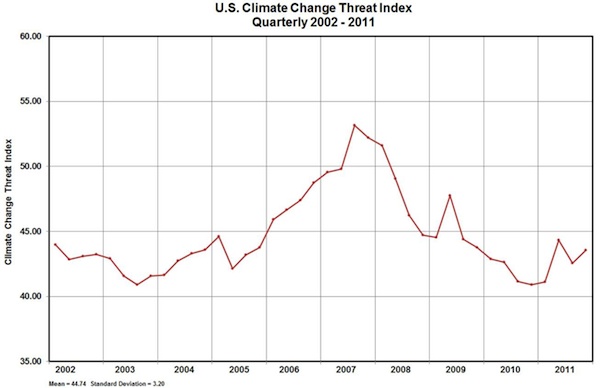
    In the USA (and Australia too), concern about climate change (as measured by the climate change threat index – see chart below) peaked around 2007.  Research studies find that media coverage of climate change directly affects public concern levels, and that the actions of political elites turn out to be the most powerful driver of public concern. Concern in the USA was at its heightat the time of media focus on the IPCC’s 2007 fourth assessment reports and Al Gore’s “The Inconvenient Truth”.

    The Climate Change Threat Index aggregates data from 6 different polling organizations gauging how much people worry about global warming

    As partisan and ideological divides kicked in, concern fell and opinion became more polarised. Now in the US, public understanding of climate is on the rebound despite the deniers’ assault, with Americans attributing their increased belief in global warming to their (correct) perception that the planet is warming and the weather is getting more extreme. The extreme heat wave and wildfires in the US in spring and early summer July 2012 have further contributed to the rebound. And a new poll finds that most Americans say they believe temperatures around the world are going up and that weather patterns have become more unstable in the past few years.
    But the rise of the climate denial sector in breaking down political bipartisanship and creating confusion cannot be underestimated in derailing legislation and reducing public concern about climate harm.
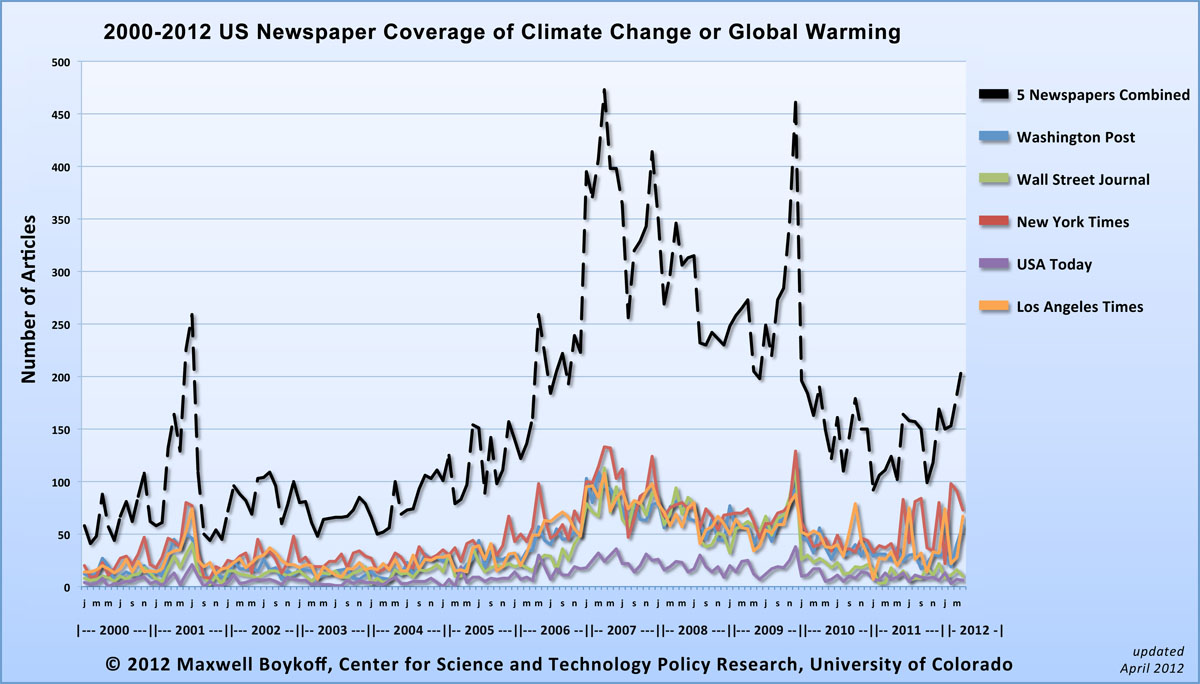
    The media’s role is graphically illustrated in the case of the USA (see chart below). There was a second spike in 2009 in the lead up to COP15 in December, but after that it continued to drop. That case was reinforced in the minds of Australia’s media editors and producers when Rudd backflipped in early 2010 and Labor took climate off the agenda.  The deniers and their collaborators in the media did the rest. Due mainly to the efforts of News Limited and a spray of right-wing radio presenters, the deniers’ influence grew strongly just as Labor retreated on the issue. The see-saw tipped decisively. From 2010 onwards numerous journalists and reporters said that the climate issue had been downgraded in priority by management.

    US newspaper coverage of climate change or global warming 2000-2012

    The bright-siding of climate advocacy by the Australian government, eNGOs and some community campaigns – talking about clean energy and jobs and not talking about climate impacts – meant that for these organisations the story of climate science and impacts was simply off the agenda, and hence also for electors. This was an unfortunate positive feedback loop that reinforced in the media’s and the public’s mind the notion that the climate threat had diminished.  It remains the most spectacular own goal in recent years (which is belatedly being recognised in some circles), though the effort of the Say Yes campaign in 2011 in giving an exclusive drop on the “Cate Blanchett” TV ad to the Murdoch media runs a close second.
    As a consequence, the opportunities to “connect the dots” between climate extremes in 2009-2011 and global warming was almost completely over-looked by the climate movement and eNGOs in Australia. (How could it be that organisations with professional communications managers missed that one?) In the case of the Labor governments, not making the connection was deliberate.  A golden opportunity was lost.
    This contrasts sharply with the way many in the US climate movement, exemplified by Bill McKibben and 350.org, have utilised the increasing frequency and severity of extreme events to “connect the dots”. Even the inside-the-beltway Washington blog “The Hill” was able to report in July 2011:

    Record-breaking heat across the country and catastrophic wildfires in Colorado are giving environmentalists a rare opening to regain the political offensive on climate change… But it also represents a wider effort by activists to use this summer’s extremes as the basis for calls for action on climate change. For the green movement, the wild weather is a chance to show that oppressive heat and dangerous storms — and maybe even big winter snowstorms — are what experts believe nature has in store. “This is another sad chapter in connecting the dots, and there will be more chapters, unfortunately, and hopefully the story won’t get too much worse before we finally do something,” said Bill Snape of the Center for Biological Diversity. “We have to talk about it. This is, unfortunately, an opportunity to do that,” said Snape, the group’s senior counsel.

    In Australia, by comparison, most of the climate movement was asleep at the wheel when presented with similar opportunities.

    2.2 Labor’s vast political incompetence

    Labor in government could not have handled the issue more incompetently:

    • Rudd’s strategic decision to isolate the Greens and deal with the opposition on the CPRS in 2008-09 kicked back in his face with the defeat of Malcolm Turnbull as opposition leader, unleashing the denier Tony Abbott into the second-highest-media-profile job in the country.
    • A failure to act decisively. The sense of urgency was lost in 2008, according to Hugh Mackay, who says that the fall in public support is not due primarily to Gillard’s failures or even Rudd’s backflip. Mackay says the trend was evident by mid-2008, when the sense of expectation accompanying the change of government was deflated by inaction and low targets in the first six months of Rudd’s term, creating “a very critical vacuum” in which “people kind of shrugged and said well, it is not that serious after all … It was seen as much more about a talking game than an acting game … When we were not called upon to act, the opportunity was lost.”
    • Getting Copenhagen wrong. Despite the gathering evidence throughout 2009, Rudd and Wong bound their strategy to a good outcome at the Copenhagen climate meeting in December of that year, and when it all went belly-up they were devastated. And politically shot. Senior government figures thought they had a deal with Rudd to go to a double dissolution in early 2010 on the CPRS and before the worst of the Copenhagen fallout had rained down. But Rudd prevaricated and lost his nerve; then Gillard and Swan pushed him into a backflip on carbon pricing, and by June 2010 he was gone.
    • Two backflips in five months. Gillard went to the August 2010 with a climate policy fit only for comedians, promising no carbon tax but “cash for clunkers” and a 100-person national consultation. Weeks later, and needing The Greens’ and independent support to save her face and her government, she backflipped and set the Multi-Party Climate Change Committee in process. Given the nature of the coup against Rudd and the election result, Gillard’s credibility was half-shot before she started and her subsequent handling of the climate issue – evasive, dispassionate, disinterested, poorly commnunicated – did more damage to Labor’s credibility. And it probably also did damage to the case it was prosecuting: climate action.
    • Weakening the legislation. Now it seems inevitable that the NSW Right faction of the ALP is using a beat-up on The Greens as a proxy for destabilizing and removing prime minister Gillard and returning to deposed-PM Rudd, in a deal which may see Rudd and the Right agree to weaken the carbon legislation and drop the minimum price. Having bagged Rudd unmercifully in early 2012 as unfit to lead, the very people who threw him out in a coup and installed Gillard in 2010 in a catastrophic failure of political judgement are now intent on doing it again, but this time in reverse.
    • Strategic communications failure. In the report Brightsiding climate is a bad strategy, the catastrophic nature of Labor’s communications failure is discussed at length. It reached its logical conclusion when the 2012 advertising campaign in support of the climate legislation not only failed to provide a reason for acting (climate harm) but even failed to mention the reason for “compensation” the TV ads were about (the pollution tax). This will make a great textbook case study on how not to do it.

    2.3 It’s the … economy (stupid)

    It a country such as Australia, where net economic growth now is due largely to expansion of the mining industry, the power of the fossil fuel lobby is always on show: threatening; trashing proposed mining and carbon taxes; buying the media (literally) who are not sufficiently compliant; and funding delay-or-deny campaigns and industry organisations. Mining and energy ministers are rarely other than vassals rendering homage. Guy Pearce’s book High and Dry and his Quarterly Essay on Quarry Vision tell the story.  With the recurring threat of international financial disorder, and most of Australia’s non-mining economy treading water, political dependence on the mining industry cargo cult may increase, foolish though that will be.
    Australia has bound itself into the neo-conservative frame of a deregulated economy – via free-trade agreements, a lack of financial and currency control, productivity and efficiency frames, and adherence to “small government” policies – to the whims and contradictions of a global capitalist economy now staggering from one crisis to the next. Whether the bank big bang is about to go off is anybody’s guess, but the chances are increasing. Once the neo-conservative paradigm is accepted as the foundation of policy-making, many of the measures necessary to save us from extreme climate harm are simply off the agenda. In their own works, both Nicholas Stern and Ross Garnaut have recognised this contradiction, without overcoming it, saying consistently that what needs to be done from a scientific point of view would be too economically disruptive.  If it’s a choice between business-as-usual and an expanding fossil fuel industry, or acting to stop extreme climate harm, the former wins. We have witnessed this under the Howard, Rudd and Gillard governments. When courageous leadership was required, what we got was market tinkering.
    The “wisdom of the market” as embodied in the COAG Complementarity Principles developed in 2008 have become a reason for demolishing all non-price mechanisms for renewable energy, with the Productivity Commission, the major political parties and the economics commentariat all in furious agreement. Under this guise, both Labor and Liberal government have cut a wide range of energy efficiency and renewable energy programmes, including feed-in tariffs. Some are now lining up to trash the RET which, with the other cutbacks, would leave us worse off than before the carbon price was legislated.  That such programmes are complimentary to a carbon price is not recognised. Nor is the fact that emerging industries need well-rounded industry policy and assistance. Yet we face the prospect of a vibrant clean energy sector being abandoned by industry policy-makers, while ailing fossil-fuel-intensive industries like car-making and aluminium have their pockets stuffed with taxpayers’ money.
    No better example of leadership failure was the response to the Global Financial Crisis (GFC) in 2008. With few exceptions (South Korea being the most notable), most developed economies threw stimulatory spending at the problem with little or no integration with climate policy objectives.  The GFC response showed governments prepared to save the banks but not the planet. In its wake, climate and energy programmes (for example FiTs) have been cut in many countries as budget balancing and “austerity” become de rigeur. There is no doubt that the GFC contributed to the failure at Copenhagen in December 2009, but was not the cause.  The impact of the GFC  directly on government priorities — but also on citizen’s concerns about immediate economic security — cannot be under-estimated in contributing to the diminution of climate as a first-tier issue.
    In summary, as John Wiseman wrote in a recent Post-Carbon postcard,

    The primary barriers to the rapid acceleration of de-carbonization policies and programs are political rather than technological. The largest obstacles remain the influence of oil and coal interests working to protect their investments from being stranded as the tide turns in the direction of more renewable and sustainable energy supply options. At a time when clouds of economic uncertainty continue to hang over Europe, there is also an abiding danger of attention on climate change and other ecological challenges being overwhelmed by the more immediate threat of rolling financial crises.

    2.4 A moment’s reflection

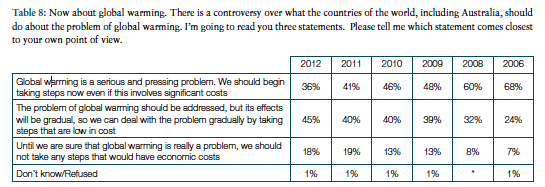
    Looking at all these factors, it’s not difficult to see (following Hugh Mackay’s analysis) that public support for action was at its height as Labor came to power in December 2007 and has been sliding ever since 2008, abetted by the denier and Murdoch media campaigns, the GFC and Labor’s incompetence.  A recent Lowry Institute poll reflects this view (below). Walking Against Warming was probably at is biggest and brightest in 2007-08. Commitments to carbon pricing and increasing the RET were made before Labor won power.

    The sun was shining brightly for urgent climate action in 2007-2008, when carbon pricing in Australia started its journey. By the time it was legislated in 2011, the light was fading. If that is the case, the climate and energy policies now legislated may have less to do with what eNGOS and the climate movement did in 2008–2011 that what happened in 2007 when Rudd in opposition appointed Garnaut, and what happened  after the hung parliament result in 2010. It was Garnaut who drive the process (with limited terms of reference) from 2007 onwards, with a quirk of history in 2010 thrown in. It was the Greens and the two independents who put climate back on the agenda and made the passage of the climate legislation possible.
    In retrospect, the 2009-2010 year takes on particular significance. As that period started, Australia was gripped by drought, citizens lived with water restrictions (and seemed to accept such utility rationing as fair and necessary), and unprecedented fires and record temperatures had left on indelible mark on most Victorians. Hopes were high that Ross Garnaut’s report would soon result in climate legislation passing parliament, whilst Copenhagen would represent a stepping-up of commitments.  But Copenhagen failed, Rudd’s linking of Australian legislative aspirations to it back-fired, and soon it was time for a new PM. By late 2010 the Australian story was of record rain and floods, and Cyclone Yasi. In just over a year, the story had flipped, just like Rudd and Labor.

    2.5 Climate campaigning

    It was clear after Copenhagen and Rudd’s backflip that the game had changed, but the big NGOs were slow to recognise it. If they had, they would have devoted significant resources to re-invigorating public concern through community education and organising (perhaps in the manner of Your Rights at Work), but they did not. A priority on operating inside the Canberra beltway and managing the media cycle continued to take precedence over spending serious resources in the field to build community support. Such activity received little or no assistance from the national eNGOs and their e-lists of contributors and supporters continued to be treated as money-and-tick-a-box fodder.
    There have been exceptions, such as GetUp’s efforts in organising locality-based meetings of supporters on climate in a pre-election period. It seems important to re-try this work more systematically with the larger eNGOs pitching in to help build, and support, existing local community campaigns, and providing sufficient resources to sustain the effort. On the other hand, GetUp’s efforts on the 5 June 2011 rallies were a great example of how not to do it.
    Australia’s climate action sector is diverse, ranging from big, national organisations with annual budgets in the tens of millions, through smaller and more nimble state and regional bodies and semi-professional advocacy campaigns, to completely voluntary locality-based community groups. Whilst it is hard to generalise, there has been inadequate talking and decision-making across the whole sector, even taking some serious differences into account. Certainly there has been no effective and continuing united front as has generally the case with big issues for the trade union movement, for example, or historically over a range of significant social and environmental campaigns.   As a consequence, strategies, priorities, campaign objectives and public messages have been inconsistent.
    There is a bit of a look-at-me, post-modernist sense to much of this: a scatter of groups with the “best” approach often talking past each other, with branding and corporate imperatives and marketing-driven bright-siding winning the battle over the need for a strategically sound, united approach. I don’t think I have ever witnessed an extended discussion amongst community climate groups on what to do about the parts of a city or large region where there are no community climate groups, and the development of a plan, tools and resources to address the problem: the part has taken precedence over the whole, in the sense that no organisations or unified structures take responsibility for the whole.
    The rise and dominance of professional, non-for-profit advocacy organisation creates a new structural challenge. With reliance on private and business donors and government funding, such groups often place communications specialists and marketeers above campaigners in the hierarchy, so all that is said and done builds a brand identity. It’s hard not to conclude that donor dependence, political allegiances and branding imperatives often triumph over good politics. When it comes to “united” action, there is a compelling reason for each eNGO to sell their view, with their CEO, to  their supporter base and the media, rather than the story as a whole. This is a systematic problem that bursts into spectacular damage on a number of occasions, such as the role of the Southern Cross Climate Coalition in 2009.
    The change we need is not going to happen to without mass civic participation and a people power’s movement for transformation. We must all help to build this, because it is fatuous to believe that government or business will take the initiative to confront and overturn the neo-liberal paradigm that condemns their politics to failure. It is here that the big advocacy groups such as ACF, WWF and Climate Institute are already facing a stark choice between a pollcy-first or power-first strategy. Should they primarily stay inside the Canberra beltway, do make-a-video-tick-a-box-send-an-email-give-us-money but fail to empower their membership and supporters or, on the other hand, put serious resources into supporting community organising, spend less time competing as brands in the climate advocacy supermarket, and share resources to help build mass civic participation?

    2.6 Dissonance

    Cognitive dissonance is growing because what needs to be done cannot be achieved in today’s neo-conservative capitalist economy. A rapid transition will required a great deal of planning, coordination and allocation of labour and skills, investment, and materials and resources, that can’t just be left to markets and pricing. There is a choice between two dystopias: some very significant social and economic disruptions now while we make the transition quickly, or a state of permanent and escalating disruption as the planet’s climate heads into territory where most people and most species will not survive. Our task now is to chart the “least-worst” outcome.
    So this will not be painless, and the mass of the population will need to actively understand and participate in some personally-disruptive measures, but they will do so because they have learned that the transition plans are both fair and necessary, and the other choice is unspeakable.  Paul Gilding addressed some of these issues in The Great Disruption, but few were prepared to continue the conversation.

  • Typhoon leaves two dead in Taiwan

    Typhoon leaves two dead in Taiwan

    Updated Sun Jul 14, 2013 12:45am AEST

    Typhoon Soulik battered Taiwan with torrential rain and powerful winds on Saturday that left two people dead and at least 100 injured.

    Roofs were ripped from homes, debris and fallen trees littered the streets, and some areas were submerged by flood waters.

    One town in central Taiwan reported “widespread” landslides and water levels a storey high.

    Around 8,000 people were evacuated from their homes before the typhoon struck, with hundreds of soldiers deployed to high-risk areas and the whole island declared an “alert zone” by the authorities.

    In the capital Taipei, a 50-year-old police officer died after being hit by bricks that came loose during the typhoon, the Central Emergency Operation Centre said.

    A 54-year-old woman from central Miaoli county died after falling from the roof of her home, the Centre added.

    In Taichung city, a man was missing after falling into a river.

    Some 104 people were reported injured, mostly by trees or flying debris, with the majority recorded in Taichung.

    Soulik made landfall on the northeast coast around 03:00 am Saturday local time, packing winds of up to 190 kilometres an hour, the Central Weather Bureau (CWB) said.

    Strong winds battered the island for much of the day but at 5:00 pm the CWB downgraded Soulik to a tropical storm and lifted the land warning as it churned towards mainland China.

    Nine people were rescued from flooded homes in the Shiangshan area of Puli, a town in central Nantou county, which was also hit by landslides.

    “The water came very fast, catching residents totally unprepared — in some areas, it was one-storey deep,” township official Wu Yuan-ming said.

    The nine were rescued by firefighters in rubber boats after the river broke its banks, Mr Wu said.

    “Flooding and landslides were widespread in the town, especially in the areas near mountains,” he added, calling the effects of the typhoon “more serious than we predicted”.

    Landslides reached the backyards of residents’ homes but they had already evacuated, Wu said, adding that the ground may have been loosened by an earthquake last month.

    A major landslide on a mountain road leading to Taian, a central town famous for its hot spring resorts, was also reported by local media.

    The northern village of Bailan saw the heaviest rain, measuring 900 millimetres over the past two days, with winds gusting up to 220 kilometres an hour.

    Streets were submerged under 30 centimetres of seawater in the port city of Keelung, the National Fire Agency said, with flooding also reported in the coastal area of Yilan and in New Taipei City, the area surrounding the capital.

    Low-lying houses along the Hsintien River through greater Taipei were flooded, including one aboriginal village from which residents had been evacuated Friday, a police officer said.

    Local television showed roofs ripped from homes in northern Keelung and in Taipei, where 120 kilometre-per-hour winds and downpours disrupted power, uprooted trees and left the streets strewn with rubbish.

    “I was very worried, I couldn’t sleep the whole night because the sound of the wind was so loud and my building was shaking almost like there was an earthquake,” Taipei resident Josephine Lin said.

    Across Taiwan, electricity supplies in nearly 800,000 homes were down but half had been restored by Saturday afternoon, according to the Taiwan Power Company.

    Around 170 flights into and out of Taiwan were cancelled or delayed, while offices and schools remained closed, with the public advised to stay indoors.

    Soulik hit China’s southeastern province of Fujian at about 4:00pm local time with winds of up to 118 kilometres an hour, the National Meteorological Centre said.

    More than 300,000 people were evacuated and 5,500 soldiers dispatched along China’s southeast coast to help with rescue efforts, state-run news agency Xinhua said.

    – AFP

  • Environmental groups welcome decision to halt drilling of 16 coal seam gas wells between Wollongong and Sydney

    Environmental groups welcome decision to halt drilling of 16 coal seam gas wells between Wollongong and Sydney

    Posted Sat Jul 13, 2013 1:15pm AEST

    Environmental groups have welcomed the NSW Planning and Assessment Commission’s decision to halt the drilling of over a dozen coal seam gas (CSG) wells.

    Apex Energy was granted approval four years ago to drill and operate 16 CSG wells between Wollongong and Sydney.

    The company wanted to extend its licence in the catchment for three years, but the commission rejected the application.

    The commission ruled it would be “inappropriate” to approve the coal seam gas activities, as many of the wells fall within the Sydney water catchment.

    Nature Conservation Council campaigns director Kate Smolski says community opposition played a significant role in the decision.

    “I think it’s important that the [commission] is actually listening to the concerns of the community, the people that live in these areas,” she said.

    Stop CSG spokeswoman Jess Moore says groups have been opposing the project since it was approved in 2009.

    “This is huge win for the campaign to stop CSG and protect our water,” she said in a statement.

    “It is the result of the extraordinary and tireless efforts of so many in the Illawarra community. It is the result of a powerful community campaign that has brought people together to stand up for what’s right.”

    Apex Energy has been unavailable for comment.

    Topics: oil-and-gas, industry, environment, mining-environmental-issues, lake-illawarra-2528, wollongong-2500, nsw