Category: Uncategorized

  • Daily update: Even if coal were free, it couldn’t compete with solar

    1 of 1
    Why this ad?
    Master of Public Healthtua.edu.au/Scholarships – Up to 30% Scholarships Available For 2014 Enrolment. Enquire Today!

    Daily update: Even if coal were free, it couldn’t compete with solar

    Inbox
    x

    Renew Economy editor@reneweconomy.com.au via mail205.atl21.rsgsv.net

    2:23 PM (18 minutes ago)

    to me
    Even if coal were free, it couldn’t compete with solar; Grattan calls for sweeping electricity tariff reform; Abbott attacked on all sides on carbon, fossil fuel subsidies; SA network operator blows away more wind energy myths; Newcastle’s $4.8b coal facility that should not be built; Myth of German de-industralisation; The emerging power of microgrids; China world’s largest solar PV market, and Australia’s cleantech beats main market.
    Is this email not displaying correctly?
    View it in your browser.
    RenewEconomy Daily News
    The Parkinson Report
    Even if coal fired power stations could generate electricity at zero cost, they could not compete with rooftop solar. The era of centralised, coal-fired power is over, and it’s time utilities turned to Plan B.
    Grattan Institute proposes sweeping reforms to limit network charges and eliminate cross subsidies to those using air conditioners.
    Abbott government accused of giving $15bln of subsidies to fossil fuels by removing carbon price, urged to embrace international permits.
    South Australian transmission network operator says state’s huge amount of wind energy has not required added spending, and has clearly reduced emissions.
    NSW government has approved a 4.8bn coal export facility in Newcastle, but analysis of market conditions suggest investors will reject the project.
    New figures from Deutsche Bank shows the Energiewende is failing to drive business out of Germany.
    After more than a century with little change, electricity infrastructure is being remade.
    China has surpassed Germany to take top spot as world’s largest solar PV market.
    Cleantech stocks, surprisingly, outperformed the main index in Australia this past year.
  • How new tech is spurring growth in recycling water

    Get the best of GreenBiz delivered to you — GreenBuzz e-news

    Blogs

    0
    inShare

    How new tech is spurring growth in recycling water

    Published June 26, 2014
    How new tech is spurring growth in recycling water

    This story originally appeared at Yale360 and is reprinted with permission.

    A ferry plows along San Francisco Bay, trailing a tail of churned up salt, sand and sludge and further fouling the already murky liquid that John Webley intends to turn into drinking water. But Webley, CEO of a Bay Area start-up working on a new, energy-skimping desalination system, isn’t perturbed.

    “Look at the color of this intake,” he says, pointing to a tube feeding brown fluid into a device the size of a home furnace. There, through a process called forward osmosis, a novel solution the company developed pulls water molecules across a membrane, leaving salt and impurities behind. When low temperature heat is applied, the bioengineered solution separates out like oil, allowing clean water to be siphoned off.

    This method uses less than a quarter of the electricity needed for standard desalination, making it easier for the technology to run on renewable power, said Webley. His company, Trevi Systems, recently won an international low-energy desalination competition and is building a pilot solar plant to desalinate seawater in the United Arab Emirates.

    With world water demands rising and extreme droughts like the one now gripping California expected to grow more frequent and widespread as the climate warms, drawing fresh water from oceans and other salty sources will be increasingly important.

    “Eventually, we’ll have to develop new sources of water,” said David Sedlak, a University of California-Berkeley professor of civil and environmental engineering and author of “Water 4.0: The Past, Present and Future of the World’s Most Vital Resource.” Desalination, along with wastewater recycling and capturing and storing rainwater, will be “three main pillars,” he said, to replace “water supplies that are going to become less reliable and less available in the future.”

    However, desalination is expensive, energy-intensive and can damage marine ecosystems. Moreover, while seawater accounts for 60 percent of desalinated water today, Sedlak and others say it’s much more practical and sustainable to desalinate less-salty brackish water and use the technology to recycle wastewater. So companies around the world are working on new technologies that cut desalination costs, reduce environmental impacts and broaden its applications.

    In addition to removing salt from seawater, technologies such as Trevi’s also can economically cleanse brackish groundwater, industrial effluent and other forms of liquid waste. That includes desalinating sewer water to recharge groundwater aquifers, which it will soon begin doing for a large urban water district in Southern California.

    “That’s what’s particularly interesting to us — we can run on really, really dirty water,” Webley said. “Where you really should start with this whole thing is, let’s squeeze everything we can out of re-use and then start talking about other options.”

    More than 17,000 desalination plants are operating in 150 countries worldwide, a capacity that could nearly double by 2020, according to the United Nations World Water Development Report 2014. Desalination produces 21 billion gallons of water a day, according to the International Desalination Association, providing a crucial water source in arid places such as the Middle East and Australia. Major new desalination facilities are in the works in China, Chile and elsewhere.

    However, the current standard technology, reverse osmosis — in which high-pressure pumps force water through semi-permeable membranes to exclude salt and impurities — uses large amounts of energy and has an outsized impact on the environment. These effects include damage to aquatic ecosystems, such as sucking in fish eggs with its intake water; using harsh chemicals to clean membranes and releasing large volumes of highly salty liquid brine back into the water. Costs vary, but the lowest price for desalinated seawater from a reverse osmosis plant is around $750 an acre-foot (325,851 gallons) — more than double the average cost of groundwater.

    Engineers and entrepreneurs across the globe are now trying to devise greener desalination. Some are inventing new alternatives to traditional reverse osmosis. Among them: Israel, whose own dependence on desalinated water has made it a world leader in the process, has come out with several state-of-the-art technologies, including a novel “semi-batch” reverse osmosis process developed by Desalitech that shrinks energy and brine, and a chemical-free “plant in a box,” produced by IDE Technologies; and Memsys, of Singapore and Germany, is working on hybrid-thermal membrane technology that is energy-efficient enough to run on solar power.California, currently facing drought, is also leading the way in innovative desalination technology. Credit: nvelichko via Shutterstock

    In the U.S., water-strapped California leads in both innovations and needs. The largest seawater desalination plant in the Western Hemisphere, a $1 billion state-of-the-art reverse osmosis facility being built near San Diego, is set to begin producing 54 million gallons a day — supplying water to 300,000 residents — in early 2016. At least 15 other desalination plants on the West Coast are in some stage of planning, and some small ones are already operating.

    But residents’ concerns about the expense and environmental impacts like chemical use and brine disposal problems have slowed down and even halted some recent projects.

    “Desalination is a really a hot button issue in California — a lot of people oppose it,” said Aaron Mandell, co-founder and chairman of Water FX.

    Mandell hopes to quell those concerns with his company’s new process using large parabolic mirrors to collect and concentrate the sun’s energy. Inside this solar still, pure water evaporates, while solids remain behind. The system is being tested by a water district in California’s agricultural Central Valley, cleaning irrigation runoff tainted with salts leached from the soil. The demonstration is producing about 14,000 gallons of fresh water a day — a welcome boon to local farmers who received no water from federal allotments this year. The company plans to expand and boost production to 2 million gallons a day early next year.

    Mandell points out that his salt byproduct is dry and can be mined for useful chemicals, rather than winding up with hazardous brine that’s costly to discard. What’s more, water districts and farms otherwise have to fallow land and lose income to dispose of the brackish effluent now being recycled into new water for crops.

    “We saw the opportunity to take something that was costing quite a lot of money as a waste product and turn it into something of value,” he said. “In essence, we are tackling both sides of the water problem … disposal and re-use.

    “One of our biggest challenges is that we are dealing with a lot of agricultural businesses that still sort of pray for rain. A lot of farmers do really rely on these seasonal water cycles. So getting people to think differently about climate change rather than just seasonal drought is definitely a challenge.”

    Researchers at Lawrence Livermore National Laboratory and Stanford University are working on a new desalinating method using porous carbon aerogel electrodes. The system, which they call flow-through electrode capacitive desalination, or FTE-CD, removes salt electrically. Although still in the early stages, its developers say the technique requires little equipment or energy, and the system could be scaled to fit any need: from portable personal devices to city water treatment.

    “In places like California, where there is brackish groundwater in large volumes, FTE-CD can provide potable water at a potentially much lower cost than sea water desalination could achieve,” said co-developer Michael Stadermann, a physical chemist at Lawrence Livermore. “For desalinating brackish water, we predict that this method could be up to five times more energy efficient than reverse osmosis.”

    One of the hottest new technologies on the bench in laboratories in the U.K., Saudi Arabia and South Korea and elsewhere is one-atom thick, perforated graphene membranes that can cut reverse osmosis desalination to a fraction of its current cost. Developed at the Massachusetts Institute of Technology, the membrane’s pores can be tuned to optimize permeability. The hang-up for now is how to mass-produce the material.

    For urban water needs, even those working on alternative methods say reverse osmosis (RO) likely will remain the top choice for the foreseeable future.

    “You can talk about some of the other technologies, and I work on some of them,” said Menachem Elimelech, professor of environmental and chemical engineering at Yale University and director of Yale’s Environmental Engineering Program, “but if you need to produce water for the drinking water supply, I still think RO is the gold standard.”

    Reverse osmosis has become much more energy-efficient in recent years, and is now near its maximum, Elimelech said. Still, he and others are trying to make further gains by improving membranes. One of the biggest problems is fouling — biofilms that grow on membranes over time, making pumps work harder to force water through. Elimelech is working with nanotechnology to make bacteria-resistant membranes.

    New methods for recycling energy also cut the electricity needed to pump water through membranes. Manufacturer Energy Recovery Inc. estimates that its piston-like pressure exchangers being installed in the new San Diego-area reverse osmosis plant will save 115 kilowatt hours of electricity annually — equivalent to keeping more than 45,000 tons of climate-warming carbon dioxide out of the air.

    Even so, desalinated water produced by the new plant will cost the San Diego County water district around $2,000 an acre-foot — twice as much as it currently pays for freshwater shipped in from the Colorado River and San Joaquin River Delta. Those sources, however, are over-tapped and growing increasingly unreliable, leaving residents of a county with scarce water resources to feel they have few other options.

    Much of the world someday may feel that same pinch, making drought-proof water supplies priceless in a parched future. But for now, many experts say, while emerging technology is making desalination ever more viable, the economic and environmental costs are still too high.

    “There are technologies available to minimize and in some cases eliminate some of the environmental impacts,” said Heather Cooley, director of the water program at the Pacific Institute, a non-profit research organization in Oakland, Calif. Burying water intakes, for instance, keeps marine life out, and diffusers can dilute brine to safer levels. As for “the other environmental impact: the energy use and the resulting greenhouse gas emission,” Cooley said, technological advances are lowering both, but the question remains, “Are other alternatives available?”

    Top photo of Utah deslination plant by Darren J. Bradley via Shutterstock

  • CETO Commercial Scale Unit Overview

    CETO Commercial Scale Unit Overview

    The CETO 5 design (pictured below) builds on the experience gained in previous generations and incorporates some important improvements. The diameter of the buoyant actuator has the most significant influence on power output and has been increased to 11m from the 7m diameter CETO 3 unit successfully tested at the Garden Island site in 2011 (see image on right).

    Further optimisation of the design and tuning of the hydraulics has been undertaken which, together with the increase in buoyant actuator diameter, leads to a rated capacity of approximately 240 kW. This capacity is some three times that of the CETO 3 unit that was tested at the Garden Island site in 2011 and higher again than the 10m CETO 4 unit currently being deployed by EDF and DCNS off Reunion Island.

  • Dark snow: from the Arctic to the Himalayas, the phenomenon that is accelerating glacier melting

    Dark snow: from the Arctic to the Himalayas, the phenomenon that is accelerating glacier melting

    Industrial dust and soil, blown thousands of miles, settle on ice sheets and add to rising sea level threat
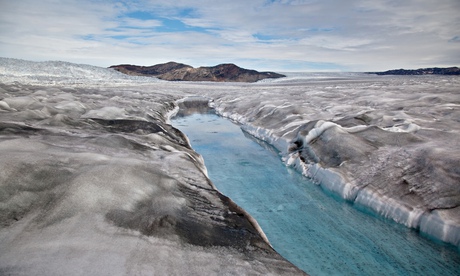
    Dark snow Greenland

    Dark deposits on icefields in Greenland, which absorb more sunlight and lead to faster glacial melting. Photograph: Henrik Egede Lassen/Alpha Film

    When American geologist Ulyana Horodyskyj set up a mini weather station at 5,800m on Mount Himlung, on the Nepal-Tibet border, she looked east towards Everest and was shocked. The world’s highest glacier, Khumbu, was turning visibly darker as particles of fine dust, blown by fierce winds, settled on the bright, fresh snow. “One-week-old snow was turning black and brown before my eyes,” she said.

    The problem was even worse on the nearby Ngozumpa glacier, which snakes down from Cho Oyu – the world’s sixth highest mountain. There, Horodyskyj found that so much dust had been blown on to the surface that the ability of the ice to reflect sunlight, a process known as albedo, dropped 20% in a single month. The dust that was darkening the brilliant whiteness of the snow was heating up in the strong sun and melting the snow and ice, she said.

    The phenomenon of “dark snow” is being recorded from the Himalayas to the Arctic as increasing amounts of dust from bare soil, soot from fires and ultra-fine particles of “black carbon” from industry and diesel engines are being whipped up and deposited sometimes thousands of miles away. The result, say scientists, is a significant dimming of the brightness of the world’s snow and icefields, leading to a longer melt season, which in turn creates feedback where more solar heat is absorbed and the melting accelerates.

    In a paper in the journal Nature Geoscience, a team of French government meteorologists has reported that the Arctic ice cap, which is thought to have lost an average of 12.9bn tonnes of ice a year between 1992 and 2010 due to general warming, may be losing an extra 27bn tonnes a year just because of dust, potentially adding several centimetres of sea-level rise by 2100. Satellite measurements, say the authors, show that in the last 10 years the surface of Greenland’s ice sheet has considerably darkened during the melt season, which in some areas is now between six and 11 days longer per decade than it was 40 years ago. As glaciers retreat and the snow cover disappears earlier in the year, so larger areas of bare soil are uncovered, which increases the dust erosion, scientists suggest.

    Research indicates that the Arctic’s albedo may be declining much faster than was estimated only a few years ago. Earlier this year a paper in Proceedings of the National Academy of Sciences reported that declining Arctic albedo between 1979 and 2011 constituted 25% of the heating effect from carbon dioxide over the same time.

    According to Danish glaciologist Jason Box, who heads the Dark Snow project to measure the effect of dust and other darkening agents on Greenland’s ice sheet, Arctic ice sheet reflectivity has been at a near record low for much of 2014. Even a minor decrease in the brightness of the ice sheet can double the average yearly rate of ice loss, seen from 1992 to 2010.

    “Low reflectivity heats the snow more than normal. A dark snow cover will thus melt earlier and more intensely. A positive feedback exists for snow in which, once melting begins, the surface gets yet darker due to increased water content,” says Box on his blog. Both human-created and natural air pollutants are darkening the ice, say other scientists.

    Nearly invisible particles of “black carbon” resulting from incomplete combustion of fossil fuels from diesel engines are being swept thousands of miles from industrial centres in the US, Europe and south-east Asia, as is dust from Africa and the Middle East, where dust storms are becoming bigger as the land dries out, with increasingly long and deep droughts. Earlier this year dust from the Sahara was swept north for several thousands miles, smothered Britain and reached Norway.

    According to Kaitlin Keegan, a researcher at Dartmouth College in the US state of New Hampshire, the record melting in 2012 of Greenland’s northeastern ice-sheet was largely a result of forest fires in Siberia and the US.

    Any reduction in albedo is a disaster, says Peter Wadhams, head of the Polar Oceans Physics Group at Cambridge University.

    He said: “Replacing an ice-covered surface, where the albedo may be 70% in summer, by an open-water surface with albedo less than 10%, causes more radiation to be absorbed by the Earth, causing an acceleration of warming. “I have calculated that the albedo change from the disappearance of the last of the summer ice in 2012 was the equivalent to the effect of all the extra carbon dioxide that we have added to the atmosphere in the last 25 years,” he says.

    UlyanaHorodyskyj, who is planning to return to the Himalayas to continue monitoring dust pollution at altitude, said she had been surprised by how bad it was.

    “This is mostly manmade pollution,” she said. “Governments must act, and people must become more aware of what is happening. It needs to be looked at properly.”

  • U.S. Military Bases Threatened by Climate Change

    U.S. Military Bases Threatened by Climate Change
    		<p>Residents are transported in a lifeboat to avoid floodwater in Cockermouth, northern England November 20, 2009. Parts of Britain are set to be battered by the worst storm of the year so far, forecasters warned earlier this month, with heavy rain and

    REUTERS/Nigel Roddis

    Printer-friendly versionPDF version

    a a
    Type Size: Small

    The Fiscal Times

    July 1, 2014

    Thousands of military facilities across the world are threatened by rising sea levels, ocean temperatures and increasing storm frequency brought on by climate change.

    A new report by the Government Accountability Office warns the Pentagon that it needs to better prepare for weather-related threats at some 7,591 locations worldwide. If the Defense Department doesn’t establish a plan in a timely manner, the facilities will be at risk.

    Related: Military Shifting Towards Clean-Energy Fuels

    The report comes just a week after the House passed a Defense Department 2015 budget that includes an amendment barring the department from spending money on climate change initiatives. Of course, that amendment is not expected to survive the Senate. So the two chambers will have to sort this out at conference.

    The auditors examined five climate change effects flagged by the Pentagon as potential threats to military assets around the world, including rising temperatures, changing precipitation patterns, more storms, higher sea levels and rising ocean temperature.

    They found that climate change is already negatively affecting some military facilities.

    In Alaska, for example, rising sea levels have caused coastal erosion at several Air Force radar installations. Similarly, officials on a Navy installation told the auditors, “They are concerned about possible storm surge during work on a submarine that will be cut in half while sitting in a dry dock.” They said, “If salt water floods the submarine’s systems, it could result in severe damage.”

    Related: 10 Biggest Risks Threatening Taxpayer Dollars

    The report also found that 9 out of 15 military areas have experienced difficult training conditions due to wildfires and precipitation changes.

    “According to DOD, its U.S. infrastructure is vulnerable to the potential impacts of climate change. These could affect DOD’s readiness and fiscal exposure,” the report said.

    Though GAO notes that the Pentagon has at least started identifying facilities that are threatened by climate change, its “lack of planning” could hinder its efforts.

    The auditors said officials “rarely propose climate change adaptation projects” because planners “may believe that climate change projects are unlikely to successfully compete with other military construction projects for funding.”

    (Congress is much happier to secure funding for things like this.)

    Still, the Pentagon concurred with the GAO and said it would develop a focused approach to survey all facilities that may be threatened by climate change.

    – See more at: http://www.thefiscaltimes.com/Articles/2014/07/01/US-Military-Bases-Threatened-Climate-Change#sthash.YbNeKo0X.dpuf

  • Hansen Web Page and Reports.

    Hansen Web Page and Reports.

    Posted in Uncategorized By Neville On March 1, 2014

    Dr. James E. Hansen

    Columbia University
    Earth Institute
    475 Riverside Drive
    New York, NY 10115 USA
    E-mail: jeh1@columbia.edu

    “Storms of My Grandchildren”, by James Hansen

    On the webpage “Updating the Climate Science: What Path is the Real World Following?”, Drs. Makiko Sato and James Hansen update figures in the book Storms of My Grandchildren (see LA Times review) and present updated graphs and discussion of key quantities that help provide understanding of how climate change is developing and how effective or ineffective global actions are in affecting climate forcings and future climate change. A few errata in Storms are also provided.

    Near Future Presentations

    Recent Communications

    Dr. Hansen periodically posts commentary on his recent papers and presentations and on other topics of interest to an e-mail list. To receive announcements of new postings, please click here.

    Go to older postings

    Recent Scholarly Publications

    Hansen, J., P. Kharecha, M. Sato, V. Masson-Delmotte, et al., Assessing “Dangerous Climate Change”: Required Reduction of Carbon Emissions to Protect Young People, Future Generations and Nature. PLOS ONE, 8, e81468.


    Hansen, J., M. Sato, G. Russell, and P. Kharecha, 2013: Climate sensitivity, sea level, and atmospheric carbon dioxide. Phil. Trans. R. Soc. A, 371, 20120294, doi:10.1098/rsta.2012.0294.

    Go to older publications

    Other Recent Publications

    Apr. 4, 2013: Keystone XL: The pipeline to disaster. Op-ed in the Los Angeles Times.

    Go to older publications

    Recent Presentations

    February 2014: Symposium on a New Type of Major Power Relationship: Presentation given at Counsellors Office of the State Council, Beijin, China on Feb. 24.
    + Download PDF (3.5 MB)

    December 2013: Minimizing Irreversible Impacts of Human-Made Climate Change: Presentation given at AGU Fall Meeting on Dec. 12.
    + Download PDF (4.3 MB)

    September 2012: A New Age of Risk: Presentation given at Columbia University on Sep. 22.
    + Download PDF (2.1 MB)
    + Download PPT (2.5 MB)

    Go to older presentations

    Recent TV Appearance

    in Recent News

    Recent Video

    December 2012: Discussion at Climate One about Superstorm Sandy and Carbon Pricing.

    Go to older video

    Posted in Uncategorized By Neville On March 13, 2014