Category: Uncategorized

  • Daily update: Utilities move to kick rooftop solar off the grid

    Click here to enable desktop notifications for Gmail.   Learn more  Hide
    1 of 4
    Why this ad?
    Get 3 Solar Power Quotessolarquotes.com.au/Solar_Power – Get 3 Local Solar Power Quotes From Installers. It’s Quick Easy & Free!

    Daily update: Utilities move to kick rooftop solar off the grid

    Inbox
    x

    Renew Economy editor@reneweconomy.com.au via mail29.atl111.rsgsv.net

    1:13 PM (39 minutes ago)

    to me
    Utilities move to kick rooftop solar off the grid, Lousy weather won’t save Victorian networks, The world’s top 10 markets for utility scale solar, Austalia ranks low in clean tech innovation, Germany hits 50% solar as Ireland hits 50% wind, Wind hits 91% of demand in SA, New financing models to cut renewables costs by 20%, Texas breaks wind power production record, and Tesla may create Pan-European supercharger network by end of year.
    Is this email not displaying correctly?
    View it in your browser.
    RenewEconomy Daily News
    The Parkinson Report
    New standards are being introduced to stop households and businesses exporting excess solar back into the grid. That may buy greater stability for networks, but it risks accelerating the adoption of battery storage and grid defections.
    Victorian’s can live without their grid if they’re forced to through unfair pricing. Even with that state’s fickle weather.
    Australia tumbles another 7 places in ranking of utility scale solar, now sitting just behind the Dominican Republic.
    Australia has one of the lowest rankings in industrialised world on cleantech innovation, a new report finds.
    … but reports about new record shares of renewable power are understandably celebratory, but they also confuse the public – and even experts.
    Wind energy accounted for up to 91 per cent of demand in South Australia in this week’s big blow.
    Widespread use of YieldCos should allow for wind and solar costs to drop by more than 20 percent compared to current project finance models.
    In March this year, Texas produced more wind power in a given moment than ever before, according to a new Energy Information Administration report.
    Tesla – rated by Morgan Stanley as world’s most important carmaker – aims to install pan-European network of Supercharger stations.
    SolarEdge is coming to your town REGISTER
  • IPCC Working Group III Recommends Nearly Quadrupling Nuclear Energy Like it?

    Sign up | Login with →

    Posted by: Rod Adams

    IPCC Working Group III Recommends Nearly Quadrupling Nuclear Energy

    Like it?

    43
    Posted April 20, 2014
    38
    91
    6
    135

    Nuclear Power and the IPCC Report

    A few of my pronuclear friends have been disappointed by the treatment of nuclear energy in the recently released final draft of the IPCC working group III Summary for policy makers. For example, Steve Aplin at Canadian Energy Issues thinks that the IPCC is prejudiced against nuclear energy.

    While there may be some members of the body who don’t like nuclear energy very much, the rational, numerate members of IPCC working group III managed to slide some very important words past the dissenters in a way that makes me, as a lover of careful wording, want to praise their composition skills.

    Policy makers should note that the word ‘nuclear’ appears 11 times in the summary. In four of those important passages, it is a key component of a short list of zero- and low-carbon energy sources.

    • At the global level scenarios reaching 450 ppm are also characterized by more rapid improvements in energy efficiency, a tripling to nearly a quadrupling of the share of zero- and low-carbon supply from renewables, nuclear energy AND fossil energy with carbon capture and storage (CCS) OR bioenergy with CCS (BECCS) by the year 2050. (p. 15)
    • Zero- and low-carbon energy supply includes renewables, nuclear energy, AND fossil energy with carbon dioxide capture and storage (CCS), OR bioenergy with CCS (BECCS). (p. 16)
    • In the majority of low-stabilization scenarios, the share of low-carbon electricity supply (comprising renewable energy (RE) nuclear AND CCS) increases from the current share of approximately 30% to more than 80% by 2050, AND fossil fuel power generation without CCS is phased out almost entirely by 2100. (p. 23)
    • annual investment in low-carbon electricity supply (i.e., renewables nuclear AND electricity generation with CCS) is projected to rise by about USD 147 (31-360) billion (median: +100% compared to 2010) (p. 29)

    (Emphasis and capitalization of operators added.)

    Not only have I spent time smithing words for human consumption in intensely political environments, but I also have a fair understanding of Boolean logic. I admire what the IPCC authors have accomplished. In both human communications and computer programming, the operators ‘AND’ and ‘OR’ have important meanings. So do modifiers like ‘with’. (Fossil with CCS is a completely different animal than fossil without CCS.)

    In my analysis, the recommendation for policy makers is quite clear. The only way to stabilize atmospheric CO2 concentration at acceptably low levels is to nearly quadruple the output of renewables, nuclear, AND electricity generation from fossil or bioenergy with CCS. The ‘and’ means that all of the items on the list are needed, the program cannot pick and choose the one or two that it likes the best.

    However, since current electricity generation with CCS is virtually zero, nearly quadrupling it will mean it is still nearly zero in 2050. Renewables will gain a substantial market share, but the biggest current source of zero- or low-carbon energy in the developed world — nuclear energy — will have to grow the most in absolute terms to keep doing its share of the heavy lifting.

    IPCC working group III also provides some explanation for the current state of nuclear energy and its perceived utility.

    Nuclear energy is a mature low-GHG emission source of baseload power, but its share of global electricity generation has been declining (since 1993). Nuclear energy could make an increasing contribution to low-carbon energy supply, but a variety of barriers and and risks exist (robust evidence, high agreement)
    Those include: operational risks, and the associated concerns, uranium mining risks, financial and regulatory risks, unresolved waste management issues, nuclear weapon proliferation concerns, and adverse public opinion (robust evidence, high agreement. New fuel cycles and reactor technologies addressing some of these issues are being investigated and progress in research and development has been made concerning safety and waste disposal.

    That explanation, in my opinion, is carefully worded to answer the logical questions that curious policy makers would be sure to ask – “If nuclear energy is a proven, mature, low- or zero-emission power source, why isn’t its use growing?” The IPCC working group has informed policy makers that the engineers and scientists are doing their part of addressing the reasons why nuclear energy has not been growing for the past 20 years, but the rest of the issues must be tackled by the policy makers themselves.

    Most of the listed barriers to increasing clean energy output using atomic fission are political, not technical. That does not make them any more difficult to solve. In fact, the solutions are at hand, now all we need is a little more honesty and accurate risk assessment. The public’s opinion can be swayed by the people who have assumed the burden of leadership and spend most of their days working to influence the public to do the right thing.

    The post IPCC working group III recommends nearly quadrupling nuclear energy appeared first on Atomic Insights.

    Photo Credit: IPCC and Nuclear Power/shutterstock

  • The Arctic Sea Ice Melt Season Is Getting Longer

    The entire universe in blog form
    June 25 2014 7:30 AM

    The Arctic Sea Ice Melt Season Is Getting Longer

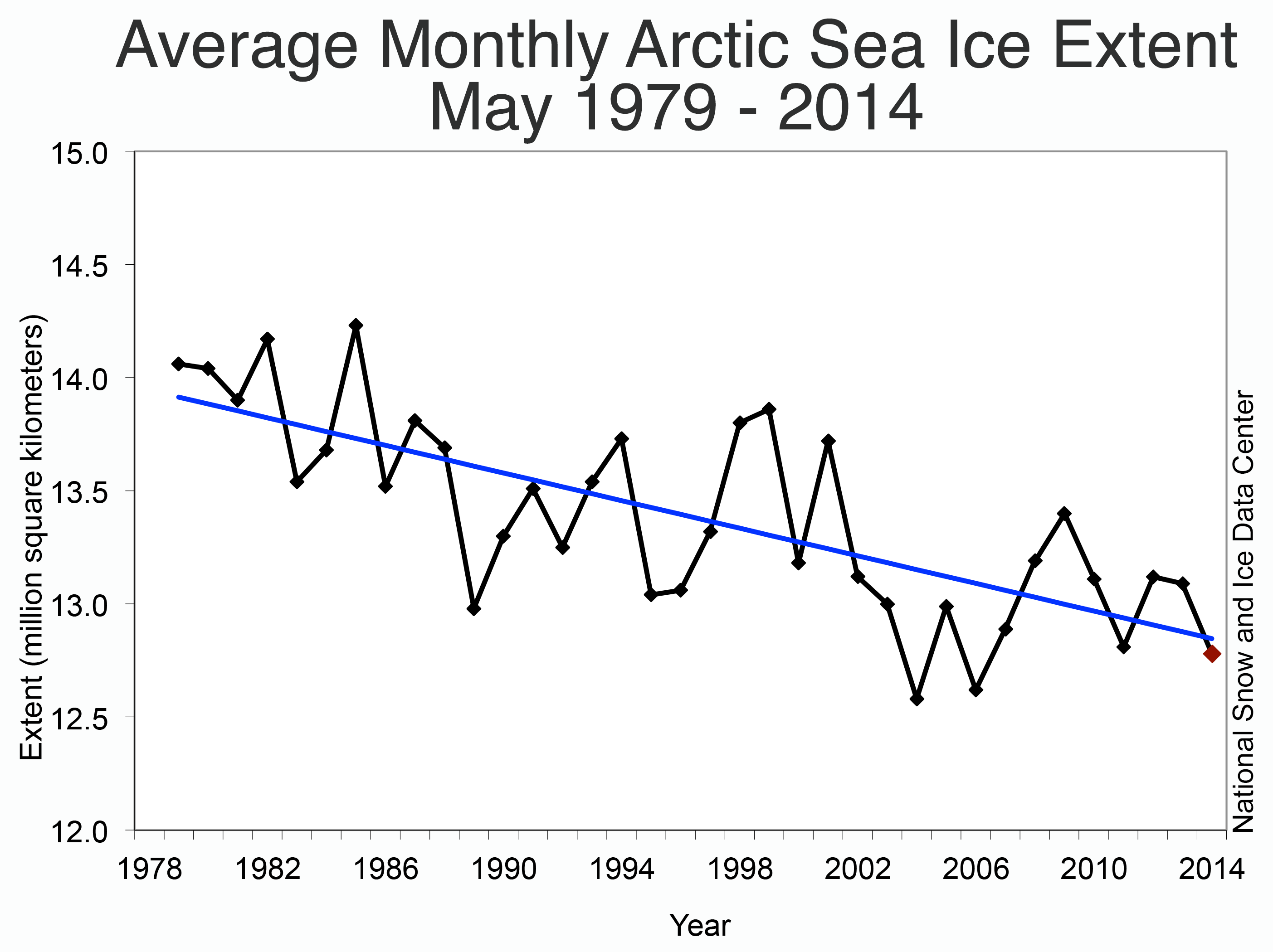
    A new study by NASA the National Snow and Ice Data Center indicates that the Arctic “melt season”—the time of the year when temperatures are warm enough for ice to melt—is getting longer all the time. There’s a lot of variation from season to season, but the overall trend is clear: The melting season has been increasing about five days every decade since 1979.

    Phil Plait Phil Plait

    Phil Plait writes Slate’s Bad Astronomy blog and is an astronomer, public speaker, science evangelizer, and author of Death from the Skies! Follow him on Twitter.

    The time of first melting is getting earlier in the spring, and the time of refreezing getting later in the fall. This trend is bad, and not unexpected. As the world warms, the length of time sea ice can melt and stay liquid will increase.

    The obvious ramification of this is that in general more ice melts every year, since there’s more time to melt it. That much has been obvious for some time; pretty much any sort of graph you care to look at shows that over time the amount of ice we see at the North Pole is getting smaller.

    The folks at NASA Goddard put together a brief video explaining this:

    One thing to note: In the video, the narrator says, “Part of what’s causing the changes is increasing amounts of solar energy that’s being absorbed by the sea ice and surrounding waters.” I want to be clear, that does not mean there’s been an increase in the Sun’s output. It means that more sunlight is being absorbed by the ice and water.

    That’s because of two reasons. Ice is generally white and reflective, but as temperatures increase the Arctic ice is getting thinner, making it easier to absorb sunlight. Also, when it melts it exposes dark water underneath, which is also more efficient at absorbing sunlight. It’s a double whammy.

    sea ice extent
    Arctic sea ice extent measured every May from 1979 to 2012. I believe the trend is obvious.
    Graph by NSIDC

    The real question here is, what effect will this have on the rest of the planet? For one, there will be some increase in sea level from the melting ice, but how much is hard to say.

    For another, there have been some ideas that the changing sea ice can have a profound effect on weather at lower latitudes, including more common occurrences of things like the polar vortex that brought so much misery to the U.S. East Coast in 2013-14.  Other studies indicate that extreme weather at southern locations won’t be affected much (though note that the authors of that study indicate that one reason extreme weather may be decreasing is itself due to global warming; cold comfort—haha—for those who deny global warming).

    However, one thing we’ve learned when it comes to climate: Small causes can have profound effects. Wiping out a few thousand cubic kilometers of ice at the North Pole will almost certainly have long-term effects we don’t yet know. The Earth is a big machine with a lot of moving parts, and if you kick one hard enough, it’s bound to have repercussions.

    Are we really willing to take that chance? When the stakes are so very, very high, perhaps we should have a care. What we’re doing here is a massive terraforming experiment on the planet we live on.

    That strikes me as a pretty dumb idea.

  • Carbon capture and storage enters the twilight zone


    Carbon capture and storage enters the twilight zone

    By on 26 June 2014
    Print Friendly

    In its latest annual review of the ailing prospects for the deployment of Carbon Capture and Storage (CCS), the International Energy Agency’s Clean Coal Centre (IEA CCC) has tentatively suggested that the cost of developing and deploying the expensive technology should be paid for by coal, oil and gas producers. It is, however, a suggestion guaranteed to be rejected by the coal industry which has most to lose.
    carbonThe glum title of the IEA CCC’s latest review –What’s in store for CCS? – is symptomatic of the gloom enveloping even the most ardent supporters of CCS. In their review, which was released earlier this week, the IEA CCC complains that “CCS investment, demonstration projects and large-scale deployment are well behind the targets envisaged by analysts, governments and industry”.

    One of the key factors in the slow rate of construction of demonstration plants has been the decade long tug of war over who carries the costs for CCS: fossil fuel producers, the companies that burn the fossil fuels or taxpayers? Or a mix of all three?

    For coal companies the widespread equipping of coal-fired power plants with CCS plants would be a boon.

    In an April 2013 presentation, the Policy Manager of the World Coal Association, Aleksandra Tomczak, explained (page 12) that “if CCS is viable and carbon prices high, coal power can be competitive with gas.” Even though CCS is far from being “viable” without taxpayer subsidies and the coal industry vehemently opposes “high” carbon prices, Tomczak bluntly pointed out a potential upside for coal companies: “coal demand further boosted by increase in coal consumption per GW [gigawatt] vs straight coal”. Estimates vary, but CCS plants could require an extra 20-30% more coal to produce the same power output.

    What is good about CCS for coal companies though is bad for utilities.

    The extra capital cost of a CCS increases the financing cost, not to mention the extra operational costs of increased coal and water consumption and the disposal costs of the compressed carbon dioxide in underground storage areas, if they exist in close proximity to the power plants.

    All up, the extra costs of CCS make coal-fired plans with the technology very expensive when designed into new plants. Earlier this year the US Department of Energy (DOE) estimated that based on current technology to capture 90-95 per cent of the carbon dioxide in waste stream would increase wholesale power prices by approximately 70 to 80 percent.  The costs of retrofitting CCS to existing plants, let alone those in old age, would be prohibitive.

    As the costs and difficulty of developing CCS have become apparent, utilities have become exceedingly wary of carrying the coal industry’s can. But if utilities don’t want to fund it, who will?

    For the best part of a decade the coal industry persuaded a number of governments to pledge to fund various R&D projects, map potential underground storage reservoirs, run pro-CCS PR campaigns and fund some test scale projects.

    Despite the expenditure of billions of dollars many projects have faltered while some in the US and Europe struggle on. The Global Financial Crisis and austerity budgets sapped the financial commitment of some governments. Even some of the hardest line pro-coal governments – such as that led by Australian Prime Minister Tony Abbot – have retreated from funding new CCS projects.

    New factors are in play too. In major economies the era of building new coal plants is all but over with electricity demand stalling, if not declining. The rise of renewables is depressing wholesale market prices while energy efficiency and rooftop solar are further cannibalising the profitable peak power spikes. The economic assumptions which underpinned the optimism towards CCS a decade ago have changed profoundly.

    Which is why the IEA CCC’s notes in its report that “in the case of power plants, operating in highly competitive electricity markets, special power purchase agreements including electricity price agreements are likely to be needed.” In other words, to be viable in the power sector, CCS needs to propped up by being shielded from falling wholesale electricity prices, which is precisely what energy efficiency and renewables deliver.

    The coal industry’s dilemma – to love or leave CCS?

    But having hyped the potential of CCS for the best part of twenty years, coal industry lobby groups now find themselves in a bind.

    In a historically coal-addicted country such as Australia, the Minerals Council of Australia (MCA) – which represents major coal companies such as BHP Billiton, Peabody Energy and Rio Tinto – hyped CCS as a solution to the greenhouse gas emissions of coal plants.  But even the MCA now cautions that “the cancellation or postponement of some CCS demonstration projects in Australia and around the world is not unexpected, particularly given global economic uncertainties, and should not be taken to reflect a failure of the technology itself.”

    At the same time, the National Mining Association (NMA) in the US – which represents some of the same companies as the MCA – recently launched an advertising campaign arguing against the Obama administration proposal requiring CCS to capture part of carbon dioxide emissions would dramatically push up electricity prices.

    Where once the coal industry had successfully sold the idea to policy makers and most commentators that CCS was an inescapable element of any emissions reduction strategy, that idea is now falling from favour.

    Three weeks ago Jonas Rooze, an analyst from Bloomberg New Energy Finance Europe said that they hadn’t included CCS-fitted power plants in their European generation scenario “because we don’t really see enough evidence of it happening enough to be relevant to our forecast.”

    If utilities don’t want to fund it and many governments are at best luke-warm to it, who is left?

    In the absence of better options the IEA’s CCC has floated the idea that fossil fuel industry itself should be the ones contributing most to the cost of developing CCS.

    For the thermal coal industry, most of which is struggling with low profit margins and in the midst of a vicious round of cost-cutting, the idea of stumping up billions of dollars for a technology that may never be viable is implausible.

    Nor is the gas industry, which has taken great pains to push coal to the fore as the fossil fuel industry’s bad boy, likely to come to the rescue of its rival.

    In the absence of enthusiastic deep-pocketed sponsors, CCS is gradually being pushed off into the twilight zone where it is likely to quietly fade away when existing government funded programs run out of cash.

    Bob Burton is a Contributing Editor of CoalSwarm and a Director of the Sunrise Project, a non-profit group promoting a shift away from fossil fuels. With Guy Pearse and David McKnight he co-authored Big Coal: Australia’s Dirtiest Habit. Bob Burton’s Twitter feed is here.

  • Battery storage maker Redflow gets fundraising boost


    Battery storage maker Redflow gets fundraising boost

    By on 26 June 2014
    Print Friendly

    Australian based zinc bromide battery developer RedFlow says it has boosted its fund raising by one third after being overwhelmed by demand from shareholders.

    The battery storage company – the only one of its type on the Australian Stock Exchange – had sought $6 million in two for seven entitlement offers to existing shareholders.

    The company says the offer was heavily supported by shareholders, with the company receiving demand in excess of the total number of new shares available. Applications for new shares totalled approximately $8.21 million resulting in oversubscriptions of approximately $2.15 million.

    redflow 1Recently, RedFlow announced their teaming with Schneider Electric that will see the companies collaborate and develop energy storage systems incorporating the Red Flow battery.

    In May the company launched plans for $6 million in capital raising, to put towards developing its unique energy storage technology and to help bring the company into a cash flow positive position.

    In March, the company revealed it was targeting a 40 per cent cut in the capital cost of energy storage systems by the end of 2015.

  • Daily update: Climate doubting coal baron saves wind and solar

    More

    1 of 2
    Why this ad?
    Get 3 Solar Quotessolarquotes.com.au/_3_Best_Quotes – Compare 3 Solar Installers. Save Time & Money Now!

    Daily update: Climate doubting coal baron saves wind and solar

    Inbox
    x

    Renew Economy editor@reneweconomy.com.au via mail6.atl111.rsgsv.net

    1:57 PM (17 minutes ago)

    to me
    Climate doubting coal baron saves wind and solar, Renewable industry rejoices but questions remain over investment, Newman’s coal generators biggest loser from Palmer’s RET, Chemical breakthrough to slash costs of solar, CCA proposes tight emissions standards for cars, Wind energy’s big week, Carbon capture and storage enters the twilight zone, The millions behind Bjorn Lomborg, Can JFK save Australia from its climate crisis? and Battery storage maker Redflow gets fundraising boost.
    Is this email not displaying correctly?
    View it in your browser.
    RenewEconomy Daily News
    The Parkinson Report
    … but not the carbon price. Clive Palmer’s triple backflip on climate policies creates a political nightmare for Tony Abbott. Now he knows his policies are really untenable.
    Certificate prices jumped, and the renewables industry rejoiced – but large scale investment will not resume anytime soon, and rooftop solar is still exposed.
    The biggest losers from Palmer’s defence of RET will be coal generators his biggest political enemy, Campbell Newman, is trying to sell.
    A UK university has hailed a major breakthrough in solar technology, using chemicals found in tofu to make solar panels much cheaper and safer.
    Climate Change Authority calls for tight emissions standards for cars, saying costs will be offset within two years in fuel savings.
    Wind energy operates near full capacity for last three days, with record output across eastern states, and accounting for nearly 2/3 of South Australia’s needs.
    Glum title of IEA’s latest review into CCS is symptomatic of gloom enveloping even the most ardent supporters of the technology.
    Bjorn Lomborg is a favourite of the Australian conservatives looking to slow down climate action and clean energy investment. An investigation raises interesting questions about the sources of his funding.
    What is little known about coal baron and federal MP Clive Palmer is his interest in world affairs – and in particular US politics in general.
    Australia battery storage developer Redflow has completed a successful capital raising after being