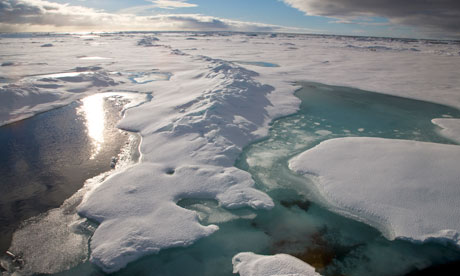
Debate over the plausibility of a catastrophic release of methane in coming decades due to thawing Arctic permafrost has escalated after a new Nature paper warned that exactly this scenario could trigger costs equivalent to the annual GDP of the global economy.
Scientists of different persuasions remain fundamentally divided over whether such a scenario is even plausible. Carolyn Rupple of the US Geological Survey (USGS) Gas Hydrates Project told NBC News the scenario is “nearly impossible.” Ed Dlugokencky, a research scientist at the National Oceanic and Atmospheric Administration’s (NOAA) said there has been “no detectable change in Arctic methane emissions over the past two decades.” NASA’s Gavin Schmidt said that ice core records from previously warm Arctic periods show no indication of such a scenario having ever occurred. Methane hydrate expert Prof David Archer reiterated that “the mechanisms for release operate on time scales of centuries and longer.” These arguments were finally distilled in a lengthy, seemingly compelling essay posted on Skeptical Science last Thursday, concluding with utter finality:
“There is no evidence that methane will run out of control and initiate any sudden, catastrophic effects.”
But none of the scientists rejecting the plausibility of the scenario are experts in the Arctic, specifically the East Siberia Arctic Shelf (ESAS). In contrast, an emerging consensus among ESAS specialists based on continuing fieldwork is highlighting a real danger of unprecedented quantities of methane venting due to thawing permafrost.
So who’s right? What are these Arctic specialists saying? Are their claims of a potentially catastrophic methane release plausible at all? I took a dive into the scientific literature to find out.
What I discovered was that Skeptical Science’s unusually skewered analysis was extremely selective, and focused almost exclusively on the narrow arguments of scientists out of touch with cutting edge developments in the Arctic. Here’s what you need to know.
1. The 50 Gigatonne decadal methane pulse scenario was posited by four Arctic specialists, and is considered plausible by Met Office scientists
The authors of the controversial new Nature paper on costs of Arctic warming didn’t just pull their decadal methane catastrophe scenario out of thin air. The scenario was first postulated in 2008 by Dr Natalie Shakhova of the University of Alaska Fairbanks, Dr Igor Semiletov from the Pacific Oceanological Institute at the Russian Academy of Sciences, and two other Russian experts.
Their paper noted that while seabed permafrost underlaying most of the ESAS was previously believed to act as an “impermeable lid preventing methane escape,” new data showing “extreme methane supersaturation of surface water, implying high sea-to-air fluxes” challenged this assumption. Data showed:
“Extremely high concentrations of methane (up to 8 ppm) in the atmospheric layer above the sea surface along with anomalously high concentrations of dissolved methane in the water column (up to 560 nM, or 12000% of super saturation).”
One source of these emissions “may be highly potential and extremely mobile shallow methane hydrates, whose stability zone is seabed permafrost-related and could be disturbed upon permafrost development, degradation, and thawing.” Even if the methane hydrates are deep, fissures, taliks and other soft spots create heat pathways from the seabed which warms quickly due to shallow depths. Various mechanisms for such processes have been elaborated in detail.
The paper then posits the plausibility of a 50 Gigatonne (Gt) methane release occurring abruptly “at any time.” Noting that the total quantity of carbon in the ESAS is “not less than 1,400 Gt”, the authors wrote:
“Since the area of geological disjunctives (fault zones, tectonically and seismically active areas) within the Siberian Arctic shelf composes not less than 1-2% of the total area and area of open taliks (area of melt through permafrost), acting as a pathway for methane escape within the Siberian Arctic shelf reaches up to 5-10% of the total area, we consider release of up to 50 Gt of predicted amount of hydrate storage as highly possible for abrupt release at any time. That may cause ∼12-times increase of modern atmospheric methane burden with consequent catastrophic greenhouse warming.”
So the 50 Gt scenario used by the new Nature paper does not postulate the total release of the ESAS methane hydrate reservoir, but only a tiny fraction of it.
The scale of this scenario is roughly corroborated elsewhere. A 2010 scientific analysis led by the UK’s Met Office in Review of Geophysics recognised the plausibility of catastrophic carbon releases from Arctic permafrost thawing of between 50-100 Gt this century, with a 40 Gt carbon release from the Siberian Yedoma region possible over four decades.
Shakhova and her team have developed these findings from data derived from over 20 field expeditions from 1999 to 2011. In 2010, Shakhova et. al published a paper in Science based on their annual research trips which highlighted that the ESAS was a key reservoir of methane “more than three times as large as the nearby Siberian wetland… considered the primary Northern Hemisphere source of atmospheric methane.” Current average methane concentrations in the Arctic are:
“about 1.85 parts per million, the highest in 400,000 years” and “on par with previous estimates of methane venting from the entire World Ocean.”
As the ESAS is shallow at only 50 metres, most of the methane being released is escaping into the atmosphere rather than being absorbed into water.
The existence of such shallow methane hydrates in permafrost – at depths as small as 20m – was confirmed by Shakhova in the Journal of Geophysical Research. There has been direct observation and sampling of these hydrates by Russian geologists in recent decades until now; this has also been confirmed by US government scientists.
2. Arctic methane hydrates are becoming increasingly unstable in the context of anthropogenic climate change and it’s impact on diminishing sea ice
The instability of Arctic methane hydrates in relation to sea ice retreat – not predicted by conventional models – has been increasingly recognised by experts. In 2007, a study in Eos, Transactions found that:
“Large volumes of methane in gas hydrate form can be stored within or below the subsea permafrost, and the stability of this gas hydrate zone is sustained by the existence of permafrost. Degradation of subsea permafrost and the consequent destabilization of gas hydrates could significantly if not dramatically increase the flux of methane, a potent greenhouse gas, to the atmosphere.”
In 2009, a research team of 19 scientists wrote a paper in Geophysical Research Letters documenting how the past thirty years of a warming Arctic current due to contemporary climate change was triggering unprecedented emissions of methane from gas hydrate in submarine sediments beneath the seabed in the West Spitsbergen continental margin. Prior to the new warming, these methane hydrates had been stable at water depths as shallow as 360m. Over 250 plumes of methane gas bubbles were found rising from the seabed due to the 1C temperature increase in the current:
“… causing the liberation of methane from decomposing hydrate… If this process becomes widespread along Arctic continental margins, tens of Teragrams of methane per year could be released into the ocean.”
The Russian scientists investigating the ESAS also confirmed that the levels of methane release they discovered were new. As Steve Connor reported in the Independent, since 1994 Igor Semilitov:
“… has led about 10 expeditions in the Laptev Sea but during the 1990s he did not detect any elevated levels of methane. However, since 2003 he reported a rising number of methane ‘hotspots’, which have now been confirmed using more sensitive instruments.”
In 2012, a Nature study mapping over 150,000 Arctic methane seeps concluded that:
“… in a warming climate, disintegration of permafrost, glaciers and parts of the polar ice sheets could facilitate the transient expulsion of 14C-depleted methane trapped by the cryosphere cap.”
3. Multiple scientific reviews, including one by over 20 Arctic specialists, confirm decadal catastrophic Arctic methane release is plausible
A widely cited 2011 Nature review dismissed such a catastrophic scenario as implausible because methane “gas hydrates occur at low saturations and in sediments at such great depths below the seafloor or onshore permafrost that they will barely be affected by [contemporary levels of] warming over even [1,000] yr.”
But this study and others like it completely ignore the new empirical evidence on permafrost-associated shallow water methane hydrates on the Arctic shelf. Scientific reviews that have accounted for the empirically-observed dynamics of permafrost-associated methane come to the opposite conclusion.
In 2007, scientists Matthew Reagan and George Moridis at the Lawrence Berkeley National Laboratory published a paper in Geophysical Research Letters exploring the vulnerability of methane gas hydrates. They concluded based on simulations of different types of oceanic gas hydrate responding to seafloor temperature changes:
“… while many deep hydrate deposits are indeed stable under the influence of rapid seafloor temperature variations, shallow deposits, such as those found in arctic regions or in the Gulf of Mexico, can undergo rapid dissociation and produce significant carbon fluxes over a period of decades.”
A 2010 scientific analysis led by the UK’s Met Office in Review of Geophysics found:
“The time scales for destabilization of marine hydrates are not well understood and are likely to be very long for hydrates found in deep sediments but much shorter for hydrates below shallow waters, such as in the Arctic Ocean… Overall, uncertainties are large, and it is difficult to be conclusive about the time scales and magnitudes of methane feedbacks, but significant increases in methane emissions are likely, and catastrophic emissions cannot be ruled out… The risk of a rapid increase in [methane] emissions is real but remains largely unquantified.”
Another extensive scientific review of data from the ESAS gathered between 1995 and 2011 by over twenty Arctic specialists published in the Proceedings of the Russian Academy of Sciences similarly concluded that:
“The [ESAS] is a powerful supplier of methane to the atmosphere owing to the continued degradation of the submarine permafrost, which causes the destruction of gas hydrates. The emission of methane in several areas of the [ESAS] is massive to the extent that growth in the methane concentrations in the atmosphere to values capable of causing a considerable and even catastrophic warning on the Earth is possible.”
Other recent scientific reviews corroborate these findings.
4. Current Arctic methane levels are unprecedented
A 2011 Nature paper found that ten times more carbon than thought is escaping via thawing coastal permafrost at the ESAS. Although it is not yet clear whether or how the quantities of Arctic methane are impacting on total atmospheric methane emissions, a number of scientists argue that the increasing spikes in methane detected in the Arctic in recent years is indeed unprecedented.
Despite NOAA scientist Dr Dlugokencky‘s reassurances that current Arctic methane emission levels are nothing to be “alarmed” about, his own data shows that Arctic methane levels were 1850 ppb in yr 2000, rising up to 1890 ppb in 2012.
Indeed, Dr Leonid Yurganov, Senior Research Scientist at the NASA/UMBC Joint Centre for Earth Systems Technology, and his co-scientists from NOAA and Harvard (Shawn Xiong and Steven Wofsy) disagree with Dlugokencky. In a paper for the American Geophysical Union last December they charted a worrying “global increase of methane” since 2007-8, with particular spikes in 2009 and 2011-12 in the northern hemisphere, with maximum methane concentrations in the Arctic:
“IASI data for the autumn months (October-November) clearly indicate Eurasian shelf areas of the Arctic Ocean as a significant methane emitter. The maximal methane concentrations were found over Kara and Laptev Seas. According to IASI data, during the last three years in autumn time, methane over Eurasian shelf has been increased by 25 ppb, over the N. American shelf, by 23 ppb, and over the land between 50 N and 70 N for both Eastern and Western hemispheres, by 20 ppb.”
Yurganov et. al point out that between January 2009 and 2013, Arctic methane levels ramped steadily higher by about 10-20 ppb on average each year. They also note that maximum Arctic methane emissions occur annually between September and October – coinciding with the Arctic sea ice minimum.
5. The tipping point for continuous Siberian permafrost thaw could be as low as 1.5C
New research led by Prof Antony Vaks published this year in Science analysing a 500,000 year history of Siberian permafrost found that “global climates only slightly warmer than today are sufficient to thaw significant regions of permafrost.” The study by eight experts found that there is a tipping point for continuous thawing of permafrost at 1.5C which “can potentially lead to substantial release of carbon trapped in the permafrost into the atmosphere.”
6. Arctic conditions during the Eemian interglacial lasting from 130,000 to 115,000 years ago are a terrible analogy for today’s Arctic
Two recent studies challenge the relevance of Arctic conditions in the Eemian interglacial. A 2012 Geophysical Research Letters study rejects the idea that the Arctic experienced ice free summers in the Eemian, noting that Arctic temperatures were cooler than previously thought, with evidence that ice sheets were more resistant – partly due to vastly different Arctic ocean currents. Similarly, a new Nature study found that the Greenland ice sheets experienced only modest melting in the Eemian, such that the extensive sea level rise at the time could only be explained by melting in Antarctica. Both studies suggest that the Arctic sea ice simply had not retreated enough to expose permafrost.
According to Prof Paul Beckwith of the University of Ottawa Laboratory for Paleoclimatology and Climatology, this can be explained by a number of factors:
“… the key distinction is that the warming today is from Greenhouse gases being higher and occurs ‘twenty-four seven’, namely the cooling at night is much less (diurnal variation smaller); in the Eemian the tilt of the Earth was much greater so there was much more seasonality, thus winters were much colder so the sea ice extent, thickness, and thus volume could build up much more, and the summers were warmer in the daytime, however the cooling at night was much greater than now (less greenhouse gas [GHG], more diurnal variation); net result is that the ice was much more durable in the Eemian. Greenland temps were higher during the daytime, but cooled off much more during the nighttime in the lower GHG concentration world.”
7. Paleoclimate records will not necessarily capture a large, abrupt methane pulse
Prof Beckwith also poured (ice cold) water on the claim that we know an abrupt methane release cannot occur, because it has never occurred before – purportedly proven as such an event is not detected in the ice cores:
“The length of time for the methane pulse is very important here. If most of the methane came out in a decade, for example then within a subsequent decade or so most of the methane will have been broken down to CO2 and H20 and also been dispersed/distributed around the planet, away from the pulse source area in the Arctic. The CO2 produced would have been small (CO2 stayed within 180-280 ppm range). It takes about 50 years or even more (depending on the snowfall rate and surface melt rates) for snow at the surface to be compacted into firn that closes off the air spaces creating the bubbles in the ice that are reservoirs of the methane and other atmospheric gases. Because of that 50 year bubble closure time, the large pulse of methane that was burped out of the marine sediments and terrestrial permafrost would be long gone and not result in a detectable signal in the ice core record. Just because the record does not capture it does not mean that it was not produced.”
These comments are confirmed by an in-depth American Geophysical Union study which notes that it “remains unclear if the full magnitude of atmospheric [methane] changes are recorded in ice cores because of diffusional smoothing of the [methane] while in the firn” as well as “signal smoothing” caused by “atmospheric effects.”
But studies do indicate past precedent. A 2009 Science paper argues that abrupt, catastrophic emissions from Arctic methane clathrates including from thawing permafrost played a key role 11,600 years ago at the end of the Younger Dryas cold period in driving wetland emissions, generating sudden massive warming.
So what?
All this proves that the $60 trillion price-tag for Arctic warming estimated by the latest Nature commentary should be taken seriously, prompting further urgent research and action on mitigation – rather than denounced on the basis of outdated, ostrich-like objections based on literature unacquainted with the ESAS.
Dr Nafeez Ahmed is executive director of the Institute for Policy Research & Development and author of A User’s Guide to the Crisis of Civilisation: And How to Save It among other books. Follow him on Twitter @nafeezahmed



 Email
Email