Category: Uncategorized

  • Australian coal plants obsolete, uneconomic in low-carbon race

    Australian coal plants obsolete, uneconomic in low-carbon race

    By on 17 June 2014
    Print Friendly

    Australia’s fossil fuel-driven electricity network is outdated, inefficient and in need of urgent reform if it hopes to compete – economically and technologically – as the world moves to limit carbon emissions, a new report has found.

    The report, released on Tuesday by the Climate Council – the crowd-funded independent advisory body formed after the abolition of the Climate Commission – warns that Australia’s ageing fleet of coal-fired power generators are obsolete in the race to curb carbon emissions, and would soon be rendered obsolete economically, undercut by cheaper and cleaner generation from wind energy and solar plants.

    The report’s recommended low-carbon energy transition – not unlike that of its author, Andrew Stock, who has graduated from being an executive at Origin Energy to his roles in the Climate Council and as an executive at Silex Solar – is widely considered necessary to meet Australia’s national and global carbon budgets; the outer limit we can safely emit to avoid catastrophic climate change, which at current rates is on track to be exhausted in the 2030s.

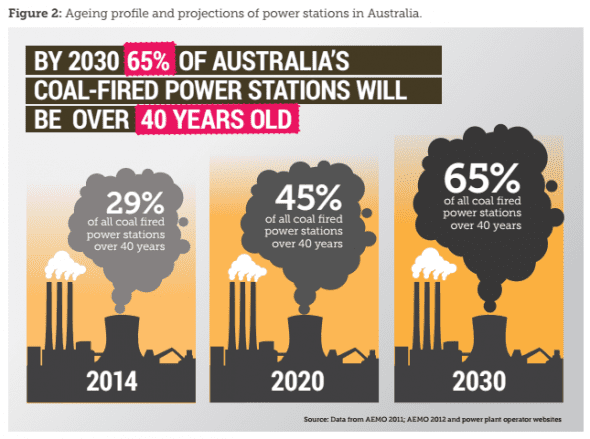
    But with the bulk of Australia’s coal power fleet pushing 30-plus years of age (significantly older than the globalaverage, with 90 per cent of the technology obsolete), the report argues that it must happen sooner, rather than later, with banks unlikely to finance coal plant replacement or retrofit with as yet untested and uncosted Carbon Capture and Storage (CCS) technologies, in light of the attached carbon risk.

    Screen Shot 2014-06-17 at 11.51.57 AM

    “In little more than a decade, Australia will have a fleet of old, inefficient, costly coal fuelled power stations unsuited physically and commercially to retrofit with CCS. Given the long planning horizons for the electricity industry, Australia needs to address these crucial dilemmas before 2020,” the report says.

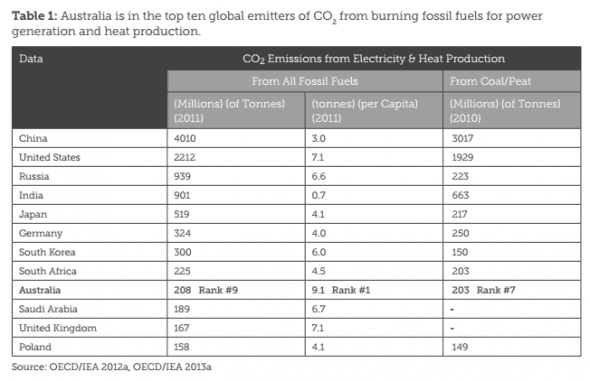
    According to the report, Australia’s electricity sector currently accounts for 33 per cent of the nation’s greenhouse gas emissions (its single biggest source) and ranks it among the world’s top 10 biggest per capita emitters from electricity and heat: two to three times above Germany, Japan and China, and around 30-50 per cent higher than the US, Russia and South Korea.

    Screen Shot 2014-06-17 at 11.52.12 AM“Urgent action is required to prepare Australia’s electricity sector for the near future,” says the report, noting that it takes over a decade to plan, design, finance, and build major new power infrastructure.

    But even without the pressure of global and national carbon budgets, the report warns that coal-fired power will struggle to compete economically with renewable electricity sources, like wind and solar which, internationally, were already generally lower than the cost of coal plants with CCS.

    “The least expensive zero emission option available at scale for deployment today in Australia is wind, closely followed by field scale solar PV,” says the report. “These costs are falling fast as take-up globally accelerates. Wind should be 20–30 per cent cheaper by 2020, solar PV is expected to halve in cost.”

    As for gas, the report says increasing prices mean that electricity generated from wind is already competitive with new gas plants, even without CCS, and lower cost than gas with CCS.

    But the report also warns that Australia is not keeping up with international investment and uptake of renewable electricity – lagging behind, in particular, in the global solar race – and will need to adapt its market and regulatory structures “to cope with the global shifts underway and accelerating growth in distributed low/zero emissions energy generation and storage.”

    RenewEconomy Free Daily Newsletter

  • Geology.com News – 12 Topics

    Why this ad?
    Frack Fluid Processingwesternfracvap.com – Reduce Cost To Transport Fluids Environment Safe Disposal Service.

    Geology.com News – 12 Topics

    Trash
    x

    Geology News fb@geology.com via google.com

    7:07 PM (3 minutes ago)

    to me

    Geology.com News – 12 Topics

    Link to Geology News

    Twin Tornadoes in Nebraska

    Posted: 17 Jun 2014 06:51 PM PDT

    “The rare twin tornadoes that spun through on Monday night wiped out the town’s business district, obliterated its fire station and ground 40 or 50 homes into rubble.”

    Russia Turns Off Gas to Ukraine

    Posted: 17 Jun 2014 06:42 PM PDT

    On Monday, Russia cut of natural gas flowing into Ukraine. Russia claims that Ukraine owes $2 billion for gas that has already been delivered.

    June 18th Flyby of Titan

    Posted: 17 Jun 2014 05:06 PM PDT

    “As NASA’s Cassini spacecraft zooms past Titan during a June 18 flyby, it will be bouncing radio waves off the moon’s surface and through its atmosphere, toward Earth.” Quoted from the NASA press release

    Academic Rank of Geoscience Professors in the USA

    Posted: 17 Jun 2014 11:08 AM PDT

    Geoscience Currents #88: Rankings & Top 10 Degree Granting Institutions for University Geoscience Faculty presents data on the academic rank of current geoscience professors in the United States and the universities where they earned their highest degree.

    Enhanced Oil Recovery

    Posted: 17 Jun 2014 10:57 AM PDT

    “Most of the world’s future oil and gas reserves won’t come from new discoveries, but by finding ways to get more oil from regions the industry already has already developed.” Quoted from the FuelFix article.

    Human Activities and the Salt Content of Streams

    Posted: 17 Jun 2014 08:29 AM PDT

    “For years we have known that activities, such as road de-icing, irrigation, and other activities in urban and agricultural lands increase the dissolved solids concentrations above natural levels caused by rock weathering, and now we have improved science-based information on the primary sources of dissolved-solids in the nation’s streams.” Quoted from the USGS press release.

    The Greatest Threat to U.S. Energy Security

    Posted: 17 Jun 2014 08:19 AM PDT

    “Senator Heidi Heitkamp (D-N.D.) warned Thursday that the greatest threat to U.S. energy security isn’t finding energy, it’s transporting it.” Quoted from TheHill.com.

    Sixth Year of Keystone Review

    Posted: 17 Jun 2014 08:16 AM PDT

    “The proposed pipeline, which would transport crude from Alberta’s oil sands to refineries on the Gulf Coast, is in its sixth year of review.” Quoted from the Bloomberg article.

    Drilling to the Marcellus with Air

    Posted: 17 Jun 2014 08:12 AM PDT

    “Indiana County-based Falcon Drilling is […] using mid-sized rigs and air drilling, as a less-expensive approach.” Quoted from TribLive.com

    No Need to Frack in North Carolina ?

    Posted: 17 Jun 2014 08:07 AM PDT

    “North Carolina could soon be deluged with cheap and abundant natural gas from the Marcellus Shale through a major pipeline expansion that could dampen urgency to incubate a home-grown fracking industry.” Quoted from the NewsObserver.com article.

    A Transit of the Sun as Seen From Mars

    Posted: 17 Jun 2014 04:42 AM PDT

    “NASA’s Curiosity Mars rover has imaged the planet Mercury passing in front of the sun, visible as a faint darkening that moves across the face of the sun.

    This is the first transit of the sun by a planet observed from any planet other than Earth, and also the first imaging of Mercury from Mars. Mercury fills only about one-sixth of one pixel as seen from such great distance.” Quoted from NASA.gov.

    Wall Maps of US States

    Posted: 17 Jun 2014 04:30 AM PDT

    Raven Maps are beautiful examples of shaded-relief wall maps that display the elevation of a state in vibrant colors. These large maps look great in a classroom, den or office. Use one to mark the locations of your work or company.

  • Facts about Thorium

    12 Apr 2014
    Home  »  Uncategorized   »   Facts about Thorium

    Facts about Thorium

    Posted in Uncategorized By Neville On April 12, 2014


    17 Sep 2013
    Home  »  Uncategorized   »   Facts about Thorium

    Facts about Thorium

    Posted in Uncategorized By Neville On September 17, 2013

    thoriumAtomic Number: 90
    Atomic Symbol: Th
    Atomic Weight: 232
    Melting Point: 3,182 F (1,750 C)
    Boiling Point: 8,650 F (4,788 C)

    Word origin: Thorium is named for Thor, the Norse god of thunder.

    Discovery: Thorium was discovered as an element in 1928 by Swedish chemist Jons Jakob Berzelius. Berzelius received a sample of an unidentified black mineral from mineralogist Jens Esmark, whose son Morten Esmark had found it on Lovoya Island, Norway. Esmark suspected it contained an unknown substance. His mineral is now known as thorite.


    Properties of thorium

    Thorium is radioactive and decays at a fixed rate into a series of other elements. In its pure state, thorium is a silvery-white metal that is stable in air and retains its luster for several months. If contaminated with oxide, however, it tarnishes slowly in air. It turns gray and eventually black. [See Periodic Table of the Elements]

    Thorium’s physical properties are strongly influenced by how much it is contaminated with oxide. Even the purest specimens of thorium often contain several tenths of a percent of oxide. Thorium oxide has a melting point of 3,300 C (5,972 F), the highest of all the oxides.

    Pure thorium is soft, very ductile, and can be swaged, drawn and cold-rolled. When heated in air, its turnings ignite and burn with a brilliantly white light. Powdered thorium is pyrophoric, requiring careful handling.

    Thorium is dimorphic, changing from a cubic to a body-centered cubic structure at 1,400 C (2,552 F). Thorium does not dissolve easily in most common acids (with the exception of hydrochloric) but water slowly attacks it.

    Much of the earth’s internally produced heat is attributed to thorium and uranium.

    Sources of thorium

    As a primordial nuclide, 232Th has existed in its current form for more than 4.5 billion years. Its existence predates the formation of Earth. Thorium was formed in the cores of dying stars through the r-process, and supernovas eventually scattered it across the galaxy. Its half-life is comparable to the age of the universe.

    Small amounts of thorium are found in most rocks and soils. Soil usually has an about 6 parts per million of thorium. Thorium is found in several minerals, including thorianite, monazite, and thorite. They occur on all continents, and thorium is now considered three times more abundant than uranium, or about as common as lead and molybdenum.

    Thorium is recovered commercially from rare-earth minerals and monazite, which is anything from 3-to-9 percent thorium. High-purity thorium has been made, and there are several methods for producing thorium metal.

    Uses of thorium

    Historically, thorium’s primary use was for the Welsbach mantle used in portable gaslights. Along with other ingredients, the thorium in these mantles produced a dazzling light when heated with a gas flame.

    Today, thorium metal is used as a source for nuclear power. Thorium-cycle converter-reactor systems are in development. Thorium’s abundance means that there is probably more energy available from thorium than from both uranium and fossil fuels, but any significant demand for thorium as a nuclear fuel is still several years in the future.

    Thorium is also used to coat the tungsten wire found in electronic equipment. Its presence as an alloying element in magnesium, imparting high strength and slowing resistance at elevated temperatures, plus its low-work function and high electron emission make it an excellent source for coating tungsten wire. Thorium oxide is also used to control grain size in tungsten when used in electric lamps and in high-temperature laboratory crucibles. Additionally, thorium oxide is useful as a catalyst in ammonia-to-nitric acid conversion, in petroleum cracking, and in sulfuric acid production.

    Gases containing thorium oxide are useful in producing high-quality camera lenses and scientific instruments. These gases have a high refractive index and low dispersion. 232Th is radioactive enough to expose a photographic plate in a few hours.

    Isotopes of thorium

    Thorium has 27 known radioisotopes. They range in atomic weight from 210 to 236 and all are unstable. 232Th is by far the most stable with a half-life as long as the universe — 14.05 billion years. Other isotopes are short lived, and are actually intermediates in the decay chain of higher elements. Only trace amounts of them are found. The longer-lived of these trace isotopes include: 230Th with a half-life of 75,380 years which is a daughter product of 238U decay; 229Th with a half-life of 7,340 years and 228Th with a half-life of 1.92 years. All of the remaining radioactive isotopes have half-lives that are less than 30 days and the majority of these have half-lives less than 10 minutes.

    232Th contains almost all naturally occurring thorium. It is an alpha emitter and goes through six alpha and four beta decay steps before becoming the stable isotope 208Pb.

  • An Early Double Dissolution? Don’t Hold Your Breath!

    13 Jun 2014
    Home  »  Uncategorized   »   An Early Double Dissolution? Don’t Hold Your Breath!

    An Early Double Dissolution? Don’t Hold Your Breath!

    Posted in Uncategorized By Neville On June 13, 2014

    10 Jun 2014
    Home  »  Uncategorized   »   An Early Double Dissolution? Don’t Hold Your Breath!

    An Early Double Dissolution? Don’t Hold Your Breath!

    Posted in Uncategorized By Neville On June 10, 2014

    Home  »  Uncategorized   »   An Early Double Dissolution? Don’t Hold Your Breath!

    An Early Double Dissolution? Don’t Hold Your Breath!

    Posted in Uncategorized By Neville On June 3, 2014

    Hold Your Breath!

    An Early Double Dissolution? Don’t Hold Your Breath!

    Posted in Uncategorized By Neville On May 27, 2014

    « JSCEM Recommends Optional Preferential Voting for the Senate | Main | Queensland set for another By-Election »

    May 19, 2014

    An Early Double Dissolution? Don’t Hold Your Breath!

    The tedious topic of a double dissolution seems to be doing the rounds again. In particular, there seems to be quite a lot of badly informed commentary on political blog sites on how a double dissolution would be brought on.

    Let me quote one website commentator who manages to encapsulate these misunderstandings in two sentences.

    “There will be a DD in early 2015 whether Abbott wants it or not (he very unlikely to want it as by then 2PP polling will be something like 60-40 against him!). Shorten will deny him supply, and rightly so.”

    This comment is wrong for two fundamental constitutional reasons. First, a Prime Minister may choose to call a double dissolution election but they cannot be forced to call one. Second, you cannot get a double dissolution from blocking a supply bill, though a government may choose to call a double dissolution on other grounds because supply is blocked.

    So let me go through the mechanism of a double dissolution and also clear up this issue with supply bills.

    The key point to make is that a double dissolution of the House and the whole Senate, followed by an election and possibly a joint sitting, is a significant constitutional event, not some euphemism for an early election.

    The double dissolution mechanism is set out in section 57 of the Constitution. It was drafted and endlessly debated in the 1890s constitutional conventions. It was a constitutional mechanism that allowed a government with a majority in the House of Representatives to overcome the blocking power of the Senate.

    The need for some method to resolve deadlocks between the House and Senate was created by the decision to give the Senate virtually co-equal powers with the House, something that was unworkable under the Westminster model of responsible government unless a deadlock provision was provided.

    As it was envisaged, Section 57 was a mechanism that would allow the population of the larger states as represented by the majority government in the House of Representatives to overcome the blocking power of the smaller states in the Senate. While the Senate never became the state assembly imagined by the constitutional drafters, the double dissolution power was still an important mechanism and has been used six times.

    The double dissolution power is unique to the Commonwealth constitution. It was a power created for the Governor-General to use in their name, not as the representative of the Queen. It is a power created by the Constitution and is not a reserve power inherited from the British Monarch.

    Putting the double dissolution mechanism in dot points, it consists of the following steps –

    • A bill must first pass the house and then be rejected, fail to pass or be unacceptably amended by the Senate.
    • After a period of three months, the bill may be re-presented to the House. After its passage through then House, if it is again rejected, fails to pass or is unacceptably amended by the Senate, then the legislation has become a ‘trigger’ for a double dissolution.
    • The Prime Minister may choose to use one or more triggers as ground for a double dissolution of both chambers followed by an election for the House and the whole Senate. This is not allowed to take place in the last six months of the House’s term.
    • After the election the legislation must be presented to the new House, and after its passage, must be presented to the new Senate.
    • If the Senate again rejects, fails to pass or unacceptably amends the legislation, then the Prime Minister can request that the Governor-General summon a joint sitting of the two chambers sitting and voting as one on the legislation. At the joint sitting, a simple majority of those members and senators present can pass the legislation which is then signed into law by the Governor General. A legislative (as opposed to ceremonial) joint sitting cannot occur without a double dissolution election having first taken place, and no other legislation can be considered at a joint sitting.

    The originally drafted Section 57 contained a requirement that three-fifths support was required for a bill to pass at a joint sitting. This was part of the draft constitution that failed to pass in NSW at the 1898 referendum. NSW Premier George Reid had the provisioned weakened to requiring a simple majority, one of several changes that strengthened the power of the Commonwealth government and the power of the larger states and led to the acceptance of the Constitution at a second referendum in 1899.

    This mechanism can be used for normal legislation but is almost impossible to be used in relation to appropriation and supply bills.

    The term ‘supply’ has a specific meaning for the parliament, but in its common use means the main Appropriation Bills that sets out how much money has been set aside for the normal working of each department in the next 12 months.

    The current appropriation bills were introduced with the budget speech last Tuesday. They specify how much money each government department can spend between 1 July 2014 and 30 June 2015. These bills are in the process of passing the House, will soon go to the Senate, and have to be passed by by both houses before 30 June this year or government will cease to function on 1 July.

    That is why the blockage of the Appropriation bill cannot be a trigger for a double dissolution. As currently formulated, it is not possible for the Appropriation bills to be defeated and the parliament come back and debate them again in three months time. The government would have run out of money by then.

    Budgets usually include other pieces of legislation covering detail of the budget. For instance the current budget will require legislation or regulation changes that cover pensions, tax rates, Medicare and the like. Any legislation of this type could be used as a double dissolution trigger after a second blockage, though regulation disallowance couldn’t. Oppositions tend to be selective in deciding which budget measures to oppose, the least popular measures being least likely to become double dissolution triggers.

    Unless there is other legislation that the government can use as a trigger to obtain a double dissolution, the blockage of supply can only force a House of Representatives election. There is no ability for the blockage of Appropriation bills as currently formulated to be used as a double dissolution trigger.

    So what happened to produce double dissolutions in 1974 and 1975 following the blockage of budget bills?

    The answer is that both of those double dissolutions had a background in the blockage of supply or appropriation bills, but in both cases it was triggers created by other blocked legislation that permitted double dissolutions to take place.

    A key point of difference between today and the Whitlam government is the timing of the budget. Today the budget is in May and the appropriation bills cover the whole of the next financial year. Until the mid-1980s the budget was in August, and what is more correctly known as a ‘supply’ bill was passed in May to authorize government expenditure between 1 July and 30 November, pending the passage of the budget.

    In 1974 it was the blockage of the interim supply bill that saw Gough Whitlam advise for a double dissolution based on six other pieces of legislation. Whitlam warned the Senate he would do this if it blocked supply, and the holding of the election was made easier as the election replaced an already announced separate half-Senate election.

    In 1975, the Opposition controlled Senate deferred the passage of the budget bills, demanding the government first announce the holding of an election. The government had interim supply to get it through to 30 November, perhaps longer if it saved money on its spending.

    In the end the Governor-General Sir John Kerr intervened to resolve the on-going deadlock before the supply period ran out. He appointed Opposition Leader Malcolm Fraser as Prime Minister, who promptly authorized his Senate members to pass the budget, and then requested a double dissolution based on other Whitlam government legislation. The subsequent Fraser government made no attempt to revive the legislation used as the basis for the double dissolution.

    If the budget bills had not been passed by the Senate on 11 November 1975, then Kerr and Fraser would have been in a very messy constitutional pickle by being unable to fund the holding of an election. But that is a scenario for alternative histories rather than relevant to today.

    For historical reasons I do not believe the Labor Party will even consider blocking the appropriation Bills. The Labor Party has demonized conservative controlled upper houses that blocked supply against Labor governments in Tasmania in 1925 and 1947, the Cain Labor government in Victoria in 1947, and the Whitlam government in 1974 and 1975.

    That using upper houses to block supply and bring on an election is a last resort weapon can be shown by the reticence of Coalition controlled Legislative Councils in the early 1990s to block supply and bring down the Lawrence Labor government in WA or Kirner Labor government in Victoria.

    The only time the Labor Party has voted against supply in an upper house in a situation where it would bring down a government was in Victoria in 1952, and that was a much more complex case involving a government that also lacked a lower house majority.

    But let me assume for a moment that the Labor Party would go against its history and vote with the Greens in the Senate to defeat the Appropriation Bills. What happens next?

    First, if the government chose to call an election of any sort, an interim supply bill would have to be passed allowing government to continue functioning from 1 July until a new parliament could convene.

    When the Hawke government announced its intention to call a double dissolution election for early July 1987, it had to continue with the sitting of parliament until supply had been passed to cover the period until after the election.

    But what election could the government call? At this stage the only option is for a separate House election. There couldn’t be a half-Senate election and there could not be a double dissolution because no trigger exists that would permit Section 57 to come into play.

    There are several pieces of legislation concerning the repeal of the Gillard’s climate change legislation that could become triggers in the near future. (You can see a full list of possible future triggers via this link.)

    Of these bills, the only one that has passed back through the House and been re-presented to the Senate is the Clean Energy Finance Corporation (Abolition) Bill 2013. If this were defeated in the next month, it would permit the calling of a double dissolution once interim supply was arranged.

    But using this bill as a double dissolution trigger would be the Prime Minister’s choice. If supply was blocked and the government was forced to an election, the Prime Minister could call a House election. Even if the Prime Minister had a double dissolution trigger, it is his choice to use it. The government can be forced to an election but it can’t be forced to a double dissolution.

    But two final political points also need to be kept in mind.

    First, any attempt to hold a double dissolution under the Senate’s current electoral system would be almost impossible. There would be even more parties and candidates contesting given the near halving of the quota for election. There will not be another election until changes are made to the Senate’s electoral system. Those changes can be legislated quickly but will need time to be implemented before an election can be held.

    A second political point is that the Abbott government’s budget is not the sort of budget you introduce if you desire an early election. It is the classic tough first term budget introduced in the hope that in three years time the anger will have subsided and the economy and budget would be in a better position.

    So everyone should just calm down and understand that in all likelihood the current government will be in place until the second half of 2016.

    Even if the government gets multiple double dissolution triggers, it will not use those triggers unless it thinks it can win the subsequent election.

    It is noteworthy that having floated the idea of a double dissolution last week, the government has quickly talked down the suggestion.

    In my opionion there is not going to be a double dissolution in the near future, and even in the more distant future, I cannot see any possibility of a double dissolution before late 2015 or the first months of 2016. Even then, a double dissolution will not occur unless the government thinks it will win.

    Posted by on May 19, 2014 at 02:28 PM in Double Dissolutions,

    About Author

  • Warnings about the dangers of climate change are coming from some new and not so new places. Military, security and foreign policy advisors, financial marketeers, the White House

    Warnings about the dangers of climate change are coming from some new and not so new places. Military, security and foreign policy advisors, financial marketeers, the White House – all have recently set…

    Even the Pentagon is issuing warnings about climate change. Duffman/Wikimedia Commons, CC BY

    Warnings about the dangers of climate change are coming from some new and not so new places. Military, security and foreign policy advisors, financial marketeers, the White House – all have recently set out the risks in stark terms.

    It is difficult to imagine a more influential set of voices – particularly among military strategists – than the ones that are now speaking out.

    The world’s biggest insurance market, Lloyd’s of London, recently urged insurers to include risks posed by climate change in their models, after a record-breaking year in 2011 which saw the industry lose US$127 billion to natural disasters.

    That warning came on the heels of a major White House report, the National Climate Assessment, which found that few places in the United States will be unaffected by the effects of climate change, and that the “observed warming and other climatic changes are triggering wide-ranging impacts in every region of our country and throughout our economy”.

    Growing security threat

    But it is in US military and foreign policy circles where some of the most potentially game-changing warnings are now being sounded. The CNA Corporation Military Advisory Board, which comprises 16 retired US military officers (none below the rank of brigadier general), last week released its report, National Security and the Accelerating Risks of Climate Change.

    It says that actions by the US and other countries have not been sufficient to adapt to climate change, and that the issue is a “catalyst for conflict in vulnerable parts of the world” – not to mention a threat to America’s domestic military readiness.

    The report also says that:

    rapid population growth … and complex changes in the global security environment have made understanding the strategic security risks of projected climate changes more challenging. When it comes to thinking about the impacts of climate change, we must guard against a failure of imagination.

    The board recommends that the United States should take a global leadership role in preparing for the projected impacts of climate change, which will affect military, infrastructure, economic and social support systems.

    In one sense, it is already doing this. Three months ago, the US government made a submission – its first ever – to the United Nations Framework Convention on Climate Change, proposing a global deal that is at least partly legally binding, and which “reflects the seriousness and magnitude of what science demands”.

    From the Obama administration’s point of view, such a deal might have to be introduced through the executive branch authority rather than through Congress, given the impossibility of Congressional action in this regard.

    Next month the administration will introduce regulation to reduce pollution from coal-fired power plants, and later this year Secretary of State John Kerry will deliver a major speech on the links between climate change and national security.

    Climate change and terrorism

    Meanwhile, the Pentagon, in its Quadrennial Defense Review, has reported that:

    the impacts of climate change may increase the frequency, scale, and complexity of future missions, including defense support to civil authorities, while at the same time undermining the capacity of our domestic installations to support training activities.

    This report, published six weeks before the CNA Corporation’s report, makes a direct link between terrorism and the effects of climate change (which, like the CNA military board, it also describes as a “catalyst for conflict”).

    According to the Pentagon, climate effects are:

    threat multipliers that will aggravate stressors abroad, such as poverty, environmental degradation, political instability and social tensions – conditions that can enable terrorist activity and other forms of violence.

    Clear and present danger

    These reports are not the first to draw a link between climate change and conflict. Previous examples include the Canadian journalist Gwynne Dyer’s Climate Wars, British policy analyst Cleo Paskal’s Global Warring and, most significantly, Climatic Cataclysm: The Foreign Policy Implications of Climate Change, compiled with the help of the influential think tank the Center for a New American Security.

    The Intergovernmental Panel on Climate Change, in its recent assessment report on climate impacts, also warned of the links between climate change and violent conflicts such as civil wars, which can be sparked by poverty and economic shocks.

    But the new warnings are different – not in terms of what they say, but because they come from the corridors of US military power.

    It is clear, as never before, that the US government and military now view climate change as a clear and present danger.

  • China-UK climate vow means game is up for Abbott

    China-UK climate vow means game is up for Abbott

    By on 18 June 2014
    Print Friendly

    The political manifesto and climate obstructionism that has underpinned Tony Abbott’s rise to the head of the Coalition, and then as head of an ultra conservative government, appears to be unraveling quickly.

    In London overnight, the world’s biggest polluter, China, and the UK vowed to act decisively on climate change, accelerating the momentum towards a biting agreement in Paris, and hastening what China premier Li Keqiang describes a global energy revolution.

    Li and the UK Tory Prime Minister David Cameron issued a powerful combined statement, underpinning their commitment to climate action and clean energy and, in doing so, directly contradicting nearly everything that Abbott has said on the issue of climate change.

    They described climate changes as one of the world most significant problems, recognised its impacts on extreme weather, vowed to support the UN efforts at a leaders summit snubbed by Abbott, and in the international negotiations that Australia has sought to obstruct.

    tony-abbott-solarThis is highly significant.

    Abbott has based his political capital and his economic blue-print, insofar as there is one, on the principal of ignoring climate risk and seeking to extract every tonne and molecule of coal, gas and oil from the country’s reserves.

    On the economic front, this approach appears to be suicidal. Even the conservative Committee for Economic Development, in a new report released on Wednesday, warned countries risked being starved of capital for future investment if it continued on the course mapped out by Abbott and his advisors.

    On the international political front, Abbott’s strategy of climate obfuscation – lifted from the anti-science ramblings of some of the world’s daftest and most Far Right commentators – and his alliance with like-minded leaders such as Canada’s Stephen Harper, might have worked in an environment where none of the major polluters, apart from the EU, were of a mind to take action.

    But that is no longer the case.

    US President Barack Obama has outlined plans to cut power emissions by 30 per cent through executive orders, the only means at his disposal given the Republican and Tea Party opposition to cap-and-trade. Obama even compared those who dispute climate science, and who want to delay action, as akin to people who thought the moon was made of cheese.

    China’s Li has foreshadowed an “energy revolution” to steer his economy away from coal – as has India’s new leader Mahendra Modi, who speaks of a saffron revolution based around solar. Other emerging economies are similarly minded.

    The joint statement issued by Li and Cameron is worth reading in full, because it directly contradicts nearly everything that Abbott has said about climate change. Here it is, with our annotations of Abbott’s position.

    “The United Kingdom of Great Britain and Northern Ireland and the People’s Republic of China recognise the threat of dangerous climate change as one of the greatest global challenges we face.” (Abbott does not)

    “The publication of the Fifth Assessment Report of the Intergovernmental Panel on Climate Change confirms that climate change is already happening, much of it as a result of human activity.”  (Abbott has ignored the document, although his favourite commentators and business advisors have rubbished it)

    “The odds of extreme weather events, which threaten lives and property, have increased.  Sea levels are rising, and ice is melting faster than we expected.  The IPCC’s report makes clear that unless we act now the impacts of climate change will worsen in coming decades.” (Abbott says there is no link between climate change and extreme weather)

    “In addition, the burning of fossil fuels creates serious air pollution, affecting quality of life for millions. Both sides recognise that climate change and air pollution share many of the same root causes, as well as many of the same solutions. This constitutes an urgent call to action.” (Abbott’s call to action is to dig up as much coal as he can and cut funding for cleaner energy options, including CCS)

    “The UK and China both recognise the clear imperative to work together towards a global framework for ambitious climate change action, since this will support efforts to bring about low-carbon transitions in our own countries.” (Abbott has reportedly attempted to form an alliance to prevent this, particularly any moves towards an international carbon price).

    “In particular our two countries recognise that the Paris Conference of Parties to the UNFCCC in 2015 represents a pivotal moment in this global effort. We must redouble our efforts to build the global consensus necessary to adopt in Paris a protocol, another legal instrument or an agreed outcome with legal force under the Convention applicable to all Parties. Both sides underline the importance for all countries to communicate their nationally determined contributions well in advance of COP21, in accordance with the decisions taken in Warsaw.” (Abbott did not even send a minister to Warsaw, and the actions of the Australian negotiating team were seen as obstructive.)

    “The Leaders’ Summit called by the UN Secretary General in September 2014 is a key milestone. In this regard, the United Kingdom and the People’s Republic of China commit to working together in support of the UN Secretary General, and to maintain the momentum through to Paris in 2015.” (Abbott has reportedly refused an invitation to go to the leaders’ summit and won’t include climate change on the agenda of the G20)

    “The United Kingdom and the People’s Republic of China have both taken substantial action to put in place policies to limit or reduce emissions and promote low-carbon development. We welcome our existing strong relationship on low-carbon cooperation that underpins our international work. Both sides agree to intensify bilateral policy dialogue and practical collaboration through the China-UK Working Group.” (Abbott has sought to erase every single climate and clean energy policy, institution and initiative).

    What are the implications of all this? As CEDA stated, and Martijn Wilder outlines here, the entire Australian economy is at risk from Abbott’s climate policy.

    “Australia risks increasing repair bills from extreme weather events and being unable to access capital for major projects if it does not get its response to climate change right,” CEDA noted.

    “The undeniable fact is that Australia’s economy will be critically exposed on two significant economic fronts if we do not ensure an appropriate response to climate change,” it said.

    “The first area that leaves our economy exposed if we don’t take action, relates to the consequences of increasing extreme weather events and the economic and social impact that these events have on Australia’s production capacity.”

    The second area was on the availability of finance.

    “Australia is reliant on foreign capital to fund major projects and new developments in international climate change policy are likely to impact international capital flow and investment decision making,” CEDA said.

    The most immediate impacts will likely be on Abbott’s economic strategy, and his and the Queensland government’s support for massive infrastructure investment in fossil fuel reserves.

    “Today’s announcement is the latest in a long line of signals that mean China’s demand for imported coal could fall,” Carbon Tracker CEO Anthony Hobley said.

    “Considering China is currently the second largest destination for Australia’s coal, this should serve as a warning that those reliant on exports to China could be left with stranded assets.” He said it was clear that major resource companies already believed that investment in new coal terminal expansions was “economically questionable.”

    Greens leader Christine Milne, in a Senate debate on the Abbott government proposal to ditch the profitable $10 billion Clean Energy Finance Corporation, was more to the point when she said that Abbott was simply “barking mad” on climate issues.

    Milne may be the only politician to say this out loud, but she is far from alone in thinking it. And Milne went on, describing Abbott’s climate policy as an“isolationist, rust bucket strategy” and suggested “Australians are recognising how conned they were by the absolute tripe, superficial nonsense of ‘axe the tax’.”

    The reports from CEDA, and the rubbishing of the short-term vested interests by the Australian Industry Group in its support of the renewable energy target, suggests that there is a broad group of business people, and political conservatives, who understand the risks, and who effectively agree with Milne.

    If only they could pierce the ring of political and economic ideologues that form the core of Abbott’s policy advice. If they can’t, then it’s just as likely that the Liberal Party backbenchers may get a chance to vote on Abbott’s climate madness before the electorate.

    RenewEconomy Free Daily Newsl