Category: Uncategorized

  • The “Unstable” West Antarctic Ice Sheet: A Primer

    The “Unstable” West Antarctic Ice Sheet: A Primer
    May 12, 2014
    Amundsen Bay region
    Although the Amundsen Sea region is only a fraction of the whole West Antarctic Ice Sheet, the region contains enough ice to raise global sea levels by 4 feet (1.2 meters).
    Image Credit:
    NASA/GSFC/SVS

    The new finding that the eventual loss of a major section of West Antarctica’s ice sheet “appears unstoppable” was not completely unexpected by scientists who study this area. The study, led by glaciologist Eric Rignot at NASA’s Jet Propulsion Laboratory, Pasadena, California, and the University of California, Irvine, follows decades of research and theory suggesting the West Antarctic Ice Sheet is inherently vulnerable to change.Antarctica is so harsh and remote that scientists only began true investigation of its ice sheet in the 1950s. It didn’t take long for the verdict on the West Antarctic Ice Sheet to come in. “Unstable,” wrote Ohio State University glaciologist John Mercer in 1968. It was identified then and remains today the single largest threat of rapid sea level rise.

    Why is West Antarctica’s ice sheet considered “unstable”?

    The defining characteristic of West Antarctica is that the majority of the ice sheet is “grounded” on a bed that lies below sea level.

    In his 1968 paper, Mercer called the West Antarctic Ice Sheet a “uniquely vulnerable and unstable body of ice.” Mercer based his statement on geologic evidence that West Antarctica’s ice had changed considerably many, many millennia ago at times when the ice sheets of East Antarctica and Greenland had not

    In 1973, University of Maine researcher Terry Hughes asked the question that scientists continue to investigate today. The title of his paper: “Is The West Antarctic Ice Sheet Disintegrating?” In 1981, Hughes published a closer look at the Amundsen Sea region specifically. He called it “the weak underbelly of the West Antarctic ice sheet.”

    Here’s the cause for concern: When the ice sheet is attached to a bed below sea level, ocean currents can deliver warm water to glacier grounding lines, the location where the ice attaches to the bed.

    Scientists recognized that this is the first step in a potential chain reaction. Ocean heat eats away at the ice, the grounding line retreats inland and ice shelves lose mass. When ice shelves lose mass, they lose the ability to hold back inland glaciers from their march to the sea, meaning those glaciers can accelerate and thin as a result of the acceleration. This thinning is only conducive to more grounding line retreat, more acceleration and more thinning. In this equation, more ice flows to sea every year and sea level rises.

    But that’s not all.

    Beginning with research flights in the 1960s that made radar measurements over West Antarctica, scientists began to understand that, inland of the ice sheet’s edge, the bed slopes downward, precipitously, in some cases.

    This downward, inland slope was theorized decades ago, but has been confirmed and mapped in detail in recent years by airborne campaigns such as NASA’s Operation IceBridge. In some spots the bed lies more than a mile and a half below sea level. The shape of this slope means that when grounding lines start to retreat, ocean water can infiltrate between the ice and the bed and cause the ice sheet to float off its grounding line.

    Why is the Amundsen Sea region more at risk than other parts of West Antarctica?

    In addition to the ice sheet being grounded below sea level, there are three main reasons. First, the glaciers here lack very large ice shelves to stem ice flow. Second, they aren’t “pinned” by obstructions in their beds except in a few small places, unlike the Ronne and Ross shelves which are pinned down by large islands. Third, as first observed in the 1990s, the area is vulnerable to a regional ocean current, ushered in by the shape of the sea floor and the proximity of the circumpolar deep current. This current delivers warm water to grounding lines and the undersides of ice shelves in the region.

    The pace and magnitude of the changes observed in this region match the expectation that Amundsen Sea embayment glaciers should be less stable than others. In some cases, the changes have outstripped expectations.

    Pine Island and Thwaites glaciers have experienced significant flow acceleration since the 1970s. Both saw the center of their grounding lines retreat dramatically. From 1992 to 2011, Pine Island’s grounding line retreated by 19 miles (31 kilometers) while the center of the Thwaites grounding line retreated by nearly 9 miles (14 kilometers). Annual ice discharge from this region as a whole has increased 77 percent since 1973.

    What would a loss of the Amundsen Sea region mean for sea level rise?

    Even as Rignot and colleagues suggest that loss of the Amundsen Sea embayment glaciers appears inevitable, it remains extremely difficult to predict exactly how this ice loss will unfold and how long it will take. A conservative estimate is that it could take several centuries.

    The region contains enough ice to raise global sea levels by 4 feet (1.2 meters). The most recent U.N. Intergovernmental Panel on Climate Change (IPCC) report estimates that by 2100, sea level will rise somewhere from just less than 1 foot to about 3 feet (26 to 98 centimeters). But the vast majority of these projections do not take into account the possibility of major ice loss in Antarctica. Rignot said this new study suggests sea level rise projections for this century should lean toward the high-end of the IPCC range.

    The Amundsen Sea region is only a fraction of the whole West Antarctic Ice Sheet, which if melted completely would raise global sea level by about 16 feet (5 meters).

    What are NASA and other science agencies doing to better understand this vulnerable region and its potential impact on global sea level?

    To better understand how this section of the ice sheet has changed in recent decades, scientists from NASA and research institutions around the world have made field campaigns to the region and used every airborne and spaceborne tool at their disposal, including NASA satellites and those launched by space agencies in Europe, Japan and Canada.

    The National Science Foundation has funded major field campaigns to West Antarctica, including POLENET, which place Global Positioning System (GPS) stations in the area to measure geological changes. A campaign to the Pine Island Glacier ice shelf led by NASA glaciologist Bob Bindschadler measured variables such as water temperature and melting rate at the underside of the ice shelf.

    NASA’s Operation IceBridge, which began in 2009, continues to fly one extended research campaign over Antarctica each year. IceBridge flights put multiple scientific instruments over key regions of the ice sheet to measure glacier thinning, the shape of the bed and other factors.

    In 2017, NASA will launch ICESat-2, the follow-up mission to ICESat, which operated from 2003 to 2009. ICESat-2 will use laser altimetry to make precise measurements of glacier heights. Combined with the ICESat and IceBridge data records, the ICESat-2 measurements will allow for a continuous record of year-over-year change in some of the most remote regions of the world.

    Alan Buis
    Jet Propulsion Laboratory, Pasadena, Calif.
    818-354-0474
    alan.buis@jpl.nasa.gov

    Steve Cole
    NASA Headquarters, Washington
    202-358-0918
    Stephen.e.cole@nasa.gov

    Written by Patrick Lynch
    NASA’s Earth Science News Team

  • Geothermal heat pumps keep cell tower cool

    June 9, 2014

    Geothermal heat pumps keep cell tower cool

    tower diagram

    Koenraad Beckers
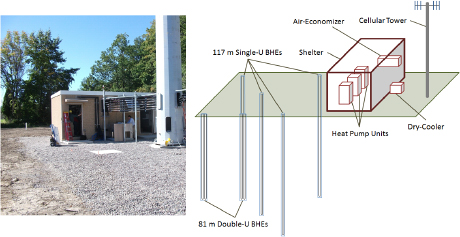
    Left: The Cornell-Verizon cellular tower shelter demonstration project during the final phase of construction. Right: Schematic layout of the geothermal heat pump setup.

    A cell phone tower on Cornell’s campus is doubling as a laboratory to study a ground-sourced cooling system for telecommunications equipment.

    In collaboration with Verizon Wireless, Cornell engineers led by graduate student Koenraad Beckers are testing a geothermal heat pump system to control the climate of cellular tower shelters. Already in many homes, geothermal heat pumps use stable underground temperatures to provide efficient space and water heating or cooling.

    The tower, located at the edge of Cornell Plantations, was completed in 2013 and looks like any other. But closer inspection will reveal the tower is equipped with a hybrid geothermal system: six heat exchangers buried underground and three water-to-air heat pumps inside the equipment shelter. Most cell phone towers use standard wall-mounted air conditioners for cooling.

    Beckers, whose adviser is Jeff Tester, the Croll Professor of Sustainable Energy Systems in the School of Chemical and Biomolecular Engineering, presented his theoretical modeling work and the design of the experiment at the International Energy Agency Heat Pump Conference in Montreal, May 12-16.

    The experimental setup includes a data-logging system to monitor behavior and performance of the geothermal reservoir and heat pumps, including the flow rate of each heat exchanger, the power consumption of different components, and ambient and shelter temperatures.

    The goal is to create a reliable, predictive model to allow engineers to assess the feasibility and economic viability of retrofitting a traditional tower with a new cooling system, using Ithaca as a test site, Beckers said. “Once we have a good model, then we can look at other places in the country.”

    During construction, Beckers led a seismic survey with several other students to assess the stratigraphy, or rock layers, of the reservoir. In addition, they collected rock cuttings from one borehole at 20-foot intervals during drilling to analyze ground composition.

    Besides the wells with heat exchangers, the experiment includes additional wells only for monitoring that are outfitted with temperature sensors at different depths.

    Tester expects data collection and testing to take several years.

    “It was a perfect opportunity for Verizon to get something useful out of this research, but it also made a lot of sense for us, because not much is known about this kind of system for cooling cell phone towers,” Tester said.

    Many students have benefitted from the project already, Tester added, by learning about geothermal heat pumps, performing reservoir modeling simulations, and participating in the seismic survey data collection.

    The research collaboration began several years ago when Verizon Communications CEO Lowell McAdam ’76 expressed interest in sustainable practices for the telecommunications giant. The Atkinson Center for a Sustainable Future hosted an exploratory roundtable discussion for McAdam, then CEO of Verizon Wireless, and a team of his managers. This resulted in an initial grant from the Verizon Foundation establishing several master’s-level “Verizon Sustainability Projects,” including the cell tower project.

    Since the original grant from the Verizon Foundation in 2010, McAdam has returned to campus multiple times, including this past fall as the Robert S. Hatfield Fellow in Economic Education

    Story Contacts

    Cornell Chronicle

    Anne Ju

    607- 255-9735

    amj8@cornell.edu

    Media Contact

    Syl Kacapyr

    607-255-7701

    vpk6@cornell.edu

  • Ponds ‘predict Arctic sea-ice melt’

    Ponds ‘predict Arctic sea-ice melt’

    By Jonathan Amos Science correspondent, BBC News

    Melt ponds on sea ice As the sea ice melts, ponds of water collect on top of the floes

    A UK team believes it can now make skilful predictions of how much sea ice will melt during Arctic summers.

    The scientists say the amount of water ponding on top of the floes as they warm in the spring has been shown to be an excellent indicator.

    Using their technique, the Reading University researchers reckon the minimum ice extent this September will be about 5.4 million square km.

    It is about the same as at the end of the melt season last year.

    The floes in the far north are the subject of intense study currently because of their rapid summer decline.

    Their extent has diminished from about 7 million square km in the 1990s to less than 5 million square km in five of the past seven years, with a record minimum of 3.6 million square km being set in 2012.

    But the year-to-year variation is large and the computer models in general have failed to capture the behaviour.

    Dark cover”The sort of three-month prediction we’re making would be useful for people who need to do operations in the Arctic, such as shipping companies for navigation purposes,” explained Prof Daniel Feltham, who leads the NERC Centre for Polar Observation and Modelling team at Reading.

    “But the physics we’re introducing will also, hopefully, help improve the climate models that look longer term,” he told BBC News.

    Sea ice The current rate of decline in September sea-ice cover is running at about 13% per decade

    Prof Feltham and colleagues have found a strong correlation between the fraction of the floes covered by pond water in May and the eventual sea-ice extent seen in September.

    The physical link is the change in reflectiveness, or albedo, brought about by the standing water.

    The ponds are darker than bare ice and therefore absorb more of the Sun’s energy, promoting further melting.

    Prof Feltham’s team has developed a model to forecast the evolution of melt ponds in the Arctic and has incorporated this into more general climate sea-ice models.

    Satellite records show that the year with smallest pond fraction in late spring (11% in 1996) had the biggest sea ice extent in September; and the year with the largest pond fraction (34% in 2012) featured the all-time low extent come the autumn.

    The team published its ideas in a recent edition of the journal Nature Climate Change.

    Southern differencesNow, it has put out its first open forecast for this September of 5.4 million square km, give or take half a million.

    It compares with 5.35 million square km averaged across September last year.

    “What could knock our prediction off course? Weather conditions, certainly. If we have anomalously cold conditions, we would expect the ice extent to be higher; or if we had very stormy conditions, like they did in August 2012 – that could diverge the ice and encourage more melting,” he said.

    In contrast to the Arctic, the Antarctic is currently showing an alternative trend, with the winter maximum extent growing to record levels.

    How useful the Reading technique would be in predicting the region’s summer minimums is uncertain.

    The factors that control the floes in the south are different to those in the north, and already they diminish to very low extents by autumn as a matter of course anyway.

    A New Zealand-led team recently demonstrated that the choppiness of Southern Ocean water could have a moderating impact on the growth of sea ice around Antarctica.

    The Reading number has been submitted to Arctic Research Consortium of the United States (ARCUS) Sea Ice Prediction Network. This has become a kind of annual academic “competition” run between scientists who study the Arctic to see whose forecast most closely matches the eventual outcome.

    Jonathan.Amos-INTERNET@bbc.co.uk and follow me on Twitter: @BBCAmos

    More on This Story

    Related Stories


  • An Ounce of Hope is Worth a Ton of Despair MONBIOT

    1 of 44
    Why this ad?
    Australian Postgrad Awardhdr.mq.edu.au – Apply for a higher degree research scholarship at Macquarie University

    Monbiot.com

    Inbox
    x

    George Monbiot news@monbiot.com via google.com

    5:10 PM (5 minutes ago)

    to me

    Monbiot.com


    An Ounce of Hope is Worth a Ton of Despair

    Posted: 16 Jun 2014 10:58 AM PDT

    We cannot reach people by terrifying them; there has to be a positive agenda.
    By George Monbiot, published in the Guardian 17th June 2014

    If we had set out to alienate and antagonise the people we’ve been trying to reach, we could scarcely have done it better. This is how I feel, looking back on the past few decades of environmental campaigning, including my own.

    This thought is prompted by responses to the column I wrote last week. It examined the psychological illiteracy that’s driving left-wing politics into oblivion(1). It argued that the failure by Labour and Democratic strategists to listen to psychologists and cognitive linguists has resulted in a terrible mistake: the belief that they can best secure their survival by narrowing the distance between themselves and their conservative opponents.

    Twenty years of research, comprehensively ignored by these parties, reveals that shifts such as privatisation and cutting essential public services strongly promote people’s extrinsic values (an attraction to power, prestige, image and status) while suppressing intrinsic values (intimacy, kindness, self-acceptance, independent thought and action). As extrinsic values are powerfully linked to conservative politics, pursuing policies that reinforce them is blatantly self-destructive.

    One of the drivers of extrinsic values is a sense of threat. Experimental work suggests that when fears are whipped up, they trigger an instinctive survival response(2). You suppress your concern for other people and focus on your own interests. Conservative strategists seem to know this, which is why they emphasise crime, terrorism, deficits and immigration.

    “Isn’t this what you’ve spent your life doing?”, several people asked. “Emphasising threats?” It took me a while. If threats promote extrinsic values and if (as the research strongly suggests) extrinsic values are linked to a lack of interest in the state of the living planet(3), I’ve been engaged in contradiction and futility. For about 30 years.

    The threats, of course, are of a different nature: climate breakdown, mass extinction, pollution and the rest. And they are real. But there’s no obvious reason why the results should be different. Terrify the living daylights out of people and they will protect themselves at the expense of others and of the living world.

    It’s an issue taken up in a report by several green groups called Common Cause for Nature(4). “Provoking feelings of threat, fear or loss may successfully raise the profile of an issue,” but “these feelings may leave people feeling helpless and increasingly demotivated, or even inclined to actively avoid the issue.” People respond to feelings of insecurity “by attempting to exert control elsewhere, or retreating into materialistic comforts”.

    Where we have not used threat and terror, we have tried money: an even graver mistake. Nothing could better reinforce extrinsic values than putting a price on nature, or making similar appeals to financial self-interest(5). And it doesn’t work, even on its own terms. A study published in Nature Climate Change, for example, tested two notices placed in a filling station(6). One asked, “Want to protect the environment? Check your car’s tyre pressure”. The other tried, “Want to save money? Check your car’s tyre pressure”. The first was quite effective, the second entirely useless.

    We’ve tended to assume that people are more selfish than they really are. Surveys across 60 countries show that most people consistently hold concern for others, tolerance, kindness and thinking for themselves to be more important than wealth, image and power(7). But those whose voices are loudest belong to a small minority with the opposite set of values. And often, idiotically, we have sought to appease them.

    This is a form of lying – to ourselves and other people. I don’t know anyone who became an environmentalist because she or he was worried about ecological impacts on their bank balance. Almost everyone I know in this field is motivated by something completely different: the love and wonder and enchantment that nature inspires. Yet, perhaps because we fear we will not be taken seriously, we scarcely mention them. We hide our passions behind columns of figures, and if sometimes we come across as insincere there’s a reason for it. Sure, we need the numbers and the rigour and the science, but we should stop pretending that these came first.

    Without being fully conscious of the failure and frustration that’s been driving it, I’ve been trying, like others, to promote a positive environmentalism, based on promise, not threat. This is what rewilding, the mass restoration of ecosystems, is all about, and why I wrote my book Feral, which is a manifesto for rewilding – and for wonder and enchantment and love of the natural world(8). But I’m beginning to see that this is not just another method: expounding a positive vision should be at the centre of attempts to protect the things we love(9). An ounce of hope is worth a ton of despair.

    Part of this means changing the language. The language we use to describe our relations with nature could scarcely be more alienating. “Reserve” is alienation itself, or at least detachment: think of what it means when you apply that word to people. “Site of special scientific interest”, “no take zone”, “ecosystem services”: these terms are a communications disaster. Even “environment” is a cold and distancing word, which creates no pictures. These days I tend to use natural world or living planet, which invoke vivid images. One of the many tasks for the rewilding campaign some of us will be launching in the next few months is to set up a working group to change the language. There’s a parallel here with the Landreader project by the photographer Dominick Tyler, which seeks to rescue beautiful words describing nature from obscurity(10).

    None of this is to suggest that we should not discuss the threats or pretend that the crises faced by this magnificent planet are not happening. Or that we should cease to employ rigorous research and statistics. What it means is that we should embed both the awareness of these threats and their scientific description in a different framework; one that emphasises the joy and awe to be found in the marvels at risk; one that proposes a better world, rather than (if we work really hard for it), just a slightly-less-shitty-one-than-there-would-otherwise-have-been.

    Above all, this means not abandoning ourselves to attempts to appease a minority who couldn’t give a cuss about the living world, but think only of their wealth and power. Be true to yourself, true to those around you, and you will find the necessary means of reaching others.

    www.monbiot.com

    References:

    1. http://www.theguardian.com/commentisfree/2014/jun/10/labour-britain-selfishness-market-inequality

    2. Kennon M. Sheldon and Tim Kasser, 2008. Psychological threat and extrinsic goal striving. Motivation and Emotion, 32:37–45. Doi: 10.1007/s11031-008-9081-5 http://www.selfdeterminationtheory.org/SDT/documents/2008_SheldonKasser_MOEM.pdf

    3. Tim Kasser, November 2011. Values and Human Wellbeing. The Bellagio Initiative. http://www.bellagioinitiative.org/wp-content/uploads/2011/10/Bellagio-Kasser.pdf

    4. Elena Blackmore & Tim Holmes (Eds); Elena Blackmore, Ralph Underhill, Jamie McQuilkin and Rosie Leach (Authors), 2013. Common Cause for Nature: values and frames in conservation. http://valuesandframes.org/initiative/nature/

    5. http://www.youtube.com/watch?v=ni1tX0bpTR8

    6. J.W. Bolderdijk et al, April 2013. Comparing the effectiveness of monetary versus moral motives in environmental campaigning. Nature Climate Change, Vol 3, pp413-416. http://www.nature.com/nclimate/journal/v3/n4/full/nclimate1767.html

    7. Elena Blackmore & Tim Holmes (Eds); Elena Blackmore, Ralph Underhill, Jamie McQuilkin and Rosie Leach (Authors), 2013. Common Cause for Nature: values and frames in conservation. http://valuesandframes.org/initiative/nature/

    8. http://www.monbiot.com/2013/05/24/feral-searching-for-enchantment-on-the-frontiers-of-rewilding/

    9. See also David M. Carter, 2011. Recognizing the Role of Positive Emotions in Fostering Environmentally Responsible Behaviors. Ecopsychology Vol. 3 No. 1, pp.65-69. doi: 10.1089/eco.2010.0071

    10. http://www.theguardian.com/environment/shortcuts/2014/jun/15/cows-belly-quest-revive-lost-language-natural-world

  • Daily update: Australia’s power struggle: Old politics vs new energy

    Click here to enable desktop notifications for Gmail.   Learn more  Hide
    1 of 3
    Why this ad?
    Your Local Solar Experts.www.saegroup.com – Get Your Quality Solar System Now Experienced Installers & Best Price

    Daily update: Australia’s power struggle: Old politics vs new energy

    Inbox
    x

    Renew Economy editor@reneweconomy.com.au via mail9.atl111.rsgsv.net

    1:54 PM (9 minutes ago)

    to me
    Politicians – the past and the future of energy, Australian coal plants obsolete in carbon race, Graph of the Day, Batteries & PV to create an unstoppable hybrid force? New moves in global climate talks, Air conditioner use in cities trigger vicious cycle, and Climate change gets a very graphic novel.
    Is this email not displaying correctly?
    View it in your browser.
    RenewEconomy Daily News
    The Parkinson Report
    Old paradigms, investment errors and vested interests are the major roadblocks holding back Australia’s clean energy energy transition – according to two of Australia’s most energy-literate politicians.
    Report by ex-Origin Energy executive calls for urgent reform of Australian electricity network, to replace ‘old, inefficient, costly’ coal-fired generation.
    How far behind is Australia lagging in the global solar race?
    Sunshine Coast warns removing RET would threaten council-led initiatives, like its 10MW solar plans, to protect ratepayers from rising electricity prices.
    Once a dominant force in solar, batteries were pushed aside in favor of grid-tied systems. But that dynamic may be changing.
    Latest round of international climate negotiations concluded in Germany, with talks are inching towards new agreement in Paris.
    Researchers in US say city-dwellers are inadvertently stoking up heat of the night – by installing air conditioners.
    French author Philippe Squarzoni condenses the climate saga into a 484-page graphic novel. Can he make it sing?
  • New report: Australia’s electricity sector ageing, inefficient & unprepared

    More

    1 of 2
    Why this ad?
    Compare Electricity Plansiselect.com.au/Electricity – Find a Range of Plans to Match Your Needs. You Could Save at iSelect.

    New report: Australia’s electricity sector ageing, inefficient & unprepared

    Inbox
    x

    Amanda McKenzie – Climate Council via sendgrid.info

    11:01 AM (1 hour ago)

    to me
    Hi Inga

    Earlier this morning Climate Councillors Professor Tim Flannery and Andrew Stock held a press conference in Sydney to launch a landmark report investigating the future of Australia’s electricity sector.

    The report’s findings are resounding: Australia’s electricity sector is ageing, inefficient, unprepared and requires urgent reform.

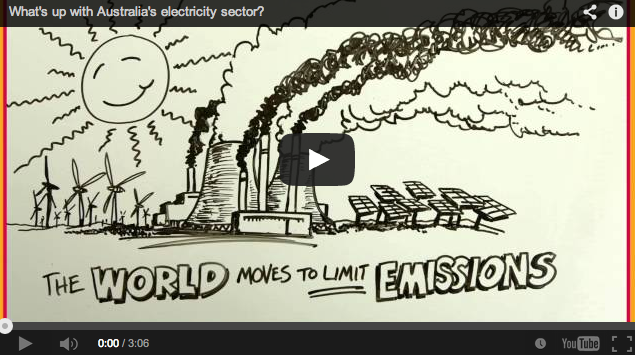
    It’s also clear that coal-fired power will struggle to compete economically with other sources of electricity as the world moves to limit emissions and that there are substantial opportunities for Australia in renewable energy, which is already lowering the cost of electricity

    See more of the top findings and watch the 3 minute video to get across the key points.

    VIDEO IMAGE

    The report comes at a time when electricity prices, renewable energy and coal-fired power are extremely topical issues in the public debate. The Climate Council’s latest report provides clear, authoritative expert information to inform the current discussions on the key issues facing the electricity sector.

    Read the key findings and download the full report now

    I’m particularly excited about this report as it responds to many requests we have had from the community to investigate issues in the electricity sector.

    It would not have been possible without the ongoing support of our incredible Founding Friends and the broader community. I urge you to keep an eye out for us in the media today and join the conversation by sharing these important findings with your friends & networks.

    Thank you for your support,

    Amanda McKenzie,
    Climate Council CEO

    P.S The Climate Council’s reports are 100% independent, crowd-funded and powered by community support. If you aren’t already, consider become one of our Founding Friends now at climatecouncil.org.au/donate. Your donation will power accurate information on climate change &