Category: Uncategorized

  • Daily update: Solar turns tables on Australia’s electricity markets

    Click here to enable desktop notifications for Gmail.   Learn more  Hide
    1 of 4
    Why this ad?
    3 Best Solar Power Quotessolarquotes.com.au/_Get_Free_Quotes – 1 Form – 2 Minutes – 3 Free Quotes. We Use 8,000 Reviews To Hand-Pick 3

    Daily update: Solar turns tables on Australia’s electricity markets

    Inbox
    x

    Renew Economy editor@reneweconomy.com.au via mail198.atl21.rsgsv.net

    3:09 PM (8 minutes ago)

    to me
    Solar turns tables on Australia’s electricity markets, The remarkable energy transition in SA, Does Tony Abbott believe the moon is made of cheese? Australia’s “best” wind energy project changes hands, World wind energy capacity to double by 2020, City of Sydney extends solar roll-out to historic Rocks, Nsw cuts solar tariffs as Qld lifts network costs, Communities and wind power, and Grid parity still doesn’t matter.
    Is this email not displaying correctly?
    View it in your browser.
    RenewEconomy Daily News
    The Parkinson Report
    Demand from Australia’s electricity grids is being downgraded again. The new data will be seized by incumbent generators to protect their interests, but they betray a fundamental, and essentially unstoppable, change in the way electricity is generated and delivered.
    South Australia is poised to become a world leading, textbook example of a clean energy transition, official demand forecasts suggest
    Obama says those who reject the science of climate change are akin to those who think the moon is made of cheese.
    Hornsdale, considered to be the “best” undeveloped wind project, sold to new consortium, and solar projects may follow.
    ACT opens bidding for 1MW of community-owned solar as a new coalition formed to tap into groundswell for community energy.
    Research firm Gobal Data has released figures stating that wind power will increase from from 319.6 Gigawatts (GW) at the end of 2013 to 678.5 GW by 2020.
    City of Sydney adds 82kW solar array to recreation centre in historic Rocks.
    IPART announces yet another cut to the recommended tariffs for export to the grid from rooftop solar owners.
    Community-owned projects has underpinned renewable energy in Europe and has major potential in Australia.
    PV + storage could be competitive with power from the grid by 2020 in Germany. The result
  • Ocean Currents Drive The World’s Climate

    Ocean Currents

    IT MUST BE REMEMBERED THAT SEA LEVEL RISE MAY NOT BE UNIFORM DUE TO THE CURRENTS DISTRIBUTIONS


    Ocean Currents Drive The World’s Climate

    By

    Ocean currents

    Ocean currents drive the water of the world ocean.

    Getty Images

    Ocean currents are the vertical or horizontal movement of both surface and deep water throughout the world’s oceans. Currents normally move in a specific direction and aid significantly in the circulation of the Earth’s moisture, the resultant weather, and water pollution.Oceanic currents are found all over the globe and vary in size, importance, and strength. Some of the more prominent currents include the California and Humboldt Currents in the Pacific, the Gulf Stream and Labrador Current in the Atlantic, and the Indian Monsoon Current in the Indian Ocean. These are just a sampling of the seventeen major surface currents found in the world’s oceans.

    The Types and Causes of Ocean Currents

    In addition to their varying size and strength, ocean currents differ in type. They can be either surface or deep water.Surface currents are those found in the upper 400 meters (1,300 feet) of the ocean and make up about 10% of all the water in the ocean. Surface currents are mostly caused by the wind because it creates friction as it moves over the water. This friction then forces the water to move in a spiral pattern, creating gyres. In the northern hemisphere, gyres move clockwise and in the southern they spin counterclockwise. The speed of surface currents is greatest closer to the ocean’s surface and decreases at about 100 meters (328 ft) below the surface.

    Because surface currents travel over long distances, the Coriolis force also plays a role in their movement and deflects them, further aiding in the creation of their circular pattern. Finally, gravity plays a role in the movement of surface currents because the top of the ocean is uneven. Mounds in the water form in areas where the water meets land, where water is warmer, or where two currents converge. Gravity then pushes this water down slope on the mounds and creates currents.

    Deep water currents, also called thermohaline circulation, are found below 400 meters and make up about 90% of the ocean. Like surface currents, gravity plays a role in the creation of deep water currents but these are mainly caused by density differences in the water.

    Density differences are a function of temperature and salinity. Warm water holds less salt than cold water so it is less dense and rises toward the surface while cold, salt laden water sinks. As the warm water rises though, the cold water is forced to rise through upwelling and fill the void left by the warm. By contrast, when cold water rises, it too leaves a void and the rising warm water is then forced, through downwelling, to descend and fill this empty space, creating thermohaline circulation.

    Thermohaline circulation is known as the Global Conveyor Belt because its circulation of warm and cold water acts as a submarine river and moves water throughout the ocean.

    Finally, seafloor topography and the shape of the ocean’s basins impact both surface and deep water currents as they restrict areas where water can move and “funnel” it into another.


    The Importance of Ocean Currents

    Because ocean currents circulate water worldwide, they have a significant impact on the movement of energy and moisture between the oceans and the atmosphere. As a result, they are important to the world’s weather. The Gulf Stream for example is a warm current that originates in the Gulf of Mexico and moves north toward Europe. Since it is full of warm water, the sea surface temperatures are warm, which keeps places like Europe warmer than other areas at similar latitudes.The Humboldt Current is another example of a current that affects weather. When this cold current is normally present off the coast of Chile and Peru, it creates extremely productive waters and keeps the coast cool and northern Chile arid. However, when it becomes disrupted, Chile’s climate is altered and it is believed that El Niño plays a role in its disturbance.

    Like the movement of energy and moisture, debris can also get trapped and moved around the world via currents. This can be man-made which is significant to the formation of trash islands or natural such as icebergs. The Labrador Current, which flows south out of the Arctic Ocean along the coasts of Newfoundland and Nova Scotia, is famous for moving icebergs into shipping lanes in the North Atlantic.

    Currents plan an important role in navigation as well. In addition to being able to avoid trash and icebergs, knowledge of currents is essential to the reduction of shipping costs and fuel consumption. Today, shipping companies and even sailing races often use currents to reduce time spent at sea.

    Finally, ocean currents are important to the distribution of the world’s sea life. Many species rely on currents to move them from one location to another whether it is for breeding or just simple movement over large areas.


    Ocean Currents as Alternative Energy

    Today, ocean currents are also gaining significance as a possible form of alternative energy. Because water is dense, it carries an enormous amount of energy that could possibly be captured and converted into a usable form through the use of water turbines. Currently this is an experimental technology being tested by the United States, Japan, China, and some European Union countries.Whether ocean currents are used as alternative energy, to reduce shipping costs, or in their natural to state to move species and weather worldwide, they are significant to geographers, meteorologists, and other scientists because they have a tremendous impact on the globe and earth-atmosphere relations.

    Watch an narrated slide show about ocean currents and their global impact from the National Oceanic and Atmospheric Administration.


  • Big trouble in the Antarctic has been brewing for a long time Climate Code Red David Spratt

    1 of 3
    Why this ad?
    $8k+ Debt Consolidationfoxsymes.com.au/Debt-Consolidation – Forget Loans & High Interest Rates. There Are Better Ways To Solve Debt

    climate code red

    Inbox
    x

    Climate Code Red noreply@blogger.com via google.com

    7:17 PM (24 minutes ago)

    to me

    climate code red


    Big trouble in the Antarctic has been brewing for a long time

    Posted: 15 Jun 2014 01:43 AM PDT

    by David Spratt

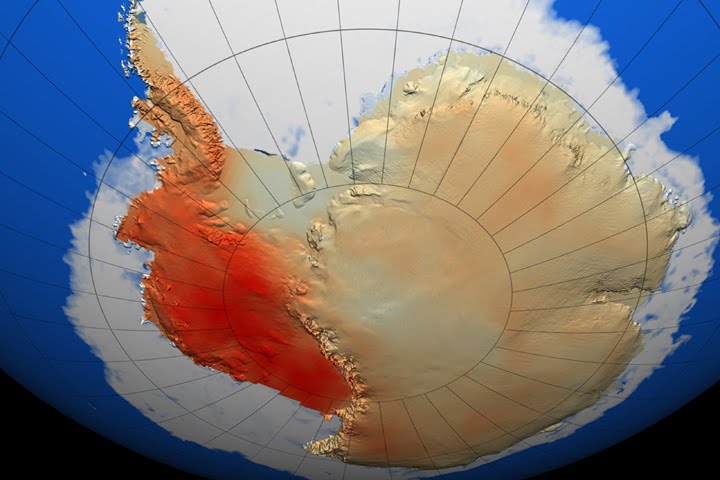
    “A game changer” is how climate scientist Dr Malte Meinshausen describes newly published research that West Antarctic glaciers have passed a tipping point much earlier than expected and their disintegration is now “unstoppable” at just the current level of global warming. The research findings have shocked the scientific community. “This Is What a Holy Shit Moment for Global Warming Looks Like,” ran a headline in Mother Jones magazine.

    In the Guardian, lead researcher Dr Eric Rignot explained:

    We announced that we had collected enough observations to conclude that the retreat of ice in the Amundsen sea sector of West Antarctica was unstoppable, with major consequences – it will mean that sea levels will rise one metre worldwide. What’s more, its disappearance will likely trigger the collapse of the rest of the West Antarctic ice sheet, which comes with a sea level rise of between three and five metres. Such an event will displace millions of people worldwide.

    But this news should not have come as a shock. In 2007 when we wrote “Climate Code Red”, Philip Sutton and I devoted a chapter to Antarctica, and surveyed scientists who were warning of this scenario. We quoted NASA climate chief James Hansen:

    We find it implausible that BAU [‘business-as-usual’] scenarios, with climate forcing and global warming exceeding those of the Pliocene, would permit a West Antarctic ice sheet of present size to survive  even for a century.

    As far back as 1968 John Mercer had predicted that the collapse of ice shelves along the Antarctic Peninsula could herald the loss of the ice sheet in West Antarctica, and 10 years later contended that: “a major disaster — a rapid deglaciation of West Antarctica — may be in progress … within about 50 years.”

    Such science was excluded from “mainstream” reports such as those of the IPCC, which systematically and embarrassing underestimated likely sea-level rises, with the most recent, 2013 report being no exception.

    It’s par for the course for climate policy-makers to hope for the best, rather than plan for the worst. More than once this blog has warned that sea-level rises are being underestimated by Australian policy-makers, and that the tens of millions of dollars being put into adaptation planning for sea-level rises of no more than 1.1 metres by 2100 will be a waste of money, and all that work will have to be done again. And now that has come to pass.

    It’s so dumb, but putting politics ahead of science has got us into this mess, and there is little sign that even peer-reviewed evidence that West Antarctic has passed a tipping point for partial or total collapse of its ice sheets will get those in power to acknowledge scientific reality.

    So here, for the record, is what we said back in late 2007.

    Climate Code Red (extract): Antarctica

    Big changes are also underway at the other end of the world, in the Antarctic, where most of the world’s ice sits on the fifth largest continent. The majority of Antarctic ice is contained in the East Antarctic ice sheet — the biggest slab of ice on Earth, which has been in place for some 20 million years and which, if fully melted, would raise sea levels by more than 60 metres.

    Considered more vulnerable is the smaller West Antarctic ice sheet, which contains one-tenth of the total Antarctic ice volume. If it disintegrated, it would raise sea levels by around 5 metres, a similar amount to what we would see with a total loss of the Greenland ice sheet.

    While it was generally anticipated that the West Antarctic sheet would be more stable than Greenland at a 1–2 degree rise, recent research demonstrates that the southern ice shelf reacts far more sensitively to warming temperatures than scientists had previously believed. Ice-core data from the Antarctic Geological Drilling joint project (being conducted by Germany, Italy, New Zealand, and the United States) shows that ‘massive melting’ must have occurred in the Antarctic three million years ago, during the Miocene–Pliocene period, when the average global temperature in the oceans increased by only 2–3 degrees above the present temperature. Geologist Lothar Viereck-Götte called the results ‘horrifying’, and suggested that ‘the ice caps are substantially more mobile and sensitive than we had assumed’.

    The heating effect caused by climate change is greatest at the poles, and the air over the West Antarctic peninsula has warmed nearly 6 degrees since 1950. At the same time, according to a report in the Washington Post on 22 October 2007, a warming sea is melting the ice-cap edges, and beech trees and grass are taking root on the ice fringes.

    Another warning sign was the rapid collapse in March 2002 of the 200-metre-thick Larsen B ice shelf, which had been stable for at least twelve thousand years, and which was the main outlet for glaciers draining from West Antarctica. An ice shelf is a floating sheet, or platform, of ice. Largely submerged, and up to a kilometre thick, the shelf abuts the land and is formed when glaciers or land-based ice flows into the sea. Generally, an ice shelf will lose volume by calving icebergs, but these are also subject to rapid disintegration events. Larsen B, weakened by water-filled cracks where its shelf attached to the Antarctic Peninsula, gave way in a matter of days, releasing five hundred billion tonnes of ice into the ocean.

    Neil Glasser of Aberystwyth University and Ted Scambos from the NSIDC found that as glacier fl ow had begun to increase during the 1990s, the ice shelf had become stressed. The warming of deep Southern Ocean currents (which increasingly reach the Antarctic coastline) had also led to some thinning of the shelf, making it more prone to breaking apart. Scambos concludes that ‘the unusually warm summer of 2002, part of a multi-decade trend of warming [that is] clearly tied to climate change, was the final straw’.

    Looking at the overall pace of events, Scambos says: ‘We thought the southern hemisphere climate is inherently more stable, [but] all of the time scales seem to be shortened now. These things can happen fairly quickly. A decade or two of warming is all you need to really change the mass balance … Things are on more of a hair trigger than we thought.’

    Much of the West Antarctic ice sheet sits on bedrock that is below sea level, buttressed on two sides by mountains, but held in place on the other two sides by the Ronne and Ross ice shelves; so, if the ice shelves that buttress the ice sheet disintegrate, sea water breeching the base of the ice sheet will hasten the rate of disintegration.

    In 1968, the Ohio State University glaciologist John Mercer warned, in the journal of the International Association of Scientific Hydrology, that the collapse of ice shelves along the Antarctic Peninsula could herald the loss of the ice sheet in West Antarctica. A decade later, in 1978, his views received a wider audience in Nature, where he wrote: ‘I contend that a major disaster — a rapid deglaciation of West Antarctica — may be in progress … within about 50 years.’ Mercer said that warming ‘above a critical level would remove all ice shelves, and consequently all ice grounded below sea level, resulting in the deglaciation of most of West Antarctica’. Such disintegration, once under way, would ‘probably be rapid, perhaps catastrophically so’, with most of the ice sheet lost in a century. Credited with coining the phrase ‘the greenhouse effect’ in the early 1960s, Mercer’s Antarctic prognosis was widely ignored and disparaged at the time, but this has changed.

    (James Hansen says it was not clear at the time whether Mercer or his many critics were correct, but those who labelled Mercer an alarmist were considered more authoritative and better able to get funding. Hansen believes funding constraints can inhibit scientific criticisms of the status quo. As he wrote in New Scientist on 28 July 2007: ‘I believe there is pressure on scientists to be conservative.’ Hansen is responsible for coining the term ‘The John Mercer Effect’, meaning to play down your findings for fear of losing access to funding or of being considered alarmist.)

    Another vulnerable place on the West Antarctic ice sheet is Pine Island Bay, where two large glaciers, Pine Island and Thwaites, drain about 40 per cent of the ice sheet into the sea. The glaciers are responding to rapid melting of their ice shelves and their rate of fl ow has doubled, whilst the rate of mass loss of ice from their catchment has now tripled. NASA glaciologist Eric Rignot has studied the Pine Island glacier, and his work has led climate writer Fred Pearce to conclude that ‘the glacier is primed for runaway destruction’. Pearce also notes the work of Terry Hughes of the University of Maine, who says that the collapse of the Pine Island and Thwaites glaciers — already the biggest causes of global sea-level rises — could destabilise the whole of the West Antarctic ice sheet. Pearce is also swayed by geologist Richard Alley, who says there is ‘a possibility that the West Antarctic ice sheet could collapse and raise sea levels by 6 yards [5.5 metres]’, this century.

    Hansen and fellow NASA Goddard Institute for Space Studies researcher Makiko Sato agree:

    The gravest threat we foresee starts with surface melt on West Antarctica, and interaction among positive feedbacks leading to catastrophic ice loss. Warming in West Antarctica in recent decades has been limited by effects of stratospheric ozone depletion. However, climate projections find surface warming in West Antarctica and warming of nearby ocean at depths that may attack buttressing ice shelves. Loss of ice shelves allows more rapid discharge from ice streams, in turn a lowering and warming of the ice sheet surface, and increased surface melt. Rising sea level helps unhinge the ice from pinning points … Attention has focused on Greenland, but the most recent gravity data indicate comparable mass loss from West Antarctica. We find it implausible that BAU [‘business-as-usual’] scenarios, with climate forcing and global warming exceeding those of the Pliocene, would permit a West Antarctic ice sheet of present size to survive  even for a century.

    Even in East Antarctica, where total ice loss would produce a sea-level rise of 60 metres, mass loss near the coast is greater than the mass increase inland (mass increase inland is caused by the extra snowfall generated from warming-induced increases in air humidity).

    While the inland of East Antarctica has cooled during the last 20 years, the coast has become warmer, with melting occurring 900 kilometres from the coast and in the Transantarctic Mountains, which rise up to an altitude of 2 kilometres.

    Research published in January 2008 by Rignot and six of his colleagues shows that ice loss in Antarctica has increased by 75 per cent in the last ten years due to a speed-up in the flow of its glaciers, so that the ice loss there is now nearly a great as that observed in Greenland.

  • Hansen Web Page and Reports.

    Uncategorized By Neville On March 23, 2014

    Hansen Web Page and Reports. Posted in Uncategorized By Neville On March 23, 2014

    Posted in Uncategorized By Neville On May 27, 2014

    Posted in Uncategorized By Neville On March 23, 2014

    Hansen Web Page and Reports. Posted in Uncategorized By Neville On March 23, 2014

    Posted in Uncategorized By Neville On April 24, 2014

    23 Mar 2014
    Home  »  Uncategorized   »   Hansen Web Page and Reports.

    Hansen Web Page and Reports.

    Posted in Uncategorized By Neville On March 23, 2014

    Home  »  Uncategorized   »   Hansen Web Page and Reports.

    Hansen Web Page and Reports.

    Posted in Uncategorized By Neville On March 17, 2014

    Home  »  Uncategorized   »   Hansen Web Page and Reports.

    Hansen Web Page and Reports.

    Posted in Uncategorized By Neville On March 13, 2014

    Home  »  Uncategorized   »   Hansen Web Page and Reports.

    Hansen Web Page and Reports.

    Posted in Uncategorized By Neville On March 1, 2014

    Dr. James E. Hansen

    Columbia University
    Earth Institute
    475 Riverside Drive
    New York, NY 10115 USA
    E-mail: jeh1@columbia.edu

    “Storms of My Grandchildren”, by James Hansen

    On the webpage “Updating the Climate Science: What Path is the Real World Following?”, Drs. Makiko Sato and James Hansen update figures in the book Storms of My Grandchildren (see LA Times review) and present updated graphs and discussion of key quantities that help provide understanding of how climate change is developing and how effective or ineffective global actions are in affecting climate forcings and future climate change. A few errata in Storms are also provided.

    Near Future Presentations

    Recent Communications

    Dr. Hansen periodically posts commentary on his recent papers and presentations and on other topics of interest to an e-mail list. To receive announcements of new postings, please click here.

    Go to older postings

    Recent Scholarly Publications

    Hansen, J., P. Kharecha, M. Sato, V. Masson-Delmotte, et al., Assessing “Dangerous Climate Change”: Required Reduction of Carbon Emissions to Protect Young People, Future Generations and Nature. PLOS ONE, 8, e81468.


    Hansen, J., M. Sato, G. Russell, and P. Kharecha, 2013: Climate sensitivity, sea level, and atmospheric carbon dioxide. Phil. Trans. R. Soc. A, 371, 20120294, doi:10.1098/rsta.2012.0294.

    Go to older publications

    Other Recent Publications

    Apr. 4, 2013: Keystone XL: The pipeline to disaster. Op-ed in the Los Angeles Times.

    Go to older publications

    Recent Presentations

    February 2014: Symposium on a New Type of Major Power Relationship: Presentation given at Counsellors Office of the State Council, Beijin, China on Feb. 24.
    + Download PDF (3.5 MB)

    December 2013: Minimizing Irreversible Impacts of Human-Made Climate Change: Presentation given at AGU Fall Meeting on Dec. 12.
    + Download PDF (4.3 MB)

    September 2012: A New Age of Risk: Presentation given at Columbia University on Sep. 22.
    + Download PDF (2.1 MB)
    + Download PPT (2.5 MB)

    Go to older presentations

    Recent TV Appearance

    in Recent News

    Recent Video

    December 2012: Discussion at Climate One about Superstorm Sandy and Carbon Pricing.

    Go to older video