Category: Uncategorized

  • Geology com news 13 items

    1 of 3
    Why this ad?
    Credit Card Magento Storehotextension.com – CommonWealth ANZBank Gateway Integrate Directly Magento Store

    Geology.com News – 13 Topics

    Inbox
    x

    Geology News fb@geology.com via google.com

    7:17 PM (30 minutes ago)

    to me

    Geology.com News – 13 Topics

    Link to Geology News

    The Geology of D-Day

    Posted: 06 Jun 2014 10:07 AM PDT

    Today is the 70th anniversary of the D-Day invasion. Scientific American has an interesting article titled “The Geology of D-Day“.

    Shrapnel in Omaha Beach Sand

    Posted: 06 Jun 2014 10:00 AM PDT

    The September 2011 issue of The Sedimentary Record has an article titled: “Shrapnel in Omaha Beach Sand“.

    Anadarko Has 1000 Eagle Ford Wells

    Posted: 06 Jun 2014 07:43 AM PDT

    Anadarko Petroleum has drilled over 1000 wells in the Eagle Ford Shale and is completing an average of one well per day.

    Related: What is the Eagle Ford Shale?

    New Suspect in Supernova Explosion

    Posted: 06 Jun 2014 07:42 AM PDT

    “There were no witnesses to a stellar blast that lit up our skies a millennium ago, but NASA’s Spitzer Space Telescope is finding clues in the charred remains.” Quote from the NASA press release.

    Kansas Oil and Gas at $4B/year

    Posted: 06 Jun 2014 07:40 AM PDT

    “The Kansas Geological Survey estimates the cumulative value of the state’s oil production at $4.1 billion in 2013, up from $3.7 billion in 2012.” Quote from the Wichita Business Journal.

    Consol: Moving from Coal to Natural Gas

    Posted: 06 Jun 2014 07:40 AM PDT

    “Consol Energy has a 9,000-acre sweet spot containing an estimated 1 Tcf of Marcellus Shale natural gas just outside its Pittsburgh headquarters.” Quoted from the Platts.com article.

    Energy Policy Can Fuel Economies

    Posted: 06 Jun 2014 07:38 AM PDT

    “Alaska is one of the best examples of how energy policy can change not just the trajectory of energy production, but how it can greatly improve the enhance the lives and livelihoods of its citizens.” Comment by Jack Gerard, President of the American Petroleum Institute.

    Higher Landslide Incidence Expected in Colorado

    Posted: 06 Jun 2014 06:56 AM PDT

    “Higher-than-average snowpack, climbing temperatures, and an increase in the wet and wild rainstorms called microbursts are saturating slopes and taking the brakes off masses of unstable soils.” Quoted from The Denver Post.

    Photos: Lava on Pavlof

    Posted: 06 Jun 2014 05:00 AM PDT

    Alaska’s Pavlof Volcano has been erupting for the past week. The Alaska Volcano Observatory has a number of photos that show lava fountaining, ash plumes and other features of the eruption, which so far has been low level.

    Related: Pavlof Volcano article

    Landslide Closes Historic Columbia River Highway

    Posted: 06 Jun 2014 04:47 AM PDT

    “A landslide shut down the Historic Columbia River Highway east of the Stark St. Bridge, June 5, 2014.” The highway is expected to reopen in a few days.

    Produce Where You Have Infrastructure Support

    Posted: 06 Jun 2014 04:44 AM PDT

    “Magnum Hunter is focusing on the Marcellus and Utica shale plays more than North Dakota because its Eureka Hunter subsidiary has pipeline there to easily move its product.” Quote from the Biz Journal article.

    How to Prepare for Hurricane Season

    Posted: 06 Jun 2014 04:43 AM PDT

    The USA.gov blog has an article titled: “How to Prepare for Hurricane Season”.

    What is El Niño?

    Posted: 06 Jun 2014 04:39 AM PDT

    The National Science Foundation has an article that answers twelve basic questions about El Niño? If you want to learn a lot about El Niño in just five minutes, this is a good thing to read.


    NOAA Image

  • Ripping Apart the Fabric of the Nation MONBIOT

    1 of 44
    Why this ad?
    Mining is Hiring Urgentlywww.australia-mining.com – Jobs average $100k+. No experience positions available also. Apply now

    Monbiot.com

    Inbox
    x

    George Monbiot news@monbiot.com via google.com

    5:05 PM (3 minutes ago)

    to me

    Monbiot.com


    Ripping Apart the Fabric of the Nation

    Posted: 05 Jun 2014 05:19 AM PDT

    In an extraordinary coup, farmers’ unions and the UK government have torpedoed the European Soil Framework Directive


    By George Monbiot, published on the Guardian’s website, 5th June 2014

    “British soils are reaching crisis point”. Don’t take my word for it – this is a quote from a loyal friend of the farming industry, Farmers’ Weekly.

    You would expect farmers to try to protect their soils, which are the foundations of their livelihood, and many do. There are some excellent farmers in Britain, careful, well-informed and always thinking of the future. But across large areas of land, short-termism now triumphs over common sense. Farmers are often in debt to the banks, and seek to clear that debt as quickly as they can. Many are growing crops that are simply incompatible with protecting the soil. Some don’t seem to know very much about soil erosion and why it happens. Others – especially contract farmers working on other people’s land – don’t seem to care. Sensible land use is giving way to smash-and grab-exploitation.

    I always flinch at the name given to soil in the US: dirt. Here there’s a similar conflation: something dirty is said to have been soiled. But soil is a remarkable substance, a delicately-structured cushion between rock and air, formed from thousands of years of physical and biological processes. It supports an ecosystem that turns unusable materials into plant food, it stores carbon, filters water and protects us from floods. Oh, and there’s the small consideration that without it we would starve. It is, as it takes so long to re-form once it is lost, effectively non-renewable.

    Yet this great gift of nature is being squandered at a horrifying rate. One study suggests that soil in Devon is being lost at the rate of five tonnes per hectare per year. There are several reasons for this, mostly to do with bad practice, but the problem has been exacerbated by an increase in the cultivation of maize.

    Like the growing of potatoes, maize cultivation with conventional methods in this country is a perfect formula for ripping the soil off the land, as the ground is ploughed deeply then left almost bare for several months. A study in south-west England suggests that the soil structure has broken down in 75% of the maize fields there. Maize cultivation has expanded from 1,400 hectares to 160,000 since 1970. It is not grown to feed people, but to feed livestock and to supply anaerobic digestion plants producing biogas. If the National Farmers’ Union gets its way, maize growing will expand by another 100,000 hectares in the next six years, solely to make biogas.

    Subsidies which were meant to encourage farmers to turn their slurry and crop wastes into biogas – a sensible and commendable idea – are instead being used to grow virgin feedstocks on the best arable land. Across the European Union, thanks to this perverse incentive, virgin crops (mostly maize) now account for 55% of all the feedstock being poured into biogas plants. Our soils are being torn apart for no good reason.

    Soil erosion and an associated problem, soil compaction – mostly caused by using heavy machinery in the wrong conditions – is a major contributor to floods. Rain percolates into soils whose structure is intact, but flashes off fields where the structure has broken down, taking the soil – and the pesticides and fertiliser – with it. This means that the rivers fill up more quickly with both water and silt (which is what we call soil once it has entered a waterway). Siltation blocks channels and smothers the places where wildlife lives, including the gravel beds where fish spawn.

    In some parts of Britain, soil erosion is now so severe that it causes floods without the help of exceptional rainfall, as saturated fields simply slump down the slopes into the houses below. In some places, soil compaction has increased the rate of instant run-off from 2% of all the rain that falls on the land to 60%.

    All this is a result of a complete failure of effective regulation. The only rules that seek to protect soils in this country are the conditions applied to farm subsidies, which are called cross compliance. Just as social security claimants have to abide by certain rules in order to qualify for public money, so, in theory, farmers are meant to meet certain conditions in return for their much larger pay-outs. But while the rules applied to social security have been tightened to the point at which they have become degrading and oppressive, the rules attached to farm subsidies have been loosened by Defra, the environment department, until they are almost useless.

    What they now amount to in practice is filling out the Soil Protection Review, a booklet or online form in which you state how well you are looking after your soil. Rural Payments Agency inspectors, whose job is to ensure that farmers aren’t taking public money while also taking the piss, visit 1% of farms a year, which means, on average, that a farm can expect a visit once every century. They seldom check whether there is any connection between what the farmer has written on the form and what is happening on the farm.

    And even if there is a problem, they can’t do anything about it. As the Rivers Trust notes,

    “the Soil Protection Review is an unenforceable mechanism because provided a farmer has completed his SPR, identified a risk level for each field and allocated the appropriate number of optional measures, he cannot be deemed non-compliant even if he is causing a significant soil erosion problem on his farm.”

    You doubt it can be as bad as this? Then take a look at this exchange between two farmers on The Farming Forum:

    Question: “Is the Soil Protection Review the biggest load of red tape codswallop that Defra have ever written? Farmers do have common sense, so this should be scrapped.”

    Response: ” … The Soil Management Review is an entirely paperwork based affair that Defra invented to satisfy the EU that they were ‘doing something’ about soil management, without actually doing anything. In fact its an example of the UK civil service learning from our European cousins about how to play the EU system without hamstringing the people on the ground. … Defra only want to see that it’s been filled in, that’s it. They will fine you if you don’t so they can say to their EU masters ‘Look we’re enforcing the rules like you told us too’. But beyond that they pretty much let the farmers get on with it. They know we fill the thing in at the end of the year with any old rubbish – they don’t care, as long as the farm doesn’t look like a warzone. Its the ultimate in ‘We pretend to abide by the rules, and you pretend to enforce the rules, and everyone’s happy’ concepts. Take 10 mins to fill your form in once a year and be very glad Defra have decided this is the way to go”.

    Yet even this is now deemed too onerous. Soon after it took office, the Coalition government set up a Farming Regulation Task Force, chaired by a former director-general of the National Farmers Union. I’ve come across plenty of self-serving reports by old boys’ networks, but seldom anything as bad as this. It insisted that “food and farming businesses must be freed from unnecessary bureaucracy”, by which it appeared to mean almost any regulation at all. “Government must trust industry … we suggest that Government should invite industry to play a leading role in drafting guidance.”

    On protecting the soil, it had this to say:

    “We recommend: that the Soil Protection Review becomes voluntary … not completing the Review correctly (or at all) should not result in a breach”.

    In other words, give us the subsidies, but please remove the last remaining conditions attached to them. We want your money, no strings attached. Imagine how the government would respond to a report by ordinary benefit claimants, making the same demand.

    But these are landowners, and an entirely different set of political rules apply.

    At this year’s conference of the National Farmers’ Union, the farming minister, George Eustice, announced that

    “I want to bear down on the burden of regulation today. We’ve just published the conclusion to the Red Tape Challenge on Agriculture. In total we will scrap 156 regulations and simplify 134 more. And we’re going to slash guidance.”

    There will, he promised, be even fewer farm inspections (fewer than one per century, in other words). If, by some miracle, a farmer is found to be in breach of rules so feeble that they’re almost impossible to break, Eustice promised that they would lose as few of their subsidies as he could manage: “We are pushing hard at an EU level for sanctions and penalties to be more proportionate.”

    That is the sum total of the protection given to our soils in the UK: no meaningful protection at all.

    You may detest the European Union and all its works, but I think even the most indurated sceptic would struggle to explain what was wrong with the measures it proposed for defending soils. Since 2006 it has been seeking to extend to soil the same basic protections which now apply to air and water. To this end it drafted something called the Soil Framework Directive.

    The draft directive asked the member states to take precautions to minimise soil erosion and compaction, to maintain the organic matter soil contains, to prevent landslides and to prevent soil from being contaminated with toxic substances. Terrified yet?

    At the end of last month, unreported by any British newspaper or broadcaster, something unprecedented happened: a European legislative proposal was withdrawn. The Soil Framework Directive has been scrapped.

    The National Farmers’ Union took credit for the decision.

    “From the early stages of the negotiations on the draft Soils Directive, and since the halt on its progress at the end of 2007, the NFU has actively called for these proposals to be thrown out. Our long held and firm belief has been that there is no need for additional legislation in this area – soils in the UK, and across the EU, are already protected by a range of laws and other measures”.

    For eight years the NFU and its counterparts in other European nations lobbied against the directive. They were supported by a small number of member states, led by the United Kingdom. Both the Labour and Coalition governments collaborated with the union on this project. Under these administrations, Defra, the Department for Environment, Food and Rural Affairs, has been captured by the industry it is supposed to regulate, until it now stands for Doing Everything Farmers’ Representatives Ask.

    Farmers’ Weekly, which must have forgotten that “British soils are reaching crisis point”, celebrated with the headline “Red tape victory as soils rules axed”.

    The people who got this directive ditched claim to love their country. But they’ve ensured that it will continue to run down the rivers and into the sea. You want to get Britain out of Europe? Well how about ensuring that our soils stop ending up on the coastlines of France and Holland and Germany?

    Where is the “range of laws and other measures” which, the NFU claims, already protect our soils? There are words on paper, but nothing that amounts to anything resembling actual protection.

    So goodbye fertility. Goodbye to the land’s capacity to absorb and filter water, hold carbon and support crops. Goodbye to clean and healthy rivers. If the NFU and the British government had set out to damage the interests of this country they could scarcely have done a better job. Their work is a monument to short-termism and stupidity. Remember, next time you hear them say that Britain should produce as much of our food as it can, how they have helped to destroy our capacity to do so.

    George Monbiot’s book Feral: rewilding the land, sea and human life is published in paperback this week.

    www.monbiot.com

  • Daily update: Who is the greenest energy retailer in Australia? RENEW ECONOMY

    1 of 3
    Why this ad?
    Compare Electricity Plansiselect.com.au/Electricity – Find a Range of Plans to Match Your Needs. You Could Save at iSelect.

    Daily update: Who is the greenest energy retailer in Australia?

    Inbox
    x

    Renew Economy editor@reneweconomy.com.au via mail68.us2.rsgsv.net

    1:56 PM (5 minutes ago)

    to me
    The greenest energy retailer in Australia, Outdated power proving burden on Aus households, Aus urged to aim for 50+% renewables by 2030, CEFC dedicates $50m to WA waste-to-energy projects, Aus coal industry at risk as major powers act on fossil fuels, RET road trip #7, Can light-weight cars be made of “renewable” bamboo? and Major greenhouse threat from new CFCs found in air.
    Is this email not displaying correctly?
    View it in your browser.
    RenewEconomy Daily News
    The Parkinson Report
    “Who is the greenest energy retailers of them all?” It is a question commonly posed to RE, so we decided to use the retailers’ submissions to the renewable energy target to help you be the judge. Most want the RET to be cut.
    Australia’s electricity network operators wedded to pricing model that drives up cost of supply, benefiting oldest, outdated and inflexible baseload coal plants. There are alternatives.
    Leading international agency says Australia should become one of world leaders in renewables, arguing that the world could double renewable capacity by 2030, save money and slash emissions in the process.
    The CEFC says it will provide up to $50m in debt finance towards development of two Australian designed waste-to-gas facilities in Western Australia.
    The Australian coal industry is at significant financial risk of stranded assets as major global powers act on climate change.
    The RET road trip visits solar homeowners in the affluent bayside suburb of Brighton East.
    Could bamboo replace carbon fiber in many common auto-industry applications in the near future?
    Thirty years of air samples show three new CFC gases potentially 10,000 times more potent than
  • Climate change to erode home values, double insurance premiums

    the 5th estate

    SEARCH

    Climate change to erode home values, double insurance premiums

    Share/Save/Bookmark

    Insurance premiums are predicted to double due to climate change.

    By Cameron Jewell

    5 June 2014 — Climate change-fuelled extreme weather events could lead to a doubling in insurance premiums and reduce home values by more than 20 per cent, new research from The Climate Institute and consumer group CHOICE has revealed.

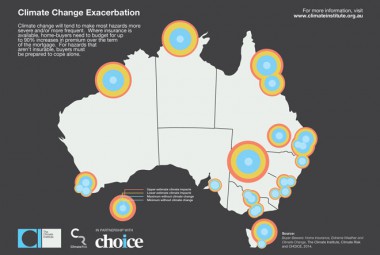
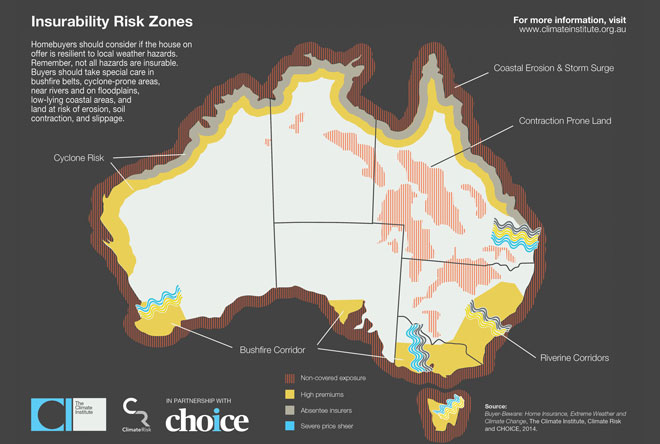
    The report, Buyers Beware: Home Insurance, Extreme Weather and Climate Change, found that some areas, like the cyclone prone north of Australia and even parts of major cities, already had premiums up to 10 times that of lower risk areas.

    And if the high end of climate change predictions turns out to be true – and there’s evidence suggesting we’re tracking along this path – insurance premiums could rise by an average 92 per cent by 2050, with the impact of insurability reducing home values by 20 per cent or more over the life of a standard 30-year mortgage.

    • A checklist for home buyers to gauge risk is provided below

    A growing threat

    Home insurability is quickly becoming a large problem for Australia. With extreme weather events from floods, bushfires, severe storms, cyclones, erosion, drought and seawater inundation increasingly affecting the security of homes, insurers have little choice but to raise premiums to cover the higher probability of paying out for losses, insurers say.

    On top of this many Australians are living in locations with high natural amenity, with high prices paid for homes along the coast, near rivers and backing on to, or within, bushland. Analysis by Risk Frontiers, for example, estimates there are 150,000 Australian addresses exposed to over ground flooding in a 1-in-100 year event.

    Some insurers are already refusing to offer insurance in these high-risk areas, and the report notes that both the affordability and availability of insurance is likely to decrease in response to increased climate and weather risks, which have been predicted by the CSIRO and Bureau of Meteorology.

    Australia is an expensive place to insure

    Already Australia accounts for a disproportionate amount of insured losses globally. While the country only accounts for two per cent of the global reinsurance market, it accounted for six per cent of global losses last year, according to data obtained from the Insurance Council of Australia.

    “This report warns homebuyers that they need to consider extreme weather risk and climate change very seriously,” Climate Institute chief executive John Connor said.

    “In high-risk locations, some home insurance policies are already unaffordable and there are insurers who won’t even offer policies at all.

    “This report finds that climate and extreme weather impacts add to Australians’ cost of living, with homeowners and buyers often unwittingly caught between failures by government and the marketplace to reveal information about the current risks and how they are projected to worsen.”

    Insurance affordability crisis

    CHOICE chief executive Alan Kirkland said that homeowners who unknowingly bought in high-risk areas could find themselves subjected to unaffordable insurance rates. Those currently in high-risk areas were feeling the pain too.

    “If you already own in a high-risk area, you need to be careful about the risks of underinsurance – otherwise you may find that your insurance payout is not enough to allow you to rebuild after a major event.”

    In fact, underinsured homes in high-risk could receive as little as half of what it would cost to build a new home resilient to local weather extremes and climate change.

    Insurance industry gets it, but investors and governments need to catch up

    While superannuation funds, some institutional investors and governments put their head in the sand regarding climate risk, the insurance industry is using its high-level risk analysis to price in climate risk – and because the risk is very real that translates into higher premiums.

    The whole community ends up paying

    But it is taxpayers who invariably end up footing the bill for extreme weather events and uninsured losses. The report noted that after the Queensland floods in 2011, Queensland taxpayers were levied an estimated $1.8 billion to help make up the $5.8 billion needed for relief and reconstruction.

    “The rising cost of insurance isn’t a problem just for homeowners and buyers, but rather it lumbers the whole community with a bigger financial burden, with governments often seen as the insurer-of-last-resort,” Mr Connor said. “Ultimately, it’s taxpayers – everyday Australians – who foot the bill when big, costly market failures like this are ignored.”

    Governments are doing little to help. A report released in March from the Intergovernmental Panel on Climate Change found that the lessons of past extreme weather events had not been learnt, exposing homeowners and homebuyers to risk.

    “Australia is a land of floods and fire, but this hasn’t prevented all tiers of government from allowing the development of many, many vulnerable homes in locations known to be at risk from floods, bushfires, severe storms, erosion, drought and seawater inundation,” Mr Connor said. “And unwitting homebuyers become the ultimate victim of this negligence.”

    The report noted that some governments did not require risk disclosure to buyers, and some laws made impeded the availability of risk information.

    “Recent legal changes in some states actually make it hard for local government to either protect buyers or inform them of emerging risks revealed by hazard modelling. A recent paper by legal firm DLA-Piper even suggests that the situation is going backward. Under a proposal in New South Wales, for example, councils without a policy on future hazards may not be permitted to include risk warnings in mandatory disclosure on 149(2) certificates, used during house conveyancing. Instead these warnings would be provided in advisory notices available upon request in 149(5) certificates. This type of change may help protect present property owners from having projected risks revealed at the point of sale, but it does so at the expense of new buyers.”

    The report called for governments to mandate the disclosure of all available hazard mapping, require that all dwellings and associated infrastructure be built or renovated as fit-for-purpose for the maximum projected impacts over their design life, disclose current and projected insurance premiums for a property at the point of sale, and disclose settlements where climate change risks would make future habitation untenable this century.

    Checklist

    There was some good news to come out of the report, the authors said. Potential property buyers could use insurability to gauge extreme weather risk and gain insight into whether climate change may exacerbate these risks.

    The report listed five insurability risk factors to watch out for:

    • Underinsurance – the insurance premium is inadequate to cover the cost of replacing the house to an equivalent level of amenity
    • Heightened premiums – the insurance premium of a property is significantly higher than for equivalent properties in other locations
    • Absentee insurers – one or more insurers refuse to provide standard online quotes for the property, location or region
    • Price sheer – the ratio of the highest quote to the lowest quote; a high ratio indicates an abnormal variation in premiums between insurers for the same level of cover
    • Non-covered exposure – a property that is exposed to hazards that are not covered by the insurance policies offered

    It also recommended potential homebuyers take into account the following:

    • ask local council whether the dwelling is in a location in which historic climate data puts it at risk from extreme weather impacts
    • check whether the dwelling will be exposed to rising extreme weather risk because of climate change
    • test the house against the five insurability risk indicators mentioned above
    • factor into the home purchase price the costs of adaptation, and current and future insurance price increases
    • avoid properties where insurance is uncertain, may become unaffordable or unavailable, or will lead to deterioration in property value

    The report was put together by Climate Risk, independent climate change adaptation analysts who last year developed a software platform to revalue property and infrastructure assets based on climate risk exposure.

    Read the full report.

    6 June, 2014

  • Atmospheric water generator From Wikipedia, the free encyclopedia

    Atmospheric water generator

    From Wikipedia, the free encyclopedia
    THESE CAN BE POWERED BY SOLAR

    An atmospheric water generator (AWG), is a device that extracts water from humid ambient air. Water vapor in the air is condensed by cooling the air below its dew point, exposing the air to desiccants, or pressurizing the air. Unlike a dehumidifier, an AWG is designed to render the water potable. AWGs are useful where pure drinking water is difficult or impossible to obtain, because there is almost always a small amount of water in the air that can be extracted. The two primary techniques in use are cooling and desiccants.

    The extraction of atmospheric water may not be completely free of cost, because significant input of energy is required to drive some AWG processes, sometimes called “trading oil for water”. Certain traditional AWG methods are completely passive, relying on natural temperature differences, and requiring no external energy source. Research has also developed AWG technologies to produce useful yields of water at a reduced (but non-zero) energy cost.

    History

    The Incas were able to sustain their culture above the rain line by collecting dew and channeling it to cisterns for later distribution. Historical records indicate the use of water-collecting fog fences. These traditional methods have usually been completely passive, requiring no external energy source other than naturally occurring temperature variations.

    Modern technologies

    Many atmospheric water generators operate in a manner very similar to that of a dehumidifier: air is passed over a cooled coil, causing water to condense. The rate of water production depends on the ambient temperature, humidity, the volume of air passing over the coil, and the machine’s capacity to cool the coil. These systems reduce air temperature, which in turn reduces the air’s capacity to carry water vapor. This is the most common technology in use, but when powered by coal-based electricity it has one of the worst carbon footprints of any water source (exceeding reverse osmosis seawater desalination by three orders of magnitude) and it demands more than four times as much water up the supply chain as it delivers to the user.[1]

    An alternative available technology uses liquid, or “wet” desiccants such as lithium chloride or lithium bromide to pull water from the air via hygroscopic processes.[2] A proposed similar technique combines the use of solid desiccants, such as silica gel and zeolite, with pressure condensation.

    Cooling condensation

    Example of cooling-condensation process.

    In a cooling condensation type atmospheric water generator, a compressor circulates refrigerant through a condenser and then an evaporator coil which cools the air surrounding it. This lowers the air temperature to its dew point, causing water to condense. A controlled-speed fan pushes filtered air over the coil. The resulting water is then passed into a holding tank with purification and filtration system to help keep the water pure and reduce the risk posed by viruses and bacteria which may be collected from the ambient air on the evaporator coil by the condensing water.[3]

    The rate at which water can be produced depends on relative humidity and ambient air temperature and size of the compressor. Atmospheric water generators become more effective as relative humidity and air temperature increase. As a rule of thumb, cooling condensation atmospheric water generators do not work efficiently when the temperature falls below 18.3°C (65°F) or the relative humidity drops below 30%. This means they are relatively inefficient when located inside air-conditioned offices. The cost-effectiveness of an atmospheric water generator depends on the capacity of the machine, local humidity and temperature conditions and the cost to power the unit.

    The Airdrop system consists of a mast-like tube with a wind-powered turbine that sucks air down into a coiled metal pipe buried in the earth. There, the air is cooled until it hits 100% humidity and the water starts to condense out. This technology is basically a cooling condensation system that takes advantage of the significant temperature difference between underground and the air above it. The inventor, Ed Linacre, was James Dyson Award Winner in 2011.[4] Video of Edward Linnacre’s AirDrop Irrigation

    Wet desiccation

    One form of wet desiccant water generation involves the use of salt in a concentrated brine solution to absorb the ambient humidity. These systems then extract the water from the solution and purify it for consumption. A version of this technology was developed as portable devices which run on generators. Large versions, mounted on trailers, are said to produce up to 1,200 US gallons (4,500 l) of water per day, at a ratio of up to 5 gallons of water per gallon of fuel.[5] This technology was contracted for use by the US Army and the US Navy from Terralab[citation needed] and the Federal Emergency Management Agency (FEMA).[6]

    A variation of this technology has been developed to be more environmentally friendly, primarily through the use of passive solar energy and gravity. Brine is streamed down the outside of towers, where it absorbs water from the air. The brine then enters a chamber and subjected to a vacuum and heated. The vacuum significantly lowers the boiling point of the brine, so the boiling process requires only a small amount of energy. The water vapor is collected and condensed, while the remaining brine is recirculated through the system. As the condensed water is removed from the system using gravity, it creates the vacuum which lowers the boiling point of the brine.[7]

    In greenhouses

    A special case is the water-generation in greenhouses because the air inside a greenhouse is much hotter and more humid than the outside. Particularly in climatic zones with water scarcity, a greenhouse can strongly enhance the conditions necessary for atmospheric water generation. Examples are the seawater greenhouse in Oman, and the proposed Integrated Biotectural System or IBTS-Greenhouse.

    In fiction

    In Star Wars, Luke Skywalker’s family on Tatooine used atmospheric water generation on their moisture farm.

    In the Star Trek: The Next Generation episode “The Inner Light“, Captain Picard suggests building “atmospheric condensers” for a planet experiencing prolonged drought.

    See also

    References

  • Composting toilet

    Composting toilet

    From Wikipedia, the free encyclopedia

    Public composting toilet facility on E6 highway in Sweden

    A composting toilet is a dry toilet that uses a predominantly aerobic processing system that treats excreta, typically with no water or small volumes of flush water, via composting or managed aerobic decomposition.[1] Composting toilets may be used as an alternative to flush toilets in situations where there is no suitable water supply or waste treatment facility available or to capture nutrients in human excreta as humanure. They are in use in many of the roadside facilities in Sweden and in national parks in both the United States and the United Kingdom.

    The human excrement is normally mixed with sawdust, coconut coir or peat moss to support aerobic processing, absorb liquids, and to reduce the odor. The decomposition process is generally faster than the anaerobic decomposition used in wet sewage treatment systems such as septic tanks.

    Operating process

    A urine-diverting-dehydration toilet. 1:Humus compartment, 2:Ventilation pipe, 3:Toilet seat, 4:Urinal, 5:Urine collection and dehydration, A:Second floor, B:First floor, C:Ground floor

    Although there are many designs, the process factors at work are the same. Rapid aerobic composting will be thermophilic decomposition in which bacteria that thrive at high temperatures (40-60 °C or 104-140 °F) oxidize (break down) the waste into its components, some of which are consumed in the process, reducing volume, and eliminating potential pathogens.

    Drainage of excess liquid or leachate via a separate drain at the bottom of the composter is featured in some manufactured units, as the aerobic composting process requires moisture levels to be controlled (ideally 50±10%): too dry, and the mass decomposes slowly or not at all; too wet and anaerobic organisms thrive, creating undesirable odors (cf. Anaerobic digestion). This separated liquid may be diverted to a blackwater system or collected for other uses. Some units include a urine-separator or urine-diverting system.

    Where solar heat is used, this might be called a “solar” toilet.[2] These systems depend on desiccation to achieve sanitation safety goals[3] features systems that make use of the separated liquid fraction for immediate area fertilization. A model developed at University of Colorado uses the energy generated by the sun via fiber-optic cable system to heat up the reaction chamber to over 600 degrees Fahrenheit to treat the waste material, disinfect pathogens in both feces and urine and produce char.[4]

    Urine can contain up to 90 percent of the nitrogen, up to 50 percent of the phosphorus, and up to 70 percent of the potassium present in human excreta.[5] In healthy individuals it is usually pathogen free, although undiluted it may contain inorganic salts and organic compounds at levels toxic to plants.[6]

    The other requirement critical for microbial action (as well as drying) is oxygen. Commercial systems provide methods of ventilation that move air from the room, through the waste container, and out a vertical pipe, venting above the enclosure roof. This air movement (via convection or fan forced) will vent carbon dioxide and odors.

    Some units require manual methods for periodic aeration of the solid mass such as rotating a drum inside the unit or working an “aerator rake” through the mass. Composting toilet brands have different provisions for emptying the “finished product,” and supply a range of capacities based on volume of use. Frequency of emptying will depend on the speed of the decomposition process and capacity, from a few months (active hot composting) to years (passive, cold composting). With a properly sized and managed unit, a very small volume (about 10% of inputs) of a humus-like material results, which can be suitable as soil amendment for agriculture, depending on local public health regulations.

    Composting toilets greatly reduce the volume of excreta on site through psychrophilic, thermophilic or mesophilic composting and yield a soil amendment that can be used in horticultural or agricultural applications as local regulations allow. In combination with a constructed wetland these even require only the half area.[7]

    These should not be confused with the pit latrine, arborloo or tree bog all of which are forms of less controlled decomposition, and may not protect ground water from nutrient or pathogen contamination or provide optimal nutrient recycling.

    Types

    Manufactured composting toilet systems

    Several manufactured composting toilet models are on the market, and construct-it-yourself systems are also popular.[8]

    “Self-contained” composting toilets complete or begin the composting in a container within the receiving fixture. They are slightly larger than a flush toilet, but use roughly the same floor space. Some units use fans for aeration, and optionally, heating elements to maintain optimum temperatures to hasten the composting process and to evaporate urine and other moisture. Operators of composting toilets commonly add a small amount of absorbent carbon material (such as untreated sawdust, coconut coir, peat moss) after each use to create air pockets for better aerobic processing, to absorb liquid, and to create an odor barrier. This additive is sometimes referred to as “bulking agent.” Some owner-operators use microbial “starter” cultures to ensure composting bacteria are in the process, although this is not critical.

    “Remote,” “central,” or “underfloor” units collect excreta via a toilet stool, either waterless or micro-flush, from which it drains to a composter. “Vacuum-flush systems” can flush horizontally or upward with a small amount of water to the composter; “micro-flush toilets” use about 500 millilitres (17 US fl oz) per use. These units feature a chamber below the toilet stool (such as in a basement or outside) where composting takes place and are suitable for high-volume and year-round applications as well as to serve multiple toilet stools.

    “Desiccating toilets” dry the excreta to destroy pathogens, though one study suggested that drying can result in rehydration of pathogens when in contact with moisture later.[9]

    Self built unit

    Site-built or self-built composting toilet designs vary, ranging from rollaway containers fitted with aerators to large concrete sloped-bottom tanks.

    Regulation

    There are no universally accepted performance standards for composting toilets in the United States, although seven jurisdictions in North America[10] rely on testing of manufactured systems to American National Standard/NSF International Standard ANSI/NSF 41-1998: Non-Liquid Saturated Treatment Systems.[11] An updated version of ANSI/NSF Standard 41 was published in 2011.[12][note 1] Systems might also be listed with CSA, cETL-US, and other standards programs.

    Gallery

    • This is the pedestal for a split-system composting toilet where collection/treatment chambers are located below the bathroom floor.

    • Inexpensive do-it-yourself compost toilet at Dial House, Essex, England, utilizing an old desk as the toilet unit.

    • Henry Moule‘s earth closet, patented in 1873. Example from around 1875. Rear chamber for dispensing cover material

    • Composting toilet in wood

    See also

    Not