Category: Uncategorized

  • What’s your power company up to? GET-UP

    1 of 45
    Why this ad?
    CEC Callaghan Electricalwww.cecontractors.com.au – Our Focus is Safety & Excellence Domestic, Comercial & Industrial

    c

    Inbox
    x

    GetUp!

    12:34 PM (2 hours ago)

    to me

    Dear NEVILLE,

    It was created under the Howard Government and expanded under Labor. Since 2001 it’s enabled a whopping $20 billion in investment value into the Australian economy, created more than 24,000 new jobs and opened up the electricity market to increased competition and lower prices for consumers1. It’s the Renewable Energy Target, and new economic modelling shows that abolishing the Renewable Energy Target would actually increase electricity bills for consumers over time rather than reducing them2,3. So why on earth would anyone be lobbying the government to water it down?

    In a nutshell, some of Australia’s biggest power companies want their market monopoly protected. Origin and Energy Australia have been gunning to have the target removed or watered down, whilst AGL, a previous supporter of the RET, have gone very quiet since they invested in a coal fired plant and coal seam gas. Thanks to their pressure there’s now an independent government review into the target’s future, and in the absence of public pressure, the big power companies are set to hoodwink decision-makers into making a disastrous decision. But, it’s not enough to simply protect the Renewable Energy Target from the dirty power companies, we need a stronger target to:

    1. Grow our economy and create new jobs
    2. Generate cheaper power and more options for consumers
    3. Build a clean energy future and end the dirty power monopoly

    The call for public submissions closes this Friday. Can you make sure the voices championing the public good outweigh those of fossil fuel special interests? Send in your comments today:

    www.getup.org.au/BetterPower

    The target is under attack from the big power companies because renewables are taking market share from coal and gas in the electricity market, as well as undercutting their profits at peak times. Renewables don’t need to be a huge percentage of the market to actually drive down the cost of electricity for everyone when demand is at its highest.

    Richard Denniss from The Australia Institute explains:

    “The main reason that electricity has been getting dearer is the overinvestment in poles and wires, and the fundamental inefficiency in the way that the national electricity market’s working.”4

    If a handful of big energy companies succeed in getting the rules changed now, they’ll threaten billions of dollars in investment, thousands of Australian jobs and our future capacity to deliver smart, cost-effective reductions in carbon pollution – while restricting competition that is actually lowering electricity prices for all of us. And while there are a few smaller renewable retailers fighting the good fight on our behalf, they simply aren’t as powerful as the big 3. But, you can change that. Add your voice to the call for a stronger Renewable Energy Target that benefits all Australians:

    www.getup.org.au/BetterPower

    Former Reserve Bank governor and Chair of the Federal Government Climate Change Authority Bernie Fraser puts it bluntly:

    “Policymakers need to look beyond short-term economic considerations in the interests of some of the big companies to longer-term community interests. And that’s what governments are supposed to do, but unfortunately it’s not happening.”4

    Right now households are paying less than $1 a week on average to support the transition to a cleaner energy mix, and energy market experts ROAM Consulting predict that if the target is dumped, Australian households will pay about $50 more for electricity up to 2020 and up to $140 more each year after that.3 And while renewable energy is getting cheaper and cheaper each year, the costs of polluting energy sources are going up.

    Australians already get it. Already millions of us – one in six – are powering our homes, businesses and farms with renewable power, as well as pumping clean energy back into the grid. Most live in rural and regional areas, or the ‘mortgage belt’ suburbs surrounding capital cities. Breaking 14 years of cross-party support for renewable energy now would threaten the livelihoods of thousands of wind and solar workers, be a kick in the guts for the businesses, large and small, that have invested in renewable energy and hurt the 5 million Australians who have invested in renewables through their superannuation. And, over time, cutting renewable energy will drive up energy prices for everyone.

    We know the big three power giants have enjoyed a near monopoly over our power market. They’re cashed up and so far Origin and Energy Australia are fighting dirty. Now, we need to make sure they don’t also monopolise the policy debate over the future of a practical policy that’s giving Australians better power and more choice, driving down emissions and driving up billions of dollars in investment and jobs. Last time the Renewable Energy Target was under review, over 7,820 GetUp members just like you made submissions, sending a strong, clear message to the government. NEVILLE, add your voice so together we can make another powerful contribution towards Australia’s renewable economy: www.getup.org.au/BetterPower

    Thanks for speaking up,
    Paul and the GetUp team

    PS: Let’s face it. Origin and Energy Australia could have led the way in the transition to renewable power, but instead they’re trying to water it down or kill it. Please don’t let them get away with it: www.getup.org.au/BetterPower

    [1] Why we need the Renewable Energy Target. Clean Energy Council
    [2] Explaining electricity markets to dummies. Climate Spectator 8 May, 2014.
    [3} Fighting off a gas price spike. Business Spectator. 30 April, 2014.
    [4] The Price of Power. ABC Radio National: Background Briefing. 27 April, 2014.


  • Big Oil Under Serious Threat

    Small-cap, macro, value
    Profile| Send Message| Follow (1,564)

    Summary

    • Oil majors face serious challenges, for decades, resource nationalization has kept them out of many of the cheapest fields.
    • They’re struggling to replace existing reserves and production with new reserves and production.
    • Climate change could present them with a staggering $28 trillion bill.

    They are amongst the biggest and most profitable companies in the world, the big oil, gas, and (to a lesser extent) coal companies. But whether they’re good longer-term bets for investors is very much in doubt. It isn’t that the world is running out of carbohydrates, peak-oil keeps ever receding into the future.

    However, instead of peak-oil, a series of important threats has emerged on the horizon threatening some of the core businesses of these companies. In no particular order, these threats are:

  • Geology Com News 3 items.

    elete forever

    2 of 2
    Why this ad?
    Vet Nursing Coursesopencolleges.edu.au/Certificate-IV – TAFE Accredited. Study online at your own pace. Enquire now.
    c

    Trash
    x

    Geology News fb@geology.com via google.com

    7:02 PM (17 minutes ago)

    to me

    Geology.com News – 3 Topics

    Link to Geology News

    Rare Earth Element Mining Projects

    Posted: 09 May 2014 06:56 AM PDT

    An article on the ResourceInvestor.com website looks at current rare earth element price trends and mining projects.

    Related: What are rare earth elements?

    Explosive Eruption at 1000 Meters Below Sea Level?

    Posted: 09 May 2014 06:52 AM PDT

    An article in the The Sydney Morning Herald explores the Havre eruption of July 2012 that occurred on the Kermadec Arc, a chain of submarine volcanoes extending for thousands of kilometers north of New Zealand.

    Penalties for Water Consumption in California

    Posted: 09 May 2014 06:42 AM PDT

    The New York Times has an article that explains how some water utilities in California have sharply escalating rates after your monthly usage surpasses an allocated amount.

  • Daily update: UBS says average Australian houses could go off-grid by 2018

    4 of 27
    Why this ad?
    Solar – Sales & Serviceswww.rmsservice.com.au – Solar Systems for Home and Business Solar Hot Water & Electricity

    Daily update: UBS says average Australian houses could go off-grid by 2018

    Trash
    x

    Renew Economy editor@reneweconomy.com.au via mail19.atl111.rsgsv.net

    1:37 PM (1 hour ago)

    to me
    Australian households could go off-grid by 2018, Origin lines up another attack on RET, ARENA defends renewables role, ACT energy minister slams Hockey’s wind comments, CEFC key to unlocking huge potential in renewables market, Cost gap between renewables and gas is closing in US, Is Europe paying the price for its solar leadership? and From grid defected to grid connected.
    Is this email not displaying correctly?
    View it in your browser.
    RenewEconomy Daily News
    The Parkinson Report
    Investment bank UBS says average Australian households may find it cost competitive to leave the grid as soon as 2018, as the cost of solar continues its decline and the cost of battery storage also falls.
    Origin Energy suggests changes to RET that would mean no large scale projects, or no rooftop solar – or little of both.
    ARENA says audit commission has misunderstood its role, as it prepares for bad news about funding – and possibly its independence – in next week’s budget.
    ACT energy minister Simon Corbell says he is “ashamed” of federal government’s renewable policies, and mocks Joe Hockey’s wind farm comments.
    CEFC CEO Oliver Yates says fund’s role as ‘circuit-breaker or catalyst’ in Australian renewables has been crucial, and he hopes it can keep doing its job.
    Wind’s levelized cost of energy is catching up to gas in the US, and solar is only a step behind.
    Parts of Europe could be feeling the effects of starting the solar party on their own.
    Companies like eLab’s Sunverge are combining grid-tied solar power and batteries to provide
  • Your MP is invited. SAVE THE ABC

    1 of 45
    Why this ad?
    2015 Europe River Cruisesevergreentours.com.au/RiverCruises – Fly Free To Europe Return If You Book Before 15 Oct 2014

    Your MP is invited

    Inbox
    x

    Erin – GetUp!

    9:04 AM (5 minutes ago)

    to me
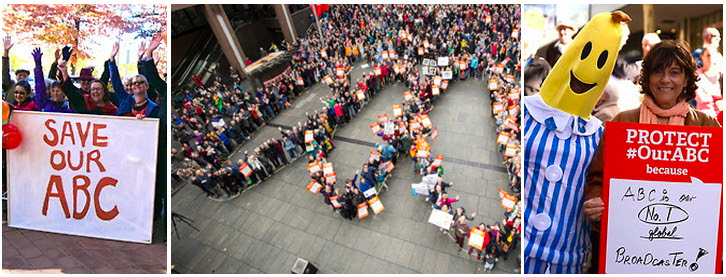
    ~ In the last fortnight, more than 6,000 GetUp members have rallied at actions in support of the ABC. Now, let’s drive the message home and take it to Canberra. Here’s your last chance to get involved before budget decisions are made: https://www.getup.org.au/email-your-mp ~

    Hi NEVILLE,

    Another efficiency study into the ABC, another predictable result:

    “The ABC’s news department is not over-resourced, according to Malcolm Turnbull’s review into whether the broadcaster and SBS could work more efficiently.”1

    In fact, the most glaringly obvious inefficiency regarding the ABC in recent years surely must be the time and resources wasted on frequent, duplicative and unjustified inquiries into the broadcaster. It doesn’t matter how many they do, the result is always the same: the ABC is not only doing its job as our trusted public broadcaster, it’s doing it on a shoestring budget.

    But Australians already know this, which is exactly why hundreds of thousands of us have been fighting so hard to protect the ABC’s creative, iconic, dependable, independent and unbiased content; and prevent the foreshadowed cuts in the upcoming Budget.

    Now, in these critical few days before Budget, we need to be louder than ever. What does that sound like?

      • It sounds like sharing the 247,000 signature-strong GetUp member petition to make sure as many as your friends, family and networks are given the opportunity to stand up and show our leaders that Australians won’t stand for Tony Abbott breaking his election promise not to cut funds to our ABC.
      • Writing to your MP before Tuesday, urging them to fight for a fully-funded ABC, and asking them to come along and accept the petition on behalf of your electorate in Canberra at 11am on budget day
    • It looks like a big, bold visual in support of protecting the ABC on the lawns of Parliament Lawns on Budget day – all thanks to you!

    Can you help? Click here to email your MP to invite them along to the event, and share the campaign: https://www.getup.org.au/email-your-mp

    We’ve already shown that breaking promises with our ABC is not a gamble worth taking. In the last fortnight alone:

      • Nearly 4000 GetUp people turned up in Sydney and Melbourne for a huge snap action. Their message was simple: we will not allow Tony Abbott get away with breaking his core pre-election promise to protect our ABC’s funding.
      • More than 1800 GetUp members turned out to self-organised, grassroots petition deliveries in 61 electorates across the country. They hit the streets with their neighbours to deliver our 246,000 signature-strong (and still growing!) petition to their local MPs.
    • Right now, a member-funded, hard-hitting TV ad is running – right up until budget – reminding Mr Abbott that Australians won’t stand for him going back on his word.

    The campaign is still escalating, the petition is still growing, now we just need to bring it home. We’ll make sure our message is seen by our political leaders by staking the thousands of messages written by GetUp members on the lawns of Parliament on Budget Day. Will you invite your MP to join GetUp members there on the lawns next Tuesday?

    https://www.getup.org.au/email-your-mp

    Our ABC belongs to all Australians. It’s our most trusted, independent public broadcaster and it’s one that GetUp members have proven time and time again is worth fighting for.

    Whatever happens on Budget day, the fight is far from over. We know that the right-wing factions of the government have been chomping at the bit to defund, privatise and otherwise water down our ABC for years now. We know they’ll stop at nothing to make crippling cuts disguised as “efficiency savings”.

    But the good news is that just last week Tony Abbott told us we “shouldn’t assume that every decision has been made and the Budget is finalised”, which means there’s still time to intervene. Let’s give them a compelling case for protecting our ABC, and give it all we’ve got in these critical final days.

    Let’s bring this one home,

    Erin, Alycia and Kelsey, for the GetUp team

    PS – On Budget day, we’ll be taking hand-written messages straight to our politicians in Canberra, and making them a part of a huge visual delivery to the lawns of Parliament House. Keen to be a part of it? Check out some of the best messages below, or see the whole gallery and submit your own here: https://www.getup.org.au/abc-messages

    “it’s an invaluable link for young people in rural areas” – Chris, NSW
    “It’s my heritage” – Lachlan, QLD
    “A strong, healthy, creative democratic Australia MUST have a strong, healthy, creative national broadcaster.” – Steven, NSW
    “It has our back. Progressive, ground-breaking…and feels like home.” – Diana, WA
    “The ABC promotes Australian music and original content more than any other institution.” – Mandy, Victoria
    “A viewpoint that does not answer to anyone but the people of Australia is a vital part of our democracy.” – Judith, NSW

    ~ References ~

    [1] ABC news department not over-resourced, Coalition review finds, The Guardian Australia, Wednesday 7 May 2014


    G

  • Hydrogen Fuel Production Gets Big Boost From Cheap New Material

    From Cheap New Material

    Hydrogen Fuel Production Gets Big Boost From Cheap New Material

    Posted in Uncategorized By Neville On February 24, 2014


    Hydrogen Fuel Production Gets Big Boost From Cheap New Material

    While hydrogen fuel production — via the splitting of water into hydrogen and oxygen using sunlight — has long been prominent in the public imagination, the reality is that the technology is still quite a ways off from being economical. That gap between the economical and the reality is narrowing though, as new research from the University of Wisconsin-Madison shows.

    Researchers there have succeeded in achieving a new record (with regard to oxide-based photoelectrode systems) solar-to-hydrogen conversion efficiency of 1.7% — while using relatively inexpensive new materials.

    Sunny day

    “In order to make commercially viable devices for solar fuel production, the material and the processing costs should be reduced significantly while achieving a high solar-to-fuel conversion efficiency,” states researcher Kyoung-Shin Choi, a chemistry professor at the University of Wisconsin-Madison.

    So, to address this, the researchers created solar cells from bismuth vanadate and used electrodeposition (think gold-plated jewelry) to boost “the compound’s surface area to a remarkable 32 square meters for each gram.”

    “Without fancy equipment, high temperature or high pressure, we made a nanoporous semiconductor of very tiny particles that have a high surface area,” explains Choi. “More surface area means more contact area with water, and, therefore, more efficient water splitting.”


    The University of Wisconsin-Madison provides more:

    Bismuth vanadate needs a hand in speeding the reaction that produces fuel, and that’s where the paired catalysts come in. While there are many research groups working on the development of photoelectric semiconductors, and many working on the development of water-splitting catalysts, according to Choi, the semiconductor-catalyst junction gets relatively little attention.

    Choi and Kim exploited a pair of cheap and somewhat flawed catalysts — iron oxide and nickel oxide — by stacking them on the bismuth vanadate to take advantage of their relative strengths.

    “Since no one catalyst can make a good interface with both the semiconductor and the water that is our reactant, we choose to split that work into two parts,” Choi states. “The iron oxide makes a good junction with bismuth vanadate, and the nickel oxide makes a good catalytic interface with water. So we use them together.”

    The dual-layer catalyst approach allows for the simultaneous optimization of the semiconductor-catalyst junction and also the catalyst-water junction.

    “Combining this cheap catalyst duo with our nanoporous high surface area semiconductor electrode resulted in the construction of an inexpensive all oxide-based photoelectrode system with a record high efficiency,” Choi continues.

    “Other researchers studying different types of semiconductors or different types of catalysts can start to use this approach to identify which combinations of materials can be even more efficient,” says Choi. “Which some engineering, the efficiency we achieved could be further improved very fast.”

    The researchers are currently working to tweak their design further.

    The new research was just published in the journal Science.

    Image Credit: UW-Madison/Bryce Richter

    How much is your roof worth with solar panels?

    Profit from your roof space: find local deals on solar in your area, eliminate your power bill, and join the solar revolution.