Category: Uncategorized

  • Oil Price Daily News Update

    1 of 2
    Why this ad?
    Price Of Unleaded Petrolmynrma.com.au/businessWise – Keep Your Business Moving with our Fleet Roadside Support. Call Now!

    Oil Price Daily News Update

    Spam
    x

    OilPrice.com Daily News Update admin@oilprice.com via google.com

    8:47 AM (7 hours ago)

    to me
    Why is this message in Spam? You previously marked messages from admin@oilprice.com as spam.  Learn more

    Oil Price Daily News Update


    Money Flowing into the Montney (and for Good Reason)

    Posted: 05 May 2014 11:16 AM PDT

    A thirst for liquids is driving capital into the Alberta Montney at a surprising rate these days.In the last two months, 7 private equity firms have come to Calgary to open up shop, and giants like Encana [ECA.TO] are starting to refocus their efforts into developing their liquid Montney assets.What’s causing this surge?It appears there are three drivers that are causing this movement:LNG is becoming a reality soon, and the market knows it.Large scale oil sands development should stretch condensate supplies. a.   Demand for condensate…Read more…

    This Key Event Is Really Happening

    Posted: 05 May 2014 06:53 AM PDT

    At least, it appears. The much-touted Chinese coal import ban.News last week out of China suggests this elusive regulation is close to becoming reality. With the government perhaps having already enacted the legislation.What we know is that the Chinese parliament has approved a new set of environmental laws. The first such rule change in over two decades in the country.That’s been officially announced. What we don’t know yet is the exact content of the new rules. But sources told market analysts Platts that new rules on coal shipments into China…Read more…

    Mexico Proposes Energy Rules To Attract Investment

    Posted: 02 May 2014 01:22 PM PDT

    The Mexican government has released its much-anticipated new rules on its oil sector, putting some meat on the bones of major energy reforms it announced last year. The rules appear to be crafted with the intention of attracting quick investment from international oil companies, according to the Wall Street Journal. Mexican President Enrique Pena Nieto has made energy reform a centerpiece of his agenda for a reason: Mexico’s economy is dependent on oil. Its oil industry accounted for 32 percent of government revenues in 2013. But in the last…Read more…

    Weakening Russian Energy Sector May Not Support Geopolitical Ambitions

    Posted: 02 May 2014 01:08 PM PDT

    The Russian economy may not be able to finance the Kremlin’s ambitions in Eastern Europe for much longer because the country’s oil and gas output is no longer a strong support of growth. Russian Energy Minister Alexander Novak said on May 2 that gas supplies through Ukraine might be severed unless Kiev pays in advance for its June deliveries. Russian energy company Gazprom cut gas supplies through Ukraine in 2009 because of contractual disputes. The deal that ended the impasse left Kiev with some of the highest gas debt obligations in…Read more…

    Iran Tears Up Azadegan Contact With China

    Posted: 02 May 2014 01:01 PM PDT

    China — one of the few countries to invest in Iran despite international sanctions against it over its nuclear program — has had its contract to develop Iran’s Azadegan oil field terminated. On April 29, the National Iranian Oil Co.’s legal department informed state-run China National Petroleum Corporation (CNPC), China’s biggest oil and natural gas company, that Iranian Oil Minister Bijan Namdar Zanganeh had issued a decree canceling its contract to develop North Azadegan, citing unacceptable delays. In February, Zanganeh had voiced…Read more…

    Scientists Say ‘Frackquakes’ Are Going To Get Stronger

    Posted: 02 May 2014 12:39 PM PDT

    The man-made earthquakes that have been shaking up the southern United States only stand to get stronger and more dangerous as the controversial practice of hydraulic fracturing, or fracking, increases, scientists warned at a Thursday conference.According to multiple reports, scientists attending the Seismological Society of America annual meeting agreed that fracking can change the state of stress on existing faults to the point of failure, causing earthquakes. That stress is generally not caused by fuel extraction itself, but by a process called…Read more…

    U.S. Announces First Superstorm-Related Oil Reserve

    Posted: 02 May 2014 12:14 PM PDT

    The U.S. Department of Energy announced on May 2 that it plans to build an oil storage facility in the northeast to prepare for future emergencies. The storage reserve will hold approximately 1 million barrels of gasoline, and DOE estimates it will cost $215 million to build. The decision to build gasoline storage infrastructure is part of the government’s response to the widespread damage caused by 2012’s Hurricane Sandy. In the super storm’s aftermath, people in New Jersey and New York suffered through periods of blackouts and…Read more…

    Oil Price Slide Comes To A Halt Amid Jobs Data, Ukraine Tension

    Posted: 02 May 2014 12:08 PM PDT

    Prices for WTI and Brent oil reversed declines as positive employment numbers and geopolitical tension put upward pressure on prices. For June delivery, WTI was up 10 cents per barrel and Brent jumped 60 cents on May 2. The two benchmarks regained some lost ground after hitting a five-week low earlier this week. The U.S. Labor Department reported that employers added 288,000 jobs in the month of April, suggesting that the U.S. economy is picking up steam. The unemployment rate also dropped to 6.3 percent, the lowest it has been since 2008. The…Read more…

    Greenpeace Activists Detained, Arctic Oil Delivered

    Posted: 02 May 2014 12:00 PM PDT

    In Rotterdam on April 1, Dutch police raided a Greenpeace ship intended to block the delivery of oil coming from the Russian Arctic. The tanker was set to deliver the first shipment of oil from Russia’s newly operational Arctic oil platform. Greenpeace activists draped a “No Arctic Oil” banner from the Russian ship, and were detained by Dutch police. The Greenpeace group included some of the same activists who were arrested in Russia in 2013 and held for more than two months, becoming known as the “Arctic 30.” The…Read more…

    Midstream Opportunities in the Marcellus

    Posted: 02 May 2014 08:34 AM PDT

    I’ve been warning readers about 1st quarter energy results in the Exploration and Production companies – believing that the results would be overhyped and lead to disappointments.  But nothing like that has happened.  In fact, the E+P’s have been killing it, if not from increased realizations, then by the strong prices in natural gas during the winter of 2013.  And, if that weren’t enough, the wide differentials in domestic crude benchmarks led to some incredible results from the refiners and in the downstream…Read more…

    How to Profit from Chinese LNG Demand

    Posted: 02 May 2014 08:31 AM PDT

    On April 30, a U.S. House congressional committee passed a bill that would streamline the approval process for exporting liquefied natural gas from the United States. Sponsored by Rep. Cory Gardner (R-CO), the bill would require the Department of Energy to make a decision on LNG export applications within 90 days after the close of the public comment period. The bill has a long way to go before becoming law, but its ultimate fate may not be that important. It appears that the Obama administration is keen to allow LNG exports to move forward, albeit…Read more…

    Newfield Exploration: A Microcosm Of US Oil & Gas

    Posted: 02 May 2014 08:26 AM PDT

    The US oil and gas industry has been in transition over the last decade or so. It is not that long ago that offshore oil and international exploration were the way forward. Conventional wisdom had it that in order to survive a company had to go deeper and further. As the technology for releasing oil and gas from rock improved, however, vast reserves of oil were opened up and the future shifted back to US soil. In any industry, that complete change of direction would cause major disruption. Oil and gas exploration is no exception, but the flexibility…Read more…

    Global Energy Advisory – 2nd May 2014

    Posted: 02 May 2014 08:18 AM PDT

    Libya lifts force majeure at ZueitinaThe Libyan National Oil Corp. announced it lifted a legal clause that absolved it from meeting contractual obligations at the eastern oil terminal because of what it said was an “improvement of the circumstances” in the country. NOC said the first barrels from the 70,000 bpd facility could leave the eastern port at some point this week. The port’s re-opening is a response to a deal brokered with eastern rebel leaders last month and Libyan Justice Minister Salah al-Merghani said protracted conflict could drag…Read more…

    Why This Midstream Player is Making Waves

    Posted: 02 May 2014 08:12 AM PDT

    More North American energy companies are turning to rail transport as an option to get crude oil to refineries because there isn’t enough pipeline infrastructure in place to keep pace with the boom. Though cross-border options like Keystone XL are stuck in bureaucratic limbo, the intra-continent midstream sector is emerging as a good opportunity for energy players keen on nibbling at the margins of the region’s oil bonanza.Genesis Energy (NYSE: GEL) this week said it was looking to take advantage of the best of both worlds by exploring options…Read more…

    Y
  • Clean tech, Big Oil hottest new couple in energy world

    Advertisement

    E&E Publishing&nbsp

    RENEWABLE ENERGY:

    Clean tech, Big Oil hottest new couple in energy world

    Katherine Ling, E&E reporter

    Greenwire: Monday, May 5, 2014

    Advertisement

    ClimateWire -- Start A Trial!

    First of three stories on the traditional energy industry’s embrace of clean technology.

    “Sometimes you need to kiss many frogs before you find the princes.”

    That sums up the past few years of investing in clean technology, says Wal van Lierop, co-founder and CEO of Chrysalix Energy Venture Capital. But now the industry has transformed to the point that even a small but growing number of traditional energy companies are embracing the use of renewables.

    “What we are seeing is a maturing of clean technology, and it is arising in the mainstream of existing large industries,” van Lierop said. Chrysalix, which focuses solely on clean technology, has attracted a majority of its $250 million in funding from conventional energy companies like Royal Dutch Shell PLC, Total SA and Électricité de France (EDF).

    The key, van Lierop said, is to “try to develop technology that can have a major impact on the world, but you try to develop it on the nickel of the people that have the capital.”

    In theory, using renewables makes sense to power the everyday operations of traditional energy companies, which often work in remote and harsh conditions where infrastructure like roads or pipelines is minimal. The current relationship between the traditional and clean technology energy industries, however, is far from a fairy tale.

    But the two may need each other more than they would like to admit. The International Energy Agency and U.S. Energy Information Administration have issued report after report acknowledging a foreseeable need for fossil fuels and mining but saying they must be part of a “low-carbon solution” — a notion echoed by Energy Secretary Ernest Moniz and the Obama administration.

    The traditional energy sector has another oft-overlooked reason to embrace renewables: It is in itself a considerable consumer of energy, especially in the form of heat supplied by diesel and other carbon-based fuels.

    In the United States, the mining sector — including oil and gas extraction — accounted for about 33 percent of the industrial consumption of distillates and fuel oil in 2012, with almost two-thirds of that by oil and gas, according to a Greenwire analysis using EIA data. The U.S. industrial sector is only second to transportation in consumption of petroleum products, according to EIA’s monthly energy review from March.

    Relying on petroleum products is a costly proposition for any industry with rising prices that may soon be compounded by carbon emission regulations in California, Australia and other places. That is even more of a pressing issue in countries outside the United States that do not have the same access to low-cost natural gas.

    The budding relationship has benefits for renewables, too. For the burgeoning clean technology sector, the energy industry offers two crucial components of success: capital and expertise. These two inputs make the difference for a technology becoming commercially successful rather than just another report in a science journal.

    A union is not that simple, of course. The traditional industry’s general view of renewable energy is that it is too expensive, unreliable, risky and not large-scale enough to provide solutions — and is a competitor in the long run.

    Clean technology startups often view partnering with traditional energy as selling out, or in direct conflict with many founders’ mission — fighting climate change. Plus the small, new companies designed themselves to be providers of technology without the infrastructure, desire or experience to offer the power solutions that these larger industries seek.

    Nathanael Greene, director of the renewable energy policy program at the Natural Resources Defense Council, said his “knee jerk” reaction to the idea of renewable energy helping to clean up the traditional power industry was a bit of the proverbial “putting lipstick on a pig.”

    But he acknowledged, “Any renewable energy advocate that is serious about renewable getting to scale recognizes that the answers are going to be really big companies playing in that space.”

    “I think this sort of purist approach of renewable energy development only lasts for a little while,” Greene added. “Technical expertise is technical expertise, and we need that to flow to the best technologies, and money is critical to scaling renewable to the level we need them to achieve to stop global warming.”

    Van Lierop estimates the traditional energy industry market to be worth $3 trillion to $4 trillion that could be an important source of investment for startups to tap now.

    That’s especially important as governments continue to cut back on funding meant to take technology from the laboratory to the market. Plus, a traditional source of private money, venture capitalism, has been pulling back on funding for energy projects because of the longer five- to 10-year return on investment timelines, favoring instead the “clean Web” startups based on websites and software.

    There is much to be gained for both sides if the two industries work together, according to Matt Scullin, founder and president of Alphabet Energy Inc., a company that converts waste heat into energy and is targeting the mining and drilling industry as its first market.

    “These ‘dirty’ companies stand to be cleaned up the most,” he said. “We want to have impact. We think we can have impact. The impact can be had in these global dirty industries.”

    Highest-value customers

    Like many of his California clean tech compatriots, Scullin is an idealistic and driven scientist-turned-entrepreneur. He previously worked at IBM Corp., General Motors Co. and X/Seed Capital, backed by his doctorate and master of science in materials science from University of California, Berkeley, where he was advised by Arun Majumdar, the former head of the Advanced Research Projects Agency-Energy.

    Alphabet Energy wants to be the “Intel of waste heat recovery,” Scullin said, becoming a critical component of efficiency and a power source for industry no matter what fuel or equipment is used. One of the company’s thermoelectric modules is only the size of a shoebox and could be adapted to many different applications, he said. While the technology existed in the lab for a long time, Scullin was able to find low-cost materials and manufacturing that made it possible to commercialize.

    Alphabet first looked at waste heat energy technology to improve fuel consumption of cars, using the heat from the cars’ exhaust to provide additional power. But the company found that market moved too slowly to provide the kind of funding and customers it needed in the near term to grow, said Scullin, who co-founded the company five years ago.

    Although his products are clean technology that cuts emissions, that is not the leading marketing point for his company. The most important point, Scullin said, is the cost savings for companies.

    “The quickest to market is very, very high-value waste heat,” Scullin explained. Oil, gas and mining companies “are going to pay the quickest and the most, and allow us time to come down on the cost curve on volume.” Lowering the technology price through volume could lead to more partnerships with industries that deal with furnaces, such as steel, with others that use a great deal of heat and then finally to the tailpipes of cars.

    “We have to take the right steps. We have to be pragmatic and seek the highest-value customers first,” Scullin said.

    He added, “Rome wasn’t built in a day. You can think about changing the world, but the fact of the matter is, these energy industry and very heavy industries are very slow-moving. One should not expect for adoption to be rapid in a single industry and for disruption to occur overnight.”

    Encana Corp., a leading North American energy producer, is a key investor in Alphabet Energy and has offered the startup important engineering and market insights into real-world applications via a pilot project — another significant benefit to partnering with established energy companies, according to Scullin. Alphabet is preparing to announce one of its first products for application in the mining and oil industries within weeks.

    ‘Simply too brown’

    Other startup companies are following a similar strategy to Alphabet Energy’s. But partnering with the traditional energy sector is not always the easiest path forward for clean technology.

    Steve Taub, senior vice president of Investment Strategy at GE Ventures, advised the battery company Solid Power during a recent Energy Department investment pitching session that targeting oil drilling and other sectors could be difficult because they have a “tough, long cycle” in terms of buying new equipment and are “heavily regulated.”

    Solid Power is considering down-hole drilling operations as the first market it will target, Douglas Campbell, founder and president, told the panel, because the “nasty environment” of drilling requires reliable and “extremely high-tech” solutions like the solid-state battery his company offers. Solid Power says its battery could be lighter and safer and could run longer than lithium-ion batteries at a lower cost.

    Chicago-based PyroPhase Inc. is also concentrating on oil companies but that has come at a cost to fundraising, particularly with the federal government, according to PyroPhase President Jeff Presley. The company is now mainly concentrating on the Canadian market.

    Oil sands operations currently use mostly natural gas to produce the heat and steam necessary to extract the oil. PyroPhase’s technology uses lower-frequency radio waves to heat up oil sands to release petroleum. Renewable energy could power the radio waves, so the technology could be an important consumer of renewable power when there is more supply than demand on the system — such as spring runoff or windy nights.

    “Our technology could take that electricity and convert it to heat underground and, in a way, treat it like a battery,” storing the energy in the form of oil being heated and separated into a usable form, he said. “The real fundamental thing is for utilities to have a customer who likes intermittent energy. Industrial-scale customers — the kind that consumes megawatts, not kilowatts.”

    The technology could also be used in environmental remediation or oil spills, Presley added.

    But Presley said because the technology is helping oil sands development and doesn’t necessarily have to be powered by renewable energy, it is “not as green as people would like.”

    Despite a good reception from experts — including winning a “Sustainable Technology of the Year Award” in 2011 from the McGraw-Hill Platts Global Energy Awards — Presley said the government’s response for the technology during the Obama administration has been “frustrating.”

    A DOE staffer at an oil shale symposium several years ago “flat told me, ‘We loved this technology, but it was simply too brown,’” he said.

    NRDC’s Greene said some caution in pairing the renewable and traditional energy sectors is wise. There should be awareness that traditional energy investment in clean technology may not be “altruistic,” he said.

    “Marginal improvements are good, but if you are already on the unsustainable side of the ledger, you are just getting closer to less bad,” he said.

    “There is this sort of green-washing potential that needs to be guarded against,” he added. “We are going to be needing low-carbon energy and energy that doesn’t destroy habitat and pollute water, and it is not like at some point we’ll just, the market will just decide on its own to start producing that and we won’t think about it anymore. It’s not like those challenges are going away.”

    But Chrysalix’s van Lierop said the current push toward clean energy strategies for companies is comparable to a decade ago, when businesses all wanted an Internet strategy; Internet strategies are no longer a separate business plan.

    “Frankly, I always say that if in a decade — at most two decades from now — if we still talk about clean technology, then something horrible has gone wrong,” van Lierop said. “It really needs to become a normal part of doing business.”

    Tomorrow: How a solar power technology for oil production may turn a California regulation to promote low-carbon fuels on its head.

  • Solar Activity Data And Near Real-Time Solar Images

    Site » Data » Solar


    Solar Activity Data And Near Real-Time Solar Images

    The sun is the engine of the Earth’s weather. The role of the sun in influencing climate and the various mechanisms that may be involved is a matter of some debate. What is not in doubt is that the sun is going through a particularly quiet patch at the moment. This page gives a snapshot of some of the current data on the sun’s atmosphere, sunspots and magnetic field as well as sharing some fascinating images of the sun at various wavelengths.

    Images below are near real-time and are from two instruments on NASA’s Solar Dynamics Observatory (SDO) spacecraft launched in 2010 which keeps a constant eye on the sun. At the foot of each image you can see the date and time that it was recorded (Universal Time (UT) is equivalent to GMT). The graphs below come from NOAA’s Space Weather Prediction Center. There are some notes on the data below the graphs.

    Near Real Time Image Of The Sun As Seen Just Now By Instrument’s On NASA’s Solar Dynamics Observatory (SDO) Spacecraft…

    This is the sun as it is about now. The image is in near real time from NASA’s Solar Dynamics Laboratory spacecraft with its Atmospheric Imaging Assemby (AIA) instrument. Courtesy: NASA, SDO.


    Latest Data From NOAA’s Space Weather Prediction Center

    Courtesy: NOAA Space Weather Prediction Center

    Courtesy: NOAA Space Weather Prediction Center

    Courtesy: NOAA Space Weather Prediction Center


    Data Notes From NOAA’s SWPC

    Update Schedule

    The Solar Cycle products are updated once a month and are put on-line the first Tuesday after the new values are available. The latest values are usually available on the 3rd of every month.

    Terms And Definitions

    Observed numbers are simple averages of the daily values for the month.

    SWO Sunspot Numbers are issued by the NOAA Space Weather Prediction Center (SWPC) in Boulder Colorado, USA.

    The official International Sunspot Number (RI) is issued by the Sunspot Index Data Center (SIDC) in Brussels, Belgium. Data and plots are available from the SIDC web site at http://sidc.oma.be

    10.7cm Radio Flux is the preliminary observed value measured in Penticton, B.C. Canada. The values are displayed in solar flux units (1 sfu = 10^-22 W/m^2/Hz).

    The Ap Geomagnetic Index is the preliminary estimate calculated by the United States Air Force (USAF).

    For daily values, see http://www.swpc.noaa.gov/ftpmenu/indices.html

    Daily Solar Data — last 30 days

    Daily Solar Data — current quarter

    Solar, Particle, and Geomag. Indices beginning Jan. 1994

    Smooth values are an average of 13 monthly observed values centered on the month of concern (the 1st and 13th months are given a weight of 0.5).

    Ap(avg)=(0.5*Ap(1) +1.0*Ap(2) +1.0*Ap(3)+ … +1.0*Ap(12) +0.5*Ap(13))/12.0

    SWPC products use preliminary values. Final values are available through the National Geophysical Data Center (NGDC) at http://www.ngdc.noaa.gov/ normally one to two months later.

    The Sun In Near Real-Time As Seen By SDO’s AIA And HMI Instruments

    Images below are near real-time and are from two instruments on NASA’s Solar Dynamics Observatory (SDO) space craft launched in 2010 which keeps a constant eye on the sun. The Atmospheric Imaging Assembly (AIA) instrument looks at the solar corona at a variety of wavelengths and you can see those in those images below. The Helioseismic and Magnetic Imager (HMI) is an instrument designed to study oscillations and the magnetic field at the solar surface, called the photosphere. HMI observes the full solar disk at 6173 Å with a resolution of 1 arcsecond. HMI and AIA are two of three instruments on the Solar Dynamics Observatory; together, the SDO’s suite of instruments observes the Sun nearly continuously and takes a terabyte of data a day.

    ...

    AIA image from space at 0193 Angstrom wavelength

    ...

    AIA image from space at 0171 Angstrom wavelength

    ...

    AIA image from space at 0304 Angstrom wavelength

    ...

    AIA image from space at 0211 Angstrom wavelength

    ...

    AIA image from space at 0131 Angstrom wavelength

    ...

    AIA image from space at 0335 Angstrom wavelength

    ...

    AIA image from space at 094 Angstrom wavelength

    ...

    AIA image from space at 1600 Angstrom wavelength

    ...

    AIA image from space at 1700 Angstrom wavelength

    ...

    AIA image from space 211, 193, 171 Angstrom wavelengths

    ...

    AIA image from space at 304, 211, 171 Angstrom wavelengths

    ...

    AIA 094, 335, 193

    ...

    AIA 171 & HMIB

    ...

    Magnetogram image from SDO’s Helioseismic and Magnetic Imager (HMI) instrument.

    ...

    Intensitygram from SDO’s Helioseismic and Magnetic Imager (HMI) instrument that shows the Sun as it would be seen in filtered white light.

    ...

    Dopplergram image from SDO’s Helioseismic and Magnetic Imager (HMI) instrument. Dopplergrams provide maps of velocity on the sun’s surface and help spot fast moving changes such as flares.


  • Geology.com News – 9 Topics

    2 of 44
    Why this ad?
    Landscape Garden Edgingwww.kwikkerb.net.au/Garden-Edging – Make Your Garden Look Amazing. Call Us For Free Onsite Quote!

    Geology.com News – 9 Topics

    Inbox
    x

    Geology News fb@geology.com via google.com

    7:01 PM (24 minutes ago)

    to me

    Geology.com News – 9 Topics

    Link to Geology News

    Landslides in Arizona

    Posted: 04 May 2014 05:29 AM PDT

    The Arizona Geological Survey has a new article by Michael Conway titled: Landslides – Mitigating a clear and present danger.

    The Arizona landscape is no stranger to landslides. The entire spectrum of landslide types – debris avalanche, debris flow, earthflow, creep, rock fall, rock slide, topple, rotational and translational landslides – are encountered here.

    Guide to the Redwall Limestone of the Grand Canyon

    Posted: 04 May 2014 05:25 AM PDT

    Here is a really nice educational guide from the Arizona Geological Survey Repository. One of the best educator documents that we have seen.

    “What makes the Redwall Limestone a unique and important stratigraphic unit in the Grand Canyon? This is one of the questions asked and answered in this guide to the Redwall. Written to assist guides in describing the geology of Grand Canyon, this colorful product should be of use to professional geologists, geophiles and people generally interested in geology.”

    Aftermath of the Afghanistan Landslide

    Posted: 04 May 2014 05:22 AM PDT

    This Reuters article describes some of the problems associated with the massive landslide that killed perhaps 2000 people in Afghanistan.

    Ohio GeoFacts: Geologic Hazards

    Posted: 04 May 2014 05:13 AM PDT

    As part of their GeoFacts series, the Ohio Geological Survey has fact sheets on some of their geologic hazards. These include: mine subsidence, landslides and earthquakes.

    Related: What your homeowner’s insurance does not cover.

    Tar Volcano on the Floor of the Gulf?

    Posted: 04 May 2014 04:59 AM PDT

    Researchers searching for a shipwreck site discovered what appears to be a tar volcano on the floor of the Gulf of Mexico. Video and article.

    BP Wins 24 Blocks in the Gulf of Mexico

    Posted: 04 May 2014 04:53 AM PDT

    BP paid $41.6 million for the right to drill on tracts in the Gulf of Mexico that total to an area about twice the size of Maine.

    Oregon: Online Public Landslide Database

    Posted: 04 May 2014 04:51 AM PDT

    The Oregon Department of Geology and Mineral Industries expanded its online public database that identifies the location of tens of thousands of known landslides across Oregon.

    Leaf Analysis to Determine Ancient Climate?

    Posted: 04 May 2014 04:33 AM PDT

    An article in The Columbus Dispatch explains how a study of leaves might reveal ancient climates in parts of what is now southern Saskatchewan.

    Mineral Hardness Picks

    Posted: 04 May 2014 04:25 AM PDT

    Mineral hardness picks are pencil-like tools that have points made from materials that match the hardness of minerals in the Mohs Hardness Scale. With them you can easily test the hardness of mineral grains in a rock and test the hardness of small-size specimens. In our opinion they are easier to use than pieces of minerals and allow you to obtain more accurate results. They also do not contaminate your specimen with particles of the hardness mineral.

  • Who gives a buck? GET-UP

    1 of 44
    Why this ad?
    Windows 7 Driver Downloadwww.windows-7.driverupdate.net – Windows 7 Driver – Latest Download. Microsoft Certified. – Recommended!

    Who gives a buck?

    Inbox
    x

    GetUp!

    7:01 PM (22 minutes ago)

    to me
    ~ This might be the best chance we’ve had in decades to get big donations from vested interests out of Australian politics. Add your voice to the campaign: https://www.getup.org.au/political-donations ~

    Dear NEVILLE,

    In today’s news, Liberal Party Minister Christopher Pyne took us by surprise by calling for a ban on all political donations from corporations and thid-party entities.

    Tiptoeing away from the party line, Pyne told the ABC: “I think all donations should be banned other than from individual Australians”.1

    This might be the first time such a prominent Liberal Minister has opened the door to cleaning up political donations. It’s a good start, but not nearly enough. Let’s add our voices to the call for reform. If we can show huge public support now, we can continue the debate about reform, and convince more politicians to get on board:

    https://www.getup.org.au/political-donations

    Cleaning up our democracy will take more than just a ban on corporate and third-party donations, as Minister Pyne proposes.

    Last year, the largest individual political donation came from the Packer family, who donated $580,000 to the Liberal Party.2 Whether with bottles of expensive wine, or large cash donations, the ongoing NSW Independent Commission Against Corruption (ICAC) hearings have shown clearly that wealthy individuals try to use donations to gain influence on behalf of their companies.

    That’s why it’s so important caps are also placed on individual donations – preventing big money from buying undue influence and drowning out everyone else’s voice.

    It’s a brave and unusual move for any politician to suggest banning corporate donations. But as loud as he can be, Pyne alone won’t be loud enough to drown out the powerful vested interests looking to buy influence.

    Without public support, Pyne’s comments could easily become yesterday’s news, so let’s add our voice to the call for reform, and ask all MPs to get behind it. Sign the petition, and then ask your local MP: will you support getting big money out of politics?

    https://www.getup.org.au/political-donations

    This issue has never been hotter.

    Just today it was reported that Federal Treasurer, Joe Hockey, is the most recent figure to find himself in hot water for “offering privileged access to a select group of people including business people and industry lobbyists in return for tens of thousands of dollars in donations to the Liberal Party”.3 Nearly all political parties use similar fundraising tactics in our current system, they’re left behind if they don’t. Today’s news is just the latest in a string of revelations about vested interest using donations to influence both major parties, as the New South Wales Independent Commission Against Corruption investigates party fundraising bodies.

    As Fairfax’s chief political correspondent, Mark Kenny, puts it:

    “Nobody is suggesting Joe Hockey is corrupt. But it is increasingly clear the Treasurer is party to a process that is corrupting Australia’s democratic integrity… political representation increasingly turns on how much cash you have, and where you are prepared to direct it”.4

    It’s time to change the rules. Sign the petition calling on both major parties to get behind reforms to keep big money out of politics:

    https://www.getup.org.au/political-donations

    Thanks for your support,
    the GetUp team

  • We moved mountains last week 350 org

    e desktop notifications for Gmail.   Learn more  Hide

    1 of 4
    Why this ad?
    Top10 eCommerce Solutionsbusiness-software.com/eCommerce – 2014 Top eCommerce Solution Ranking Get Vendor Research by Top Analyst

    We moved mountains last week

    Inbox
    x

    Charlie Wood – 350.org Australia <charlie@350.org> Unsubscribe

    5:24 PM (7 minutes ago)

    to me

    Dear friends,

    Last week we moved mountains together.

    Hundreds of Australians – grandmothers, farmers, children, business-owners, doctors, musicians and more – turned an ordinary week into an extraordinary display of courage, compassion and determination to move Australia beyond fossil fuels to a just and sustainable energy future.

    Today, we want to celebrate those extraordinary acts….

    Let’s start with Maules Creek where, in the wee small hours of Saturday morning, a group of doctors from around Australia responded to a medical emergency.

    Despite busy schedules, little sleep and risks to their professional careers, these doctors blocked construction of Australia’s largest new coal mine to protect current and future generations from a future of fossil-fuel driven ill health.

    “I believe this is an emergency in health and I believe that, as doctors, we need to face this emergency like we would any other emergency.”  – Lin Wang, 23 (pictured above)

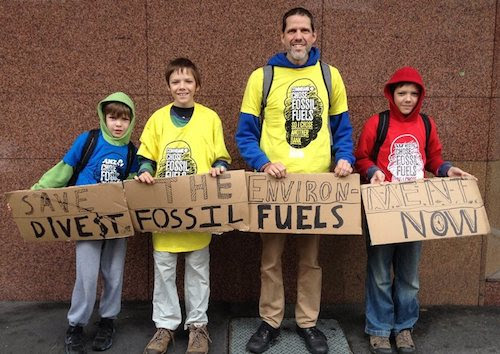
    And while doctors put their bodies on the line in the dead of night, in the light of day, hundreds of Australians turned out at Big 4 Bank branches around the country as part of 350.org and Market Forces first and largest national day of divestment action. Together, people from all walks of life used their consumer power to start building a better future.

    There were folks like 96-year old Nance from Brisbane…

    Families...

    Doctors….

     Mothers… 

    Some were motivated by concern for their children, some about the impact of fossil fuels on their land, others the financial risks of stranded fossil assets on their hard-earned savings. Whatever the motivation, together we put fossil fuel risks firmly on the Big 4’s agenda and, together, moved over $200 million out of the Big 4 Banks since last October alone!

    Watch and share this Divestment Day highlights video…

    Who would have thought that we’d see doctors locking on to coal-mines whilst grandmothers, farmers and local business owners cut up their credit cards?

    The movement we’re building is a growing force to be reckoned with. Through our actions we are starting to change the system…

    Who would have thought that the world’s largest fund manager – BlackRock – would team up with London’s FTSE group to build fossil-free stock market indexes, or that the world’s largest Sovereign Wealth Fund would consider divesting from the fossil fuel’s upon which it’s wealth was built, or that UniSuper, one of Australia’s largest super funds, would divest fossil fuels from one of its portfolios? Or that mining interests would be afraid of an ice-cream company?

    These changes are thanks to people like you, taking action, inspiring others and showing our power-holders that climate change is an issue that knows no borders, respects no fences, cities, towns, nobody’s children, retirements or bank savings.

    It’s thanks to you that this campaign was last week referred to, in the Australian Financial Review, as “brilliantly organised” and “the best organized campaign I’ve seen in 50 years.”

    Together, we’re taking matters into our own hands, inspiring a movement of ordinary people to do extraordinary things.

    Thank you for moving mountains with us last week. Let’s go move some more.

    With huge thanks,

    Charlie, Blair, Aaron, Josh, Simon, Phil and the whole 350.org Australia team

    —-

    For more about Divestment Day:

    For more about the doctors at Maules Creek:


    350.org is building a global climate movement.