Charlie Wood – 350.org Australia <charlie@350.org>
6:40 PM (19 minutes ago)
to me
Dear friends,
Australia’s coal industry is pushing the Government to make our fossil fuel divestment campaign and other boycotts illegal. We need your help to push back.
Just days after launching its “Australians for Coal” campaign*, The Minerals Council of Australia is “considering whether to join the push by resource industries to ban environmental boycott campaigns as it battles an escalating grassroots movement calling for banks, superannuation funds and institutions to ditch fossil fuel investments.”**
The Minerals council says it wants to stop the “small number of noisy extremists creating the false impression that the community does not support Australia’s second-largest export sector”.
Can you chip in $10 or more to help us grow our divestment campaign in Australia?
True, we are noisy but we are not small in number. And the real extremists are the fossil fuel companies that are willing to profit from the wreckage of our country and climate. We think it’s pretty reasonable to try to maintain a planet somewhat like the one we were born into.
We need to show Australia’s fossil fuel industry and our Government, that we’re not backing down from this campaign. Instead, we’re turning up the heat. Chip in today to help us do just that.
Clearly our campaign is already having an impact. But with your support, we can:
Grow our network of divestment organisers and campaigns around the country
Help thousands of Australians to push their banks and superannuation funds to divest
Educate more investors about the huge stranded asset** risks of investing in massive new Australian fossil fuel projects, from the Galilee basin mega mines in Queensland to Australia’s largest new coal mine at Maules Creek which is under construction as we speak
Support more individuals to travel to places like Maules Creek to help halt fossil fuel expansions on the frontline
As Gandhi said: “First they ignore you, then they laugh at you, then they fight you, then you win.” No longer are we being ignored. No longer are we being laughed at. Now, the fight is on. We can win this, but we need your support.
Let’s fight back this attack by the radical fossil fuel industry and move Australia beyond fossil fuels to a bright and sustainable future. Here’s two steps you can take today:
*** A stranded asset is one that has become obsolete or non-performing, and must be recorded as a loss. Many financial experts believe that assets such as coal, oil and gas are likely to become stranded due to the global commitment to keep climate change at or below a 2°C which will require a rapid move away from polluting energy.
Earlier this week, footage obtained by Fairfax media showed asylum seekers being attacked by security guards, just hours before Reza Berati was killed inside the Manus Island detention centre.1 They were attacked whilst trying to escape from the detention centre after they were told there would be no hope of resettlement for them outside PNG.
Australia is fast building an international reputation for our treatment of asylum seekers, but sadly, not one we can be proud of. While the actions of our Government fail to reflect our nation’s values of compassion and a fair go, we can lead the way in the meantime by demonstrating these values ourselves.
~ Read on for a call to action from Julian Burnside AO QC, Australian barrister and human rights advocate, on behalf of GetUp. Your details have not been shared with him or anyone else. ~
Dear NEVILLE,
In June of last year I received a letter from a courageous, young Iranian man who fled persecution in his country, which led to him being detained inside Sydney’s Villawood detention centre.
He had spent the last three and a half years of his life in detention, during which time he’d suffered more than any young man should and seen many of his friends, who could no longer bear the burden of detention, die or return voluntarily to face persecution.
He wrote asking for help. This is part of his story:
“When I set foot on Australian soil, I had felt I set foot in a land where the people there would see me as a human being who is reaching out a hand towards them for help, but… now it is [42 months]
I need help, but my voice is not reaching anywhere and I am extending my hands seeking help from you.”
This young man, like so many others who are currently detained in Australian centres, could be forgiven for seeing Australia as a country, which doesn’t abide by its international obligations under the Refugee Convention, or thinking Australians might be unwelcoming people, who don’t care about the plight of those less fortunate.
We know that’s far from the case.
On a daily basis I encounter the kind of Australians, whom I know represent this country and its values. Those with hearts as big as our land and bright as our sun. Those who embody our ethos of being the land of the fair go – a country with “boundless plains to share”.
Another letter I received from a person held in detention ended with the words:
“Please write again. Please do not forget us; we are human.”
This is where you can help. Will you be part of my letter writing campaign and show some of the world’s most vulnerable people that we’re capable of compassion and empathy?
In February GetUp members, along with thousands of Australians, lit a candle for all those who have suffered, and continue to suffer, under our government’s asylum seeker policies. Together, we attended Light the Dark vigils across the country and showed Australia, and the world, what we’re capable of – compassion, love and hope that we can make a difference.
Now we need to show asylum seekers that there are Australians who are thinking about them and are doing everything they can to fight these brutal policies put in place by our so-called leaders.
Will you write to an asylum seeker on Manus Island or Nauru and let them know, we have not forgotten them and we care?
In the early 2000s, I initiated a similar letter-writing campaign and it received extremely encouraging feedback, proving to be, not only valuable in helping keep up the spirits of asylum seekers, but also a great way to help Australians understand what our detention system means in simple human terms.
Will you help us do it again?
Yours in hope,
Julian
[1] Reza Barati death: Papua New Guinea nationals attacked asylum seekers on Manus Island, Sydney Morning Herald, 21 April 2014
On the webpage “Updating the Climate Science: What Path is the Real World Following?”, Drs. Makiko Sato and James Hansen update figures in the book Storms of My Grandchildren (see LA Times review) and present updated graphs and discussion of key quantities that help provide understanding of how climate change is developing and how effective or ineffective global actions are in affecting climate forcings and future climate change. A few errata in Storms are also provided.
Apr. 15 (Tues): “Can We Avert the Unfolding Climate Crisis?” to the wide MIT community (in the afternoon/early evening)
Apr. 16 (Wed): “Ice Sheet Melt, Sea Level and Storms” to MIT Earth, Atmospheric, and Planetary Science Department, 4 p.m.
Recent Communications
Dr. Hansen periodically posts commentary on his recent papers and presentations and on other topics of interest to an e-mail list. To receive announcements of new postings, please click here.
Feb. 26, 2014: Beijing Charts: Charts shown at Symposium on a New Type of Major Power Relationship, organized by the Counsellors’ Office of the State Council of the People’s Republic of China and the Kissinger Institute on China and the United States.
February 2014: Symposium on a New Type of Major Power Relationship: Presentation given at Counsellors Office of the State Council, Beijin, China on Feb. 24.
+ Download PDF (3.5 MB)
December 2013: Minimizing Irreversible Impacts of Human-Made Climate Change: Presentation given at AGU Fall Meeting on Dec. 12.
+ Download PDF (4.3 MB)
September 2012: A New Age of Risk: Presentation given at Columbia University on Sep. 22.
+ Download PDF (2.1 MB)
+ Download PPT (2.5 MB)
‘Censored’ IPCC summary reveals jockeying for key UN climate talks
In the wake of this month’s Intergovernmental Panel on Climate Change (IPCC) report on ways to cut global greenhouse gas emissions, accusations began to fly in the media that the report had been censored…
IPCC leaders release their climate mitigation report in Berlin – but governments already have one eye on next year’s UN climate summit. EPA/JOERG CARSTENSEN/AAP
Are these accusations true? Well no, not exactly. Parts were edited out of the summary, although all of the details survive elsewhere in the report.
But although this doesn’t amount to the censorship scandal some people clearly wanted to read about, the edits do tell an interesting story. They show us that countries are already looking at how their bargaining chips will stack up at the crucial round of United Nations climate negotiations in Paris next year.
What part of the report was changed?
All IPCC reports include an executive summary called the Summary for Policymakers (SPM). The contents of this summary are approved by the member governments at a plenary meeting once the report itself is complete. This process begins with a draft developed by the researchers who wrote the actual report. Government delegates then debate which of these points should be included in the approved summary, and what emphasis they should receive.
At the plenary meeting in Berlin last week, significant changes were made to the draft summary. The approved SPM emphasises justice and sustainability more than the draft did, and downplays the need for countries to cooperate to deal with climate change.
Delegates also deleted all of the graphs and text that describe the greenhouse gas emissions of specific regions and groups of countries. The approved summary only presents data on global totals.
However, the governments are not allowed to make any fundamental changes to the underlying report, all of which is publicly available. There is also a second executive summary, called the Technical Summary, which governments are not allowed to edit either.
So countries get to put the spin they want on the SPM, but they do not and cannot “censor” the report itself. Nor can they amend the Technical Summary, which remains the executive summary as the scientists see it.
Why do countries want to spin the summary?
In November and December next year, the governments of the world will meet in Paris at the 21st annual meeting of the members of the United Nations Framework Convention on Climate Change. Their goal is to achieve a binding, worldwide agreement on climate change. This will be the most important summit since the meeting in Copenhagen in 2009 and possibly since Kyoto in 1997, which spawned the Kyoto Protocol.
It is easy to be sceptical about the likelihood of governments reaching such an agreement. But as long as an agreement is on the table, each country will want to secure the most favourable terms possible.
In Copenhagen, governments forged a non-binding agreement to limit global warming to 2C over the pre-industrial average. But there is no agreement on the specific way in which the burden of cutting emissions should be distributed.
Some governments might suggest that all countries should eventually move towards an equal level of emissions per person. Others such as China and India might argue that that is not fair because rich countries have a longer history of high emissions, which those countries should be held responsible for.
Many countries have good reasons for not wanting specific information about their own emissions to make it into the IPCC summary. If the SPM includes details of regional trends as well as global ones, that might be seen as an endorsement of a particular approach to burden-sharing.
What was left out of the summary and why?
There are three graphs of historical emissions trends that are in the Technical Summary but not the approved version of the SPM. Each of these shows emissions broken down into broad groups of countries based on geography or development status.
I was an author on Chapter 5 of the report, which deals with historical trends in emissions. I was not at the governmental plenary meeting, so I can only speculate about why some things made it into the approved summary and others did not. But it is easy to see why some governments might find some graphs controversial.
The first of these graphs breaks down annual emissions and historical cumulative emissions by broad global regions. One of these regions is the developed countries – North America, Western Europe, Japan, Australia, and New Zealand. The rest of the world is split into four geographical regions. The graph clearly shows that since the 1970s, growth in total greenhouse gas emissions came mostly from developing countries.
Figure 2 of the Technical Summary IPCC
Click to enlarge
The graph also shows that developed countries are now responsible for less than half of total historical greenhouse gas emissions. Historical responsibility for emissions looks like an idea that might backfire on its proponents in the developing world.
Another graph shows that per capita emissions have grown rapidly in middle-income countries like China and India, but have declined in both the richest and the poorest countries. Despite that, it also shows that per capita emissions remain much higher in the developed world than in developing countries.
Both rich and poor countries would have reason for not wanting others to see this graph.
Figure 4 of the Technical Summary IPCC
Click to enlarge
Finally, there is a graph showing that the greenhouse gases emitted to produce goods destined for rich countries outweigh the emissions created by rich countries to make goods for export elsewhere. Naturally, the reverse is necessarily true for middle- and low-income countries.
Figure 5 of the Technical Summary IPCC
Click to enlarge
These results are often used to argue that rich countries have reduced their emissions by offshoring production to developing countries, although the reality is somewhat more complicated.
It is understandable why rich importers like the United States and Europe might not want details of their offshored emissions to be highlighted, or why China might not want attention drawn to its rapid emissions growth.
It’s diplomatically more prudent to keep the information general and avoid specifics. But while that might help countries get around the negotiating table in Paris, it doesn’t really show them what to do when they get there.
Wind turbines keep getting bigger and less desirable to live around. So one designer rethought the whole thing.
What if wind power could be incorporated directly into buildings, in a way that actually made the buildings look better?
Wind power usually doesn’t as work well in cities, where surrounding buildings tend to block the breeze, but in certain cases–like buildings located directly on the coast–a new design from TU Delft architecture student Murtada Alkaabi might make a lot of sense.
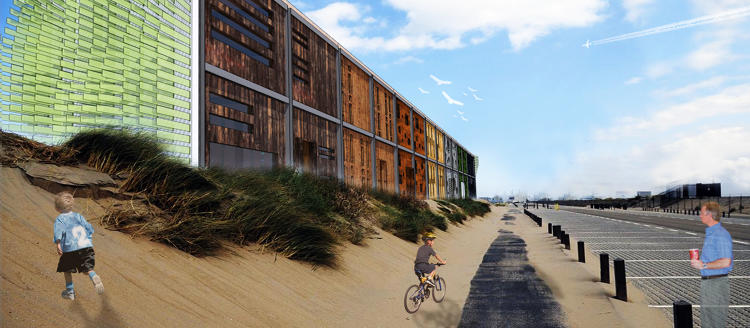
The design uses panels on a moving facade to capture energy as the wind blows, creating a pattern inspired by waving grass that grows on beaches.
Wind turbines keep getting bigger and less desirable to live around. So one designer rethought the whole thing.
1
2
3
4
Here’s A Wind Farm You’ll Want To Live Inside
Wind power panels designed by Murtada Alkaabi can be incorporated into buildings, making them convenient for cities.
There are a couple of catches: It’s hard for smaller generators be as efficient as a giant tower, and wind power usually doesn’t as work well in cities, where surrounding buildings tend to block the breeze. But in certain cases–like buildings located directly on the coast–a new design from TU Delft architecture student Murtada Alkaabi might make a lot of sense.
The design uses panels on a moving facade to capture energy as the wind blows, creating a pattern inspired by waving grass that grows on beaches. It’s not the first concept to consider ways to integrate wind power in buildings. But Alkaabi says most other ideas don’t really focus on aesthetics.
“In recent years, we’ve seen some small conceptual developments by different research centers and universities, but unfortunately the focus stays mainly on the engineering aspect of the design,” he explains. “At the same time, there’s little interest in wind energy because of the remote location of wind farms and the reputation that they are unsuitable for habitation and recreation. This proposal tries to bring design and engineering to a greater audience, in a seamless way.”
In Alkaabi’s design, the panels would be added to a modular building that can be configured in different shapes and used as housing or event space. To make reconfiguration easier, the facade is removable. The design includes other sustainable features, like a green roof that collects rainwater and circulates it through the plumbing in the building. But the wind-generating panels are the main feature.
“Architecture should not only focus on designing buildings, but also focus on combining sustainable energy and habitability,” Alkaabi says. “This is exactly what this project aims to achieve–to let people experience the benefits of wind energy in a sustainable living environment, by combining architecture and a new wind energy system. The concept has the potential to become a tourist attraction and an architectural landmark.”
The power the facade generates would go back in the grid, helping the building dramatically cut electricity bills. As Alkaabi worked on the design, he calculated how it would compare with an existing Belgian windfarm that covers around three square miles and uses 11 wind turbines. To generate the same amount of power, the new design would use a much smaller footprint.
“If we want to produce seven megawatts of energy, we only need to use 1.3 square miles of surface area,” he explains. “That’s less than half what’s needed for 11 big, expensive, and ugly wind turbines.”
Daily update: Rooftop Solar: Does it really need the grid?
Inbox
x
Renew Economy editor@reneweconomy.com.au via mail13.us2.mcsv.net Unsubscribe
1:55 PM (18 hours ago)
to me
Does rooftop solar really need the grid? Wind and solar generation half the cost of nuclear, Abbott’s business guru insists the world is cooling, Mixed greens, Reforms needed to stop free-riding of grid on back of solar PV, Energy-smart appliances cut Australian power bills by billions, Germany renewable energy policy designed to keep industries at home, 5 key ingredients for a sustainable home, and Oklahoma utilities hit homes using solar with extra fee.
The plunging cost of rooftop solar, the anticipated fall in battery costs, and the potential ability to buy a home energy system from the local hardware store, is causing a split between those that believe the grid will follow in the footsteps of the Post Office, and those that insist we can’t do without it.
Carnegie Wave capital raising oversubscribed; Kangaroo green bond market tipped to hit $1bn; Barrier Reef’s solar protector; Redflow improves batteries.