Category: Uncategorized

  • Barry O’Farrell freezes coal seam gas exploration applications in NSW

    world news

    Barry O’Farrell freezes coal seam gas exploration applications in NSW

    The premier said Labor had granted exploration licences ‘like confetti’ and warned that existing licences would be audited

    NSW premier Barry O'Farrell.
    NSW premier Barry O’Farrell. Photograph: Nikki Short/AAP

    Australian Associated Press

    Wednesday 26 March 2014 17.53 EST

    Coal seam gas exploration applications will be frozen for six months across NSW while the state government reviews the controversial process.

    The Premier, Barry O’Farrell, accused the former Labor government of granting petroleum exploration licences “like confetti” and warned that the government would also audit existing licences.

    “We’re taking decisive action to ensure the state’s resources are developed for the people of NSW and not for the benefit of Labor MPs, their cronies and their union mates,” he told the chamber on Wednesday after making the announcement.

    The six-month freeze will also allow the government to introduce a “new, thorough regime” for allocating future licences, the premier said.

    Advertisement

    The government is concerned about the application process, which has seen small companies, sometimes run by one person, being allowed to explore large areas, despite not having the experience or financial backing for the projects.

    O’Farrell said the former Labor government granted 39 exploration licences, while his government had yet to grant a single one.

    Three-quarters of the licences granted under Labor were issued by former ministers Eddie Obeid and Ian Macdonald, he said, who were later found to have acted corruptly by the Independent Commission Against Corruption.

    The premier said the licences granted under Labor were handed out with “virtually no oversight and clearly no thought”.

    He slammed Labor for only charging $1000 for exploration applications, which was “less than Ian Macdonald spent on his average lunch”.

    That fee is now being raised to $50,000.

    Advertisement

    Resources minister Anthony Roberts said the government was committed to ending Labor’s practice of “flogging off the state’s natural resources to their mates and business partners”.

    “We are sending a very clear message that only reputable operators are wanted in the state of NSW,” he told parliament.

    The Greens welcomed the decision but said the premier must go further on cracking down on CSG applications.

    “The key issue remains the rights of farmers and the community to say no to CSG,” the Greens’ mining spokesman, Jeremy Buckingham, told AAP.

    “Until that right is given to communities and farmers, this will continue to be a headache for the government.”

    Phil Laird, from anti-CSG group Lock the Gates, commended the government.

    “The previous regime seemed to focus entirely on mining and gas, whereas this is showing that the government’s trying to clean up the process,” he said.

    The announcement comes after Roberts on Wednesday announced that the government had knocked back five CSG exploration licences applications by Grainger Energy for a 43,100 square kilometre area in the Riverina region.

    The minister said the company had one director and was formed just six days before lodging its application.

    It also had “no history of conducting petroleum exploration activities” and had submitted a “manifestly deficient application”.

  • What a day! We declared 1M hectares ‘Gasfield Free’

    1 of 2
    Why this ad?
    Compare Electricity Priceyoucompare.com.au/electricity – Save On Gas & Electricity. Beat Rising Prices. Compare & Save

    What a day! We declared 1M hectares ‘Gasfield Free’

    Inbox
    x

    Anne Kennedy for Lock the Gate annkenn@bigpond.com via email.nationbuilder.com

    4:32 PM (8 minutes ago)

    to me
    Lock the Gate Alliance
    Dear Neville,

    My name is Anne Kennedy, I’m a farmer from Coonamble in north-west NSW.
    We had a big day here on Saturday, with more than 630 people turning out to declare our entire district ‘Gasfield Free’.  That’s an area of 1 million hectares!

    Together the people of our region have done their utmost to knock on every door of every property in the district. And the results are absolutely unequivocal – 96% of people want our region ‘Gasfield Free’.

    Our big celebration on Saturday was led out by our new Gasfield Free ‘Light Horse Brigade’ – 50 wonderful men and women on horseback.  There were hordes of our little ones on bikes and scooters and together we sang a stirring rendition of “We’re the boys from the bush and we don’t want gas“.  You can view some wonderful images of the day by clicking on the photo below

    028_resize.jpg

    The crowning moment of the day took place on the local oval, the declaration itself!  The 24 communities of Coonamble Shire lined up one-by-one to declare themselves “Gasfield Free” and accept their ‘Gasfield Free Road’ signs.  It was a beautiful event that drew on everything that I love most about Coonamble and the determined people of the district.

    Click on this image to watch a short and inspiring 2 minute video from the day:

    CoonamblePlay.png

    As I have said many times, I’m not anti-mining and I’m not a radical.

    I’m a conservative and a 66 year old grandmother of 11, and I would like nothing more than to be spending all my time with grandchildren and my husband on the farm.  But the threat of coal seam gas mining puts all that at risk.

    For me, it’s all about the water.  You see, I’m the President of the NSW Artesian Bore Water Users Association and I am painfully aware that farmers in our region are entirely dependent on the Great Artesian Basin.

    Our Governments are not prepared to stand up and protect our scarce water resources and our farm businesses from big CSG companies.  So we have no choice but to stand strong together, and to protect the country ourselves.

    And that’s what we were doing on Saturday.

    And it’s happening now right across Australia.  More than 220 communities across 3 million hectares of land have now declared their land, water and communities ‘Gasfield Free’.  And we are just getting started!

    We are incredibly grateful for the support that we have received from Lock the Gate supporters from all walks of life.  We know our best hope is when we stand shoulder to shoulder, united in our love for country.

    Out here in the bush, your support from right across Australia means everything to us.

    If you have the inclination to get a taste for life out here, please join us in the Pilliga on the 5th April, for music, celebration and song, and lend your support on the front line to prevent dangerous coal seam gas mining!

    Many thanks,

    Anne Kennedy from Coonamble

    Anne Kennedy for Lock the Gate
    http://www.lockthegate.org.au/

  • SPA: Newsletter, Issue 115, April 2014

    1 of 38
    Why this ad?
    Drug and Alcohol Coursewww.seeklearning.com.au/Counselling – Alcohol And Drug Counselling Course Nationally Recognised & Accredited

    SPA: Newsletter, Issue 115, April 2014

    Inbox
    x

    SPA President president@population.org.au via messaging-master.net

    12:17 PM (2 hours ago)

    to me
    SPA Logo

    Sustainable Population Australia

    www.population.org.au

    info@population.org.au

    02 6288 6810

    Dear members and supporters of Sustainable Population Australia
    Please find attached the latest newsletter (no. 115, April, 2014) which is also available online at http://www.population.org.au/sites/default/files/newsletters/nl2014102_114-web.pdf.
    In this issue you will find:
    • a front page story about Camilo Mora’s critical paper in Ecology and Society
    • a speech by Paul Ehrlich
    • an explanation from Martin Tye as to why he set up Population Growth Slow Down (PGSD)
    • an Opinion article by SPA member Keith Lethbridge
    • the latest research commissioned by the UK’s Population Matters
    • book reviews of Guy McPherson’s Going Dark and Andrew Glikson’s Evolution of the atmosphere, fire and the anthropocene climate event horizon
    • population news
    • SPA news
    • notice of our upcoming AGM on 5 April plus symposium and dinner.
    All the best

    Jenny Goldie
    Newsletter editor


    This email has been sent to you because you are on an SPA mailing list or are receiving a one-off group response to an action you’ve undertaken involving SPA. If you do not wish to receive emails from SPA, please unsubscribe . Please note that you may be on more than one SPA mailing list and un-subscription will remove you from all of these. If you have any queries regarding your subscriptions, please contact SPA. Contact details can be found at www.population.org.au/contact.

    SPA Inc.
    ABN: 28 399 654 270
    PO Box 3851
    Weston Creek, ACT 2611
    Australia

  • “First shots fired in mining battle” 350 ORG

    1 of 38
    Why this ad?
    Leading met coal eventwww.eurocokesummit.com – 10th annual Eurocoke Summit. ThyssenKrupp, CRU, Giprokoks, more

    “First shots fired in mining battle”

    Inbox
    x

    Blair Palese, 350.org Australia australia@350.org

    6:10 PM (43 minutes ago)

    to me

    Dear friends and supporters,

    “First shots fired in mining battle”: That’s the headline of an article in today’s Australian Financial Review. Over the last two days, we’ve been bombarded with news of how the Minerals Council of Australia has started a campaign against the divestment campaign. As the article in the AFR points out, it’s our clearest sign yet that we’re having impact:

    “The decision to loose the Minerals Council on the coal problem says only that the campaign to undermine community, investor and government confidence in Australia’s second biggest export industry is beginning to develop potentially debilitating momentum.”

    We believe we can win this battle, but we need your support to make us powerful enough to win this fight. To sustain our efforts in the coming months, we need 100 people to donate monthly an average of $8/week. Will you be one of those 100 people? Click here to find out how.

    Up until now, the coal industry has been content in taking the occasional pot shot at us, but now they know we mean business and are determined to take us on. Yesterday, writing in The Australian, the CEO of the Minerals Council came out attacking 350.org and other groups fighting coal. It was also revealed that they are now campaigning against the divestment campaign, lobbying super funds and investors against divesting.

    This is a true David and Goliath fight. While we can count our staff on less than two hands, they have thousands of dollars in PR budget at their fingertips. They’re Australia’s most powerful industry. We’re fighting not just one company but many – from BHP and Rio Tinto to Whitehaven and Glencore. That’s why we’re writing to ask you to chip in and make us powerful in this fight.

    The time to wind down on coal has arrived. Despite the coal industry’s superior fire power, and no matter what the Minerals Council tell them, investors are increasingly waking up to the ethical and financial risks of investing in coal. We need to speed that waking up…up.

    With your financial support, we’ll continue to front up to this most powerful of industries, from the Maules Creek campaign to the National Divestment Day of Action on May 3rd.

    These companies paint us out as radicals, yet they are the ones who are the radicals. They are the ones stopping the action required to prevent further extreme heat, intense cyclones, and the loss of much of the Great Barrier Reef.

    Click here to stand by us in this fight. Thanks for all that you do!


    Blair, Aaron, Charlie, Josh, for 350.org Australia

    P.S. If you have any questions about donating, please do not hesitate to send us an email. Just hit reply to this one.

    _____

    * Here’s some of the coverage from the last two days: In The Australian: “Miners target funds to spread the message on coal”. In the Australian Financial Review:  “Fossil fuel campaigns to plague miners”“First shots fired in mining battle”. In The Age : “Coal miners starting to count the cost of activist pressure on funding”.


    350.org is building a global climate movement.


  • Destroyer of Worlds MONBIOT

    Destroyer of Worlds

    March 24, 2014

    New research suggests there was no state of grace: for two million years humankind has been the natural world’s nemesis.

    By George Monbiot, published in the Guardian 25th March 2014

    You want to know who we are? Really? You think you do, but you will regret it. This article, if you have any love for the world, will inject you with a venom – a soul-scraping sadness – without an obvious antidote.

    The Anthropocene, now a popular term among scientists, is the epoch in which we live: one dominated by human impacts on the living world. Most date it from the beginning of the industrial revolution. But it might have begun much earlier, with a killing spree that commenced two million years ago. What rose onto its hindlegs on the African savannahs was, from the outset, death: the destroyer of worlds.

    Before Homo erectus, perhaps our first recognisably-human ancestor, emerged in Africa, the continent abounded with monsters. There were several species of elephants. There were sabretooths and false sabretooths, giant hyaenas and creatures like those released in The Hunger Games: amphicyonids, or bear dogs, vast predators with an enormous bite.
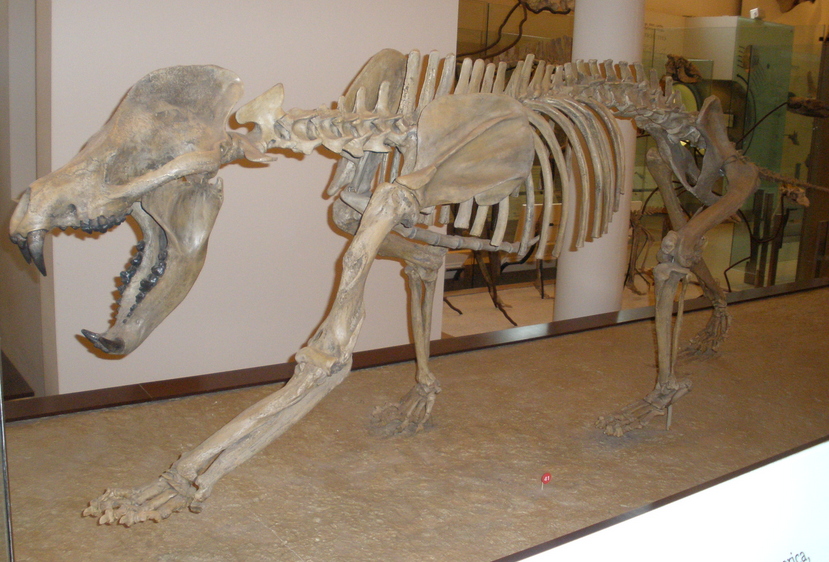
    Amphicyonid ("bear dog") skeleton

    Amphicyonid (“bear dog”) skeleton

    Professor Blaire van Valkenburgh has developed a means by which we could roughly determine how many of these animals there were(1). When there are few predators and plenty of prey, the predators eat only the best parts of the carcas. When competition is intense, they eat everything, including the bones. The more bones a carnivore eats, the more likely its teeth are to be worn or broken. The breakages in carnivores’ teeth were massively greater in the pre-human era(2).
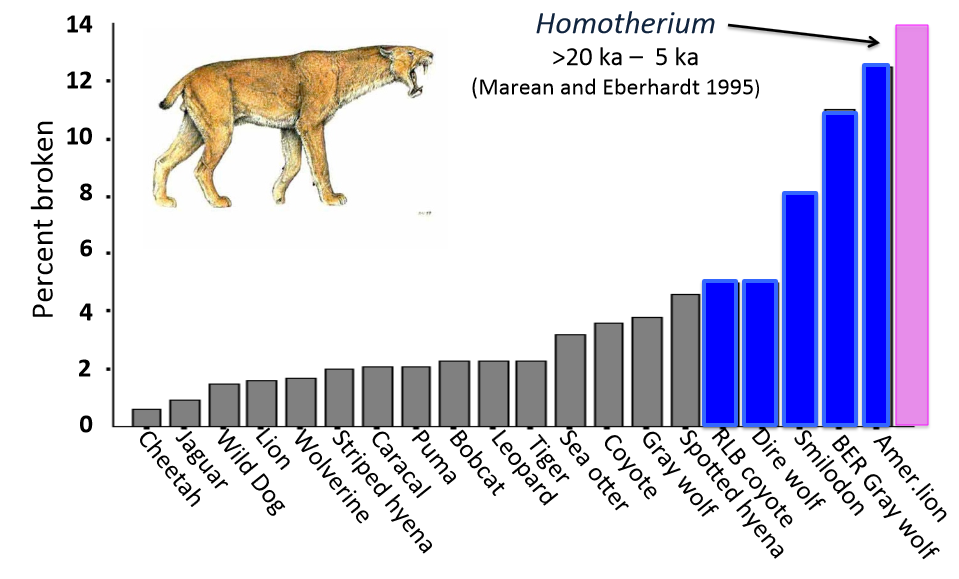
    Blaire van Valkenburgh's tooth breakage graph

    Blaire van Valkenburgh’s tooth breakage graph

    Not only were there more species of predators, including species much larger than any found on earth today, but they appear to have been much more abundant – and desperate. We evolved in a terrible, wonderful world – that was no match for us.

    Homo erectus possessed several traits that appear to have made it invincible: intelligence, cooperation; an ability to switch to almost any food when times were tough; and a throwing arm that allowed it to do something no other species has ever managed – to fight from a distance. (The increasing distance from which we fight is both a benchmark and a determinant of human history). It could have driven giant predators off their prey and harried monstrous herbivores to exhaustion and death.

    As the paleontologists Lars Werdelin and Margaret Lewis show, the disappearance of much of the African megafauna appears to have coincided with the switch towards meat eating by human ancestors(3). The great extent and strange pattern of extinction (concentrated among huge, specialist animals at the top of the food chain) is not easy to explain by other means.

    At the Oxford megafauna conference last week, I listened as many of the world’s leading scientists in this field mapped out a new understanding of the human impact on the planet(4). Almost everywhere we went, humankind erased a world of wonders, changing the way the biosphere functions. For example, modern humans arrived in Europe and Australia at about the same time – between 40 and 50,000 years ago – with similar consequences. In Europe, where animals had learnt to fear previous versions of the bipedal ape, the extinctions happened slowly. Within some 10 or 15,000 years, the continent had lost its straight-tusked elephants, forest rhinos, hippos, hyaenas and monstrous scimitar cats.
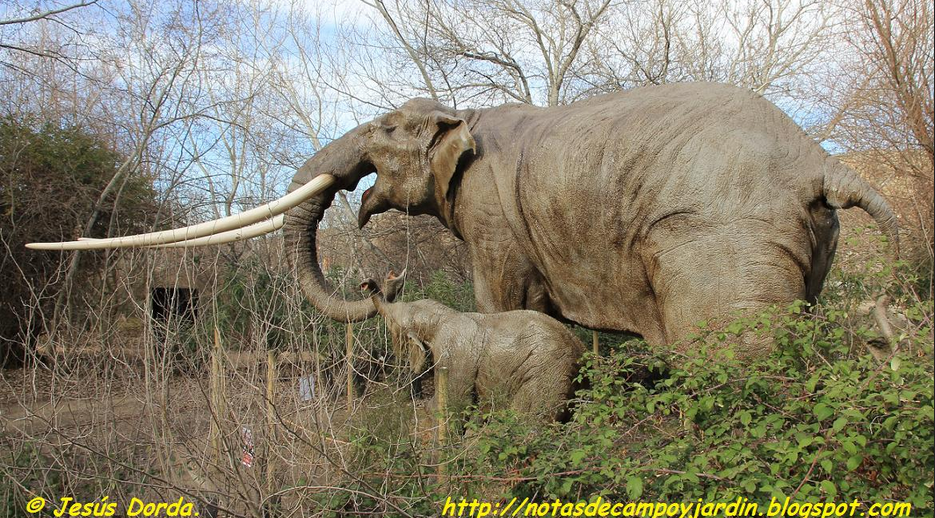
    Straight tusked elephants once dominated the British ecosystem

    Straight tusked elephants once dominated the British ecosystem

    In Australia, where no hominim had set foot before modern humans arrived, the collapse was  almost instant. The rhinoceros-sized wombat(5), the ten-foot kangaroo, the marsupial lion, the monitor lizard larger than a Nile crocodile(6), the giant marsupial tapir, the horned tortoise as big as a car(7) – all went, in ecological terms, overnight.
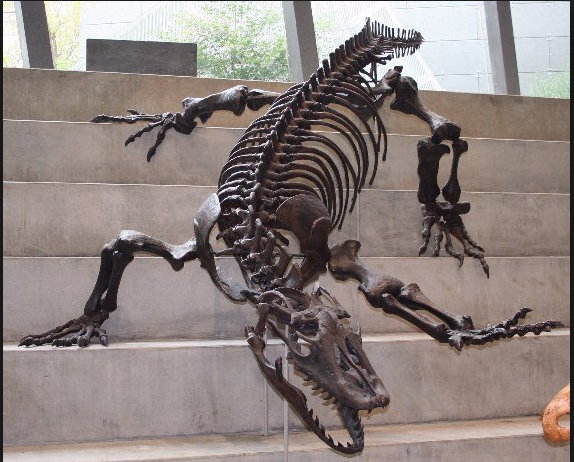
    Giant monitor lizard skeleton

    Giant monitor lizard skeleton

    A few months ago, a well-publicised paper claimed that the great beasts of the Americas – mammoths and mastodons, giant ground sloths, lions and sabretooths, eight-foot beavers(8), a bird with a 26-foot wingspan(9) – could not have been exterminated by humans, because the fossil evidence for their extinction marginally pre-dates the evidence for human arrival(10).

    I have never seen a paper demolished as elegantly and decisively as this was at last week’s conference. The archaeologist Todd Surovell demonstrated that the mismatch is just what you would expect if humans were responsible(11). Mass destruction is easy to detect in the fossil record: in one layer bones are everywhere, in the next they are nowhere. But people living at low densities with basic technologies leave almost no traces. With the human growth rates and kill rates you’d expect in the first pulse of settlement (about 14,000 years ago), the great beasts would have lasted only 1,000 years. His work suggests that the most reliable indicator of human arrival in the fossil record is a wave of large mammal extinctions.

    These species were not just ornaments of the natural world. The new work presented at the conference suggests that they shaped the rest of the ecosystem. In Britain during the last interglacial period, elephants, rhinos and other great beasts maintained a mosaic of habitats: a mixture of closed canopy forest, open forest, glade and sward(12). In Australia, the sudden flush of vegetation that followed the loss of large herbivores caused stacks of leaf litter to build up, which became the rainforests’ pyre: fires (natural or manmade) soon transformed these lush places into dry forest and scrub(13).

    In the Amazon and other regions, large herbivores moved nutrients from rich soils to poor ones, radically altering plant growth(14,15). One controversial paper suggests that the eradication of the monsters of the Americas caused such a sharp loss of atmospheric methane (generated in their guts) that it could have triggered the short ice age which began 12,800 years ago, called the Younger Dryas(16).

    And still we have not stopped. Poaching has reduced the population of African forest elephants by 60% since 2000(17). The range of the Asian elephant – which once lived from Turkey to the coast of China – has contracted by 97%; the ranges of the Asian rhinos by over 99%(18). Elephants distribute the seeds of hundreds of rainforest tree species; without them these trees are functionally extinct(19,20).

    Is this all we are? A diminutive monster that can leave no door closed, no hiding place intact, that is now doing to the great beasts of the sea what we did so long ago to the great beasts of the land? Or can we stop? Can we use our ingenuity, which for two million years has turned so inventively to destruction, to defy our evolutionary history?

    www.monbiot.com

    References:

    1. eg Wendy J. Binder and Blaire Van Valkenburgh, 2010. A comparison of tooth wear and breakage in Rancho La Brea sabertooth cats and dire wolves across time. Journal of Vertebrate Paleontology. http://www.tandfonline.com/doi/abs/10.1080/02724630903413016#.UzBUcM40uQk
    2. http://www.eci.ox.ac.uk/news/events/2014/megafauna/valkenburgh.pdf

    3. Lars Werdelin, 2013. King of Beasts. Scientific American. http://www.scientificamerican.com/magazine/sa/2013/11-01/

    4. http://oxfordmegafauna.weebly.com/

    5. Diprotodon.

    6. Megalania.

    7. http://www.wired.com/wiredscience/2010/08/last-giant-land-turtle/

    8. Castoroides ohioensis

    9. The Argentine roc (Argentavis magnificens).

    10. Matthew T. Boulanger and R. Lee Lyman, 2014. Northeastern North American Pleistocene megafauna chronologically overlapped minimally with Paleoindians. Quaternary Science Reviews 85, pp35-46. http://dx.doi.org/10.1016/j.quascirev.2013.11.024

    11. http://www.eci.ox.ac.uk/news/events/2014/megafauna/surovell.pdf

    12. Christopher J. Sandom et al, 2014. High herbivore density associated with vegetation diversity in interglacial ecosystems. Proceedings of the National Academy of Sciences, vol. 111, no. 11, pp4162–4167. www.pnas.org/cgi/doi/10.1073/pnas.1311014111

    13. Susan Rule et al, 23rd March 2012. The Aftermath of Megafaunal Extinction: Ecosystem Transformation in Pleistocene Australia. Science Vol. 335, pp 1483-1486. doi: 10.1126/science.1214261. https://www.sciencemag.org/content/335/6075/1483.full

    14. Christopher E. Doughty, AdamWolf and Yadvinder Malhi, 11 August 2013. The legacy of the Pleistocene megafauna extinctions on nutrient availability in Amazonia. Nature Geoscience vol. 6, pp761–764. doi: 10.1038/ngeo1895. http://www.nature.com/ngeo/journal/v6/n9/full/ngeo1895.html

    15. Adam Wolf, Christopher E. Doughty, Yadvinder Malhi, Lateral Diffusion of Nutrients by Mammalian Herbivores in Terrestrial Ecosystems. PLOS One, doi: 10.1371/journal.pone.0071352. http://www.plosone.org/article/info%3Adoi%2F10.1371%2Fjournal.pone.0071352

    16. Felisa A. Smith, 2010. Methane emissions from extinct megafauna. Nature Geoscience 3, 374 – 375. doi:10.1038/ngeo877. http://www.nature.com/ngeo/journal/v3/n6/full/ngeo877.html

    17. http://www.salon.com/2014/01/05/african_forest_elephants_are_being_massacred_into_extinction_partner/

    18. http://www.eci.ox.ac.uk/news/events/2014/megafauna/campos.pdf

    19. http://www.eci.ox.ac.uk/news/events/2014/megafauna/campos.pdf

    20. http://www.eci.ox.ac.uk/news/events/2014/megafauna/galetti.pdf

    Bookmark and Share
  • We’re taking it to court (again) REEF FIGHT

    1 of 37
    Why this ad?
    Solar Systems From $2,399energyaustralia.com.au/Solar – If You Find A Better Price, We’ll Match It. We Are The Solar Experts

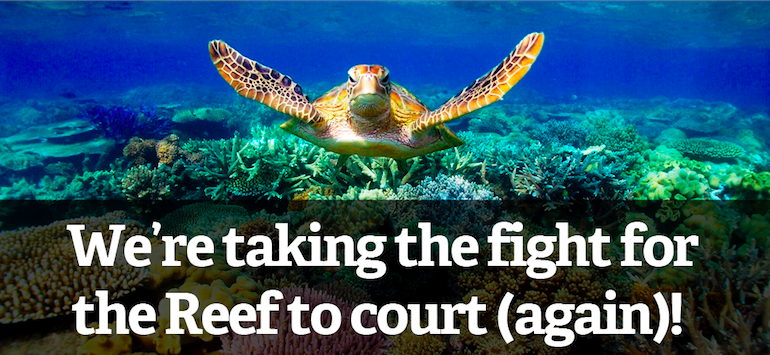
    We’re taking it to court (again)

    Inbox
    x

    Sam – GetUp!

    10:27 AM (6 hours ago)

    to me

    NEVILLE,

    We hope you like legal fights, because we’ve just committed funding for a second court case to protect our Reef! This time, Environment Minister Greg Hunt is in the firing line for approving the dredging of 3 million cubic metres of World Heritage Area seabed.

    It’s been the largest and most diverse grassroots crowd funding effort our movement has ever seen. First, thousands of GetUp members helped North Queensland Conservation Council launch a case against the dumping approval. Now, we’re helping fund this critical dredging case as well.

    Our total contribution stands at $300,000 – made up of donations from more than 17,500 GetUp members all across the country.

    This is a significant day for the campaign to save our Reef, and one we should all be proud of. Congratulations and thank you to everyone who helped make this happen.

    If you haven’t already, you can still get in on the action and contribute to the citizen-led Reef Fighting Fund that’s already helped launch two potentially game-changing court cases for the Reef: https://www.getup.org.au/reef

    The case filed today argues that Minister Hunt failed his obligation to protect the World Heritage Area. If successful, the case would prevent the massive dredging project in Great Barrier Reef waters.

    But that’s not all. It could set a precedent that would make it harder for any development that threatens our World Heritage Area to get approval. The stakes are huge, and you can be sure the whole world will be watching closely.

    Can you help the fight?

    https://www.getup.org.au/reef

    We’re working with EDO Queensland, the same formidable lawyers leading the fight on the dumping case. This time, they’re representing the Mackay Conservation Group, who have been protecting our environment on the front lines for almost 30 years. There’s no-one better equipped to lead the charge, and we’re proud to throw our support behind them.

    “This is a big step for our organisation, but one that we know is necessary for protecting the Great Barrier Reef. Our local community is passionate about the future of the Reef and it’s crucial for us to have the support of GetUp members from around Australia.” – Dr Michael Williams, Mackay Conservation Group President and local paediatrician.

    The fight to protect our Reef isn’t going to be easy. Today we took another huge step, but there’s still a lot of work to be done.

    Whether it’s helping to launch further legal challenges, running high-impact television or newspaper ads or another strategic campaign, let’s be ready for whatever comes next.

    Can you be a part of the citizen-led Fighting Fund to save the Reef?

    https://www.getup.org.au/reef

    We’ll keep you posted on updates from both cases as they arise. But in the mean time, congratulations to everyone involved, and thank you for being part of this incredible movement. Days like today are what it’s all about.

    Sam, Erin, Kelsey and Aly, for the GetUp team.