Author: admin

  • We need to act urgently on global warming

    News 2 new results for PEAK-OIL
    National View: We need to act urgently on global warming
    SouthCoastToday.com
    Barring state intervention and environmental activism, industrial civilization will not rethink its oil addiction, any more than a shark can be talked into going vegetarian. What peak oil means is that the quest for oil will become more nasty, violent 
    See all stories on this topic »
    We need to act urgently on global warming
    The Olympian
    Back in 2009, British environmental polemicist George Monbiot warned that the peak oil disaster was upon us. But in a July 2 London Guardian column he did an about-face. “We were wrong on peak oil,” he said. “There is enough to fry us all.” While other 
    See all stories on this topic »
  • Employment Gains Keep Pace with Population Growth, but Leave Job Deficit …

    News 10 new results for POPULATION GROWTH
    Employment Gains Keep Pace with Population Growth, but Leave Job Deficit 
    Brookings Institution (blog)
    Since January labor market gains have been fast enough to keep pace with population growth, but not fast enough to put a dent in the nation’s unemployment rate. The number of unemployed and the unemployment rate were essentially the same in July as 
    See all stories on this topic »
    NSSO Data: Strong rural growth in 2010-12 or base effect?
    Moneycontrol.com
    There has to be some kind of an increase in rural consumption, there was some of an increase that was happening to the bottom sections of the rural population and the urban population. The kind of picture that you see between 2004-2005 to 2009-2010 and 
    See all stories on this topic »
    Taxi population growth rate slashed until end-2013
    Straits Times
    Land Transport Authority said Singapore’s taxi fleet – which has grown by more than 40 per cent to more than 27000 since the industry was liberalised in 2003 – will only be allowed to grow 2 per cent per annum up to end-2013. — ST PHOTO: CHEW SENG 
    See all stories on this topic »

    Straits Times
    Population control is crucial
    Ottawa Citizen
    Re: Curb population growth, July 27. I heartily agree with the opinion of letter writer Roderick Taylor. I too have noticed the scrupulous way that, not only the media, but politicians, scientists and activists avoid mentioning population control when discussing 
    See all stories on this topic »
    ADEA Awarded Grant to Increase Diversity Among Dental Faculty
    Dentistry IQ
    all student and faculty populations, while developing leadership in new dental faculty. “We must work together at a systems level to address the oral health inequities among vulnerable children and families, and to do this, it’s critical to increase the diversity 
    See all stories on this topic »
    US economy adds 163K jobs, unemployment rises
    Crain’s New York Business
    Still, the economy has added an average of 151000 jobs a month this year—enough to keep up withpopulation growth but not enough to drive down the unemployment rate. “After a string of disappointing economic reports … we’ll certainly take it,” said James 
    See all stories on this topic »
    Scottish GPs demand premises investment as population soars
    GP online
    He said: ‘At present there is no requirement for planning departments to consider the impact ofpopulation growth on local health services, we believe that it would make sense to include this as part of the planning process. ‘General practice is very much at the 
    See all stories on this topic »
    From Youth Bulge to Food and Family Planning, Los Angeles Times’ “Beyond 7 
    New Security Beat
    Los Angeles Times correspondent Kenneth Weiss and photographer Rick Loomis examine these numerous and interconnected challenges in a five-part series on population growthand consumption dynamics. Speaking to demographic and health experts 
    See all stories on this topic »

    New Security Beat
    Scottish GPs call for more practices to cope with rise in population
    Management in Practice
    Scottish GPs have called upon the government to support their plea in building new GP surgeries in areas where there is “significant” population growth. In his annual report published yesterday (2 August), the Registrar General found Scotland’s population 
    See all stories on this topic »
    Taxi fleet growth capped at 2% per year until 2013
    Channel News Asia
    But despite the growing taxi population, commuters are still complaining about not being able to get a cab when they need one. To address these complaints, the government is taking steps to improve taxi availability. After January 2014, taxi operators will be 
    See all stories on this topic »


    This once a day Google Alert is brought to you by Google.

    Delete this alert.
    Create another alert.
    Manage your alerts.

  • HANSEN Are we experiencing more extreme hot weather due to climate change? The evidence is in.

    climate code red


    Are we experiencing more extreme hot weather due to climate change? The evidence is in.

    Posted: 03 Aug 2012 05:06 PM PDT

    By James Hansen, Makiko Sato and Reto Ruedy (available at PDFhere)

    The greatest barrier to public recognition of human-made climate change is probably the natural variability of local climate. How can a person discern long-term climate change, given the notorious variability of local weather and climate from day to day and year to year?

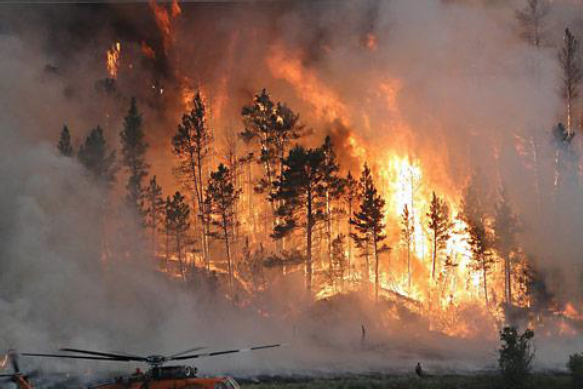
    Figure 1: Fire fighters battle the Taylor Creek blaze, one of several fires which have burned over 75,000 acres in southeastern Montana in summer 2012. Image credit: USFWS/Gerald Vickers via InciWeb.org.

    The question is important because actions to stem emissions of gases that cause global warming are unlikely until the public appreciates the significance of global warming and perceives that it will have unacceptable consequences. Thus when nature seemingly provides evidence of climate change it needs to be examined objectively by the public, as well as by scientists.
    Therefore it was disappointing that most early media reports on the heat wave, widespread drought, and intense forest fires in the United States in 2012 did not mention or examine the potential connection between these climate events and global warming. Is this   reticence justified?
    In a new paper (Hansen et al., 2012a), we conclude that such reticence is not justified. The paper attempts to illustrate the data in ways that properly account for climate variability yet are understandable to the public.
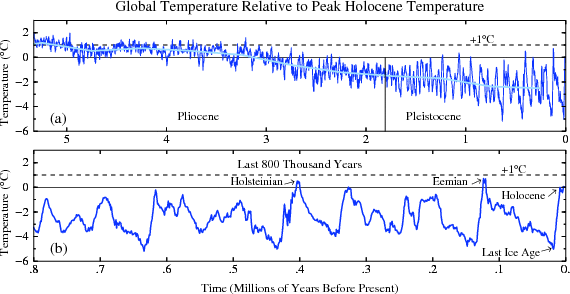
    We show how the probability of unusually warm seasons is changing, emphasizing summer when the changes have large practical effects. We calculate seasonal-mean temperature anomalies relative to average temperature in the base period 1951-1980. This is an appropriate base period because global temperature was relatively stable and still within the Holocene range to which humanity and other planetary life are adapted (note 1).
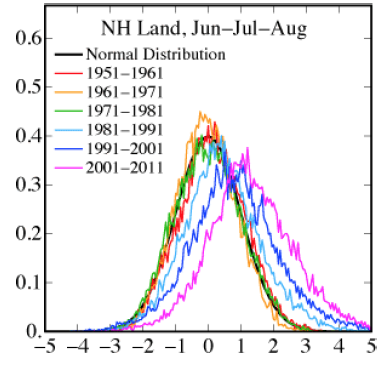
    We illustrate variability of seasonal temperature in units of standard deviation (σ), including comparison with the normal distribution (“bell curve”) that the lay public may appreciate. The probability distribution (frequency of occurrence) of local summer-mean temperature anomalies was close to the normal distribution in the 1950s, 1960s and 1970s in both hemispheres (Figure 2). However, in each subsequent decade the distribution shifted toward more positive anomalies, with the positive tail (hot outliers) of the distribution shifting the most.

    Figure 2. Temperature anomaly distribution: The frequency of occurrence (vertical axis) of local temperature anomalies (relative to 1951-1980 mean) in units of local standard deviation (horizontal axis). Area under each curve is unity. Image credit: NASA/GISS.

    An important change is the emergence of a subset of the hot category, extremely hot outliers, defined as anomalies exceeding +3σ. The frequency of these extreme anomalies is about 0.13% in the normal distribution, and thus in a typical summer in the base period only 0.1-0.2% of the globe is covered by such hot extremes. However, we show that during the past several years the global land area covered by summer temperature anomalies exceeding +3σ has averaged about 10%, an increase by more than an order of magnitude compared to the base period. Recent examples of summer temperature anomalies exceeding +3σ include the heat wave and drought in Oklahoma, Texas and Mexico in 2011 and a larger region encompassing much of the Middle East, Western Asia and Eastern Europe, including Moscow, in 2010.
    The question of whether these extreme hot anomalies are a result of global warming is often answered in the negative, with an alternative interpretation based on meteorological patterns. For example, an unusual atmospheric “blocking” situation resulted in a long-lived high pressure anomaly in the Moscow region in 2010, and a strong La Niña in 2011 may have contributed to the heat and drought situation in the southern United States and Mexico. However, such meteorological patterns are not new and thus as an “explanation” fail to account for the huge increase in the area covered by extreme positive temperature anomalies. Specific meteorological patterns help explain where the high pressure regions that favor high temperature and drought conditions occur in a given summer, but the unusually great temperature extremities and the large area covered by these hot anomalies is a consequence of global warming, which is causing the bell curve to shift to the right (Fig. 2).
    Yet the distribution of seasonal temperature anomalies (Fig. 2) also reveals that a significant portion (about 15 percent) of the anomalies are still negative, corresponding to summer-mean temperatures cooler than the average 1951-1980 climate. Thus people should not be surprised by the occasional season that is unusually cool. Cool anomalies as extreme as -2σ still occur, because the anomaly distribution has broadened as well as moved to the right. In other words, our climate now encompasses greater extremes.
    Our analysis is an empirical approach that avoids use of global climate models, instead using only real world data. Theories for the cause of observed global temperature change are thus separated as an independent matter. However, it is of interest to compare the data with results from climate models that are used to simulate expected global warming due to increasing human-made greenhouse gases.
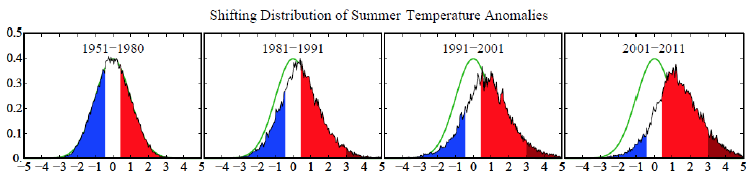
    Indeed, the “climate dice” concept was suggested in conjunction with climate simulations made in the 1980s (Hansen et al., 1988) as a way to describe the stochastic variability of local temperatures, with the implication that the public should recognize the existence of global warming once the dice become sufficiently “loaded” (biased). Specifically, the 10 warmest summers (Jun-Jul-Aug in the Northern Hemisphere) in the 30-year period (1951-1980) were used to define the “hot” summer category, the 10 coolest the “cold” category, and the middle 10 the “average” summer. Thus it was imagined that two sides of a six-sided die were colored red, blue and white for these respective categories. The divisions between “hot” and “average” and between “average” and “cold” occur at +0.43σ and -0.43σ for a normal distribution.
    Temperatures simulated in a global climate model (Hansen et al., 1988) reached a level such that four of the six sides of the climate dice were red in the first decade of the 21st century for greenhouse gas scenario B, which is an accurate approximation of actual greenhouse gas growth (Hansen and Sato 2004; updates are provided by a Columbia Univ. webpage). Observed summer temperature anomalies over global land during the past decade averaged about 75% in the “hot category”, thus midway between four and five sides of the die were red, which is reasonably consistent with expectations.
    The relation between the bell curve and climate dice is illustrated in Figure 3. Extremely hot outliers already occur more frequently than unusually cold seasons. If the march of the bell curve to the right continues unabated, within a few decades even the seasons that were once considered average will cease to occur.

    Figure 3. Frequency of occurrence (vertical axis) of local June-July-August temperature
    anomalies (relative to 1951-1980 mean) for Northern Hemisphere land in units of local standard deviation (horizontal axis). Temperature anomalies in the period 1951-1980 match closely the normal distribution (“bell curve”, shown in green), which is used to define cold (blue), typical (white) and hot (red) seasons, each with probability 33.3%. The distribution of anomalies has shifted to the right as a consequence of the global warming of the past three decades such that cool summers now cover only half of one side of a six-sided die, white covers one side, red covers four sides, and an extremely hot (red-brown) anomaly covers half of one side..

    We have shown that the increased frequency of “hot” seasons is a result of global warming. The cause of global warming is a separate matter, but observed global warming is now attributed with high confidence to increasing greenhouse gases (IPCC 2007a).
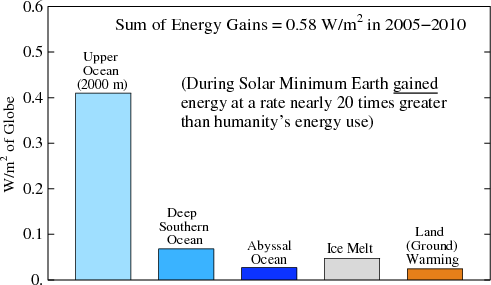
    Both attributions are important. Together they allow us to infer that the area covered by extreme hot anomalies will continue to increase in coming decades and that even more extreme outliers will occur. Indeed, we conclude that the decade-by-decade shift to the right of the temperature anomaly distribution (Fig. 2) will continue, because Earth is now out of energy balance, with more solar energy absorbed than heat radiation emitted to space (Hansen et al., 2011); it is this imbalance that drives the planet to higher temperatures. Even an exceedingly optimistic scenario for fossil fuel emissions reduction, 6%/year beginning in 2013, results in global temperature rising to almost 1.2°C relative to 1880-1920, which compares to a current level ~0.8°C (Hansen et al., 2012b).

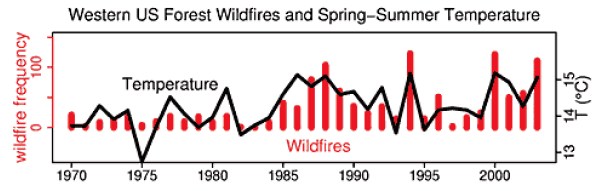
    Figure 4. Wildfire frequency and spring-summer temperature in the western United States.
    Image credit: Westerling et al. (2006).

    Practical effects of increasingly loaded climate dice occur mainly via amplified extremes ofEarth’s water cycle. The broadening of the “bell curve” of temperature anomalies is related to interactions of warming with the water cycle. Hot summer anomalies occur when and where weather patterns yield an extended period of high atmospheric pressure. This condition is amplified by global warming and the ubiquitous surface heating due to elevated greenhouse gas levels, thus increasing the chances of an extreme anomaly. Yet global warming also increases atmospheric water vapor overall, causing, at other times or places, more extreme rainfall and floods, consistent with documented changes over Northern Hemisphere land and the tropics (IPCC 2007b).
    The (Northern Hemisphere) summer of 2012 is still unfolding. A global map of the anomaly distribution will be provided on a Columbia Univ. webpage once the data are complete; the data so far suggest that parts of the United States and Asia likely will be in the extreme (+3σ) category. One of the consequences of extreme summer heat anomalies is increased area and intensity of wildfires, as shown in Fig. 4. Updates of these data and other climate impacts after the 2012 data are complete will be useful for assessing impacts of continued global warming.

    Related Articles
    NASA News: How Warm was Summer 2010?
    NASA Earth Observatory: Image of the Day, Aug. 9, 2010: Heatwave in Russia
    NASA Earth Observatory: Image of the Day, June 29, 2012: Heat Wave Fuels Wildfires in the Rockies
    NASA Earth Observatory: Image of the Day, July 17, 2012: Drought Grips the United States

    Footnote
    1 In contrast, we infer that current global temperature is above the Holocene range, as evidenced by the fact that the ice sheets in both hemispheres are now rapidly shedding mass (Rignot et al., 2011) and sea level is rising (Nerem et al., 2006) at a rate (more than 3 mm/year or 3 m/millennium) that is much higher than the rate of sea level change during the past several millennia.

    References
    Hansen, J., I. Fung, A. Lacis, D. Rind, Lebedeff, R. Ruedy, G. Russell, and P. Stone, 1988: Global climate changes as forecast by Goddard Institute for Space Studies three-dimensional model. J. Geophys. Res., 93, 9341-9364, doi:10.1029/JD093iD08p09341.
    Hansen, J., and Mki. Sato, 2004: Greenhouse gas growth rates. Proc. Natl. Acad. Sci., 101, 16109-16114, doi:10.1073/pnas.0406982101.
    Hansen, J., Mki. Sato, P. Kharecha, and K. von Schuckmann, 2011: Earth’s energy imbalance and implications. Atmos. Chem. Phys., 11, 13421-13449, doi:10.5194/acp-11-13421-2011.
    Hansen, J., Mki. Sato, and R. Ruedy, 2012a: Perception of climate change. Proc. Natl. Acad. Sci., in press. Early draft posted as “Public perception of climate change and the new climate dice”, arXiv.org:1204.1286.
    Hansen, J., P. Kharecha, Mki. Sato, F. Ackerman, P.J. Hearty, O. Hoegh-Guldberg, S.-L. Hsu, F. Krueger, C. Parmesan, S. Rahmstorf, J. Rockstrom, E.J. Rohling, J. Sachs, P. Smith, K. Steffen, L. Van Susteren, K. von Schuckmann, and J.C. Zachos, 2012b: Scientific case for avoiding dangerous climate change to protect young people and nature. Proc. Natl. Acad. Sci., submitted.
    Intergovernmental Panel on Climate Change (IPCC), 2007a: Climate Change 2007: The Physical Science Basis. Solomon, S., et al. eds., Cambridge University Press, 996 pp.
    Intergovernmental Panel on Climate Change (IPCC), 2007b: Climate Change 2007, Impacts, Adaptation and Vulnerability. Parry, M.L., Canziani, O.F., Palutikof, J.P., Van Der Linden, P.J., and Hanson, C.E. eds., Cambridge Univ Press, 996 pp.
    Nerem, R.S., Leuliette, E., and Cazenave, A., 2006: Present-day sea-level change: A review. C. R. Geosci., 338, 1077-1083, doi:10.1016/j.crte.2006.09.001.
    Rignot, E., Velicogna, I., van den Broeke, M.R., Monaghan, A., and Lenaerts, J., 2011: Acceleration of the contribution of the Greenland and Antarctic ice sheets to sea level rise. Geophys. Res. Lett., 38, L05503, doi:10.1029/2011GL046583.
    Westerling, A.L., Hidalgo, H.G., Cayan, D.R., Swetnam, T.W., 2006: Warming and earlier spring increase western U.S. forest wildfire activity. Science, 313, 940-943, doi:10.1126/science.1128834.

    Contact
    Please address all inquiries about this research to Dr. James Hansen.

    You are subscribed to email updates from Climate Code Red
    To stop receiving these emails, you mayunsubscribe now.
    Email delivery powered by Google
    Google Inc., 20 West Kinzie, Chicago IL USA 6
  • Updating the Climate Science (HANSEN)

    Updating the Climate Science

    What Path is the Real World Following?

    Makiko Sato & James Hansen

    Columbia University
    web page maintained by Makiko Sato (mhs119@columbia.edu)


    Our aim is to help people understand global climate change — and how the factors that drive climate are changing.

    We start with climate diagnostics — people are usually most interested in climate change itself. But cause-and-effect analysis requires also data on climate forcings (which drive climate change) and feedbacks (which amplify or diminish climate change).

    We update graphs of “Storms of My Grandchildren.” Yet the greatest insight about processes discussed in “Storms” is often provided by other quantities, for example, the rate of ice sheet disintegration. We include some data from other scientists or their web sites, as indicated.

    Continual updating of data curves, whether global temperature, the Greenland ice sheet mass, the sun’s brightness, Keeling’s carbon dioxide record, or other more obscure quantities, is a most interesting aspect of science. Sometimes data curves follow an expected path, sometimes not, but we usually learn something. As Richard Feynman said, there is a pleasure of finding things out.

    That pleasure is now mixed with concern. Humans are altering the measured curves. But whether climate change will be moderate — something humans and most species can adjust to — or whether climate change accelerates and spins out of control, with devastating consequences for future generations — that depends.

    Future climate depends on how climate forcings change — human-made greenhouse gases, especially carbon dioxide, and forcings that are not yet well measured, especially aerosols. The speed and degree of climate change also will depend upon how fast amplifying feedbacks, such as Arctic sea ice, the large ice sheets, and methane hydrates come into play.

    Construction of this web site is just beginning. But already there are interesting new data.

    “Storms of My Grandchildren” by James Hansen

    Critical Climate Diagnostics and Feedbacks


    Climate Forcings


    Recent Publications

    Target CO2 (2008)

    Global Temperature Change (2010)

    Earth’s Energy Imbalance (2011)

    Paleoclimate Implications (2012)

    Perceptions and Dice (2012)

    • “Perception of Climate Change” will be published in PNAS Plus online in the week of August 6.
    • Figures Only (last modified 2012/07/31)

    Case for Young People (2012?)

    • “Scientific Case for Avoiding Dangerous Climate Change to Protect Young People and Nature” submitted to Proc Nat Acad Sci USA in February 2012, and posted on arXiv on 2012/03/23.
    • Figures Only (last modified 2012/02/03)

    Climate Sensitivity (2012?)

    • “Climate Sensitivity Estimated from Earth’s Climate History” submitted to Phil. Trans. R. Soc. A in May, 2012.
    • Figures Only (last modified 2012/05/08)
  • The implications of overpopulation are terrifying. But will we listen to them?

    The implications of overpopulation are terrifying. But will we listen to them?

    The Royal Court’s new play about overpopulation, Ten Billion, could be seen as a wake up-call – or just a cry of despair

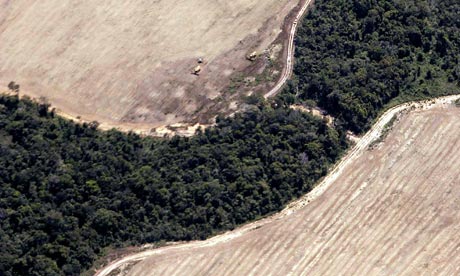
    Aerial view of advancing deforestation in the Amazon Basin

    A tide of frightening facts … increased demand for food leads to deforestation, as pictured here in the Amazon. Photograph: RICKEY ROGERS/REUTERS

    Sitting on my own in the bar of the Royal Court theatre on Wednesday with my orange juice and lightly sea-salted packet of crisps, I remembered that I was first here more than 50 years ago, as a teenager down on holiday from Scotland and determined to witness England’s cultural revolution. In 1961 that still meant John Osborne, whose new play, Luther, had just opened at the Court with Albert Finney. I queued at the box office and got two tickets to stand at the back of the stalls, where my brother and I were so thrilled (so this is what the Reformation was like!) that when the play came to the Edinburgh festival later that year, I bought another ticket and stood through it all over again.

    The contrast between Luther and the performance I was about to see couldn’t have been starker. Luther was intensely theatrical – as gorgeous as a pantomime – the stage filled sometimes with pious monks and at other times with flag-waving knights. Finney’s Luther grappled loudly with his faith and his constipation, while a cynical huckster sold the weirdest of Papal indulgences. Comedy, seriousness, noise, colour and, above all, those biting monologues that were Osborne’s trademark: they made for that thing called “a wonderful night at the theatre”, but the play’s message, whatever it was, would never have fitted under the rubric “news you can use”. When you left the theatre, you stepped out of the Reformation and into the relevance of the present day.

    Ten Billion, on the other hand, is a piece of theatre only because it occurs in a theatre. The curtain rises on a reconstruction of a modern office; we hear the melancholy sound of a cello; a middle-aged man walks on stage, opens his laptop and begins to talk. He says he’s a scientist and not an actor – that will become obvious – but that the set is a “depressingly accurate” reproduction of his office in Cambridge. His name is Stephen Emmott. He’s head of computational science at Microsoft Research in Cambridge and professor of computational science at Oxford, and what he wants to tell us about is the future of life, particularly human life, on Earth. And for the next 75 minutes that’s what he does, moving just a little around the set with the help of a stick (because a disc in his lower spine has popped out) as visuals appear on screens to illustrate what soon becomes a tide of frightening facts and predictions.

    Taken singly, few of these facts would be new to even the most casual Monbiot reader or the least faithful friend of the Earth, but their accumulation and the connections between them are terrifying. Rarely can a lay audience have heard their implications spelled out so clearly and informally: a global population that was 1 billion in 1800 and 4 billion in 1980 will probably have grown to 10 billion by the end of this century; the demand for food will have doubled by 2050; food production already accounts for 30% of greenhouse gases – more than manufacturing or transport; more food needs more land, especially when the food is meat; more fields mean fewer forests, which means even more carbon dioxide in the atmosphere, which means an even less stable climate, which means less reliable agriculture – witness the present grain crisis in the US.

    On and on he goes, remorselessly. It takes 3,000 litres of water to make a burger and the UK eats 10bn burgers a year. A world population of 10 billion will need 960 new dams, each of them the size of the world’s largest in China’s Three Gorges, plus 15,000 nuclear power stations and/or (my note-taking in the dark isn’t up to his speed) 11m wind farms. The great objective of intergovernmental action, such as it is, has been to restrict the rise in average global temperature to no more than 2C, but a growing body of research suggests a warming by 6C is becoming more and more likely. In which case, Emmott says, the world will become “a complete hellhole” riven by conflict, famine, flood and drought. Go to a climate change conference these days, he says, and as well as all the traditional attendees there will usually be a small detachment of the forward-looking military.

    What’s to be done? Emmott takes us through the ideas offered by “the rational optimists” who believe that, faced with the species’ near extinction, human inventiveness will engineer a solution. Desalination plants, a new green revolution, seeding the oceans with iron filings to absorb more CO2: all of these threaten to produce as many problems as they solve. He believes the only answer is behavioural change. We need to have far fewer children and consume less. How much less? A lot less; two sheets of toilet paper rather than three, a Prius instead of a Range Rover – that kind of sacrifice won’t really do it. And does he believe we’re capable of making this necessarily far bigger curb on our desires? Not really. He describes himself as a rational pessimist. “We’re fucked,” he says. If a large asteroid were on course to the Earth and we knew when and where it would hit – say France in 2022 – then every government would marshal its scientific resources to find ways of altering the asteroid’s path or mitigating its damage. But there is no asteroid. The problem is us.

    Recently he asked one of his younger academic colleagues what he thought could be done. “Teach my son how to use a gun,” said the colleague.

    And there the performance ends. Emmott steps forward to take the applause and then the audience files down the stairs to Sloane Square, busy with taxis and young people standing on the pavement with plastic beakers of white wine, as though there would be infinite tomorrows. It isn’t quite clear what we’ve seen – a lecture or a theatrical event – but what its ominous content most resembled, or so it seemed to me, was the kind of Protestant sermon brought about by the Reformation, in which humankind was told to repair its ways if it wanted to avoid damnation. In retrospect, this looks a relatively easy matter of regular churchgoing, refraining from obvious adultery and not doing the washing on Sundays. Light qualifications for entry to heaven compared to the levels of material renunciation needed to save the species.

    The speed at which our likely future has arrived is the frightening thing. How little we realised, leaving Luther in 1961, that the atmosphere’s carbon content had been increasing since the industrial revolution, which you might argue was a Lutheran/Calvinist byproduct. We had our worries, of course, but the cold war and nuclear weapons didn’t seem intractable threats. They produced protest rather than the fearful depression that touches some of us from time to time, when every distraction has failed. Emmott sees his performance as a wake-up call and it has apparently had that effect on its young audiences (its entire run is sold out). But it would be just as easy to see it as a well-articulated piece of despair, a scientist’s soliloquy in front of the final curtain.

  • Real battles lie within Abbott’s own camp

    Real battles lie within Abbott’s own camp

    Date
    August 4, 2012
    • 20 reading now
    • 26

    TONY Abbott and his team are living in the straitjacket of ambition. Like those (mostly) disciplined Olympic athletes, their eyes are on victory. Everything has to be tailored to winning, which means staying ”on message”, stomping around the stunt route of meat and fish markets, and managing controversial issues and restless colleagues with a minimum of headlines about splits and divisions.

    This week we have seen Abbott squaring away the internal problem of foreign investment policy and continuing to stare down the Liberal industrial relations radicals. And, if anyone cares to ask, he’ll say he’s very happy with his frontbench team, never mind that his good friend and former colleague Mal Brough, having won preselection at the weekend, is headed to Canberra with his eyes on securing a ministry ASAP.

    The opposition’s good polls and Labor’s woes mask, much of the time, the opposition’s policy and personality conflicts. The Nats, the Liberal ”dries”, periodic tensions within his own economic team, the odd party room outbreak, and keeping the Young Turks occupied all test Abbott, and would do so in government.

    The mild-mannered Warren Truss heads the Nationals but their Senate leader and wannabe future leader, Barnaby Joyce, is their spear carrier. It was Joyce who led the charge on foreign investment, being openly critical of Chinese investment by state-owned enterprises; the Nationals generally ramped up the concern about overseas designs on agricultural land.

    Free-market Liberals such as shadow treasurer Joe Hockey battled to rein in the Nats’ influence. Abbott’s confusing comments in Beijing last week, which were interpreted as being more anti-foreign investment than they were, perhaps reflected the squeeze he has been in. The discussion paper Abbott released yesterday gave ground to the Nationals by lowering the threshold for Foreign Investment Review Board examination of bids for agricultural land and agribusinesses (all those made by foreign state-owned enterprises are already scrutinised). But it retained the policy on foreign investment in other areas. Some in the Nats (whose members include both economic ”dries” and ”wets”) would have liked to go further. But they they won’t be pushing it. The Nats believe Abbott is the best Liberal leader they could have. Malcolm Turnbull wasn’t on their wavelength, and if Hockey had won the top job, he wouldn’t have been either.

    In government, things would get really interesting between the Liberals and the Nationals if Joyce, expected to move to the House of Representatives at the election, became deputy prime minister. This would not happen in the short term. But assuming Truss later retired, Joyce would probably get the numbers.

    Abbott and Joyce have more in common than a quick glance suggests. Both were educated at Sydney’s top Catholic school, Riverview, and each has been deeply influenced by Catholic social values. They are centrist, pragmatic and populist. Joyce recognises in Abbott a congenial leader; Abbott can persuade Joyce when he needs to.

    While the foreign investment policy is now more or less settled, the Coalition’s industrial relations blueprint will continue to develop until it is released. Abbott is caught between the hardline stance of business and some Liberals, and his determination to give the government minimum room to flail him. After saying that businesses would have to make the case for change, Abbott is now confronted by them shouting that case from the rooftops. If an election were called tomorrow, the Coalition’s policy would be different from the one it would have produced a year ago.

    But Abbott insists he will be cautious. The policy will promote flexibility, aim to enhance productivity, and limit what the Coalition sees as growing union militancy. But retention of the ”better off overall test (BOOT)” will be a core commitment.

    One issue will be how specific the policy is. Abbott is very aware – having watched the experience of Julia Gillard – of the cost of breaking promises, so if he says he won’t change some aspect of the IR law, he can be believed. Those wanting to push for a bigger overhaul would prefer a more general policy. ”The key thing is having enough room to do what is necessary in government to create prosperity,” one Liberal says. But everyone can play that game: Abbott will be under political pressure not to leave too many gates open. He will also have to convince business, especially small business, that there is a distinction between ”prudence” (which he promises) and ”wimpishness” (which is how they might see it) – although some business disappointment might also reassure the public that his policy is indeed cautious.

    It seems bizarre that an abundance of talent could be a problem for a leader. But this has already brought tensions – some backbenchers have been frustrated that Abbott has not been willing to shake up his frontbench – and after the election will present a dilemma. Abbott’s attitude is that reshuffles cause trouble and make enemies; he is also loyal to colleagues. The up-and-comers now reluctantly accept that, barring something unexpected, Abbott won’t change his team this side of the election. But he will have to do so, to a certain extent at least, if he wins.

    For example, the idea that Arthur Sinodinos, John Howard’s talented former chief-of-staff, would not be in the ministry – and indeed the cabinet – is ludicrous. But in what spot? Logically, finance, but Abbott has guaranteed that Andrew Robb will still hold that.

    Backbenchers such as Kelly O’Dwyer and Jamie Briggs would be looking for a post-election step up. Now, however, there are also some high-profile candidates who will walk through the parliamentary door armed with frontbench credentials – notably Brough and former West Australian treasurer Christian Porter. You would have to be a brave leader to tell Brough, who sat in John Howard’s cabinet, that he could not have an immediate and reasonable portfolio.

    Some Liberal sources think that Abbott would basically stick with his existing team, with a few unavoidable changes, and then use later opportunities to make others. But a PM is in a very strong position at the start and should go for the best possible team initially. Government is hard; all available talent is needed on its front line. Abbott would say all this is getting ahead of ourselves. His focus is on the nearer term.

    And, of course, there is the spectre of Kevin Rudd. If Labor changed leaders, and its vote jumped, Abbott would suddenly be having to manage a more nervous and critical bunch. That would be a real challenge.

    Read more: http://www.smh.com.au/opinion/political-news/real-battles-lie-within-abbotts-own-camp-20120803-23kw1.html#ixzz22X9r6vOR

    Date
    August 4, 2012
    • 20 reading now
    • 26

    TONY Abbott and his team are living in the straitjacket of ambition. Like those (mostly) disciplined Olympic athletes, their eyes are on victory. Everything has to be tailored to winning, which means staying ”on message”, stomping around the stunt route of meat and fish markets, and managing controversial issues and restless colleagues with a minimum of headlines about splits and divisions.

    This week we have seen Abbott squaring away the internal problem of foreign investment policy and continuing to stare down the Liberal industrial relations radicals. And, if anyone cares to ask, he’ll say he’s very happy with his frontbench team, never mind that his good friend and former colleague Mal Brough, having won preselection at the weekend, is headed to Canberra with his eyes on securing a ministry ASAP.

    The opposition’s good polls and Labor’s woes mask, much of the time, the opposition’s policy and personality conflicts. The Nats, the Liberal ”dries”, periodic tensions within his own economic team, the odd party room outbreak, and keeping the Young Turks occupied all test Abbott, and would do so in government.

    The mild-mannered Warren Truss heads the Nationals but their Senate leader and wannabe future leader, Barnaby Joyce, is their spear carrier. It was Joyce who led the charge on foreign investment, being openly critical of Chinese investment by state-owned enterprises; the Nationals generally ramped up the concern about overseas designs on agricultural land.

    Free-market Liberals such as shadow treasurer Joe Hockey battled to rein in the Nats’ influence. Abbott’s confusing comments in Beijing last week, which were interpreted as being more anti-foreign investment than they were, perhaps reflected the squeeze he has been in. The discussion paper Abbott released yesterday gave ground to the Nationals by lowering the threshold for Foreign Investment Review Board examination of bids for agricultural land and agribusinesses (all those made by foreign state-owned enterprises are already scrutinised). But it retained the policy on foreign investment in other areas. Some in the Nats (whose members include both economic ”dries” and ”wets”) would have liked to go further. But they they won’t be pushing it. The Nats believe Abbott is the best Liberal leader they could have. Malcolm Turnbull wasn’t on their wavelength, and if Hockey had won the top job, he wouldn’t have been either.

    In government, things would get really interesting between the Liberals and the Nationals if Joyce, expected to move to the House of Representatives at the election, became deputy prime minister. This would not happen in the short term. But assuming Truss later retired, Joyce would probably get the numbers.

    Abbott and Joyce have more in common than a quick glance suggests. Both were educated at Sydney’s top Catholic school, Riverview, and each has been deeply influenced by Catholic social values. They are centrist, pragmatic and populist. Joyce recognises in Abbott a congenial leader; Abbott can persuade Joyce when he needs to.

    While the foreign investment policy is now more or less settled, the Coalition’s industrial relations blueprint will continue to develop until it is released. Abbott is caught between the hardline stance of business and some Liberals, and his determination to give the government minimum room to flail him. After saying that businesses would have to make the case for change, Abbott is now confronted by them shouting that case from the rooftops. If an election were called tomorrow, the Coalition’s policy would be different from the one it would have produced a year ago.

    But Abbott insists he will be cautious. The policy will promote flexibility, aim to enhance productivity, and limit what the Coalition sees as growing union militancy. But retention of the ”better off overall test (BOOT)” will be a core commitment.

    One issue will be how specific the policy is. Abbott is very aware – having watched the experience of Julia Gillard – of the cost of breaking promises, so if he says he won’t change some aspect of the IR law, he can be believed. Those wanting to push for a bigger overhaul would prefer a more general policy. ”The key thing is having enough room to do what is necessary in government to create prosperity,” one Liberal says. But everyone can play that game: Abbott will be under political pressure not to leave too many gates open. He will also have to convince business, especially small business, that there is a distinction between ”prudence” (which he promises) and ”wimpishness” (which is how they might see it) – although some business disappointment might also reassure the public that his policy is indeed cautious.

    It seems bizarre that an abundance of talent could be a problem for a leader. But this has already brought tensions – some backbenchers have been frustrated that Abbott has not been willing to shake up his frontbench – and after the election will present a dilemma. Abbott’s attitude is that reshuffles cause trouble and make enemies; he is also loyal to colleagues. The up-and-comers now reluctantly accept that, barring something unexpected, Abbott won’t change his team this side of the election. But he will have to do so, to a certain extent at least, if he wins.

    For example, the idea that Arthur Sinodinos, John Howard’s talented former chief-of-staff, would not be in the ministry – and indeed the cabinet – is ludicrous. But in what spot? Logically, finance, but Abbott has guaranteed that Andrew Robb will still hold that.

    Backbenchers such as Kelly O’Dwyer and Jamie Briggs would be looking for a post-election step up. Now, however, there are also some high-profile candidates who will walk through the parliamentary door armed with frontbench credentials – notably Brough and former West Australian treasurer Christian Porter. You would have to be a brave leader to tell Brough, who sat in John Howard’s cabinet, that he could not have an immediate and reasonable portfolio.

    Some Liberal sources think that Abbott would basically stick with his existing team, with a few unavoidable changes, and then use later opportunities to make others. But a PM is in a very strong position at the start and should go for the best possible team initially. Government is hard; all available talent is needed on its front line. Abbott would say all this is getting ahead of ourselves. His focus is on the nearer term.

    And, of course, there is the spectre of Kevin Rudd. If Labor changed leaders, and its vote jumped, Abbott would suddenly be having to manage a more nervous and critical bunch. That would be a real challenge.

    Read more: http://www.smh.com.au/opinion/political-news/real-battles-lie-within-abbotts-own-camp-20120803-23kw1.html#ixzz22X9r6vOR