Author: admin

  • The Summer of 2012–Too Hot to Handle? NASA

    The Summer of 2012–Too Hot to Handle?

    Inbox
    x
    NASA Science News noreply@nasascience.org
    7:53 AM (2 hours ago)

    to NASA
    NASA Science News for August 3, 2012

    Are the heat waves of summer 2012 a sign of climate change, ordinary weather, or some mixture of the two? Earth scientists discuss the possibilities in today’s story from Science@NASA.

    FULL STORY: http://science.nasa.gov/science-news/science-at-nasa/2012/03aug_summer2012/

    You are currently subscribed to snglist as: nevilleg729@gmail.com.

    This is a free service

  • Kurds Hold the Aces in Iraqi Oil Sector

    Oil Price Daily News Update


    Kurds Hold the Aces in Iraqi Oil Sector

    Posted: 02 Aug 2012 12:54 PM PDT

    The Kurdish government in Iraq announced Wednesday it would resume oil exports from the region later this week. Erbil had shut down exports in April, blaming the central government in Baghdad for withholding payments owed to international oil companies working in the semi-autonomous north.  The region’s Ministry of Natural Resources said the resumption was a goodwill gesture meant to encourage the central government to settle the outstanding payments. With foreign companies seemingly focusing their financial energy in northern Iraq, however,…

    Read more…

    Sudanese Government Backtrack on Decision to Increase Electricity Rates by 150%

    Posted: 02 Aug 2012 12:46 PM PDT

    Gee, sometimes a head of state wanted by the International Criminal Court on two warrants for his arrest just can’t get a break.Sudan’s government is described by the U.S. State Department as a “Constitutional democracy in form.”Sudan’s titular leader, President, Prime Minister, and Commander in Chief of the Armed Forces–Lt. Gen. Omar Hassan Ahmed al-Bashir, is unique among world leaders in that he is the only head of state currently subject to not one, but two arrest warrants issued by the ICC for genocide committed…

    Read more…

    Investing Lessons in One of the World’s Most Volatile Sectors

    Posted: 02 Aug 2012 12:33 PM PDT

    One of the biggest questions energy investors face is how to trade volatility. For example, in a flat to down energy market, professionals often say trading volatility is the only way to make money. “A flat bear market can give flat performance, but with a lot of volatility,” says Martin Pelletier, Managing Director at Trivest Wealth Counsel of Calgary. “Fifty per cent to 100% swings either way are quite common.“Unfortunately investors have reacted incorrectly—buying the tops of secular bull markets and selling the…

    Read more…

    Can the Big Shift in Energy bring a Return of Industrial Demand?

    Posted: 02 Aug 2012 12:17 PM PDT

    Outsourcing has become a dirty word in the 2012 election, in part, because over the last decade the US lost more than 5 million jobs to offshore emerging markets.  While politicians are busy scoring points about which party or players are responsible for these job losses, they are losing sight of a reversal of fortunes now taking place that offers the potential of bringing many of these manufacturing jobs back to the US—if we get our policy and political act together. Accenture just released a new research report entitled “North…

    Read more…

    Iran will Look to Refine its Crude Domestically, Rather than Export it

    Posted: 02 Aug 2012 12:08 PM PDT

    President Mahmoud Ahmadinejad says Iran should focus now on oil products in light of tightening sanctions Iranian President Mahmoud Ahmadinejad said Iran should stop exporting crude oil and focus on selling refined oil products instead, a day after the US tightened sanctions on Tehran. “We must stop the exports of crude oil,” Ahmadinejad was quoted as saying by the Islamic Republic News Agency (IRNA) in a speech opening a new refinery near Tehran. “We must go in such a direction that we do not export crude oil, and this is doable through the development…

    Read more…

    You are subscribed to email updates fromOilPrice.com Daily News Update
    To stop receiving these emails, you mayunsubscribe now.
    Email delivery powered by Google
    Google Inc., 20 West Kinzie, Chicago IL USA 60610
  • The New Climate Dice (HANSEN)

    James Hansen jimehansen@gmail.com via mail111.us2.mcsv.net
    7:03 AM (3 hours ago)

    to me
    Email not displaying correctly? View it in your browser.
    The New Climate Dice
    Public Perception of Climate Change: the New Climate Dice

    A paper Perception of Climate Change will be published next week in the Proceedings of the National Academy of Sciences and is available to reporters via PNAS; stories are embargoed until 3 PM Monday 6 August.  This is a paper submitted earlier this year under the title “Public Perception of Climate Change: The New Climate Dice”.  We were not allowed to keep Climate Dice in the title.

    “popular science” write-up on the paper is available on the GISS web siteand some unpolished Q&A on the paper is also available.

    Jim Hansen
    3 August 2012

  • Amazon deforestation falls again

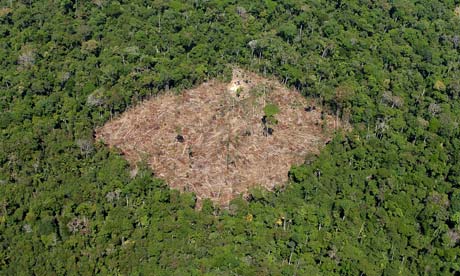
    Amazon deforestation falls again

    Data from satellite images shows 23% reduction in deforestation from August 2011 to July 2012 against the previous year

    A deforested area in southern Para state, Brazil - Amazon rainforest

    A deforested area in southern Para state, Brazil. Clearance rates in the Amazon have fallen by about three quarters since peak deforestation in 2004. Photograph: Jefferson Ruddy/AFP/Getty Images

    Deforestation in the Amazon rainforest has fallen again in the past 12 months, according to preliminary data published by Brazil‘s National Institute for Space Research.

    The reduction follows the passing of Brazil’s Forest Code in April, which green campaigners say weakened forest protection measurements, despite a partial veto by president Dilma Rouseff of the most controversial elements.

    Data from satellite images shows a 23% reduction in deforestation from August 2011 to July 2012 against the previous year, with 2,049 sq km being cleared compared with 2,679 sq km in the previous 12 months.

    The figures, published on Thursday, mark the continuation of a long-term trend that has seen clearance rates in the Amazon fall by about three quarters since peak deforestation in 2004.

    Brazil’s environment minister, Izabella Teixeria, said: “This is a great result, which makes us want to work even harder to tackle illegal deforestation.”

    But the figures from the Real Time Deforestation Detection System (Deter), may be revised upwards later after work by the separate Prodes project, which provides Brazil’s official annual deforestation figures. The Deter early warning system is relatively low resolution and can only detect deforestation larger than 25 hectares and can miss deforestation masked by cloud cover.

    Official figures published in June showed that annual deforestation was at a record low in the 12 months before 31 July 2011.

    The Brazilian government also announced that R$100m (£31m) from the country’s Amazon Fund will be given out in coming weeks to local projects that are shown to be maintaining the rainforest. Carlos Nobre, secretary for research and development policies and programmes at the ministry of science and technology, said: “Lasting reduction in deforestation requires more than enforcement and control.”

    Brazil also hopes to launch a new satellite in 2013 to help monitor clearing of the world’s largest rainforest, which is home to millions of species and is one of the world’s biggest stores of carbon.

    Greenpeace Brazil said in a statement that the new data showed that “it is possible to achieve zero deforestation in Brazil”.

  • Capitalism, not population growth, is cause of world’s crises

    Powell pipeline
    Salt Lake Tribune
    Preliminary population projections from the Governor’s Office of Planning and Budget have raised that possibility. Growth in St. George has slowed dramatically in the wake of the Great Recession and the bursting of the real estate bubble. Fewer new homes 
    See all stories on this topic »
    Utility ponders new sources of water as drought, population growth strain supply 
    The Republic
    Picture those and you’ll get an idea of what Citizens Water engineers have been pondering for the years ahead as Indiana’s largest metro area struggles with drought and population growth that have strained its water supply. “Forty to 50 million gallons per 
    See all stories on this topic »
    Traffic tie-up: Austin’s rapid population growth causes major bumps in the road
    CultureMap Austin
    Austin’s traffic problems are the direct result of our dramatic, ongoing population growth, and our dramatic, ongoing failure to invest in the systems and infrastructure we need to stay ahead of it.” Some help is on the way. In a partnership between the Capital 
    See all stories on this topic »

    CultureMap Austin
    Capitalism, not population growth, is cause of world’s crises
    The Militant
    The old nostrum that the solution to these problems lies in stemming population growth has again become fashionable discourse among bourgeois and petty-bourgeois liberals in Europe and North America. Under the rubric of population control as a panacea 
    See all stories on this topic »
    Don’t make a growth industry out of growth-bashing
    Times of India
    But many point to paltry spending by the bottom 10% of the population to question the conclusion thatgrowth is indeed boosting income and consumption of aam admi. Yes, per capita consumption expenditure of the poor, rural or urban, should rise at a faster 
    See all stories on this topic »
    Iran gives up birth control program to boost population
    Al-Arabiya
    boost population. Friday, 03 August 2012. While about half of Iranians are under 35, officials fear the low growth rate – currently 1.2 percent compared with 3.2 percent in 1986 – would eventually lead to an ageing and eventually decreasing population. (AP) 
    See all stories on this topic »

    Al-Arabiya
    Statistics: Scotland’s population highest ever
    eGov monitor
    “Scotland’s population has seen a continuous increase in recent years, partly because there have been more births than deaths, but mainly because more people have moved to Scotland than have left. This trend continued in 2011, with migration largely 
    See all stories on this topic »
    Baby boom: Scotland’s population hits record high
    Scottish Daily Record
    SCOTLAND’S population has soared to an all-time high of 5254800. The estimated figure for last June caps nine years of growth. That’s largely due to more people moving here than left for a new life elsewhere. Another factor is that births, although dropping, 
    See all stories on this topic »

    Scottish Daily Record
    An awesome decade of growth – and fallacy
    China.org.cn
    The total increase in GDP per capita over the decade was 158 percent. Historically, as shown in World Bank data, and for earlier periods in Angus Maddison’s standard work World Population, GDP and GDP Per Capita 1-2006AD, this makes China’s the 
    See all stories on this topic »

    China.org.cn
    What everyone ought to know about our property markets
    SmartCompany.com.au
    But the long-term prospects for Australian property are easier to forecast because over the long-term property prices are really driven by two main factors: population growth and the wealth of the nation. In Australia, strong future population growth is a given 
    See all stories on this topic »


    This once a day Google Alert is brought to you by Google.

    Delete this alert.
    Create another alert.
    Manage your alerts.

    Click here to Reply or Forward
  • Dust Dominates Foreign Aerosol Imports to North America NASA

    News Releases

    Steve Cole 
    Headquarters, Washington 
    202-358-0918 
    stephen.e.cole@nasa.gov

    Kathryn Hansen 
    Goddard Space Flight Center, Greenbelt, Md. 
    301-286-1046 
    kathryn.h.hansen@nasa.gov

    Nicole Ruediger 
    University of Maryland, Baltimore County 
    410-455-5791 
    nruedige@umbc.edu

    Aug. 2, 2012

    RELEASE : 12-262

    Dust Dominates Foreign Aerosol Imports to North America

    WASHINGTON — NASA and university scientists have made the first measurement-based estimate of the amount and composition of tiny airborne particles that arrive in the air over North America each year. With a 3-D view of the atmosphere now possible from satellites, the scientists calculated that dust, not pollution, is the main ingredient of these imports. 

    According to a new analysis of NASA satellite data, 64 million tons of dust, pollution and other particles that have potential climate and human health effects survive a trans-ocean journey to arrive over North America each year. This is nearly as much as the estimated 69 million tons of aerosols produced domestically from natural processes, transportation and industrial sources. The results were published Aug. 2 in the journal Science. 

    “This first-of-a-kind assessment is a crucial step toward better understanding how these tiny but abundant materials move around the planet and impact climate change and air quality,” says Hongbin Yu, lead author and an atmospheric scientist at the University of Maryland, College Park, and NASA’s Goddard Space Flight Center in Greenbelt, Md. 

    Observing these microscopic airborne particles and quantifying their global impact on warming or cooling Earth remains one of the most difficult challenges of climate science. Dust and pollution particles rise into the atmosphere and can travel for days across numerous national boundaries before settling to Earth. 

    Data from several research satellites with advanced observing technology developed and launched by NASA enabled the scientists to distinguish particle types and determine their heights in the atmosphere. They combined that information with wind speed data to estimate the amount of pollution and dust arriving over North America. The scientists used data from instruments on NASA’s Terra satellite and the Cloud-Aerosol Lidar and Infrared Pathfinder Satellite Observations (CALIPSO) satellite, a joint effort between NASA and the French space agency, Centre National d’Etudes Spatiales. 

    Yu and colleagues estimated that dust crossing the Pacific Ocean accounts for 88 percent, or 56 million tons, of the total particle import to North America every year. Dust movement is particularly active in spring, when the rise of cyclones and strong mid-latitude westerlies boost particle transport across the Pacific. Global aerosol transport models revealed Asia was a primary source of the dust reaching North America. Sixty percent to 70 percent comes from Asia and the remaining 30 percent to 40 percent comes from Africa and the Middle East. 

    Dust particles are fine pieces of minerals that primarily come from dry, desert-like regions. Winds lift these lightweight particles high into the atmosphere where they meet even faster-moving winds capable of transporting them around the planet. Pollution particles, in contrast, come from combustion sources such as wildfires or agricultural fires and fossil fuel burning for power and industry. These particles are emitted close to the ground, making them of prime interest to air quality researchers and managers. High-altitude dust particles are less a concern for human health, but their impact on climate can be significant. 

    One such impact on climate is a cooling effect, brought about by dust and some pollution particles that reflect sunlight back to space. The team calculated that the imported particles account for one third of the reduction in solar radiation, or solar dimming, over North America. “Globally this can mask some of the warming we expect from greenhouse gases,” says Lorraine Remer, an atmospheric scientist at University of Maryland, Baltimore County, and co-author on the study. 

    Climate change brought about by greenhouse gases could influence the relevance of dust in the future, according to Remer. “Desertification and reclamation, the land use modifications that change the exposure of dusty soils to wind erosion, are going to have a big impact on particle distribution and climate around the planet,” she says. 

    The study poses new questions about the magnitude of the particles’ indirect effects on local weather and climate. Dust and pollution could alter wind circulation, foster cloud growth and affect rainfall patterns. Soot and dust particles that land on snow, most likely in the western United States, could speed the melt of the snowpack and affect water supplies. 

    To see a video and images related to this study, visit: 

    http://www.nasa.gov/topics/earth/features/dust-imports.html

    – end –


    text-only version of this release

    NASA press releases and other information are available automatically by sending a blank e-mail message to hqnews-subscribe@mediaservices.nasa.gov. To unsubscribe from this mailing list, send a blank e-mail message to hqnews-unsubscribe@mediaservices.nasa.gov.

    Back to NASA NewsroomBack to NASA Homepage