Author: admin

  • Burnt fingers all round in US shale gas boom

    Burnt fingers all round in US shale gas boom

    Illustration: Greg Bakes.

    Illustration: Greg Bakes.

    THE US shale gas train wreck continued on Tuesday when BP posted a loss for the June quarter of $US1.4 billion and announced write-downs of

    $US4.8 billion, including a $US1 billion-plus reduction in the carrying value of its American shale gas assets.

    It followed BG Group’s $US1.3 billion write-down of the value of its US shale gas interests late last week on a lower long-term gas price outlook, and Encana Corporation’s $US1.7 billion write-down on shale assets in the US and Canada, accompanied by a warning that more were likely if gas prices did not recover.

    BHP will add to the carnage on August 22, when it reports a 2011-12 profit of about $US17 billion, and a write-down of shale gas assets bought in the US last year at a cost of $US20 billion that will put BP, BG and Encana in the shade. A $US3 billion hit is on the cards, but it could be higher.

    BHP is part of a rush into shale gas acreage in the southern states of the US by a large herd of oil majors, including BP, Total, Chevron, Petronas, CNOOC, PetroChina, BG, Shell, Mitsubishi and Mitsui, and they are all victims of their own success.

    The standard strategy has been to buy up acreage from US independents, and apply superior balance-sheet power to increase exploration and production. It has resulted in a production surge that will eventually turn the US into a petroleum products exporter, but is crushing its domestic gas prices in the meantime.

    US domestic gas is priced at the Henry Hub, an intersection of nine interstate and four national pipelines in southern Louisiana. It fell from a peak of $US14 per thousand cubic feet in 2005 to $US3.88 per thousand cubic feet in February last year when BHP paid $US4.6 billion for Arkansas gas shale leases owned by a US independent, Chesapeake. It was not much higher at $US4.27 per thousand cubic feet a year ago when BHP paid $US15 billion – 65 per cent above the market price – for Petrohawk, a listed US shale gas company.

    By April this year, after a mild American winter, the Henry Hub price had fallen below $2 to a 10-year low. It has recovered slightly since then and was at $3.21 yesterday, but the 2005 peak will not be revisited: there is simply too much new shale gas coming on stream.

    BHP’s strategy is similar to those of all the other big companies – increase production and wait for the gas price to rise as the US becomes an important supplier in the global liquefied natural gas market, where Asian demand is holding prices up.

    However, LNG export facilities and contracts take years to put together, and the Henry Hub price is reacting now to both the expansion in domestic supply and weak demand as the US economy continues to crawl away from the 2008-09 global crisis.

    BHP has been able to offset some of the damage by increasing production of liquids out of fields it picked up with Petrohawk. They reference the oil price rather than the Henry Hub price, holding revenue up, and limiting the potential size of the write-down.

    The forward price curve for Henry Hub gas is, however, still about $US1.50 lower than it was when BHP entered the race. BHP is one of the bigger producers, and market estimates of the write-down cluster between $US2 billion and $US6 billion: not fatal for a group that will post earnings of about $US17 billion, but a setback, for the chief executive, Marius Kloppers, and BHP’s petroleum boss, Mike Yeager, in particular.

    SOLOMON Lew has been attached limpet-like to Country Road’s share register for 14 years with an 11.8 per cent stake that has prevented Woolworths of South Africa, an 88 per cent shareholder, taking unfettered control. He is unlikely to be prised free by the share issue Country Road has announced to help fund its $172 million acquisition of the Witchery group from Gresham Private Equity.

    The 1-for-2 offer at $2.66 a share will raise $92 million and Woolworths (no relation to Australia’s Woolies) says it will pay $81 million for its share.

    If the Lew family company, Australian Retail Investments, does not pay about $10.9 million to take up the balance of the offer, Woolworths will move above 90 per cent and be in a position to compulsorily acquire ARI’s blocking stake at ”fair value”.

    Woolworths says it has not yet decided if it would do so, but for the Lews, shutting down the option is a no-brainer.

    Solomon Lew’s son Peter built Witchery up and sold it to Gresham private equity in 2006 for $160 million and the family would see Witchery – the upmarket Mimco bag and accessories chain that was bought in 2007 after Gresham took over – and Country Road itself as potential acquisitions if the price is right, by the family company, ARI, or perhaps by their listed Premier-Just group.

    Woolworths has shown staying power too, but if it decides to sell, the Lews are in the box seat as long as they hold a blocking stake. Any other buyer would, like Woolworths, be unable to move to 100 per cent ownership.

    Read more: http://www.smh.com.au/business/burnt-fingers-all-round-in-us-shale-gas-boom-20120801-23g03.html#ixzz22LFOYSs7

  • Climate change the cause of summer’s extreme weather, Congress told

    Climate change the cause of summer’s extreme weather, Congress told

    IPCC scientists tell Senate committee drought, wildfires and hurricanes are becoming normal because of climate change

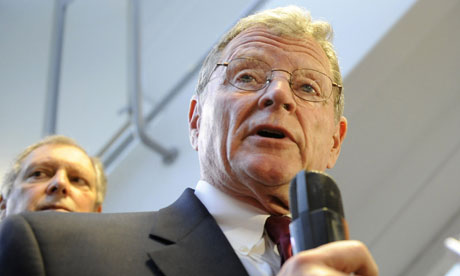
    Jim Inhofe

    Oklahoma senator Jim Inhofe, a prominent climate sceptic, told the committe: ‘The global warming movement has collapsed.’ Photograph: Axel Schmidt/AFP/Getty

    Drought, wildfires, hurricanes and heatwaves are becoming normal in America because of climate change, Congress was told on Wednesday in the first hearing on climate science in more than two years.

    In a predictably contentious hearing, the Senate’s environment and public works committee heard from a lead scientist for the UN’s climate body, the IPCC, on the growing evidence linking extreme weather and climate change.

    “It is critical to understand that the link between climate change and the kinds of extremes that lead to disaster is clear,” Christopher Field, a lead author of the IPCC report and director of global ecology at the Carnegie Institute for Science, said in testimony.

    “There is no doubt that climate has changed,” he went on. “There is also no doubt that a changing climate changes the risks of extremes, including extremes that can lead to disaster.”

    He later told the committee that those climate-related disasters would have profound effects on industry and agriculture.

    Field was the first IPCC scientist to appear before the committee since February 2009. It was a time when there was real optimism about prospects for action on climate change under the new Obama Administration.

    By Wednesday, however, it was universally acknowledged there was no prospect of moving climate change legislation through Congress. There was also little chance the scientists’ presentations would persuade the most prominent Republican climate contrarian, Senator Jim Inhofe, who told the committee: “The global warming movement has completely collapsed.”

    Senator Barbara Boxer, the California Democrat who chairs the committee, also noted she had deliberately avoid calling any administration officials or government scientists.

    The Republican’s campaign against Obama’s green agenda, with their attacks on the Environmental Protection Agency and his clean energy loans, would make their presence a political distraction, she indicated.

    But Boxer told reporters before the hearing she had faced growing pressure from the public to air the issue of climate change. The Republican-controlled House has turned down 15 requests from Democrats for a similar hearing.

    Field, in his testimony, warned that the devastating extremes of the last year could soon become routine.

    “The US experienced 14 billion-dollar disasters in 2011, a record that surpasses the previous maximum of 9,” he said. “The 2011 disasters included a blizzard, tornadoes, floods, severe weather, a hurricane, a tropical storm, drought and heatwaves, and wildfires. In 2012, we have already experienced horrifying wildfires, a powerful windstorm that hit Washington DC, heat waves in much of the country, and a massive drought.”

    He went on to make a point of warning Texans that the future of farming and ranching could be put in jeopardy because of climate change.

    The committee also heard from James McCarthy, a Harvard oceanographer and IPCC author, who warned that sea-level rise was occurring about three times faster than scientists believed even a decade ago.

    The hearing quickly veered off course from reviewing the latest climate science to the intractable politics surrounding climate change in America.

    In one of the liveliest exchanges, Bernie Sanders of Vermont continued his effort to take down Inhofe for his statements that climate change is a hoax and a conspiracy.

    Sanders asked the scientists on the panel for their opinions on some of Inhofe’s more notorious assertions – that climate change is a hoax, that the planet is actually in a state of cooling, and that such environmental concerns were a conspiracy by the UN, Al Gore, and Hollywood.

    The scientists did not support Inhofe’s claims.

  • A New Way To Fracture Oil and Gas Wells

    Oil Price Daily News Update

    What the Future Holds for Our Oil Based Economy

    Posted: 01 Aug 2012 06:08 AM PDT

    Oilprice.com’s geopolitical editor Daniel J. Graeber was a guest on Infowars evening show last night where he discussed the following topics: • Middle East tensions and their impact on oil prices.• Why oil prices will remain stable the remainder of this year.• How the government will most likely respond to oil price rises.• Why alternatives are taking so long to come on line• Why oil prices aren’t the hot issue they once were• Gas prices and the elections• Tapping…

    Read more…

    Rail May Hold its Own Against Pipelines

    Posted: 31 Jul 2012 03:29 PM PDT

    The Association of American Railroads reports the number of rail tankers carrying crude oil and petroleum products in the United States increased more than 35 percent during the first six months of the year when compared with 2011. After the U.S. Energy Department, in its report, noted the lack of pipeline infrastructure in North Dakota, British supermajor BP announced it was considering rail to bring oil from the Bakken formation there to its refinery in Washington state. In terms of the environmental footprint, meanwhile, rail deliveries account…

    Read more…

    IAEA Says Nuclear Energy Will Go From Strength to Strength

    Posted: 31 Jul 2012 03:25 PM PDT

    Global production of nuclear energy is expected to grow significantly in future years, despite setbacks in Japan and Germany, as China and the United States eyes next-generation reactors.Worldwide nuclear electricity generating capacity is expected to increase between 44 percent and 99 percent by 2035, the International Atomic Energy Agency and the Organization for Economic Cooperation and Development Nuclear Energy Agency said in their joint biannual report on uranium resources, released this week.Japan’s decision to shut down all but two of its…

    Read more…

    A New Way To Fracture Oil and Gas Wells

    Posted: 31 Jul 2012 03:21 PM PDT

    GASFRAC of Calgary, Alberta, Canada, has developed an innovative closed stimulation process and injection method, utilizing gelled LPG rather than water based conventional formation fracturing fluids.The firm has developed a Liquefied Petroleum Gas (LPG) or propane based gel that is as natural to a well as soil is to the earth. It’s dissolves into the formation hydrocarbons improving performance without using water.LPG will burn of course so GASFRAC has developed a zero-oxygen, closed system and specialized equipment that protects worker…

    Read more…

    Using Geoengineering to Control the Climate

    Posted: 31 Jul 2012 03:17 PM PDT

    Let me say at the outset that geoengineering to control Earth’s climate is not the wisest path which Homo sapiens (“Wise Man”) could travel down. Because of the large scales involved, future geoengineering may turn out to be the dumbest thing our dumb (albeit clever) species has ever done.On Tuesday Jim Kunstler spoke of the unintended consequences of applying technology willy-nilly to solve all our problems. As global warming really gets going in the coming decades, the temptation to geoengineer the climate will become stronger and stronger.Indeed,…

    Read more…

    A New Global Pattern is Emerging Which Will Dictate How Strategies Are Planned

    Posted: 31 Jul 2012 03:12 PM PDT

    Economic, social, political, and demographic changes are key drivers in what is a transforming global strategic architecture. This will necessitate a revision of existing power projection, trade, and intelligence priorities, structures, and doctrine to meet the emerging realities. But they are not yet set in stone. Oswald Spengler gave ample warning, in The Decline of the West (which he wrote mainly during World War I), that Western civilization was even then reaching some of its natural limits. He demonstrated that Roman and later Western civilization…

    Read more…

    More than 700 Million Left without Power after Latest Blackouts in India

    Posted: 31 Jul 2012 03:09 PM PDT

    India has suffered yet more blackouts, this time leaving more than 700 million people without power, and raising serious doubts about the country’s failing infrastructure and the government’s ability to meet the increasing energy demand as they pursue ambitions to become an Asian superpower.20 of India’s 28 states were left without electricity, including the capital New Delhi, when three out of the nation’s five grids went down.Hundreds of trains ground to a halt, leaving passengers stranded along tracks from Kashmir to…

    Read more…

    China Pay $20 Billion for Front Seat in Africa’s Hydrocarbon Show

    Posted: 31 Jul 2012 03:08 PM PDT

    In the recent Forum on Chinese-Africa Cooperation (FOCAC), China has secured its ties with Africa by pledging almost twice as much aid money as last year. President Hu Jintao promised $20 billion to help develop infrastructure and agriculture in Africa.China’s interest and investment in Africa is purely to do with the continents hydrocarbon reserves. Niger’s President Mahamadou Issoufou recently visited CNPC in China and praised them for “turning Niger into an oil producer.” Ghana’s Vice President John Dramani Mahama…

    Read more…

    Lloyds to Invest £333 Million in UK Renewable Energy Projects

    Posted: 31 Jul 2012 03:05 PM PDT

    Lloyds Banking Group has recently declared that it will invest £1 billion into the British governments new Infrastructure Plan. Lloyds have identified nine social and economic infrastructure projects, three conventional power plants, and up to 12 clean energy projects where it will invest its money. Around £333 million will be set aside to be invested in renewable energy projects.Chris Heathcote, Lloyds managing director and global head of project finance, said that Lloyds is mainly interested offshore wind, solar power, and biomass…

    Read more…

    Saudi Arabia Cancel Multi-Million Dollar Contracts with Russia

    Posted: 31 Jul 2012 03:03 PM PDT

    Russia and Saudi Arabia’s opposing stances over the situation in Syria has finally led to action. Saudi business tycoon Mubarak Swaikat has cancelled several multi-million dollar oil and gas contracts with nearly 20 Russian companies in protest against Moscow’s support of Syrian President Bashar Al-Assad’s regime. The decision was made by Swaikat himself without any pressure from the government.“This is the least that I can do to support our brothers in Syria. The Saudi government and society have already given a shining…

    Read more…

    You are subscribed to email updates fromOilPrice.com Daily News Update
    To stop receiving these emails, you mayunsubscribe now.
    Email delivery powered by Google
    Google Inc., 20 West Kinzie, Chicago IL USA 60610
  • US bid for multibillion-dollar nuclear aircraft carrier strike group in Perth

    US bid for multibillion-dollar nuclear aircraft carrier strike group in Perth

    Date
    August 1, 2012 – 4:25PM
    • US base in Perth would cost billions
    • Strike group includes aircraft carrier, 9 squadrons, 2 submarines
    • Read the full report

    A report for the US military contains a recommendation to expand America’s defence presence in Australia by massively expanding a base in Perth for a US aircraft carrier and supporting fleet.

    Comparable cost estimates in the past have ranged from $1 billion to create a nuclear-capable homeport for a carrier at Mayport in Florida to $6.5 billion for similar capability in Guam

    The plan is included as part of one of four options set out in a report by the Centre for Strategic and International Studies (CSIS), commissioned by the Department of Defence.

    US military report recommends basing carrier strike group in Perth.

    US military report recommends basing carrier strike group in Perth.

    The report’s authors will give testimony before Congress’s Armed Services Committee on Wednesday in the US.

    The CSIS was directed to consider how the US military could undertake the “pivot” to the Asia-Pacific region announced by President Barack Obama last year in response to China’s increasing influence.

    The third option in the report – formally titled US Force Posture Strategy in the Asia Pacific Region: An Independent Assessment – details moving a US carrier strike group to the HMAS Stirling base in Perth.

    The strike group would include a nuclear powered aircraft carrier, a carrier air wing of up to nine squadrons, one or two guided missile cruisers, two or three guided missile destroyers, one or two nuclear powered submarines and a supply ship.

    “Australia’s geography, political stability, and existing defence capabilities and infrastructure offer strategic depth and other significant military advantages to the United States in light of the growing range of Chinese weapons systems, US efforts to achieve a more distributed force posture, and the increasing strategic importance of south-east Asia and the Indian Ocean,” says the report.

    “Enhanced US Navy access to Her Majesty’s Australian Ship Stirling (submarines and surface vessels) is a possible next phase of enhanced access arrangements with Australia,” it says.

    “HMAS Stirling offers advantages including direct blue-water access to the Indian Ocean and to the extensive offshore West Australian Exercise Area and Underwater Tracking Range, submarine facilities including a heavyweight torpedo maintenance centre and the only submarine escape training facility in the southern hemisphere, and space for expanded surface ship facilities, including potentially a dock capable of supporting aircraft carriers.”

    The report suggests the US could also consider building airport facilities to support “bombers and other aircraft”.

    It suggests other initiatives could include “increased US support for Australia’s ailing Collins class submarine replacement project” and “full Australian participation in US theatre missile defence”.

    The other options consider how the US military could direct its “force posture” to the region with different levels of military power.

    Option one lays out a plan for using existing forces where they are now stationed. Option two describes how the military could operate given the increases already planned for. Option three, which includes the build-up in Australia, presumes an increased force, and option four lays out plans for a decreased force.

    The Defence Secretary, Leon Panetta, has already stated he plans to increase the US naval presence in the region from 50 to 60 per cent of the total force.

    The report says such a fleet in Perth would be a “force multiplier” and estimated it would provide the equivalent military benefit of having three similar groups based outside the region.

    “HMAS Stirling is not nuclear carrier-capable,” the report says. “This forward-basing option would require significant construction costs. Comparable cost estimates in the past have ranged from $1 billion to create a nuclear-capable homeport for a carrier at Mayport in Florida to $6.5 billion for similar capability in Guam.”

    Option three also proposes basing intelligence, surveillance and reconnaissance drones and aircraft in either Australia or Guam.

    According to the report the carrier base would “present some operational constraints” because of Perth’s southern location, “further from trouble spots in the Western Pacific than Guam, and further from the Middle East than Diego Garcia”.

    But it says the distant location could also be a benefit by putting it beyond the increasing range of China’s defences.

    It said the option was “subject to important variables” including how well the new US Marine presence in Darwin was welcomed by the local community and whether bipartisan support for the increasing military ties between Australia and the US could be maintained.

    The study notes that Australia’s strategic history “is one of a close alignment with a ‘great and powerful friend’”.

    It says public support for the US alliance is at an eight-year high, with “87 per cent of Australians regarding it as important for Australia’s security and 74 per cent considering the United States as Australia’s most important security partner over the next 10 years.

    “While not mainstream, anti-Americanism is prevalent among some elite circles, particularly in academia, parts of the media, and the fringes of the trade union movement and politics,” it says.

    “Australia is unique among America’s allies in having fought alongside the United States in every major conflict since the start of the 20th century,” the report notes.

    A spokesman for the CSIS said the think tank was unable to comment on the report until after some of the report’s authors testified before the Senate Committee on Armed Services tomorrow, Wednesday US time.

    The paper criticised the US Department of Defence for failing adequately to articulate the new Asia Pacific strategy, nor detailing how it would manage the change in the face of budget constraints.

    In a statement the Armed Services Committee’s chairman, Senator Carl Levin, said he agreed with comments made by the US Secretary of Defence, Leon Panetta, that “efforts to strengthen alliances and partnerships in the Asia-Pacific to advance a common security vision for the future is essential to the US strategy to rebalance toward the region”.

    In a cover letter to the report written by the CSIS president John Hamre to Mr Panetta, Mr Hamre writes: “We found a strong consensus on this overall objective within the Department, in the policy community generally, and especially with allies and partner countries.”

    The proposal met a lukewarm reaction in Western Australia with the Premier, Colin Barnett, saying it would never happen.

    “I don’t think there’s any possibility of that happening,” he said. “I don’t think you could squeeze a nuclear aircraft carrier into Cockburn Sound.”

    – with Courtney Trenwith

    Read more: http://www.smh.com.au/opinion/political-news/us-bid-for-multibilliondollar-nuclear-aircraft-carrier-strike-group-in-perth-20120801-23emq.html#ixzz22IltKxq7

  • Europe looks to open up Greenland for natural resources extraction

    Europe looks to open up Greenland for natural resources extraction

    Melting of icy surface opens up possibility of extracting rare earth metals and gemstones, but many fear it could destroy the Arctic

    UE  Jose Manuel Barroso with Greenland Prime Minister Kuupik Kleist

    European commission chairman, Jose Manuel Barroso, (right) and Greenland prime minister, Kuupik Kleist. The EU sees potential in a massive opening up of mining operations across the world’s biggest island. Photograph: AFP/Getty Images

    Europe is looking to open a new frontier in the ever more urgent quest for new natural resources – the pristine icy wastes of Greenland.

    Oil and gas have been the focus of exploitation so far – but the EU sees just as much potential in a massive opening up of mining operations across the world’s biggest island, according to Antonio Tajani, the European commission’s vice-president and one of the most powerful politicians in the union. He called the move “raw material diplomacy”.

    Latest satellite data reveal that 97% of the surface of the Greenland ice sheet underwent surface melting over four exceptionally warm days in July, indicating natural resources will become more available for extraction in the coming decades.

    The potential gold rush is being welcomed by some in Greenland, but has raised fears of environmental damage, pollution and despoliation across the Arctic that could destroy one of the world’s last wildernesses.

    Tajani said: “Greenland is hugely important in terms of natural resources, it has vast opportunities. We are currently working very hard with the prime minister of Greenland on this – we are working on our own agreement with Greenland on raw materials.”

    He said: “This is raw material diplomacy. We have allies working on this worldwide.”

    Greenland’s government is keen to exploit the island’s natural wealth in order to alleviate some of the serious poverty and social problems that blight the indigenous population.

    Henrik Stendal, of the Greenland government’s mineral extraction department, told the Guardian: “The government would like to have another source of income – currently there is just fishing, and a little from tourism, so this is a big opportunity for us. These explorations can be done sensitively, we believe.”

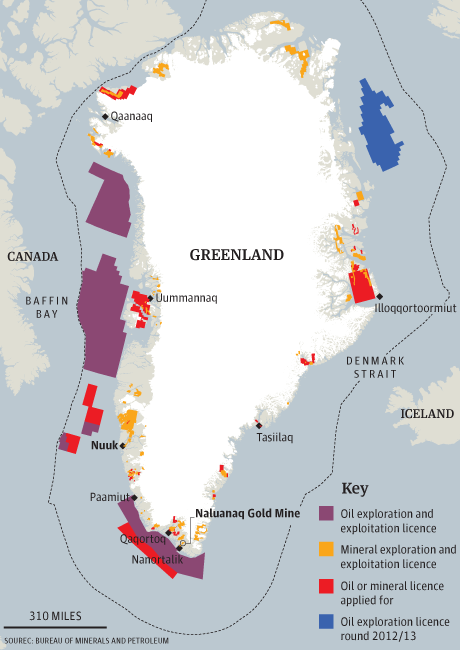
    Only one company is currently operating a productive mine in Greenland, producing gold. But at least five are in the advanced stages of setting up new mines, and more than 120 sites are being explored. Greenland is thought to contain vast mineral wealth, including rare earth metals, gemstones and iron ore.

    GREENLAND.png

    As competition from developing world pushes up price of energy, metals, minerals and other raw materials, finding new sources of supply is at a premium – putting densely populated Europe at a disadvantage, with little opportunity to expand its oil and gas supplies or mining operations.

    But Greenland – with strong historical ties to the EU through Denmark, though the island now has home rule – represents a vast and largely untapped resource. Drilling for oil in Greenland’s waters is now at the exploratory stage, having been impractical until recent advances in deep sea drilling. Mining has also been all but impossible across most of the country, which is covered in a 150m thick sheet of ice except for a few coastal strips, but melting ice and new techniques are likely to bring more of the region’s potential mineral resources within reach in the coming years.

    But Europe may face competition. China is already ahead; one of the most advanced metals mining projects in Greenland is nominally owned by London Mining, a UK company, but most of the finance and direction comes from China. Other countries are also eyeing the prize – although Greenland’s historical ties are mainly with Europe, it is geographically close to the US and Canada.

    Tajani’s aggressive push into the Arctic puts him on a potential collision course with Greenpeace, the global environmental pressure group. Greenpeace recently opened up a new campaign focusing on the threats to the Arctic – one of the last places on earth where the industrial revolution and exploitation of natural resources have yet to penetrate. As part of the campaign they closed 74 UK Shell petrol stations in protest at the company’s moves to drill for oil in the Arctic.

    Jon Burgwald, an Arctic expert at Greenpeace, said that mining operations can bring pollution and destruction: “There could be some very harsh environmental consequences.”

    Mikkel Myrup, chair of the Greenlandic environmental campaigning group Akavaq, said that dealing with waste and “tailings” from the mines would be a key concern, as well as handling the toxic chemicals that are used in some forms of mining. “Mining does not have the same risks as oil drilling, but mining can be very hazardous to the environment. It’s a real worry, and we don’t think that the Greenlandic government has the capabilities to regulate this in the way that’s needed – they can’t stand up to these multinational companies. The public haven’t been given the full picture,” he said from his office in Nuuk, Greenland’s only town of any size, with 15,000 inhabitants.

    Burgwald also warned of the potential social consequences. “What happens when you have [scores of] Chinese workers living next to a small town of indigenous people?”

    Greenpeace has already succeeded in delaying attempts by Cairn Energy to establish oil and gas drilling operations in the Arctic seas. Activists have more such protests in their sights. Burgwald said that if there was damage or prospective damage from mines in Greenland, they too would attract similar actions. “We would certainly oppose it if it wasn’t being done right.”

    He did not rule out mining in Greenland altogether, if done in a sustainable manner, but said that current plans were unclear and Greenland’s government would need substantial help in order to set up the right standards that would avoid the dangerous consequences. There was little sign of such help being forthcoming yet, he said.

    Melting of icy surface opens up possibility of extracting rare earth metals and gemstones, but many fear it could destroy the Arctic

    UE  Jose Manuel Barroso with Greenland Prime Minister Kuupik Kleist

    European commission chairman, Jose Manuel Barroso, (right) and Greenland prime minister, Kuupik Kleist. The EU sees potential in a massive opening up of mining operations across the world’s biggest island. Photograph: AFP/Getty Images

    Europe is looking to open a new frontier in the ever more urgent quest for new natural resources – the pristine icy wastes of Greenland.

    Oil and gas have been the focus of exploitation so far – but the EU sees just as much potential in a massive opening up of mining operations across the world’s biggest island, according to Antonio Tajani, the European commission’s vice-president and one of the most powerful politicians in the union. He called the move “raw material diplomacy”.

    Latest satellite data reveal that 97% of the surface of the Greenland ice sheet underwent surface melting over four exceptionally warm days in July, indicating natural resources will become more available for extraction in the coming decades.

    The potential gold rush is being welcomed by some in Greenland, but has raised fears of environmental damage, pollution and despoliation across the Arctic that could destroy one of the world’s last wildernesses.

    Tajani said: “Greenland is hugely important in terms of natural resources, it has vast opportunities. We are currently working very hard with the prime minister of Greenland on this – we are working on our own agreement with Greenland on raw materials.”

    He said: “This is raw material diplomacy. We have allies working on this worldwide.”

    Greenland’s government is keen to exploit the island’s natural wealth in order to alleviate some of the serious poverty and social problems that blight the indigenous population.

    Henrik Stendal, of the Greenland government’s mineral extraction department, told the Guardian: “The government would like to have another source of income – currently there is just fishing, and a little from tourism, so this is a big opportunity for us. These explorations can be done sensitively, we believe.”

    Only one company is currently operating a productive mine in Greenland, producing gold. But at least five are in the advanced stages of setting up new mines, and more than 120 sites are being explored. Greenland is thought to contain vast mineral wealth, including rare earth metals, gemstones and iron ore.

    GREENLAND.png

    As competition from developing world pushes up price of energy, metals, minerals and other raw materials, finding new sources of supply is at a premium – putting densely populated Europe at a disadvantage, with little opportunity to expand its oil and gas supplies or mining operations.

    But Greenland – with strong historical ties to the EU through Denmark, though the island now has home rule – represents a vast and largely untapped resource. Drilling for oil in Greenland’s waters is now at the exploratory stage, having been impractical until recent advances in deep sea drilling. Mining has also been all but impossible across most of the country, which is covered in a 150m thick sheet of ice except for a few coastal strips, but melting ice and new techniques are likely to bring more of the region’s potential mineral resources within reach in the coming years.

    But Europe may face competition. China is already ahead; one of the most advanced metals mining projects in Greenland is nominally owned by London Mining, a UK company, but most of the finance and direction comes from China. Other countries are also eyeing the prize – although Greenland’s historical ties are mainly with Europe, it is geographically close to the US and Canada.

    Tajani’s aggressive push into the Arctic puts him on a potential collision course with Greenpeace, the global environmental pressure group. Greenpeace recently opened up a new campaign focusing on the threats to the Arctic – one of the last places on earth where the industrial revolution and exploitation of natural resources have yet to penetrate. As part of the campaign they closed 74 UK Shell petrol stations in protest at the company’s moves to drill for oil in the Arctic.

    Jon Burgwald, an Arctic expert at Greenpeace, said that mining operations can bring pollution and destruction: “There could be some very harsh environmental consequences.”

    Mikkel Myrup, chair of the Greenlandic environmental campaigning group Akavaq, said that dealing with waste and “tailings” from the mines would be a key concern, as well as handling the toxic chemicals that are used in some forms of mining. “Mining does not have the same risks as oil drilling, but mining can be very hazardous to the environment. It’s a real worry, and we don’t think that the Greenlandic government has the capabilities to regulate this in the way that’s needed – they can’t stand up to these multinational companies. The public haven’t been given the full picture,” he said from his office in Nuuk, Greenland’s only town of any size, with 15,000 inhabitants.

    Burgwald also warned of the potential social consequences. “What happens when you have [scores of] Chinese workers living next to a small town of indigenous people?”

    Greenpeace has already succeeded in delaying attempts by Cairn Energy to establish oil and gas drilling operations in the Arctic seas. Activists have more such protests in their sights. Burgwald said that if there was damage or prospective damage from mines in Greenland, they too would attract similar actions. “We would certainly oppose it if it wasn’t being done right.”

    He did not rule out mining in Greenland altogether, if done in a sustainable manner, but said that current plans were unclear and Greenland’s government would need substantial help in order to set up the right standards that would avoid the dangerous consequences. There was little sign of such help being forthcoming yet, he said.

  • Coral reef thriving in sediment-laden waters Posted: 31 Jul 2012 05:12 PM PDT

    ScienceDaily: Earth Science News


    Coral reef thriving in sediment-laden waters

    Posted: 31 Jul 2012 05:12 PM PDT

    Rapid rates of coral reef growth have been identified in sediment-laden marine environments, conditions previously believed to be detrimental to reef growth. A new study has established that Middle Reef – part of Australia’s iconic Great Barrier Reef – has grown more rapidly than many other reefs in areas with lower levels of sediment stress.

    Scientists probe link between magnetic polarity reversal and mantle processes

    Posted: 31 Jul 2012 06:47 AM PDT

    Scientists have discovered that variations in the long-term reversal rate of the Earth’s magnetic field may be caused by changes in heat flow from the Earth’s core into the base of the overlying mantle.
    You are subscribed to email updates fromScienceDaily: Earth Science News
    To stop receiving these emails, you may unsubscribe now.
    Email delivery powered by Go