Author: admin

  • Logging companies gain easy access to PNG’s forests, says Greenpeace

    Logging companies gain easy access to PNG’s forests, says Greenpeace

    Deforestation and land sales have blighted Papua New Guinea, but new prime minister ‘is progressive figure’, says Greenpeace

    MDG : Land grab in Papua New Guinea : logging and deforatation

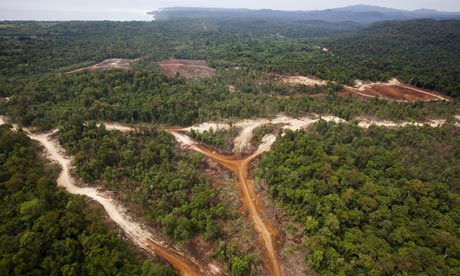
    Roads to logging concessions in West Pomio, East New Britain province, Papua New Guinea. Photograph: Paul Hilton/Greenpeace

    More than 5m hectares (12.35m acres) of customary-owned land in resource-rich Papua New Guinea have been signed over to unrepresentative landowner companies and foreign-owned corporations for up to 99 years, according to a report by Greenpeace.


    Of the total 5.1m hectares covered by special agricultural and business leases (SABLs), 75%, or 3.9m hectares, are controlled by foreign-owned companies under 54 subleases or development agreements. Malaysian and Australian firms control at least 3m hectares through 32 SABLs.


    PNG has the world’s third largest tropical forest, but demand for its logs has led to extensive deforestation. A satellite study in 2008 said the forests of this south Pacific country were being chopped down so quickly that more than half of its trees could be lost by 2021.


    The 5.1m hectares of customary-owned land represent 11% of the country and more than 16% of accessible commercial forests. PNG log exports grew by almost a fifth in 2011, largely due to logging under SABLs. Since 2006, logging companies have exported more than 1.5 cubic metres of whole logs, netting $145m (£92m) for the mostly Malaysian companies involved. Almost all the logs were exported to China.


    The Greenpeace report, Up for Grabs, is highly critical of the previous government of Sir Michael Somare for allocating forests to industrial logging companies, which often occured against the wishes of people who live in PNG’s forests and customary landholders.


    “The previous Somare government continued this predatory relationship with customary landholders by actively facilitating the granting of SABLs with legislative amendments that enabled logging companies to gain easy access to customary-held forested land,” said Greenpeace.


    In May 2011, the PNG government announced a commission of inquiry into SABLs following international condemnation. The commission completed its inquiry in May this year, but will not be made public until it is tabled in parliament by the newly elected prime minister this year.


    Last week, PNG’s rival prime ministers ended a political feud that had left the country with two leaders for most of the past year. Somare, the elder statesman of South Pacific politics at 76 and the country’s first prime minister in 1975, recontested his seat despite being ill for much of last year. Peter O’Neill was voted in as prime minister after Somare was ruled ineligible due to his prolonged absence from parliament.


    Although O’Neill had the support of parliament, the supreme court twice ruled that Somare was the legitimate prime minister, leaving the country with rival leaders. Last week’s agreement means O’Neill is likely to head the new government and form a coalition with backing from Somare. O’Neill’s People’s National Congress party is expected to win most of the seats in parliament – 3,500 candidates stood for 100 seats. Votes are still being counted.


    Despite PNG’s mineral wealth, successive governments have been unable to deliver infrastructure or services to a country of 6.5 million people, with about 80% of the population living on subsistence village farming and small cash crops. The general elections were PNG’s eighth since independence from Australia in 1975.


    Greenpeace said O’Neill’s leadership could be a turning point in PNG’s land policy. “He is a progressive figure and is best placed to implement the findings of the commission of inquiry,” said Paul Winn, author of the report. “But he’s had to team up with Somare’s party, with vested interests, so he might find it difficult to implement the recommendations in full.” Winn said the commission had done a thorough job. “We believe it is a hard-hitting report, saying how elites have benefited from corruption.”


    The Greenpeace report said the single biggest issue highlighted during the commission’s inquiry was the lack of fair representation of customary landholders in agreeing to SABLs being granted over their land. The report pointed out that the Department of Lands and Physical Planning, the agency responsible for evaluating and granting SABL applications and registering subleases, was described by judicial authorities as grossly incompetent and entirely corrupt. In many cases, said Greenpeace, it was the corporations applying for logging or agricultural development that financed the government approval process.


    To address many of the underlying issues that led to PNG’s “land grab”, Winn said it was vital for the new government to seek international help – possibly from Norway, Japan and Australia – to develop a national land planning process to identify land to be used for development, conservation or tourism and to ensure that land use benefited all of the population.


  • ABS – AUSTRALIAN BUREAU OF STATISTICS : Melbourne dominates 4-traders

    News 10 new results for POPULATION GROWTH
    Big population growth in outer suburbs
    The Australian
    Melbourne beat the other capital cities with the largest population growth with over half a million new people (647200), mostly filling up the city’s outer areas, according to the Australian Bureau of Statistics (ABS). Outer suburbs across the country are 
    See all stories on this topic »
    Urbanization, Population Growth Fuel Waste-to-Energy Projects
    SustainableBusiness.com
    Urbanization, Population Growth Fuel Waste-to-Energy Projects. SustainableBusiness.com News. Even though many businesses and municipal governments have policies requiring reductions in waste sent to landfills, more than three-quarters of what 
    See all stories on this topic »
    Regional Qld growth above average
    Fraser Coast Chronicle
    The latest regional population growth figures, collected during the 2011 Census, show Brisbane had the second-highest population growth in the nation – up 25% – between 2001 and 2011, behind only Perth, Western Australia on 26%. Several regional areas 
    See all stories on this topic »
    ABS – AUSTRALIAN BUREAU OF STATISTICS : Melbourne d ominates
    4-traders
    Population growth in Australia between June 2001 and June 2011 was strongest in the outer suburbs, according to the Australian Bureau of Statistics (ABS). The five areas with the largest growth in the country were all on the outskirts of Melbourne, with the 
    See all stories on this topic »
    Big growth in outer suburbs population
    Sky News Australia
    Melbourne has beaten Australia’s other capital cities in population growth with almost 650 thousand new people, mostly filling up the city’s outer areas. Outer suburbs across the country are experiencing a boom as more land opens up for development, but 
    See all stories on this topic »
    Melbourne’s population boom
    Weekly Times Now
    In Western Australia, Perth had the fastest growth of all of Australia’s capital cities and the Pilbara had the largest and fastest population increase with 23300 people or 59 per cent of any region outside of Perth. In Queensland, Brisbane’s population increased 
    See all stories on this topic »
    Women Call for Policies to Regulate Population Growth
    AllAfrica.com
    The Social Democratic Party’s women committee called on the new government to set clear policies to regulate population growth in order to fulfill social justice, establish sustainable development and enhance the standards of economic and social 
    See all stories on this topic »
    ACT’s population soars by almost 50000
    ABC Online
    The Bureau says in the ten years to June 2011 the ACT’s population reached 368 thousand people. Almost all of the Territory’s population growth was in the north, where Gungahlin’s population more than doubled. Tuggeranong’s population had the biggest 
    See all stories on this topic »
    Population increases in Fraser Coast
    Fraser Coast Chronicle
    It was the sixth-highest growth rate across all local government areas in Queensland. When broken down by electorate, the figures showed a 41% population growth in Hervey Bay over the past decade and a 22% growth in Maryborough. The report also 
    See all stories on this topic »
    Hong Kong Population Projections 2012-2041
    7thSpace Interactive (press release)
    In the updated set of projections, the Hong Kong Resident Population is projected to increase at an average annual rate of 0.6%, from 7.07 million in mid 2011 to 8.47 million in mid 2041.The average annualgrowth rate over the ten-year period from 
    See all stories on this topic »


    This once a day Google Alert is brought to you by Google.

    Delete this alert.
    Create another alert.
    Manage your alerts.

  • 250 years of global warming: Berkeley Earth releases new analysis

    ScienceDaily: Earth Science News


    Tiny airborne pollutants lead double life

    Posted: 30 Jul 2012 12:50 PM PDT

    Researchers have provided visual evidence that atmospheric particles separate into distinct chemical compositions during their life cycle. Observations could have important implications for modeling global climate change and predicting air quality conditions.

    250 years of global warming: Berkeley Earth releases new analysis

    Posted: 30 Jul 2012 11:25 AM PDT

    According to a new Berkeley Earth study released July 29, the average temperature of Earth’s land has risen by 1.5 °C over the past 250 years. The good match between the new temperature record and historical carbon dioxide records suggests that the most straightforward explanation for this warming is human greenhouse gas emissions.

    Cooling, not population loss, led to fewer fires after 1500 in New World

    Posted: 30 Jul 2012 06:41 AM PDT

    After Columbus’ voyage, burning of New World forests and fields diminished significantly – a phenomenon some have attributed to decimation of native populations. But a new study suggests global cooling resulted in fewer fires because both preceded Columbus in many regions worldwide.
    You are subscribed to email updates fromScienceDaily: Earth Science News
    To stop receiving these emails, you may unsubscribe now.
    Email delivery powered by Google
    Google Inc., 20 West Kinzie, Chicago IL USA 60610
  • Billions of dollars of mining projects in doubt

    Billions of dollars of mining projects in doubt

    Updated July 31, 2012 15:39:59

    A report has found the nation’s mining industry is in survival mode and $200 billion worth of planned resources projects are in doubt.

    The report, by Newport Consulting, has found falling commodity prices and surging operating costs are the major reasons why companies are becoming less optimistic about the future of the resources boom.

    The report involved interviews with dozens of miners about their willingness to invest in future projects.

    It found only 25 per cent of companies are planning to invest in capital expenditure projects this year, compared with 52 per cent last year.

    Newport’s David Hand says many miners are thinking twice about investment decisions.

    “We believe that $200 billion worth of investment is in jeopardy and in doubt,” he said.

    Meanwhile iron ore prices continue to slump, yesterday falling to a two and a half year low.

    Topics:mining-industry, perth-6000, karratha-6714

    First posted July 31, 2012 14:34:57

  • Anti-nuclear campaigners launch Japan’s first green party

    Anti-nuclear campaigners launch Japan’s first green party

    Greens Japan promises voters to put environment first and abolish nuclear power plants

    Members of Greens Japan (Japan green party)

    Members of Greens Japan during their inaugural party meeting. The party wants to emulate other green parties of Europe and influence Japan’s energy policy. Photograph: Greens Japan

    Anti-nuclear campaigners in Japan have launched the country’s first green party, more than a year after the triple meltdown at Fukushima Daiichi power plant created a groundswell of opposition to atomic energy.


    Greens Japan, created by local politicians and activists, hopes to satisfy the legal requirements to become an officially recognised political party in time for the general election, which must be held by next summer but could come much earlier.


    The party said it would offer voters a viable alternative to the two main parties, both of which have retained their support for nuclear power, particularly after the recent decision to restart two nuclear reactors in western Japan.


    The ruling Democratic party of Japan and the minority opposition Liberal democratic party [LDP] both supported the nuclear restart, which came after Japan was briefly left without nuclear power for the first time in more than 40 years.


    Akira Miyabe, Greens Japan’s deputy leader, said voters had been deprived of the chance to support a party that puts nuclear abolition and other green policies at the top of its agenda. “We need a party that puts the environment first,” he said at a launch event in Tokyo.


    The 1,000-member party is still a gathering of disparate groups and local politicians, but believes it can emulate green parties in Germany and other parts of Europe and influence the national debate over energy policy.


    Nao Suguro, a co-leader of the party who sits on a local assembly in Tokyo, said the aim was “to create a broad network to accommodate calls for the abolition of nuclear power plants.”


    The party will struggle to field any candidates if, as some predict, the prime minister, Yoshihiko Noda, calls a snap lower house election. But it said it was prepared to put up about 10 candidates in next summer’s upper house elections.


    Recent demonstrations in Tokyo suggest Japan’s anti-nuclear movement has broken free of its long association with socialist and pacifist movements to include younger campaigners, many of whom are protesting for the first time.


    The protests are among the biggest Japan has seen in decades, although they have not succeeded in forcing Noda to reconsider his support for the restart of several reactors to avoid power cuts and lessen Japan’s dependence on expensive fossil fuel imports.


    While thousands of demonstrators held a candlelit vigil and formed a chain around the parliament building in Tokyo on Sunday night, voters in Yamaguchi prefecture in south-west Japan elected a pro-nuclear governor in a poll that some saw as a litmus test of Japan’s enthusiasm for atomic energy.


    Shigetaro Yamamoto, a former bureaucrat who was supported by the conservative LDP, defeated three rivals, including Tetsunari Iida, who had campaigned against the proposed construction of a nuclear power plant in the area. That vote came after other recent wins for pro-nuclear candidates in local elections.


    The government is currently sounding out public opinion on three options for nuclear energy’s share of the country’s energy mix in 2030: zero, 15% or 20-25%. Japan depended on nuclear power for about a third of its energy needs before the 11 March disaster.

  • Studying Evolution With an Eye on the Future

    Studying Evolution With an Eye on the Future

    Jane Charlesworth

    GLIMPSING THE FUTURE Sinéad Collins studies evolution in marine algae.

    Charles Darwin came to many of his ideas by observing the wild creatures of South America. The biologist Sinéad Collins elaborates on his work by actually creating evolution in her laboratory at the University of Edinburgh. Dr. Collins, 36, sets up experiments to uncover evolution’s basic rules. She then uses the information to help work on solutions to contemporary environmental problems like global warming and marine acidification.

    We spoke for two hours at last winter’s annual meeting of the American Association for the Advancement of Science in Vancouver, British Columbia, and then again last month by telephone. An edited and condensed version of the conversations follows.

    When people get algae in their swimming pools or their ponds, they do their best to get rid of it. Why do you deliberately grow it in Scotland?

    Oh, my gosh! We grow it only for the best of reasons. In my lab, we do something called “experimental evolution.” That’s a way of trying to figure out how evolution works by observing it. We do that by taking very small creatures — unicellular green algae — and breeding hundreds and thousands of generations of them in different environments.

    With ocean warming and acidification proceeding at an ever-growing pace, we grow the algae in high CO2 environments — which is something like what a future ocean might be like. We then say, “Hello, algae, tell us how you are different.” And from this we can get a projection of how they might be in 200 years. It’s important to know because microbes such as algae are the starting point of the marine food chain.

    Of course, we’re doing this in a laboratory. So it’s a super-simplified version of a future ocean. We’re not trying to replicate reality — the actual ocean is a complex and turbulent environment. We’re more trying to figure out the rules reality plays by.

    Is experimental evolution new?

    No. In the 1880s, there was a guy named the Rev. William Dallinger, and he did an experiment that could be published today — it was that cool. He took microbes that could live only at temperatures under 68 degrees Fahrenheit, and over several years evolved them to live at 158 degrees!

    What is new is applying evolution to current problems. I first came to the field in the 1990s while studying biochemistry at McGill. I was volunteering at a gay telephone hot line in Montreal. At the time there were all these super-strains of H.I.V. emerging. That got me interested in how viruses evolve because retroviruses like H.I.V. have this incredibly fast mutation rate.

    That was part of what pushed me to do my doctorate in experimental evolution. Right away, I could see how experimental evolution was creating tools for understanding the effects of climate change. Who survives in a warmed-up environment? How will they be different from their ancestors? Dallinger’s microbes, after years of selection, couldn’t survive at 68 degrees Fahrenheit anymore.

    Today I do Dallinger-ish experiments in my own lab. I take the results to an institute in Germany where I help their oceanographers plan their own experiments in real marine environments.

    What have your algae taught you so far?

    Let me tell you about one experiment we did. There are people who say that all the carbon we’re putting into the seas might not have a devastating effect. They posit that it won’t lead to an over-acidified marine environment because microbes will eat all that extra carbon, store it and spit it out as oxygen.

    At first glance, this makes sense because many microorganisms are photosynthesizers. They gobble up carbon, store it, use it like food for growth and transform it into oxygen.

    So to test this, we grew algae in the lab in a high CO2 environment, and 1,000 generations later we saw some really weird syndromes. Some of the algae, if you gave them more CO2, weren’t storing it anymore. Others photosynthesized many times faster than any of their ancestors had, though they were no longer able to use the extra carbon to become bigger.

    What do you make of this?

    That this hope that ocean plants will efficiently sop up all the extra CO2 may be overly optimistic.

    We did another experiment where we found that genetically identical algae evolved differently when they are part of a community than when alone. In fact, the algae that evolved the most on their own and were most adapted to the new environment got driven to extinction when they were put together with algae that had evolved in a community.