Author: admin

  • Chaos predicted as Port Botany container cap ends

    Chaos predicted as Port Botany container cap ends

    By NSW political reporter Sarah Gerathy, ABCJuly 31, 2012, 9:01 am


    The New South Wales Opposition has slammed a move to allow unrestricted container movements from Sydney’s Port Botany terminal.

    Treasurer Mike Baird says removing the current cap of 3.2 million container movements will make Port Botany a more attractive prospect for private sector companies bidding for a 99-year lease on the site.

    “The decision has been taken to remove that cap, but it’s only being done on the basis of the significant mitigants we have put in to remove congestion in that precinct,” Mr Baird said.

    But shadow treasurer Michael Daley, who is also the local MP for the area around the port, says it is an outrageous idea.

    “The M5 East is already clogged with heavy vehicles and there is a cap on Port Botany. Imagine what it will be like with no cap at all into the future,” Mr Daley said.

    Mr Baird says the Government will be adopting further measures to reduce congestion when Infrastructure NSW releases its report in September.

  • What evidence will it take to convince climate sceptics?

    What evidence will it take to convince climate sceptics?

    Prof Richard Muller’s research showing the world is warming and humans are largely to blame is being rejected by climate sceptics

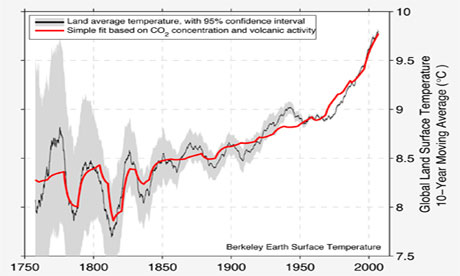
    Leo Blog : on BerkeleyEarth land surface temperature conpared to CO2 concentration

    The annual and decadal land surface temperature from the BerkeleyEarth average, compared to a linear combination of volcanic sulfate emissions and the natural logarithm of CO2. Photograph: BerkeleyEarth

    So, that’s it then. The climate wars are over. Climate sceptics have accepted the main tenets of climate science – that the world is warming and that humans are largely to blame – and we can all now get on to debating the real issue at hand: what, if anything, do we do about it?

    If only. Yesterday’s announcement by Prof Richard Muller that, as a result of his Berkeley Earth Surface Temperature (Best) project’s research, he had undergone a “total turnaround” in his views on climate science and now accepted that the Earth’s land has warmed by 1.5C over the past 250 years and that “humans are almost entirely the cause”, might be seen by many as a watershed moment in this long, often bitter debate. But not, it would appear, for climate sceptics – the very people he designed his project to please.

    Rather than join Muller on his road to Damascus, many climate sceptics have predictably been tempted by the neon signs directing them to turn back instead. Muller, as a result of his “conversion“, is now being painted as a figure of distrust and scorn, in much the same way that they have viewed many climate scientists over the years. His research methodologies and results are being mocked and slammed for being simplistic and “agenda driven”.

    Climate sceptics know better, of course, and are heralding (at first, via a bizarrely histrionic preview) a conveniently timed piece of research of their own, which they say, “devastatingly” undermines all other known work in this field. The tills at Hubris ‘R Us have certainly been ringing loudly over the past few days.

    In one sense, you could say all of this is symptomatic of healthy scientific enquiry. Claim and counter claim are being tested, reviewed and published online to allow full transparency and scrutiny. There are no hiding places. Our scientific understanding of the planet’s climate – and the forces that drive it – are advancing incrementally, yet assuredly. The truth will out.

    I would like to hug this idealistic vision tightly to my chest, but I know – as the saying goes – it’s a bit more complicated than that. There are far more factors at play (on both “sides” of the debate) than mere “science” and that murky soup includes – to name just a few ingredients – ideology, vested interest, confirmation bias and a suite of formal and informal fallacies. I can’t comment on either of the latest results being presented by both Muller and Watts et al (who claim that US temperature trends over the past few decades have been “spuriously doubled”). Neither has been peer-reviewed or published in an academic journal so any conclusions seem premature.

    What is clear, though, is that Muller’s results are largely symbolic, as opposed to representing a genuine leap forward in scientific understanding. His team’s results are broadly in synch with what mainstream climate science has been claiming for well over a decade.

    The power of his findings lay in the journey he has undertaken to arrive at his conclusions. He has sought to address key concerns of climate sceptics about temperature reconstructions (many of which he had himself), as well as investigate why the world has warmed in the way it has over the past couple of centuries. In effect, he has laid down a challenge to climate sceptics (who, I admit, come in many flavours) to come up with a better-evidenced theory than mankind’s emissions being the key reason why temperatures have risen. As he himself says: “To be considered seriously, an alternative explanation must match the data at least as well as carbon dioxide does.”

    The key question for me is whether climate sceptics actually want to tackle that all-important question. What evidence will it take to convince them? Are they forever destined to keep saying “it’s not enough for us”? When does the balance of risk tip over in favour of them accepting that pumping ever more greenhouse gases into the atmosphere is not a wise thing to keep on doing?

  • Magnetic field, mantle convection and tectonics

    Magnetic field, mantle convection and tectonics

    Posted: 29 Jul 2012 11:21 AM PDT

    On a time scale of tens to hundreds of millions of years, the geomagnetic field may be influenced by currents in the mantle. The frequent polarity reversals of Earth’s magnetic field can also be connected with processes in the mantle. New results show how the rapid processes in the outer core, which flows at rates of up to about one millimeter per second, are coupled with the processes in the mantle, which occur more in the velocity range of centimeters per year.
    You are subscribed to email updates fromScienceDaily: Earth Science News
    To stop receiving these emails, you may unsubscribe now.
    Email delivery powered by
  • Researchers analyze melting glaciers and water resources in Central Asia

    ScienceDaily: Oceanography News


    Researchers analyze melting glaciers and water resources in Central Asia

    Posted: 29 Jul 2012 11:23 AM PDT

    Scientists have analyzed climate changes and glaciation in the Tien Shan Mountains (Central Asia), and explained their consequences.

    New discovery of how carbon is stored in the Southern Ocean

    Posted: 29 Jul 2012 11:22 AM PDT

    Scientists have discovered an important method of how carbon is drawn down from the surface of the Southern Ocean to the deep waters beneath. The Southern Ocean is an important carbon sink in the world – around 40 percent of the annual global CO2 emissions absorbed by the world’s oceans enter through this region.
    You are subscribed to email updates fromScienceDaily: Oceanography News
    To stop receiving these emails, you may unsubscribe now.
    Email delivery powered by Google
    Google Inc., 20 West Kinzie, Chicago IL USA 60610
  • Chronic 2000-04 drought, worst in 800 years, may be the ‘new normal’

    ScienceDaily: Severe Weather News


    Chronic 2000-04 drought, worst in 800 years, may be the ‘new normal’

    Posted: 29 Jul 2012 11:21 AM PDT

    The chronic drought that hit western North America from 2000 to 2004 left dying forests and depleted river basins in its wake and was the strongest in 800 years, but those conditions will become the “new normal” for most of the coming century, scientists conclude in a new report. Such climatic extremes, they say, have increased as a result of global warming.
  • Anchoring Wealth to Sustain Cities and Population Growth

    Google Alert – POPULATION GROWTH

    Inbox
    x
    Google Alerts googlealerts-noreply@google.com
    7:08 PM (1 hour ago)

    to me
    News 9 new results for POPULATION GROWTH
    Anchoring Wealth to Sustain Cities and Population Growth
    Truth-Out
    Population growth will otherwise reinforce the unstable and unsustainable cities we now have, which serve as major drivers of global warming. Regional planning can result in positive outcomes—for example, retooling the automobile industry to manufacture 
    See all stories on this topic »
    Pangasinan town exec ‘unhappy’ over low population growth
    Inquirer.net
    DAGUPAN CITY—Despite posting the lowest average annual population growth rate in the Ilocos region, the population officer of Burgos, a fourth class town (with annual income of P25-P35 million) in western Pangasinan, is not happy about it.
    See all stories on this topic »
    Growth in Elk City stems from new oil boom
    NewsOK.com
    The rapid population growth quickly filled the available housing, driving up rent and property values. “The RV parks are full,” Elk City Economic Development Director Shane Frye said. “The temporary housing outside the city is full. We have trailer parks 
    See all stories on this topic »
    City notes growth of registered vehicles and sees need for … rail
    Austin American-Statesman
    Even if the number of cars merely tracked the population growth, that would be something like 175000 more cars and trucks buzzing around greater Austin than were here in 2002. That’s where my restaurant example comes in. The city’s response to this 
    See all stories on this topic »
    Iran Urges Baby Boom With Population Aging
    Huffington Post
    After the 1979 Islamic Revolution, families were strongly encouraged to contribute to a baby boom demanded by leader Ayatollah Ruhollah Khomeini, who wanted fast population growth to contribute to a “20 million member army” in support of the ruling 
    See all stories on this topic »
    Huge Increase in Illegal Israeli Settlers in the West Bank
    International Middle East Media Center
    Most of this increase has occurred outside of the large settlement blocs, which have maintained population stability. Ariel has about 50000 settlers, Ma’aleh Adumim has about 45000 and Gush Etzion about 22000. The total population living in these large 
    See all stories on this topic »

    International Middle East Media Center
    ‘Rampant urbanisation resulting in negative growth
    Hindustan Times
    Therefore, the ‘upper population limit’ for new and growing towns should be only 2 million, so that there is some space for future growth too. In Gurgaon, we are heading to a new direction as far as population is concerned. We are planning a future for 3 million 
    See all stories on this topic »
    Rate of population decrease in Iran is faster than other countries: Official
    Payvand
    The rate of population decrease in Iran is faster than other countries, an official at the organization for civil registration says. The rapid decline in population growth has prompted a study of the issue in parliamentary committees, Ali Akbar Mahzoon said.
    See all stories on this topic »
    Iran, with eye on long-term economy, urges baby boom
    The Seattle Times
    In 1986, toward the end of the eight-year war with Iraq, census figures show the population’s growth rate reached 3.9 percent — among the highest in the world at the time and in line with Persian traditions that favor big families. But the leadership just as 
    See all stories on this topic »


    Tip: Use quotes (“like this”) around a set of words in your query to match them exactly. Learn more.

    Delete this alert.
    Create another alert.
    Manage your alerts.