Author: admin

  • Food price crisis feared as erratic weather wreaks havoc on crops

    Food price crisis feared as erratic weather wreaks havoc on crops

    ‘What the world economy really needs right now is a break’, one economist says, but instead it appears headed toward upheaval

    corn drought food

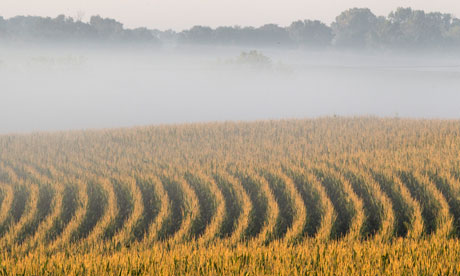
    Fog rolls over a corn field in Nebraska. The drought gripping the United States is the widest since 1956. Photograph: Nati Harnik/AP

    Freak weather in some of the world’s vital food producing regions is ravaging crops and threatening another global food crisis like the price shocks that unleashed social and political unrest in 2008 and 2010.

    As the US suffers the worst drought in more than 50 years, analysts are warning that rising food prices could hit the world’s poorest countries, leading to shortages and social upheaval.

    The situation has sparked comparisons to 2008 when high food prices sparked a wave of riots in 30 countries across the world, from Haiti to Bangladesh.

    Researchers say rising food prices also helped trigger the Arab Spring in 2011.

    Nick Higgins, commodity analyst at Rabobank, said: “Food riots are a real risk at this point. Wheat prices aren’t up at the level they got to in 2008 but they are still very high and that will have an effect on those who are least able to pay higher prices for food.”

    In America’s agricultural heartland, searing heat and sparse rainfall have left farmers helpless as their corn and soy bean crops wither in dry fields. Earlier this month, the US department of agriculture (USDA) slashed forecasts for the corn crop by 12%.

    US agricultural secretary Tom Vilsack said: “I get on my knees every day, and I’m saying an extra prayer right now. If I had a rain prayer or a rain dance I could do, I would do it.”

    As it is, current weather forecasts suggest the drought will continue and experts fear the USDA may have to cut its targets again in August.

    Dan Basse, president of AgResources in Chicago, said the government’s prediction would prove too optimistic if the drought continues. “We’ve been traipsing through the fields of southern Illinois, and it is worse than the government says.”

    The US is crucial to global food markets as the world’s largest exporter of corn, soy beans and wheat, so the impact of the drought will be felt across the globe.

    Corn prices have already shot up 40% since June to hit all-time highs, soy bean prices have jumped 30% to record levels, and wheat has surged 50%.
    It is not just the US. Unseasonal weather, thought to be caused by climate change, is affecting farmers across the world.

    South America has been hit by a drought, which could damage the soy bean harvest, while UK wheat has been damaged by the rain.

    Flash flooding in Russia could also affect the wheat harvest. Traders are particularly concerned about the latter as Russia might limit exports if it is worried about wheat supplies at home, causing further price spikes.
    Shortages have been compounded by huge orders for corn and soy beans to make biofuels, in order to meet quotas in the US and Europe.

    The US agriculture secretary said last week the situation was not bad enough to warrant a reduction in government mandates for biofuels, driving the price of corn even higher. Traders say China also buys and stores grain strategically, putting more pressure on limited supplies.

    Consumers will soon feel the effects of these spikes. A high price of wheat leads directly to higher prices in the shops, as it is the main ingredient for bread and other staples.

    The link is less direct with other crops. Corn and soy beans are used to feed livestock, so rising prices will ultimately cause the price of meat to rise. In the short-term, however, they will have the reverse effect. As the cost of feed rises, farmers kill cattle at lighter weights to avoid having to feed them. That will briefly flood the market with meat, causing prices to fall, but subsequent shortages will causes prices to rise sharply.

    Higgins at Rabobank said meat will then remain expensive for a long time. “It is very hard to rebuild cattle herds and these inflationary effects will be long and lingering.”

    Rising food prices have a disproportionate effect on the poorest people in the world.

    Ruth Kelly, Oxfam’s food policy adviser says people in the Western world spend around 15% of their income on food, but that rises to around 75% in developing countries, so any change in food prices has a dramatic impact on household budgets.

    Kelly says problems will be compounded by the previous two food price spikes in 2008 and 2011:

    “People are already in debt from previous spikes and suffering the consequences. When the first food crisis hit people were forced to sell off their assets, their cattle and jewellery, and take on debt to make ends meet. After multiple crises, people run out of savings and that can be quite disastrous.

    “People can find it much harder to cope when you have multiple shocks like this, without time to recover between them, rather than just a single shock.”

    Economists fear food price inflation will exacerbate the global economic crisis, as it limits the ability of emerging markets to provide any kind of stimulus to drive a recovery. Karen Ward, senior economist at HSBC, said: “What the world economy really needs right now is a break. Any inflationary pressure, particularly that stops the emerging world loosening policy and providing the boost to the global economy, would be a problem.”

  • SAVE OUR BEACHES (0LD BAR BEACH)

    The foreshore is disappearing faster than my wages, with twenty metres of beach front lost in the past decade. This loss of sand has accelerated in the past couple years due to storms and other elements, with more than three metres of beach front lost in the past 18 months. Old Bar is part of an erosion problem facing many parts of the east coast- line from Sydney to Byron Bay. Coastal towns and villages are working with their Councils and other agencies to save these major assets.

    Old Bar is a seaside town near Taree. The town has already witnessed the demolition of two homes located at the southern end of Lewis Street due to erosion. These two homes were the subject of development applications to rebuild on the rear of their blocks; however, the development applications had to be fast tracked by Taree Council. The Council had to act quickly with demolition orders, as the rapid loss saw one of the homes with part of its structure hanging over the cliff face.

    Another two neighbouring homes appear certain to head the same way, as they also succumb to the rapid erosion. The problem is highlighted at the site of one the demolished homes, which was originally on land that was 5,500 square metres in size and purchased in 2001. This property has pristine views of the ocean, and the original residence was located a healthy 27 metres from the back fence. The fast moving erosion problem has seen this distance vanish.

    Lewis Street backs onto the eroding areas, and its residents are expressing major concerns. Experts predict the beach front street may have a five to ten year life span at the current rate of erosion.

    The crisis has caused Old Bar residents to form an action group: Old Bar Beach Sand Replenishment Group Inc. under the Presidency of Elaine Pearce. The group is urging immediate work to protect the foreshore and dunes, to eliminate any further loss.

    The group formed in late 2008 and has completed a Draft Management Plan, met local Federal Member Rob Oakeshott, Greater Taree City Council, and Worley Parsons, the consultants currently compiling a report on behalf of the Council as a Coastal Hazard Assessment.

    “We have covered a lot of ground since we formed,” said Elaine Parsons. “Currently we have compiled our own solution and are applying for a Federal grant to head towards a permanent solution.”

    The action group is advised by Tim Minty, a local geological engineer who has decades of experience studying and stopping erosion problems.

    “If something is not done now, then the beach will be gone, and there is a risk the sea will enter Racecourse Creek,” said Minty. “The shore-line is now eighty metres closer to the dune.”

    Minty has suggested a solution: building a series of groins (breakwalls) at right angles to the shore-line, which will capture the sand and severely slow the erosion. Minty believes that six to eight groins varying in length from 15 to 45 metres are necessary to overcome the problem. He has estimated the cost to be between $800,000-$900,000 – something, he says, that can easily be put into place.

    “The system can be either an Elcorock (bags) or Tetra pods (interlocking) – both will be effective.”

    Resident Mark Searles, a local surveyor, is also a major contributor to the solution plan. He has been surveying the shore-line regularly and reports that his records show five to six metres of the dunes/beach have been lost in the past two years. This is in contrast to the original predications in 1997 that a metre a year would be lost.

    The Greater Taree City Council’s coastal management plan developed in 1992 is now under review, with a new coastal management line to be established citing a minimum distance for future developments.

    With some affected residents heading to the legal fraternity to be advised about their rights of compensation, the disaster appears headed to the courts for a decision. Who is responsible? The Greater Taree City Council, or the various agencies of the Federal or New South Wales Governments for approving these developments?

    Residents claim all three agencies were aware of the future losses of coast-line as far back as the mid 1990s and are legally responsible – a situation denied by all three bodies. Residents whose homes are now under threat are alarmed and annoyed at having to bear the cost of reports, after receiving written advice from Council for engineering assessments on their properties.

    “We believe the Council should cover the costs of any reports,” said Elaine Parsons. “The owners of the affected properties see it as a dismissal of responsibilities by our bureaucrats.”

    It may sound alarmist, but if the current rate of erosion continues, in 20 years we will see the shore-line decrease and the elimination of the caravan park, amenities around the reserve, the entirety of Lewis Street, Pacific Parade, part of Rose Street and the Old Bar Public School.

    So it is evident that a solution has to be found soon.

    In the early 1990s the Council recognised there was a problem and successfully built a groin-wall to divert Racecourse Creek, which at the time was eroding the fore-dunes in front of the reserve and houses located in Lewis Street. The re-direction of the creek created a build-up of sand located in the south. Since that action – which worked well – conditions have changed, with the barrier now only visible during storms.

    During the last decade, the dunes south of Racecourse Creek at Old Bar have slowly changed along with the natural coastal system, which is now a residential area.

    With the coastlines of New South Wales eroding, it is puzzling that there has been an absence of action from governments.

    Our beaches are one of the lifebloods of our tourist industry, and if the erosion is allowed to go unchecked we will have reduced revenue and a reduced amount of venues for our growing population to enjoy.

    Where does the responsibility stop? Does it rest with all levels of government, with owners of the properties or with the developers who applied and were granted permission to erect buildings?

    If history repeats itself, it is evident they will all blame each other; however, the bottom line is that we must protect our coast-line and the current residential areas from further erosion.

    Many blame climate change, while others say the change in currents and weather conditions are related to a cycle that happens every five decades. Whatever the reason, we simply cannot afford to procrastinate.

    Old Bar is not unique with its problems. Laurieton, near Port Macquarie, is becoming a victim, and recently the foreshore of Sydney had a block of units under threat after it lost an enormous amount of sand, exposing the units’ foundations.

    Protection of our coast-line has been on government agendas, as they have instigated many laws to protect marine life, vegetation etc. The Greater Taree City Council is awaiting a report on a Coastal Hazard Assessment from Worley Parsons – a group of consultants engaged to investigate and make recommendations about our coastline.

    Director of Planning and Building, Graham Gardiner says: “We are aware and concerned about the Old Bar situation. Whatever recommendations are made by the Worley Parsons report, Council will discuss what the next steps will be. Council has fast tracked the demolition orders and pending development application/s of the affected residents.

    “In the circumstances we have done everything possible and cannot do any more until we do an analysis of the Worley Parsons report due in March.”

    Residents are working hard to stop the pending demise of their beachside village, and as a tight community they are united to gain a positive outcome.

    The Old Bar village has just experienced its best ever holiday period and is fast becoming a desired venue for holiday makers – a situation that could possibly be lost if the beach front disappears.

  • Sea rise threatens ‘paradise’ Down Under July 20, 2012 by Amy Coopes‏

    • Sea rise threatens ‘paradise’ Down Under July 20, 2012 by Amy Coopes‏

    Here is proof of what is happening  our coastlines


    Sea rise threatens ‘paradise’ Down Under July 20, 2012 by Amy Coopes Enlarge Felt sheeting is seen draped over sandhills to help slow the progress of erosion in front of the Meridien holiday apartments at Old Bar Beach at the coastal town of Old Bar in Australia’s New South Wales state. Old Bar is the most rapidly eroding and at-risk piece of coast in populous New South Wales state, losing an average one metre of seafront every year. When Elaine Pearce left Sydney for the seaside peace of Old Bar 12 years ago she was assured her new house was a solid investment, with a century’s worth of frontage to guard against erosion. Ads by Google USA Property for Aussies – We are the Experts in USA Property Investments for Australians – www.usinvest.com.au/freegift But three neighbours have already lost their homes to the rising ocean and there are scores more at risk as roaring seas batter the idyllic beachside town, ploughing through 40 metres (131 feet) of foredune in just eight years. “I wanted water frontage, and frontage I’m going to get,” Pearce joked. Property values have dived along her once exclusive cul-de-sac, with homes once worth Aus$1.5 or Aus$2 million (US$1.5 or $2 million) now abandoned and offered for Aus$300,000. Weathered ‘For Sale’ signs dot the sidewalk. Insurers will not cover homes for erosion and long-time local resident Allan Willan said the banks were even struggling to sell off the land on which the repossessed homes stand. “They can’t even give it away,” said Willan, who estimates that another five metres of frontage could “easily” be lost in the next storm period. “If it continues at this rate in seven years it’s going to be at the front door.” Old Bar is the most rapidly eroding and at-risk piece of coast in populous New South Wales state, losing an average one metre of seafront every year and far outstripping other areas in terms of property at risk. Enlarge Elaine Pearce from the Old Bar Sand Replenishment Group, seen here outside her home at the coastal town of Old Bar, in Australia’s New South Wales state. Old Bar is the most rapidly eroding and at-risk piece of coast in populous New South Wales state, losing an average one metre of seafront every year and far outstripping other areas in terms of property at risk. Andrew Short, director of Sydney University’s coastal studies unit and a government planning advisor, said the 4,000-person town was among the worst erosion sites in Australia, with huge volumes of sand routinely lost in storms. Currently there are 14 similar “hot-spots” along the densely populated NSW coast — a region home to some 5.8 million Australians — with about 100 properties at risk. But Short said “many hundreds of properties, if not thousands” would be at risk in the next 50-100 years as sea levels rise due to climate change, with planning authorities factoring in a one-metre increase over the next century. Australia’s government estimates that more than Aus$226 billion in commercial, industrial and residential property and road and rail infrastructure is at risk from erosion and inundation by 2100. Ads by Google Get Solar Quotes now – 3 free quotes from Solar Installers 1 Form, 2 Minutes, 3 Solar quotes – Solar-Power-Australia.com.au That forecast includes 274,000 homes. Old Bar has been in the grip of an unprecedented storm period, in terms of both frequency and strength, and University of New South Wales oceanographer Matthew England said it was a trend likely to intensify. “The sea level rise is one thing, but we’re expecting storms to become more intense and storm surges are what really hits these low-lying coastal communities,” said England. England said a one-metre sea level rise could “really quickly” become four metres during a wild weather event, bringing “a really incredible rise of water right up the coast that just can do huge amounts of damage”. Enlarge Coastal erosion is evident in front of the Meridien holiday apartments at Old Bar Beach at the coastal town of Old Bar, in Australia’s New South Wales state. Old Bar is the most rapidly eroding and at-risk piece of coast in the populous state, losing an average one metre of seafront every year and far outstripping other areas in terms of property at risk. Even with a 50 centimetre sea-level rise the government has warned that severe weather events currently considered to be once in a century, such as the major flooding of Brisbane in 2010, would happen several times a year by 2100. More than 30 people died and tens of thousands of homes were swamped in the floods that swept across northern Australia and peaked in Brisbane, forcing Australia’s third-largest city to a standstill for several days. Major cities were expected to face profound challenges from erosion and inundation, with the government warning in a 2009 report that Sydney’s airport faced closure in the next 100 years due to its low-lying waterfront location. Ports, hospitals, power stations and other critical infrastructure were also deemed to be at risk. Short said the issue was at a “tipping point” in the public’s consciousness, with new local planning guidelines showing future sea level projections and requiring people to take measures such as elevating their property. In the longer term, authorities faced a mammoth task to counter the problem, with roads, drainage systems and other infrastructure also needing lifting, he added. England said Australia “certainly stands to be hit with massive increased costs” from sea level rise, with 85 percent of its population living near the coast and insurance and liability battles already looming in the courts. “We’ve seen some properties already across the New South Wales coast being devalued by as much as 50 percent because of their vulnerability to storm surges,” he said. “And we’re only at the very start of the projected trend from human-induced climate change.” The residents of Old Bar are banking on a government lifeline to help them build a Aus$10 million artificial reef offshore to protect their dwindling beach. For her part, Pearce has little doubt about the cause: “Climate change. It’s worldwide, isn’t it.” (c) 2012 AFP

    Read more at: http://phys.org/news/2012-07-sea-threatens-paradise.html#jCp
  • Forbes magazine ( a bastion of the USA establishment) cheering solar-power. The World’s First Baseload (24/7) Solar Power Plant


    THIS IS A REAL BREAKTHROUGH.


    G’day Neville,
    Forbes magazine ( a bastion of the USA establishment) cheering solar-power.
    The World’s First Baseload (24/7) Solar Power Plant
    http://www.forbes.com/sites/tonyseba/2011/06/21/the-worlds-first-baseload-247-solar-power-plant/


  • ‘People must be sensitised to problems of rising population’

    Google Alert – POPULATION GROWTH

    Inbox
    x
    Google Alerts googlealerts-noreply@google.com
    7:08 PM (6 minutes ago)

    to me
    News 9 new results for POPULATION GROWTH
    Teaching the census and population: news and resources round up
    The Guardian (blog)
    This geography lesson pack for ages 11-14 uses Guardian articles to cover the reasons for rapid population growth, the effects of that rapid population growthand policies to slow down population growth. Methods used in estimating population size 
    See all stories on this topic »

    The Guardian (blog)
    Met Council numbers show increase in county population
    Coon Rapids Herald
    Minneapolis, with 5295, led population growth, followed by St. Paul (1299), Woodbury (1182) and Blaine (1145). Anoka County’s population jumped 3209 from the 2010 U.S. Census figure of 330844 to the Metropolitan Council 2011 estimate of 334053.
    See all stories on this topic »
    Population rise will force schools to use empty shops and warehouses
    The Guardian
    The problems, highlighted by the latest census, are now acute in London and other big cities, where education chiefs say population growth – coinciding with the movement of people into cheaper areas as the recession and benefit cuts bite – is creating 
    See all stories on this topic »

    The Guardian
    ‘People must be sensitised to problems of rising population
    The Hindu
    People should be sensitised to socio-economic problems arising out of uncheckedpopulation growth. Government officers should join hands with youth to spread the message, said N.R.Sivapathi, Minister for School Education, Youth Welfare and Sports, 
    See all stories on this topic »

    The Hindu
    150000 left NZ since recession began
    National Business Review
    Statistics New Zealand have released their first population projection since 2009. With nearly 4.5 million people living here now, the projections show slow growth in coming years – 5 million in the mid-2020s, 6 million around 2060. But it’s the make-up of that 
    See all stories on this topic »
    Cyber corner: China’s net population, hacker mom
    Hamilton Spectator
    BEIJING (AP) It’s the biggest — and it’s getting even bigger. China’s population of Internet users is now up to 538 million. That’s an 11-per cent increase over last year’s numbers — which had already put China at No 1 in the world when it comes to netizens.
    See all stories on this topic »
    Merrill Lynch predict growth for Dubai in the coming years
    Select Property
    In its medium-term outlook report, GCC 2020, the bank said: “Diversified economy, continuedpopulation growth and superior infrastructure investment will have positive impact on Dubai’s retail, hospitality and residential market. “We believe the key drivers of 
    See all stories on this topic »
    Lewisham’s population rises 8% in a decade
    Crosswhatfields? (blog)
    It does not support the idea that Lewisham needs to build more homes. Quite the opposite. if Lewisham built fewer new homes, the population of Lewisham would have risen less. The unsustainable population growth shows that Lewisham should build fewer 
    See all stories on this topic »
    Global Apparel Manufacturing Industry Market Research Report Now Available 
    Virtual-Strategy Magazine
    Key factors affecting the industry over the past five years were population growth, disposable income levels and international trade levels. Consumers need clothing for practical reasons, causing demand to grow as the global population increases. Industry 
    See all stories on this topic »


    Tip: Use a minus sign (-) in front of terms in your query that you want to exclude. Learn more.

    Delete this alert.
    Create another alert.
    Manage your alerts.

  • cLIMATE CODE RED Record warmth at the top of the Greenland Ice Sheet

    climate code red


    Climate News

    Posted: 21 Jul 2012 07:03 PM PDT

    Week ending 22 July 2012
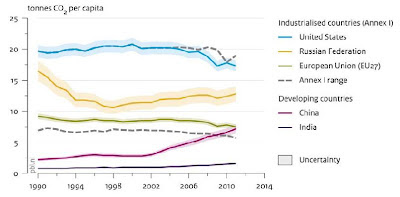
    Carbon dioxide emission per head of population – see first story

    PICKS OF THE WEEK

    As emissions rise, China loses moral high ground
    http://blogs.nature.com/news/2012/07/as-emissions-rise-china-loses-moral-high-ground.html
    Jeff Tollefson, Nature News Blog, 18 July 202
    For years China has dismissed concerns about its rising carbon emissions by pointing out that, on a per-capita basis, Chinese citizens still emit far less than their counterparts in the industrialized world. But now that China’s per-capita emissions are on par with those of the European Union, that argument will be much harder to make.
    AND
    A da xiang in the room: new emissions data
    http://www.crikey.com.au/2012/07/20/theres-a-da-xiang-in-the-room-new-greenhouse-emission-data/
    Cathy Alexander, Crikey, 20 July 2012
    There’s a dà xiàng in the room when it comes to addressing climate change. Dà xiàng is mandarin for elephant. And if you want to get your head around the latest data on greenhouse gas emissions, you’ll need to look to China.

    Remembering Stephen Covey: The Seven Habits Of Highly Effective Climate Hawks
    http://thinkprogress.org/climate/2012/07/17/530861/remembering-stephen-covey-the-seven-habits-of-highly-effective-climate-hawks
    Joe Romm, Climate Progress, July 17, 2012
    Stephen Covey, author of the mega-seller, The 7 Habits of Highly Effective People, died Monday at the age of 79

    Record warmth at the top of the Greenland Ice Sheet
    http://www.wunderground.com/blog/JeffMasters/comment.html?entrynum=2156
    Jeff Masters, Wunderblog, July 18, 2012
    The coldest place in Greenland, and often the entire Northern Hemisphere, is commonly the Summit Station.
    AND
    Climate alarm as iceberg breaks
    http://www.smh.com.au/environment/climate-change/climate-alarm-as-iceberg-breaks-20120718-22aqm.html
    SMH, July 19, 2012
    A chunk of ice twice the size of Manhattan has parted from Greenland’s Petermann glacier, a break researchers at the University of Delaware and Canadian Ice Service attributed to warmer ocean temperatures.

    Sea Level Rise: It Could Be Worse Than We Think
    http://thinkprogress.org/climate/2012/07/21/516171/sea-level-rise-it-could-be-worse-than-we-think/
    Michael D. Lemonick, Climate Central, 21 July 2012
    A new analysis released Thursday in the journal Science implies that the seas could rise dramatically higher over the next few centuries than scientists previously thought — somewhere between 18-to-29 feet above current levels, rather than the 13-to-20 feet they were talking about just a few years ago.
    AND
    Sea rise threatens ‘paradise’ Down Under
    http://phys.org/news/2012-07-sea-threatens-paradise.html
    Amy Coopes, PhysOrg, 20 July 2012
    When Elaine Pearce left Sydney for the seaside peace of Old Bar 12 years ago she was assured her new house was a solid investment, with a century’s worth of frontage to guard against erosion.

    A World Without Coral Reefs
    http://www.nytimes.com/2012/07/14/opinion/a-world-without-coral-reefs.html
    Roger Bradbury, NYT, 13 July 2013
    It’s past time to tell the truth about the state of the world’s coral reefs, the nurseries of tropical coastal fish stocks. They have become zombie ecosystems, neither dead nor truly alive in any functional sense, and on a trajectory to collapse within a human generation.

    Global Warming’s Terrifying New Math
    http://www.rollingstone.com/politics/news/global-warmings-terrifying-new-math-20120719
    Bill McKibben, Rolling Stone, 19 July 2013
    Three simple numbers that add up to global catastrophe – and that make clear who the real enemy is.

    Following the Ice: Is this global warming?
    http://blogs.scientificamerican.com/expeditions/2012/07/20/following-the-ice-is-this-global-warming-continued/
    Ben Linhoff, Scientific American, July 20, 2012
    If this were a movie, the music would be tense and building; this was the moment of truth.

    WEATHER EXTREMES AND GLOBAL WARMING

    Record Heat Wave Pushes U.S. Belief in Climate Change to 70%
    http://www.businessweek.com/news/2012-07-18/record-heat-wave-pushes-u-dot-s-dot-belief-in-climate-change-to-70-percent
    Mark Drajem, Business Week,  July 18, 2012
    A record heat wave, drought and catastrophic wildfires are accomplishing what climate scientists could not: convincing a wide swath of Americans that global temperatures are rising.

    High-Speed Research On Climate Change and Extreme Weather
    http://earthfix.opb.org/energy/article/earthfix-conversations-high-speed-research-on-clim/
    David Steve, earthfix, 16 July 2012
    By the time some of the top climate scientists published their research into the possible links between the 2003 heat wave in France and global warming, five years had passed. That was so last decade.

    Inside Story Americas – Extreme weather: Linked to climate change?
    http://www.youtube.com/watch?v=4rOi4usmINY
    AlJazeeraEnglish, July 11, 2012 
    Extreme weather has gripped much of the United States recently and thousands of heat records have been broken. At least 46 deaths have been linked to the July heat wave alone.

    The Big Heat
    http://www.newyorker.com/talk/comment/2012/07/23/120723taco_talk_kolbert
    Elizabeth Kolbert, New Yorker,  July 23, 2012
    Up until fairly recently, it was possible—which, of course, is not the same as advisable—to see climate change as a phenomenon that was happening somewhere else.

    US forecast: Hot, dry weather to linger into fall
    http://www.google.com/hostednews/ap/article/ALeqM5jtby5WdDdYzawxySOTxPJSK-7RFA
    Seth Borenstein, AP, 20 July 2012
    The unusually hot dry weather that has gripped the nation will not let up its stranglehold over the next few months, federal weather forecasters said Thursday. And that means the heartland’s “flash drought” will linger at least until around Halloween and even spread a bit farther north and east.

    Top Ten Things Climate Change Is Making Worse Right Now
    http://thinkprogress.org/climate/2012/07/21/553551/ten-impacts-climate-change-is-worsening-climate-right-now
    Rebecca Leber and Ellie Sandmeyer, Climate Progress, 21 July 2012
    The onslaught of extreme weather and record temperatures this year have had an impact on people globally, directly through drought and temperature, and more indirectly impacting food prices and public transportation.

    ENERGY AND INNOVATION

    Why the RET is gold medal-winning energy policy
    http://reneweconomy.com.au/2012/why-the-ret-is-gold-medal-winning-energy-policy-34331
    Fiona OHehir, ReNewEconomy, 17 July 2012
    There’s a reason why the Renewable Energy Target is supported by all federal political parties – it works.

    Wind turbine syndrome: a classic ‘communicated’ disease
    http://theconversation.edu.au/wind-turbine-syndrome-a-classic-communicated-disease-8318
    Simon Chapman, the Conversation, 20 July 2012
    At the beginning of this year I started collecting examples of health problems some people were attributing to wind turbine exposure. I had noticed a growing number of such claims on the internet and was curious about how many I could find. Within an hour or two I had found nearly 50 and today the number…

    Dirt cheap solar
    http://www.climatespectator.com.au/commentary/dirt-cheap-solar
    Braden Reddall, reuters, 19 July 2012
    New US import tariffs have prompted China’s solar panel makers to buy more expensive supplies elsewhere and avoid the new duties, but prices for the renewable energy equipment continue to decline.

    Digging deep into Yallourn mine failures
    http://www.climatespectator.com.au/commentary/digging-deep-yallourn-mine-failures
    Mark Wakeham, Climate Spectator, 19 July 2013
    On June 6 the Morwell River collapsed into the Yallourn coal mine in the Latrobe Valley. The river, perhaps Australia’s most poorly treated, has been moved six times to allow access to new coal deposits.

    10 Reasons Clean Coal Is Offensive
    http://www.huffingtonpost.com/kevin-grandia/clean-coal_b_1676906.html
    Kevin Grandia, Huffington ost, 17 July 2013
    According to the Washington Examiner yesterday, President Obama’s campaign team is going “on the offensive to promote [the President’s] support for clean coal”.

    Kooragang coal workers face increased cancer risk: study
    http://www.smh.com.au/environment/kooragang–coal-workers-face-increased-cancer-risk-study-20120720-22e2v.html
    Jacqui Jones, SMH, 20 July 2012
    Past and present employees of Port Waratah Coal Services’ Kooragang Island terminal in the Hunter are up to two to three times more likely to be diagnosed with cancer than the NSW and Australian populations, or colleagues based at Carrington in Newcastle, a study has found.

    Shale gas fever develops as firms see a new gold rush
    http://www.chinadaily.com.cn/cndy/2012-07/16/content_15583281.htm
    Zhou Yan, China Daily, 16 July 2012
    With China having put shale gas near the top of the government agenda for energy security concerns, the scramble for this game-changing unconventional gas is gathering momentum

    Dumping iron at sea can bury carbon for centuries, study shows
    http://www.guardian.co.uk/environment/2012/jul/18/iron-sea-carbon
    Damian Carrington, Guardian, 18 July 2012
    Iron fertilisation creates algae blooms that later die off and sink, taking the absorbed carbon deep towards the ocean floor

    POLITICS AND POLICY

    Apocalypse Soon: Has Civilization Passed the Environmental Point of No Return?
    http://www.scientificamerican.com/article.cfm?id=apocalypse-soon-has-civilization-passed-the-environmental-point-of-no-return
    Madhusree Mukerjee, Scientific American, May 23, 2012 
    Although there is an urban legend that the world will end this year based on a misinterpretation of the Mayan calendar, some researchers think a 40-year-old computer program that predicts a collapse of socioeconomic order and massive drop in human population in this century may be on target

    We’re All Climate-Change Idiots
    http://www.nytimes.com/2012/07/22/opinion/sunday/were-all-climate-change-idiots.html
    Beth Gardiner, NYT Review, 21 July 2012
    Climate change is staring us in the face. The science is clear, and the need to reduce planet-warming emissions has grown urgent. So why, collectively, are we doing so little about it?

    Generation X on climate change: Meh
    http://wwwp.dailyclimate.org/tdc-newsroom/2012/07/gen-x-climate-attitude
    Brett Israel, The DailyClimate, July 17, 2012
    Preoccupied with careers and families, the Gen Xers – adults in their 30s and 40s  – remain almost as indifferent to climate change impacts as their parents

    Time to accept that soon, the climate science deniers will be in charge
    http://www.readfearn.com/2012/07/time-to-accept-that-soon-the-climate-science-deniers-will-be-in-charge/
    Graham Readfearn, 17 July 2012
    Anyone who places any stock in safeguarding the current and future climate (and for that matter anyone who doesn’t) should prepare themselves for the risk that very soon, climate science deniers, contrarians and sceptics will be running the show.

    Global warming will accelerate without climate deal, Merkel warns
    http://www.guardian.co.uk/environment/2012/jul/17/global-warming-accelerate-deal-merkel
    Reuters/Guardian, 17 July 2012
    German chancellor says world leaders must reach a deal on limiting greenhouse gas emissions as soon as possible

    Carbon tax pledge stands, says Pyne
    http://www.theage.com.au/opinion/political-news/carbon-tax-pledge-stands-says-pyne-20120716-225ia.html
    The Age, 16 July 2012
    The Coalition will call a double dissolution election if it wins government but is prevented by the Senate from getting rid of the carbon tax, says frontbencher Christopher Pyne.

    Slow Ride Stories: Kick-starting conversations about climate change
    http://grist.org/climate-energy/slow-ride-stories-kick-starting-conversations-about-climate-change/
    By Aaron Reuben, Grist, 18 July 2012
    The climate is a-changin’ — but the debate on climate change isn’t. As a result, climate scientists and environmental advocates appear to be fighting a losing battle.

    A healthy climate change battle
    http://www.climatespectator.com.au/commentary/healthy-climate-change-battle
    David Shearman, Climate Spectator, 18 July 2012
    The tide of public opinion on climate change may be turning in the US with the impacts of massive drought, floods, storms and bushfires. A recent poll suggests so. Perhaps the removal of climate change from the realm of science to personal experience of physical and economic harm was always necessary for realisation.

    Who Needs Cute? A Jab at Shell and Arctic Drilling
    http://green.blogs.nytimes.com/2012/07/19/who-needs-cute-a-jab-at-shell-and-arctic-drilling/
    Clifford Klauss, NYT blog, 19 July 2012
    Royal Dutch Shell’s plan to drill in the Arctic waters of Alaska next month is no laughing matter for most environmentalists, who still hope the Obama administration will deny the company some permits at the last minute. But Greenpeace is having some fun all the same.

    Melbourne byelection: Kanis rated low on climate issues
    http://www.melbournetimesweekly.com.au/news/local/news/general/melbourne-byelection-kanis-rated-low-on-climate-issues/2625829.aspx
    Chris Hingston, Melbourne Times, 17 July 2012
    A Vote Climate scorecard favouring Green candidates will be delivered to more than 15,000 homes in the Melbourne electorate.
    AND
    Climate the key as inner-city voters turn from Labor
    http://www.theaustralian.com.au/national-affairs/state-politics/climate-the-key-as-inner-city-voters-turn-from-labor/story-e6frgczx-1226426661207
    Adam Shand, The Australian,  July 16, 2012 
    The Australian Labor Party lost Megan O’Connor’s vote in the ruins of Kevin Rudd’s disastrous prime ministership. Like many North Melbourne residents, she switched her allegiance to the Greens candidate Adam Bandt in the 2010 federal election, helping to deliver the party its first seat in House of Representatives.
    AND
    Vote climate assesses candidates
    http://www.stateelection.net.au/

    SCIENCE AND IMPACTS

    Following this summer’s Arctic sea-ice melt…
    http://nsidc.org/arcticseaicenews/

    Record Amount of Arctic Sea Ice Melted in June
    http://www.climatecentral.org/news/record-amount-of-arctic-sea-ice-melted-in-june/
    Andrew Freedman, Climate Central, July 13, 2012
    The Arctic melt season is well underway, and sea ice extent — a key indicator of global warming — declined rapidly during June, setting a record for the largest June sea ice loss in the satellite era. Sea ice extent is currently running just below the level seen at the same time in 2007, the year that set the record for the lowest sea ice minimum in the satellite era.

    Fossils show ocean rise risk
    http://www.sciencealert.com.au/news/20121507-23568.html
    Australian National University, 16 July 2012
    Sea levels may rise much higher than previously thought, according to scientists from The Australian National University, who have used fossil corals to understand how warmer temperatures in the past promoted dramatic melting of polar ice sheets

    Majority of Tibetan Plateau Glaciers Retreating Increasingly Rapidly
    http://www.treehugger.com/climate-change/majority-tibetan-glaciers-retreating-increasingly-rapidly.html
    Mat McDermott, treehugger, July 17, 2012
    The most comprehensive survey of glaciers on the Tibetan plateau and the surrounding areas in the Himalaya, Karakoram, Pamir, and Qilian mountain ranges has found, based on study of satellite data and field  measurements, that the majority of glaciers there are in rapid retreat—and over the past 30 years the rate has been increasing.
    AND
    For Climbers, Risks Now Shift With Every Step
    http://www.nytimes.com/2012/07/15/us/for-climbers-risks-now-shift-with-every-step.html
    AND
    Our frozen assets slowly melting away (New Zealand)
    http://www.stuff.co.nz/the-press/news/7279904/Our-frozen-assets-slowly-melting-away

    The wet side of Greenland
    http://www.climatecodered.org/2012/07/wet-side-of-greenland.html
    Arctic Sea Ice blog, 16 July 2012
    When writing The dark side of Greenland, a recent blog post on decreasing reflectivity of the Greenland ice sheet, with images comparing the southwest of Greenland with satellite images from previous years, I of course realized that when that ice sheet becomes less reflective, it will soak up more solar energy and thus melt faster. But the practical aspect of this theory never really dawned on me, until I saw this video:

    Mexico’s drought turns farms to dust
    http://www.globalpost.com/dispatch/news/regions/americas/mexico/120716/drought-farms-climate-change
    Simeon Tegel, Global Post, July 17, 2012
    ‘Is it really a drought or the region’s new climate?’ asks a climate expert.

    You are subscribed to email updates from climate code red
    To stop receiving these emails, you mayunsubscribe now.
    Email delivery powered by Google
    Google Inc., 20 West Kinzie, Chicago IL USA 60610
    YouTube – Videos from this email
    Click here to Reply or Forward