Author: admin

  • Scientists say ongoing weather extremes offer proof of climate change

    Scientists say ongoing weather extremes offer proof of climate change

    Record-shattering heatwaves, wildfires and freak storms are a sampling of what is to come in 2012 and a window to the future

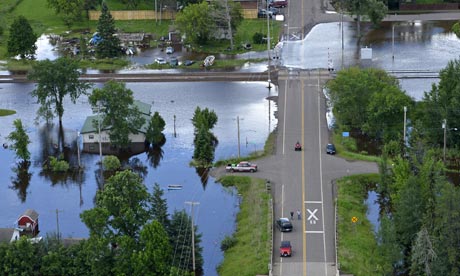
    brookston-minnesota-st.louis river-flood

    Brookston in Minnesota is among scores of places across the country witnessing extreme weather. Photograph: Brian Peterson/AP

    The bizarre weather of early summer in the US – from heatwave, wildfires, drought to freak storms – is just a sampling of what is to come for 2012 and a window to the future under climate change, scientists have said.

    Scientists are wary of linking specific weather events to climate change, and this year’s punishing heat and deadly thunder storms have been confined to the Americas. Europe, Asia and Africa haven’t experienced severe weather this year – though they have in past years.

    But the run of extreme weather offers real-time proof of the consequences of climate change, said Kevin Trenberth, who heads climate research at the National Centre for Atmospheric Research in Colorado – itself the scene of devastating wildfires.

    “We are certainly seeing climate change in action,” he said. “This year has been exceptionally unusual throughout the United States.”

    Jeff Masters director of meteorology at the Weather Underground website, told Democracy Now: “What we’re seeing now is the future. We’re going to be seeing a lot more weather like this, a lot more impacts like we’re seeing from this series of heat waves, fires and storms.”

    He added: “This is just the beginning.”

    The prime exhibit for the bizarre turn of weather is the current heat wave.

    The month of June alone shattered some 3,215 records for daily maximum heat. Cities like St Louis were sweltering under five consecutive days of triple digit temperatures on Tuesday. Last Thursday the city registered 108 degrees fahrenheit, the highest temperature in nearly 60 years.

    “Historically this is going to end up being one of the hottest Junes of all time,” said Harold Brooks, a research meteorologist at the National Severe Storm Laboratory in Oklahoma.

    The high temperatures were also hitting earlier this summer, he said. Heat waves ordinarily do not build up until July.

    But this has been a year for record-breaking heat. Since the start of the year, the United States set more than 40,000 hot temperature records and fewer than 6,000 cold temperature records, according to the National Oceanic and Atmospheric Administration.

    Ordinarily, scientists would expect those numbers to be about the same, but the hot temperature records were falling at a ratio of about 7-1.

    Such volatile temperatures, early in the year, helped contribute to the conditions for the deadly derecho thunder storm which blew through the Washington DC area with hurricane-force winds, killing some 22 people. Brooks said it was one of the most powerful such storms in recent history.

    On the other side of the country, meanwhile, extreme drought conditions across a vast swathe of the American west led to an outbreak of mega-fires in Arizona, Colorado, and New Mexico.

    Colorado’s fires, outside the cities of Colorado Springs and Boulder, have between them destroyed more than 650 houses.

    And there was no relief in sight. Aside from pockets such as northern Minnesota, Washington state, and New England, temperatures across a vast swathe of the United States were heading to record hot temperatures, Brooks said.

    The season has already raised public health concerns. At least three people, all in their 70s and 80s, have died in St Louis since last week because of heat-related illness, medical officials said.

    In the greater Washington DC area, where power outages due to the furious thunderstorm deepened the effects of a heat wave, the authorities have opened cooling centres in schools and community centres for those without access to air conditioning.

    “Watch out for a long hot summer,” said Trenberth.

    Suzanne Goldenberg and Jeff Masters discuss wildfires and climate change on Democracy Now!

  • U.S. & China Collaborate on Thorium Nuclear Power Research

    U.S. & China Collaborate on Thorium Nuclear Power Research

    Posted: 02 Jul 2012 01:34 PM PDT

    Mark Halper writing for SmartPlanet reports the U.S. Department of Energy is quietly collaborating with China on an alternative nuclear power design known as the molten salt reactor that should run on thorium for fuel.According to a March presentation at the Chinese Academy of Sciences (CAS) on thorium molten salt reactors, Peter Lyons DOE’s assistant secretary for nuclear energy is co-chairing the partnership’s executive committee, along with Jiang Mianheng from the CAS.CAS is a Chinese government group overseeing about 100 research…Read more…

  • Environmentalism is not a religion

    Environmentalism is not a religion

    Of all the nonsense climate change deniers throw at the green movement, there one criticism that does real damage, says James Murray

    Anti wind turbine : Banner slogan on trailer protesting against windfarms in Carmarthenshire

    Banner on trailer protesting against windfarms in Carmarthenshire, Wales, 25 October 2010. Photograph: Keith Morris/Alamy

    Of all the blithering nonsense climate deniers throw at the environmental movement, there is perhaps one criticism that does real damage – that “green is the new religion”.

    We can handle the scientifically illiterate and ethically questionable attempts to undermine evidence of climatic change using cherry-picked data and discredited theories, just as we can counter the increasingly futile attempts to question the importance of the green economy and the efficacy of clean technologies. The scientific evidence linking greenhouse gas emissions and potentially dangerous levels of climate change is now so well proven, and the physical demonstration of effective clean technologies so prevalent, that the guileless smears attempted by self-styled “climate sceptics” lack their former sting.

    They are fighting a losing battle with science and evidence, hence the increasingly vocal suggestion that green is the new religion. This line of attack is hugely effective and highly damaging for three main reasons.

    Firstly, and most importantly, if you can convince people to see environmentalism as a religion, then you move green issues from the field of science and data into the field of theology and belief.

    Religion can mean a “pursuit or interest followed with great devotion” – a definition which could just about allow environmentalism to be classified as a “religion”. But it is more commonly defined as “the belief in and worship of a superhuman controlling power, especially a personal God or gods”, or “a particular system of faith and worship”. Equate “greens” with this type of religion, with faith and deities, adherence and heresy, and it becomes all but impossible to prove or disprove the central tenets of environmentalism.

    “Climate change is a matter of faith,” say the climate sceptics, “green actions are acts of religion – they have no place in the real world of politics and business.” Frustratingly, you can argue against this accusation all you like, but any response is tainted in the eyes of your critics by the fact it is made with a “religious conviction” that will brook no argument.

    Secondly, this trope is doubly clever because like all good smears it draws on the weaknesses of its target. Some environmentalists are occasionally guilty of the worst excesses of religion. There is a tendency to drown out legitimate criticism in the most forceful terms, an inclination towards proselytization that can alienate many people, and an occasional willingness to cling to sacred cows even when the scientific evidence suggests we should at least discuss their being slayed (I’m thinking nuclear power and GM as prime examples). The image of environmental campaigners filled with passionate, but not religious, conviction makes the suggestion that environmentalism has become a religion look convincing.

    Thirdly, if you can convince people that green is a religion then you allow anyone who disagrees with environmental policies or business models to wrap themselves in the comforting blanket of heresy. You create a powerful narrative of brave resistance which appeals to iconoclasts, rationalists, and sceptics (in the true sense of the world) everywhere.

    All of which brings me, somewhat circuitously to the Guardian and Simon Hoggart’s second assertion in as many weeks that wind turbines are like church spires, in that “they achieve nothing but have a purely religious significance” – an argument that was expounded by drawing on James Lovelock’s recent claims that environmentalism has become a religion.

    “He’s right,” Hoggart wrote of Lovelock’s latest comments. “[Environmentalists] accuse their opponents not just of being mistaken, but of heresy. They put too much importance on symbolic acts; just as your marrow at the harvest festival doesn’t end world hunger, so you won’t save the planet by cycling to work. Wind turbines, like spires, reach for the skies to no apparent effect. Facts that contradict dogma have to be concealed, as in the East Anglia data hush-up. Allies who change their minds can be denounced as apostates.”

    Now Simon Hoggart is one of the best and most respected journalists working in Britain today, but, like his stable-mate at the Guardian, Simon Jenkins, he has decided wind turbines are loathsome and that anything to do with climate change and environmentalism should face the same cynicism that serves his peerless political sketch-writing so well.

    As such, Hoggart can argue greens have been captured by “religious fervour”, wind turbines serve no purpose beyond the symbolic, the only take away from the University of East Anglia affair was the ludicrous assertion that data was “hushed-up”, and one of the UK’s most intelligent journalists is happy to declare that “I have no idea who is right about climate change”.

    Without wishing to accuse Hoggart or many of the other commentators who have made similar points in recent years of heresy, this is all utterly nonsensical.

    Environmentalism is not a religion in any real sense of the word. Yes, some of its supporters display levels of conviction that can look religious, but the central tenets of environmentalism, not to mention green policies and campaigns, are based on evidence and the application of scientific reason.

    We might sometimes disagree on the evidence and the conclusions, but no one is using faith as an argument to advance their case. Those who do are quickly discredited and are increasingly confined to the more “out there” extremes of the environmental movement.

    I’m sure Hoggart is being truthful when he says he does not know who is right about climate change, but if he wanted to apply the same standards of knowledge to other areas he would have to admit he is not sure who is right about the link between smoking and cancer – the medical establishment, or the discredited hacks who spent years providing dodgy research to the tobacco companies. He can argue that wind turbines look ugly, but to argue that they have “no apparent effect” is to dismiss reams of independent evidence to the contrary, not least the energy meters attached to any wind turbine recording the power being fed into the grid.

    People who suggest climate change might not be happening are not heretics, but they are guilty of a quite staggering lack of intellectual rigour and those who suggest green is a religion, including the estimable James Lovelock, are guilty of a remarkable category error.

    You can call environmentalism an ideology, a political movement, even a lifestyle; but it sure as hell isn’t a religion.

    James Murray is the editor of BusinessGreen

  • Arctic sea-ice takes a nose dive

    Arctic sea-ice takes a nose dive

    Posted: 03 Jul 2012 12:40 AM PDT

    Neven Acropolis, a Climate Progress cross-post

    Arctic sea ice area for June in recent years. Source: Cryosphere Today

    If you want to mislead people into thinking that there is nothing weird going on in the Arctic, you have to do it during winter. In winter things almost look normal on some graphs, with gaps between trend lines and long-term averages not as ridiculously big as during spring and summer.  If you’re lucky, anomalous weather patterns can make those trend lines come real close to the long-term average, and you’ll have a couple of weeks of shouting ‘recovery’, ridiculing scientists and suggesting graphs are being cooked. It’s an annual ritual on pseudo-skeptic blogs, which is only logical. The Arctic is becoming ever more problematic for their life work, i.e. denying AGW could ever be a problem and thus delaying any meaningful action on mitigating the consequences of AGW. Thank God water still freezes in winter.

    Sea ice extent maximum on the left (18 March) and how it looks now on the right (15 June)  (source: NSIDC)

    But what happens in winter is only interesting in so far as it influences the melting season that comes after it. The fact that this year saw a late finish to the freezing season, with an extreme expansion of sea ice into the Bering Sea, was far from irrelevant, but it didn’t tell the whole story either. Another part of that story was covered in a guest blog on Climate Progress in February (Arctic Sea Ice Update: Spectacular and Ominous), and the whole story as I saw it was told in the 2011/2012 Winter Analysis on the Arctic Sea Ice blog. It quite simply came down to this: “Sea ice on the Atlantic side of the Arctic looks vulnerable, sea ice on the Pacific side should be thicker.”
    The melting season is well underway now and in the last two weeks sea ice has been disappearing so fast that 2012 is leading all other years on practically all sea ice extent and area graphs. Take for instance the top graph I’ve made, based on Cryosphere Today sea ice area data.
    That looks pretty spectacular, doesn’t it? Sea ice area has never been so low for this date in the satellite record, not even close to it. 2012 has over half a million of square kilometres less ice than record minimum years 2007 and 2011.
    There was a distinct possibility this would happen, although I didn’t expect it to happen quite this early. But now that it has happened, it’s not difficult to see what the causes are. First of all, the extra ice in the Bering Sea that caused the late maximum, was wafer-thin and so has now virtually disappeared (I compared this year’s situation with previous years in this post on the ASI blog). All the easy ice is as gone as the easy oil.
    Second, that vulnerability on the Siberian side of the Arctic is becoming ever more visible, with the Northern Sea Route possibly opening up for commercial shipping very early this year.

    A third reason for the recent rapid decline is the widespread formation of melt ponds on ice floes. These are fooling satellite sensors into believing that there is open water where there actually isn’t, causing sea ice area to go down faster than sea ice extent. The NSIDC FAQ page explains it well:

    A simplified way to think of extent versus area is to imagine a slice of Swiss cheese. Extent would be a measure of the edges of the slice of cheese and all of the space inside it. Area would be the measure of where there is cheese only, not including the holes. That is why if you compare extent and area in the same time period, extent is always bigger.

    One could say those melt ponds are making the trend lines artificially low, especially on sea ice area graphs. Although this is true, it isn’t the only reason for the recent nosedive and at the same time it’s an indication of how much the Sun is beating down on the Arctic right now. We are approaching Summer Solstice, meaning that the Sun shines practically all day in these northern latitudes, and thus heat will accumulate everywhere where there are clear skies and no ice to reflect the incoming sunshine.
    This effect has started to become visible on the sea surface temperature anomalies all around the Arctic:

    Source: Danish Meteorological Institute

    The water seems to be warming up big time in the polynyas that recently opened up, especially in the Kara and Barents Seas, that are ‘coincidentally’ thought to be a source for some of the blocking patterns that cause outbursts of cold air to spill out from the Arctic and cause extreme winter conditions further down on the Northern Hemisphere (also known as WACC, Warm Arctic Cold Continents).
    One could also say that the stage is being set for the latter part of the melting season, as sea surface temperatures play a big role in the final outcome of the melting season. But that’s a worry for later. What can we expect in the short-term? Will trend lines continue to plummet?
    Short answer: I don’t think they will. The weather conditions that let all that built-up melting potential come to fruition, are in the process of switching. And although this means that those Siberian Seas are also going to get a good dose of sunshine, and the Northwest Passage (which is still chock-full of ice right now) will start opening up as well, the speed of the decline will probably level off a bit on those sea ice extent and area graphs. Until weather conditions switch again, of course.
    Because if one thing is clear after the first phase of the melting season, it’s that there’s a very high chance of records being broken again if this year’s weather conditions resemble those of last year or 2010. If they resemble those of 2007, the year of the perfect storm, it will become clearer than ever that something weird and potentially dangerous is going on in the Arctic.
    I’ll report again if and when something worthwhile happens. In the meantime go to the Arctic Sea Ice blog if you want to read more regular and detailed updates. And check the daily updated graphs, maps and webcams on the Arctic Sea Ice Graphs website.

    Neven Acropolis oversees the Arctic Sea Ice blog.

    You are subscribed to email updates from climate code red
    To stop receiving these emails, you may unsubscribe now.
    Email delivery powered by Google
    Google Inc., 20 West Kinzie, Chicago IL USA 60610
  • US Navy’s ‘great green fleet’ sets sail for Pacific

    US Navy’s ‘great green fleet’ sets sail for Pacific

    Political storm rumbles on as first carrier strike group to be powered largely by biofuels heads for testing manoeuvres

    USNS Henry J. Kaiser : US biofuel ships

    The USNS Henry J Kaiseris refueled at sea on its way to international maritime warfare manoeuvres in the Pacific. Photograph: James R. Evans/U.S. Navy

    A US Navy oiler slipped away from a fuel depot on the Puget Sound in Washington state last week, headed toward the central Pacific and into the storm over the Pentagon’s controversial green fuels initiative.

    In its tanks, the USNS Henry J Kaiser carried nearly 900,000 gallons of biofuel blended with petroleum to power the cruisers, destroyers and fighter jets of what the Navy has taken to calling the “great green fleet,” the first carrier strike group to be powered largely by alternative fuels.

    Conventionally powered ships and aircraft in the strike group will burn the blend in an operational setting for the first time this month during the 20-nation Rim of the Pacific exercise, the largest annual international maritime warfare manoeuvres. The six-week exercise began on Friday.

    The Pentagon hopes it can prove the Navy looks as impressive burning fuel squeezed from seeds, algae and chicken fat as it does using petroleum.

    But the demonstration, years in the making, may be a Pyrrhic victory.

    Some Republican lawmakers have seized on the fuel’s price, which is $26 a gallon compared to $3.60 for conventional fuel. They paint the programme as a waste of precious funds at a time when the US government’s budget remains severely strained, the Pentagon is facing cuts and energy companies are finding big quantities of oil and gas in the United States.

    Navy Secretary Ray Mabus, the programme’s biggest public booster, calls it vital for the military’s energy security.

    But to Barack Obama’s critics, it is an opportunity to accuse the US president of pushing green energy policies even if they don’t make economic sense. The bankruptcy of government-funded solar panel maker Solyndra last year was a previous example of that, they say.

    The US Defense, Energy and Agriculture departments are jointly sponsoring a half-a-billion-dollar initiative to foster a competitive biofuels industry. Mabus and his counterparts at the departments of energy and agriculture are due to announce new investments in biofuels industry on Monday.

    Senator John McCain, the top Republican on the Senate Armed Services Committee, expressed outrage over the costs of the fuel at a hearing earlier this year.

    “I don’t believe it’s the job of the Navy to be involved in building … new technologies,” he said. “I don’t believe we can afford it.”

    The biofuels effort is one of the most ambitious Pentagon energy programmes since then-Defense Secretary Donald Rumsfeld set up a task force in 2006 to find ways to reduce the military’s fossil fuels dependency, involving more than 300,000 barrels a day.

    “The reason we’re doing this is that we simply buy too many fossil fuels from either actually or potentially volatile places on earth,” Mabus told a conference on climate and security last month.

    He says the Pentagon can use its buying muscle – it is the largest single consumer of petroleum in the world – to guarantee the demand needed for biofuel businesses to produce at a scale that will eventually drive down costs.

    “We use 2% of all the fossil fuels that the United States uses,” Mabus told the conference. “And one of the things that this means is that we can bring the market. And to paraphrase the old Field of Dreams line, if the Navy comes, they will build it.”

    Mabus, a former Mississippi governor and ambassador to Saudi Arabia, aims for biofuels to supply about half of the Navy’s non-nuclear fuel needs by 2020, about 8m barrels a year.

  • Abbott warns of double dissolution

    According to Antony Green, this will not be as quick as Abbott believes. See my earlier postings re Double Dissolution Elections.

    Abbott warns of double dissolution

    AAPJuly 3, 2012, 2:51 pm
    Tony Abbott says he would call a double-dissolution election in order to dump the carbon tax.

    AAP © Enlarge photo

    Opposition Leader Tony Abbott says he would call a double-dissolution election if Labor senators block his attempts to dump the carbon tax.

    “Absolutely,” he said when asked about whether he would take the drastic step.

    “Everything that we humanly can, we will do.”

    From its first day in office, Mr Abbott said the coalition would issue strong directives to public servants to prepare legislation to unwind the tax.

    “On day one of the new parliament I will introduce the carbon tax repeal legislation,” Mr Abbott told Macquarie Radio.

    “I am confident that the parliament will be able to deal with this within a matter of a couple of months.”

    Mr Abbott said his repeal laws would have no trouble passing through both houses of parliament, saying voters will use the federal election to voice their opposition to the tax.

    “I don’t believe that the Labor Party, having lost an election which is a referendum on the carbon tax, is going to commit suicide twice by saying `to hell with you voters, we still support a carbon tax’.”

    Treasurer Wayne Swan said refusing to embrace new forms of renewable energy would leave Australia lagging behind other developed nations.

    “You can’t be a first-world, first-class developed economy in the 21st century unless you’re energy efficient and substantially powered by renewable energy,” Mr Swann told Fairfax Radio on Tuesday.