Author: admin

  • Rio+20 draft text is 283 paragraphs of fluff (MONBIOT)

    Rio+20 draft text is 283 paragraphs of fluff (MONBIOT)

    World leaders have spent 20 years bracing themselves to express ‘deep concern’ about the world’s environmental crises, but not to do anything about them

    Rio+20 : People protest against the current economic system

    If ‘sustainability’ means anything, it is surely the opposite of ‘sustained growth’. Photograph: Ueslei Marcelino/Reuters

    In 1992, world leaders signed up to something called “sustainability”. Few of them were clear about what it meant; I suspect that many of them had no idea. Perhaps as a result, it did not take long for this concept to mutate into something subtly different: “sustainable development“. Then it made a short jump to another term: “sustainable growth”. And now, in the 2012 Rio+20 text that world leaders are about to adopt, it has subtly mutated once more: into “sustained growth”.

    This term crops up 16 times in the document, where it is used interchangeably with sustainability and sustainable development. But if sustainability means anything, it is surely the opposite of sustained growth. Sustained growth on a finite planet is the essence of unsustainability.

    As political economist Robert Skidelsky, who comes at this issue from a different angle, observes in the Guardian today:

    “Aristotle knew of insatiability only as a personal vice; he had no inkling of the collective, politically orchestrated insatiability that we call economic growth. The civilization of “always more” would have struck him as moral and political madness. And, beyond a certain point, it is also economic madness. This is not just or mainly because we will soon enough run up against the natural limits to growth. It is because we cannot go on for much longer economising on labour faster than we can find new uses for it.”

    Several of the more outrageous deletions proposed by the United States – such as any mention of rights or equity or of common but differentiated responsibilities – have been rebuffed. In other respects the Obama government’s purge has succeeded, striking out such concepts as “unsustainable consumption and production patterns” and the proposed decoupling of economic growth from the use of natural resources.

    At least the states due to sign this document haven’t ripped up the declarations from the last Earth summit, 20 years ago. But in terms of progress since then, that’s as far as it goes. Reaffirming the Rio 1992 commitments is perhaps the most radical principle in the entire declaration.

    As a result, the draft document, which seems set to become the final document, takes us precisely nowhere: 190 governments have spent 20 years bracing themselves to “acknowledge”, “recognise” and express “deep concern” about the world’s environmental crises, but not to do anything about them.

    This paragraph from the declaration sums up the problem for me:

    “We recognise that the planet Earth and its ecosystems are our home and that Mother Earth is a common expression in a number of countries and regions and we note that some countries recognise the rights of nature in the context of the promotion of sustainable development. We are convinced that in order to achieve a just balance among the economic, social and environment needs of present and future generations, it is necessary to promote harmony with nature.”

    It sounds lovely, doesn’t it? It could be illustrated with rainbows and psychedelic unicorns and stuck on the door of your toilet. But without any proposed means of implementation, it might just as well be deployed for a different function in the same room.

    The declaration is remarkable for its absence of figures, dates and targets. It is as stuffed with meaningless platitudes as an advertisement for payday loans, but without the necessary menace. There is nothing to work with here, no programme, no sense of urgency or call for concrete action beyond the inadequate measures already agreed in previous flaccid declarations. Its tone and contents would be better suited to a retirement homily than a response to a complex of escalating global crises.

    The draft and probably final declaration is 283 paragraphs of fluff. It suggests that the 190 governments due to approve it have, in effect, given up on multilateralism, given up on the world and given up on us. So what do we do now? That is the topic I intend to address in my column next week.
    monbiot.com

  • Coal, Renewable Energy’s Dirty Step Child

    Coal, Renewable Energy’s Dirty Step Child

    Posted: 21 Jun 2012 02:52 PM PDT

    The war on coal is environmentally sound but the lack of subtlety in getting rid of this dirty energy step child is destructive and natural gas would eventually triumph over coal without hard-hitting regulations. On 20 June, a resolution in the US Senate seeking to overturn federal regulations that limited toxic mercury and other dangerous emissions from coal-burning power plants failed to pass, with 46 votes for and 53 against. Only five of the Senate’s Democratic majority supported the resolution. Next week, on 25 June, the Environmental…

    Read more…

  • Rio+20 politicians deliver ‘new definition of hypocrisy’ claim NGOs

    Rio+20 politicians deliver ‘new definition of hypocrisy’ claim NGOs

    Greenpeace, WWF and Oxfam criticise world leaders for shirking responsibilities and say civil society must act in their place

    Rio+20

    Heads of state at Rio+20 have been criticised for showing a lack of courage on sustainable development. Photograph: Buda Mendes/STF/LatinContent/Getty Images

    World leaders at the Rio+20 Earth summit in Brazil delivered a “new definition of hypocrisy” for standing in the way of progress and failing so far to challenge the text of the draft outcome document, NGO leaders said on Thursday.

    Daniel Mittler, political director of Greenpeace, said: “The epic failure of Rio+20 was a reminder [that] short-term corporate profit rules over the interests of people.” He said the outcome of the conference was “nothing short of disastrous”, as governments came offering no money or commitments to action.

    “They say they can’t put money on the table because of the economic crisis, but they spend money on greedy banks and on saving those who caused the crisis. They spend $1 trillion a year on subsidies for fossil fuels and then tell us they don’t have any money to give to sustainable development.”

    Lasse Gustavsson, executive director for conservation at WWF, said two years of “sophisticated UN diplomacy has given us nothing more than more poverty, more conflict and more environmental destruction”. He said WWF had participated in numerous preparatory committee meetings in the runup to Rio, but there was very little to show from its efforts.

    Sharan Burrow, general secretary at the International Trade Union Confederation, who flew to Rio on Wednesday after attending the G20 meeting in Mexico, criticised leaders for their lack of courage in not challenging the document text, written by a team of negotiators, and for doing nothing to adopt a new model of development.

    She told the meeting that people should show politicians how they felt by not voting for them if they did not take decisive action. “The world we want will not be delivered by world leaders, who lack courage to come here and sit at the table to negotiate,” said Burrow. “They take no responsibility. The reality is we are living beyond our planetary means.”

    A recent poll of 175 million members of the trade union movement around the world found that the majority were disillusioned and had no hope that the next generation would fare better, she said. Leaders, she said, needed to seriously invest in green job creation.

    But although politicians have failed to impress at Rio, the NGOs agreed the conference provided an opportunity to mobilise people to act.

    Gustavsson said the 3,000 side events had shown the commitment and “strong leadership” of civil society groups, city mayors and the private sector. “Sustainable development will have to happen without the blessing of world leaders. Governments will need to play catch-up,” he said.

    Barbara Stocking, chief executive of Oxfam GB, said it was time to “pick up and move on. Civil society has to take action. They must do what they do.” She added that a meeting in Rome on Friday among four European leaders could put in motion a financial transaction tax (FTT), which could generate millions that could support efforts to alleviate poverty.

    The tax is opposed by the UK prime minister David Cameron, but has found support, at least in theory, among other European leaders. Friday’s talk will primarily be about the Eurozone crisis, but the FTT will also be under discussion. “The key thing will be to get an agreement and get this under way,” Stocking said. The money made on the tax should be spent on climate change adaption and development, she added.

    Peter Lehner, executive director of the National Resources Defence Council, said his organisation had launched a website, cloud of commitments, that would track the promises made by countries and the private sector at Rio

    He said it was “critical that we don’t equate Rio with a document. It’s not what it should be about. We don’t save the world with a document.” He added that Rio+20 could be a catalyst for action: “People are armed for real action. The document could do a lot more but the important thing is to see Rio as a catalyst for people around the world. Now it’s our turn to take the energy of people and convert that into action.”

  • The Earth in 2050 NY TIMES Going Green

    Alert Name: CLIMATE CHANGE NEWS
    June 22, 2012 Compiled: 1:18 AM

    By MIKHAIL GORBACHEV, JANE GOODALL, PARKER LIAUTAUD, JAMIE OLIVER and PHILIPPE COUSTEAU Jr. (NYT)

    Will the planet be a better or worse place halfway through the 21st century? We put the question to five world-watchers.

    By JOHN ELKINGTON (NYT)

    Industry is blamed for the environmental mess we’re in. And it is the free market that can get us out of it.

    More Articles On This Topic »

  • Rio+20 protesters perform ‘ritual rip-up’ of negotiated text

    Rio+20 protesters perform ‘ritual rip-up’ of negotiated text

    Anger rises at Rio Earth summit, as raucous demo focuses on Future We Want text that ‘moves us forward by inches’

    Activist protest at the conference center against the weakness of the UN Rio+20 agreement

    Activists protest at the Rio+20 conference centre against the weakness of the agreement. Photograph: Alex Farrow

    Protest erupted in the Rio+20 conference centre on Thursday as civil rights groups carried out a “ritual rip-up” of a negotiating text that they condemn as a betrayal of future generations.

    Climate campaigner and founder of 350.org Bill McKibben joined youth delegates, indigenous groups and environmental NGOs in the raucous demonstration, which included speeches and songs in the walkway outside the plenary pavilion.

    “We were promised leaps and bounds but this agreement barely moves us forward by inches,” shouted Cam Fenton, a Canadian in the Major Group of Children and Youth, as protesters ripped up a giant mock text that they called “The Future We Bought”.

    “World leaders have delivered something that fails to move the world forward from the first Rio summit, showing up with empty promises at Rio+20,” said Miariana Calderon, a young woman from California. “This text is a polluters’ plan, and unless people start listening to the people, history will remember it as a failure for the people and the planet.”

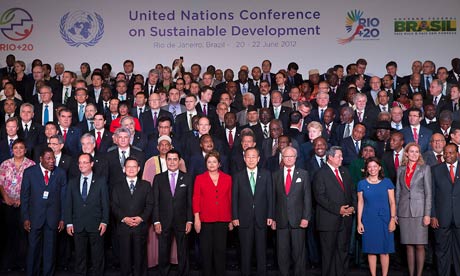
    A short distance away, the Earth summit was underway, but negotiations on the outcome text – the Future We Want – were finished before the arrival on Wednesday of more than 150 world leaders and ministers.

    Despite widespread disappointment at the weak content, the visiting leaders – Chinese premier Wen Jiabao, US secretary of state Hillary Clinton, UK deputy prime minister Nick Clegg and other national representatives – have largely been given a ceremonial role in the talks.

    Eleven-year-old Ta’Kaiya Blaney of the Sliammon nation, an indigenous group from British Columbia, sang to the gathering and appealed for action. “What are we going to leave for future generations. There’ll be no environment left without change. It needs to come not tomorrow, but today.”

    “This kind of action is important. If change is to come it won’t be inside the conference halls, it will be made here outside. These meetings just ratify weakness of what we have done,” said McKibben. “The script doesn’t seem to advance anything. The real news today is that sea ice in the Arctic is at a record low for the date and that every state in the United States, except for North Dakota, has temperatures above 90 degrees.”

    Security were said to have declared the protest “an unsanctioned action”, which meant that participants risked losing their venue passes. “What use is this anyway,” said one speaker.

    The police presence was much higher outside the conference venue than in previous days. Ranks of riot police lined up outside the main entrance, armed troops patrolled in dinghies on the nearby lake and navy frigates cruised alongside the ocean highway that delegates take from hotels to the RioCentro conference venue.

  • Mass fossil site found in southwest Qld

    Mass fossil site found in southwest Qld

    • From: AAP
    • June 21, 20125:19PM
    Giant wombat

    Scientists have discovered more than 50 skeletons of Diprotodon, a giant relative of the modern day wombat, in outback Queensland. Picture: Courtesy Carl Bento Source: Supplied

    • Fossilised collection of prehistoric animals unearthed
    • Find includes more than 50 skeletons of giant wombats
    • Scientists say find could hold clues to their extinction
    A HUGE fossilised collection of prehistoric animals, including giant wombat-like marsupials, may explain how they came to be extinct, scientists in southwest Queensland say.

    Queensland Museum and Griffith University paleontologists, working with Outback Gondwana Foundation (OGF) volunteers, made the find near Eulo, 360 kilometres west of St George.

    OGF chief Anita Milroy says more than 50 skeletons of diprotodons, a giant prehistoric mammal, had been found and are believed to be about 200,000 years old.

    Other “megafauna” unearthed include a big lizard related to the modern day komodo dragon, an extinct freshwater fish, giant kangaroos and a giant forest wallaby.

    Ms Milroy says smaller marsupials, fish and frogs were also found among the fossil “treasure trove”, indicating the animals may have gathered together for a reason.

    “It looks like it was one of the last remaining sources of water when the extinction happened of all this fauna,” she said.

    The largest diprotodon fossil uncovered, nicknamed Kenny, has a 70cm lower jaw and is expected to be about three metres tall when fully reconstructed.

    Ms Milroy said the area, which had not been studied before, was home to the largest collection of “megafauna” fossils anywhere in Australia.

    More testing is needed to work out how old they are.

    Property owner Rob Newsham said his family had been aware of the fossils since a researcher found them in the 1960s, but it was only recently that anyone became interested in them.

    “We used to walk around the property all the time, hoping to find a bone or a tooth or something else that might have been uncovered when it flooded,” he said.

    “We always suspected there were a lot of fossils and we knew it would surprise the scientists.”