Author: admin

  • Oil rush in the Arctic gambles with nature and diplomacy

    Oil rush in the Arctic gambles with nature and diplomacy

    In Svalbard politicians and scientists talk of global warming and a low carbon economy. Outside, the drilling rigs are moving in

    • A polar bear near Longyearbyen, the capital of Svalbard, Norway, where an oil rush is threatening

      A polar bear near Longyearbyen, the capital of Svalbard, Norway, where an oil rush is threatening the environment. Photograph: Andrew Stewart/Rex Features

      The small group of international scientists, politicians and business leaders are using the Arctic research station as a makeshift conference centre for urgent talks on how to fast-forward a low carbon economy. They have come to the snowy archipelago of Svalbard, a few hundred miles from the North Pole, to hear the latest bad news on melting glaciers and climate change.

      “Nowhere are the implications of global warming more visible than in the Arctic. Ecosystems as well as livelihoods are presently undergoing rapid change. In spite of all the evidence provided by science, most governments in the world have failed to take the necessary action,” warns Anders Wijkman, the Swedish MEP who is chairman of this special symposium.

      After hearing predictions that 30% of species could be extinct and a fifth of Bangladesh underwater before 2100, he urges the removal of “all subsidies on fossil fuels” and a much stronger commitment to renewable power in measures to build a sustainable future.

      Yet outside the room, in the grey Arctic waters, an oil rush looms which threatens more carbon emissions and the risk to the natural world of an accident similar to the 2010 Deepwater Horizon spill in the Gulf of Mexico.

      The drilling also threatens to spark territorial disputes and sabre rattling, such as the bellicose noises made by Argentina over British companies seeking oil off the Falkland Islands.

      While the polar bears and arctic fox of Svalbard have grazing rights, the legal standing of different human groups in the region is more fuzzy.

      Ny-Alesund research station is a base not just for the Norwegians, who have political jurisdiction, but also for British, Indian and Chinese scientists. Few believe the national bases – Beijing’s has huge stone lions outside – are there just for science. They are symbolic political and economic stakes in the future of Svalbard and the Arctic.

      Drilling is also under way in earnest off Greenland to the west and in the Barents Sea to the east of Svalbard. Oil price rises and melting ice caps have made the region more accessible for mining, shipping and drilling. Yet ownership of the Arctic seabed is far from clear.

      The 1920 Spitsbergen treaty, drawn up after the first world war, gave onshore mineral rights to more than a dozen signatories, including the UK. Yet there are arguments whether Svalbard’s coastal waters are part of the Norwegian continental shelf and fall within Oslo’s jurisdiction. Fishing rights are disputed between Norway and Russia.

      Trond Giske, Norway’s trade minister, says the uncertainty should not be exaggerated. “On our part we have no problem interpreting the treaty. We have very few conflicts with other countries in this area,” he argues, pointing to agreement with Russia last year to settle territorial boundaries in the Barents Sea.

      The impact of that deal over the “grey zone” only brings oil drilling wealth closer to Svalbard’s islands – and increases pressure on Oslo to debate limits to its sovereignty.

      Diana Wallis, a British lawyer and former MEP, touched a raw nerve with Norway in a speech to the local European Movement in Tromso. She talked of “unresolved disputes around Spitsbergen” and insisted the EU had a legitimate interest in this and the wider Arctic.

      Wallis said: “The position of Svalbard needs to be discussed openly and I can’t see why everyone is nervous about this. They seem to be waiting for a trigger event [like an oil find] and then we are going to have a real problem.”

      A wider debate does not seem to be what countries licensing drilling operations off Alaska, Russia and Greenland want to hear. They have been happy to confine dialogue to an Arctic Council largely composed of states surrounding the Arctic Ocean. And they say territorial disputes – for example, between Canada and the US over seaways – are all being handled through the UN convention on the law of the sea.

      They are determined to defend their right to introduce national oil regulations – which environmental groups and the global community are beginning to challenge.

      “Like it or not, what is happening in the Arctic and how it is dealt with becomes everyone’s business,” said Wallis. “This is an issue which Norway and other Arctic states have to accommodate. A growing number of players have a legitimate interest in what happens in the Arctic and therefore the governance regime there.”

      While Greenpeace has physically tried to halt drilling off Greenland and future operations off Alaska, Norwegian environmental group Bellona is waging a war of words with Oslo. Its leader, Frederic Hauge, said: “It’s a big, big, big gamble exploring for oil in this area. There are so many stress factors here – be it the fish, the nuclear waste from the cold war and the fragility of the ecosystem. I am also very worried about the geopolitics of the Arctic. We are acting like petroholics and I do not believe there is widespread support for it.”

      Norway’s state energy company, Statoil, has its commercial compass pointing north, believing there is nothing to stop its deep water experience of the northern North Sea being safely applied to the Arctic or sub-Arctic.
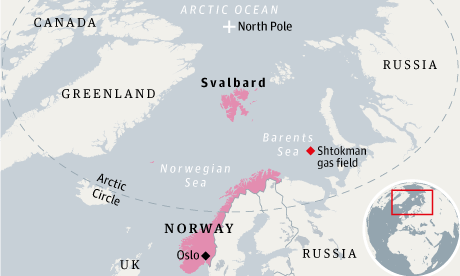
      Svalbard map Svalbard and the Shtokman gas field, where Norway’s Statoil is helping the Russians.

      Statoil points out it has been operating the first Arctic offshore gas field at Snohvit, using subsea technology and underwater links to shore, since 2007. The company – 67% owned by the government – has signed a strategic exploration and production deal with Russia’s state-owned oil group, Rosneft. Statoil is also helping another Russian state company, Gazprom, build the huge Arctic offshore gas field, Shtokman – said to hold more gas reserves than remain in all Norway.

      Hauge points to the irony of more fossil fuels being developed in an area where the impact of their carbon production is most acute.

      Giske sees no contradiction between Norway’s physical search for hydrocarbons and the hunt for low carbon solutions at Ny-Alesund. “We are all going to be dependent on fossil fuels for a long period and natural gas is the bridge into a low carbon world,” he says. “If the EU replaced all its coal-fired power stations with natural gas it would easily meet its 20/20 (20% reduction in carbon emissions by 2020) goal.”

      He is more concerned about EU energy commissioner Günther Oettinger’s recent visit to Oslo to push a new regulatory regime. Oettinger is arguing that Europe is a key customer of Norwegian oil and gas and points to Norway’s membership of the European Economic Area as a reason why a common offshore safety regime would make sense.

      Giske said Norway and Britain had more experience than anyone else in Europe – over 40 years – so why change a system that has worked well.

      Meanwhile, Norway has moved the headquarters of its army from Oslo to a northern town, Bardufoss, and signed its biggest ever single military contract for jets to be located there.

      Who is the enemy? Russia? “No,” says Giske. China? He almost chokes at the suggestion. “Look we don’t need to identify an enemy to justify defence expenditure. We are after all part of the Nato alliance.”

      In Ny-Alesund, there is no discussion of a new cold war over Arctic minerals, with Wijkman more worried about warming. He urges ministers to “raise awareness among the public about the serious risks posed by climate change and the necessity of urgent action”.

      The Norwegian government contributed to the cost of flying Terry Macalister to Svalbard

  • NASA To Hold Media Teleconference On New Ocean Discovery

    NASA To Hold Media Teleconference On New Ocean Discovery

    Inbox
    x

    NASA News Services nasa_subscriptions@service.govdelivery.com
    2:28 PM (56 minutes ago)

    to me

    You are subscribed to Earth News for NASA. This information has recently been updated, and is now available.

    06/05/2012 12:00 AM EDT

    NASA will host a media teleconference on Thursday, June 7, at 2 p.m. EDT to present research on a biological discovery in Arctic Ocean waters.

    Bookmark and Share

    This e-mail update was generated automatically based on your subscriptions. Some updates may belong to more than one category, resulting in duplicate notices.

    Click this link to sign up instantly to receive Science & Tech updates as well as the award winning newsletter from our partners at USA.gov or click this link to see all available options from USA.gov. USA.gov logo

    NASA Questions? Contact Us

    STAY CONNECTED:

  • Alpha delay could be indefinite: Seeney

    Alpha delay could be indefinite: Seeney

    AAPJune 6, 2012, 9:39 am

    The Queensland government has warned a squabble with Canberra over environmental approval for the $6.4 billion Alpha coal mine project could continue indefinitely.

    The federal government on Tuesday suspended the approval process for the project with Environment Minister Tony Burke furiously accusing the state government of creating a shambolic process.

    The first coal mine in the resources-rich Galilee Basin already has the approval of the state’s coordinator-general, but not the Commonwealth’s tick.

    Deputy Premier Jeff Seeney said Mr Burke was trying to “back peddle” on a COAG deal to streamline environmental processes by not meeting a 30-day approval deadline on other projects.

    “We just want to see this project treated fairly,” he told ABC Radio on Wednesday.

    “What we’ve got here is a delay that could go on indefinitely.”

    Mr Seeney accused Mr Burke of acting irresponsibly.

    He defended the Queensland environmental approval process, saying it did look at the project’s impact on marine life.

    But it was a minor part of the project, which is 500km from the coast.

    Mr Seeney said the approval process had examined how a new rail loop line at the Abbot Point port would affect marine life.

    “The much bigger issues relate to issues that are a long, long way inland,” he said.

  • Looking at the Cause of Global Seal Level Rises

    Oil Price Daily News Update


    Thin-Film Solar Panels, Riding Out the Turbulence

    Posted: 04 Jun 2012 03:58 PM PDT

    Thin-film solar is attractive for a number of reasons; from the fact that it is more environmentally friendly to produce, to the low cost of manufacturing these much lighter weight and less bulky cousins of the traditional solar panel. But only the fittest are surviving in this niche market of highly sophisticated technology and constant innovation.Thin-film solar panels are manufactured using solution-based, low-temperature, roll-to-roll procedures that apply conventional printing techniques to flexible materials that can easily be incorporated…

    Read more…

    13 Strange and Interesting Sources of Biofuel

    Posted: 04 Jun 2012 03:53 PM PDT

    Nothing new under the sun? Potrzebie! These biofuels feedstocks set records for ingenuity, sheer craziness and a liberal dose of “what, me worry?“Most of the stories we write on the subject of biofuels feedstocks fall into the well-established realms of normal. But every once in a while, a feedstock emerges that is so compellingly bizarre that we file the story away in our “yecch, ptooey!” file, ready for the round-up which forms our Top Story today.None of the feedstocks may change the world, but some of them, though decidedly…

    Read more…

    Pressure to go Green is Leading to Higher Energy Prices

    Posted: 04 Jun 2012 03:45 PM PDT

    As the United States continues through the interminable process that will end with the national elections in November, the continued poor state of the economy is playing an increasing part in the debate over the likely outcome. What seems to have slipped from the discussion, however, is the contribution that energy costs are making in their impact on the different economies around the world including that of the United States. That awareness is becoming more evident in the UK, particularly in the debate over Scottish Independence. The recent Uswitch…

    Read more…

    Japanese Solar Market about to Boom

    Posted: 04 Jun 2012 03:40 PM PDT

    Last year, the Japanese government announced the creation of a national feed-in tariff (FiT) for solar, joining Germany and China in creating robust public policy to drive deployment of renewable energy. The program is set to launch on July 1, 2012 and solar is regarded as one of the brightest spots in the Japanese recovery from the tsunami.The new program will guarantee payment of 40 Yen/kWh ($0.50) for solar energy produced by projects >10kw (non-residential) and 42 Yen/kWh ($0.53) for energy from projects <10kw (residential) for twenty…

    Read more…

    Nuclear Shutdown Means Japan Must Abandon Carbon Emission Targets

    Posted: 04 Jun 2012 03:38 PM PDT

    In 2009 the Japanese government signed a pledge to cut their carbon emissions by 25 percent by 2020, however following the disaster at Fukushima in 2011 and the subsequent collapse of public confidence in nuclear power, this target may have to be abandoned. Nuclear power plants used to provide a large portion of Japanese electricity, and formed the backbone of their renewable energy sector and the plans to reduce carbon emissions. After the meltdown at Fukushima all 54 of the nation’s nuclear reactors were shut down in order to undergo maintenance…

    Read more…

    Wind Power could be Competitive with Coal, Gas, and Nuclear by 2016

    Posted: 04 Jun 2012 03:37 PM PDT

    Since 2005 the global capacity of installed wind power has quadrupled, due to a variety of factors such as improved technology, large scale investment, and incentive programs designed to encourage industry growth.According to the Worldwatch Institute, in 2011 the global installed capacity increased by 21 percent on the previous year, with China alone accounting for 43 percent of total installations, the US for 17 percent, India seven percent, and Germany five percent.Whilst installing by far the largest capacity of wind power, China is having difficulty…

    Read more…

    Chesapeake Must Sell at Least $7 Billion of Assets to Avoid Faulting on Debt

    Posted: 04 Jun 2012 03:36 PM PDT

    A team of analysts led by Peter Speer from Moody’s Investor Service has announced that Chesapeake Energy Corp must sell at least $7 billion in assets this year to avoid breaching the term of their loans and receiving a credit downgrade.Chesapeake, the largest US natural gas producer after Exxon Mobil Corp., is in the midst of a cash flow crisis after the CEO Aubrey McClendon allowed hedging contracts to expire in late 2011, leaving the company exposed when natural gas prices fell to their lowest level in ten years.The company has already…

    Read more…

    Looking at the Cause of Global Seal Level Rises

    Posted: 04 Jun 2012 03:34 PM PDT

    Last week the science community was shocked by the claim that 42% of the sea-level rise of the past decades is due to groundwater pumping for irrigation purposes. What could this mean for the future – and is it true?The causes of global sea level rise can be roughly split into three categories: (1) thermal expansion of sea water as it warms up, (2) melting of land ice and (3) changes in the amount of water stored on land. There are independent estimates for these contributions, and obviously an important question is whether their sum is consistent…

    Read more…

    Spain’s Respol Shifts its Focus to Latin America’s Energy Superpower Brazil

    Posted: 03 Jun 2012 07:40 AM PDT

    Spain’s energy conglomerate Repsol has had an interesting few months in Latin America.  In 1999 Repsol bought Argentina’s Yacimientos Petroliferos Fiscales (YPF), creating Respol-YPF to begin exploiting Argentina’s vast Vaca Muerta shale gas concession, estimated to contain nearly 22.5 billion barrels of recoverable oil and natural gas. Battered by rising energy import bills and frustrated by Respol-YPF’s sluggish development of the concession, last month the Argentinean government nationalized the concession, provoking…

    Read more…

    You are subscribed to email updates from OilPrice.com Daily News Update
    To stop receiving these emails, you may unsubscribe now.
    Email delivery powered by Google
    Google Inc., 20 West Kinzie, Chicago IL USA 60610
    Reply
    Forward
    Click here to Reply or Forward
  • Newman slams ‘rogue’ Burke in reef mine spat

    Newman slams ‘rogue’ Burke in reef mine spat

    Updated June 06, 2012 06:26:22

    Sorry, this video cannot be played. You may need to install the latest version of Adobe Flash

    Video: Newman reacts to Burke’s criticism(7.30)

    The Queensland Premier has accused Federal Environment Minister Tony Burke of going “rogue” and has called on the Prime Minister to pull him into line.

    It is the latest verbal salvo over the approval process for a multi-million-dollar mine project in central Queensland.

    The state and federal governments had been working on a single environmental approval process for the Alpha Coal Project in the Galilee Basin.

    Mr Burke has halted the approval process in response to the State Government’s environmental impact statement, which he labelled a “shambolic joke”.

    But Premier Campbell Newman says most of the work of the report was done during the term of the previous state Labor government.

    He says Mr Burke’s position does not reflect that of other senior federal Labor ministers.

    “I’m really calling on the Prime Minister to rein in this rogue minister,” he told 7.30.

    “Either she’s supporting what he’s doing, or she must be looking on in appalled silence. Either way, she actually has to state her position.

    “Does she believe that the Galilee coal project should proceed with conditions, or does she really support – for Green political reasons – the actual blocking of these important resource projects for Queensland and the rest of the Australia? She needs to say what she stands for.”

    The mine’s location means it could have an impact on the health of the Great Barrier Reef.

    But Mr Newman says Mr Burke is only pretending to be concerned about the environmental factors at play.

    He says Mr Burke is playing for green votes in Sydney and Melbourne.

    “This is just a game that’s being played,” he said.

    “Right now, there’s the run-up to the next federal election and Minister Burke is trying to pretend in some way that he’s looking after the environment, where in fact what he’s doing is trying to play a wedge game.”

    Last week, Mr Burke requested more information from the Queensland Government, arguing the state’s assessment process was deficient.


    For example, he says it did not consider the coastal impacts of the earthworks for the rail line and facilities at Abbott Point Coal Terminal that could affect turtles, dolphins, dugong and whales.

    But Queensland’s Deputy Premier Jeff Seeney rejects that, and is insisting on a Federal Government decision on the coal mining project within 30 business days.

    Mr Newman is also urging the Commonwealth to get on with the job.

    “We have been through a comprehensive assessment process. I’ve talked about the statements from Labor luminaries like Martin Ferguson and Anthony Albanese who support the project; the Government says they want mining revenues because they’ve got a new mining tax,” he said.

    “What we want to know is: will the Minister approve the project in the 30-day period provided for under the Environmental Protection and Bio-diversity Conservation Act of the Federal Government?

    “That’s all the Minister has to do. Approve the project subject to conditions – let’s get the jobs for Queensland and Australia and get on with it.”

    The Federal Government says it hopes to make a decision on the Alpha Coal Project as soon as possible.

    Topics:mining-industry, business-economics-and-finance, industry, mining-environmental-issues, environment, great-barrier-reef, oceans-and-reefs, government-and-politics, federal—state-issues, qld, gladstone-4680, australia

    First posted June 05, 2012 22:03:26

  • The climate change deniers: influence out of all proportion to science

    The climate change deniers: influence out of all proportion to science

    The Heartland Institute’s recent shaming has put the denialist camp on the defensive. But they’ve already done massive harm

    • Climate change sceptic Lord Monckton told he’s not member of House of Lords

      Climate change sceptics such as Lord Monckton have mounted a campaign to delay action on global warming that has been remarkable successful, given its lack of scientitfic credibility. Photograph: Torsten Blackwood/AFP/Getty Images

      It’s been a tough few weeks for the forces of climate change denial.

      First came the giant billboard with Unabomber Ted Kacynzki’s face plastered across it: “I Still Believe in Global Warming. Do You?” Sponsored by the Heartland Institute, the nerve center of climate change denial, it was supposed to draw attention to the fact that “the most prominent advocates of global warming aren’t scientists. They are murderers, tyrants, and madmen.” Instead, it drew attention to the fact that these guys had over-reached, and with predictable consequences.

      A hard-hitting campaign from a new group called Forecast the Facts persuaded many of the corporations backing Heartland to withdraw $825,000 in funding; an entire wing of the institute, devoted to helping the insurance industry, calved off to form its own non-profit. Normally friendly politicians like Wisconsin Republican Congressman Jim Sensenbrenner announced that they would boycott the group’s annual conference unless the billboard campaign was ended.

      Which it was, before the billboards with Charles Manson and Osama bin Laden could be unveiled, but not before the damage was done: Sensenbrenner spoke at last month’s conclave, but attendance was way down at the annual gathering, and Heartland leaders announced that there were no plans for another of the yearly fests. Heartland’s head, Joe Bast, complained that his side had been subjected to the most “uncivil name-calling and disparagement you can possibly imagine from climate alarmists”, which was both a little rich – after all, he was the guy with the mass-murderer billboards – but also a little pathetic. A whimper had replaced the characteristically confident snarl of the American right.

      That pugnaciousness may return: Bast said last week that he was finding new corporate sponsors, that he was building a new small-donor base that was “Greenpeace-proof”, and that in any event, the billboard had been a fine idea anyway because it had “generated more than $5m in earned media so far”. (That’s a bit like saying that for a successful White House bid, John Edwards should have had more mistresses and babies because “look at all the publicity!”)

      Whatever the final outcome, it’s worth noting that, in a larger sense, Bast is correct: this tiny collection of deniers has actually been incredibly effective over the past years.

      The best of them – and that would be Marc Morano, proprietor of the website Climate Depot, and Anthony Watts, of the website Watts Up With That – have fought with remarkable tenacity to stall and delay the inevitable recognition that we’re in serious trouble. They’ve never had much to work with. Only one even remotely serious scientist remains in the denialist camp. That’s MIT’s Richard Lindzen, who has been arguing for years that while global warming is real, it won’t be as severe as almost all his colleagues believe. But as a long article in the New York Times detailed last month, the credibility of that sole dissenter is basically shot. Even the peer reviewers he approved for his last paper told the National Academy of Sciences that it didn’t merit publication. (It ended up in a “little-known Korean journal”.)

      Deprived of actual publishing scientists to work with, they’ve relied on a small troupe of vaudeville performers, featuring them endlessly on their websites. Lord Christopher Monckton, for instance, an English peer (who has been officially warned by the House of Lords to stop saying he’s a member) began his speech at Heartland’s annual conference by boasting that he had “no scientific qualification” to challenge the science of climate change.

      He’s proved the truth of that claim many times, beginning in his pre-climate-change career when he explained to readers of the American Spectator that “there is only one way to stop Aids. That is to screen the entire population regularly and to quarantine all carriers of the disease for life”. His personal contribution to the genre of climate change mass-murderer analogies has been to explain that a group of young climate change activists who tried to take over a stage where he was speaking were “Hitler Youth”.

      Or consider Lubos Motl, a Czech theoretical physicist who has never published on climate change, but nonetheless keeps up a steady stream of web assaults on scientists he calls “fringe kibitzers who want to become universal dictators” who should “be thinking how to undo your inexcusable behavior so that you will spend as little time in prison as possible”. On the crazed killer front, Motl said that, while he supported many of Norwegian gunman Anders Breivik’s ideas, it was hard to justify gunning down all those children. Still, he went on, it did demonstrate that “rightwing people … may even be more efficient while killing – and the probable reason is that Breivik may have a higher IQ than your garden variety leftwing or Islamic terrorist.”

      If your urge is to laugh at this kind of clown show, the joke’s on you – because it’s worked. I mean, James Inhofe, the Oklahoma Republican who has emerged victorious in every Senate fight on climate change, cites Motl regularly; Monckton has testified four times before the US Congress.

      Morano, one of the most skilled political operatives of the age – he “broke the story” that became the Swiftboat attack on John Kerry – plays rough: he regularly publishes the email addresses of those he pillories, for instance, so his readers can pile on the abuse. But he plays smart, too. He’s a favorite of Fox News and of Rush Limbaugh, and he and his colleagues have used those platforms to make it anathema for any Republican politician to publicly express a belief in the reality of climate change.

      Take Newt Gingrich, for instance. Only four years ago, he was willing to sit on a love seat with Nancy Pelosi and film a commercial for a campaign headed by Al Gore. In it, he explained that he agreed with the California congresswoman and then-speaker of the House that the time had come for action on climate.

      This fall, hounded by Morano, Gingrich was forced to recant, again and again. His dalliance with the truth about carbon dioxide hurt him more among the Republican faithful than any other single “failing”. Even Mitt Romney, who as governor of Massachusetts actually took some action on global warming, has now been reduced to claiming that scientists may tell us “in 50 years” if we have anything to fear.

      In other words, a small cadre of fervent climate-change deniers took control of the Republican party on the issue. This, in turn, has meant control of Congress. And since the president can’t sign a treaty by himself, it’s effectively meant stifling any significant international progress on global warming. Put another way, the various rightwing billionaires and energy companies who have bankrolled this stuff have gotten their money’s worth many times over.

      One reason the denialists’ campaign has been so successful, of course, is that they’ve also managed to intimidate the other side. There aren’t many senators who rise with the passion or frequency of James Inhofe, but to warn of the dangers of ignoring what’s really happening on our embattled planet.

      It’s a striking barometer of intimidation that Barack Obama, who has a clear enough understanding of climate change and its dangers, has barely mentioned the subject for four years. He did show a little leg to his liberal base in Rolling Stone earlier this spring by hinting that climate change could become a campaign issue. Last week, however, he passed on his best chance to make good on that promise when he gave a long speech on energy at an Iowa wind turbine factory without even mentioning global warming. Because the GOP has been so unreasonable, the president clearly feels he can take the environmental vote by staying silent, which means the odds that he’ll do anything dramatic in the next four years grow steadily smaller.

      On the brighter side, not everyone has been intimidated. In fact, a spirited counter-movement has arisen in recent years. The very same weekend that Heartland tried to put the Unabomber’s face on global warming, 350.org conducted thousands of rallies around the globe to show who climate change really affects. In a year of mobilization, we also managed to block – at least temporarily – the Keystone XL pipeline, which would have brought the dirtiest of dirty energy, tar sands oil, from the Canadian province of Alberta to the Gulf Coast. In the meantime, our Canadian allies are fighting hard to block a similar pipeline that would bring those tar sands to the Pacific for export.

      Similarly, in just the last few weeks, hundreds of thousands have signed on to demand an end to fossil-fuel subsidies. And new polling data already show more Americans worried about our changing climate, because they’ve noticed the freakish weather of the last few years and drawn the obvious conclusion.

      But damn, it’s a hard fight, up against a ton of money and a ton of inertia. Eventually, climate denial will “lose”, because physics and chemistry are not intimidated, even by Lord Monckton. But timing is everything – if he and his ilk, a crew of certified planet wreckers, delay action past the point where it can do much good, they’ll be able to claim one of the epic victories in political history – one that will last for geological epochs.