Author: admin

  • Only renewables – not nuclear – could be too cheap to meter

    Meanwhile German Chancellor Angela Merkel is in danger of being deposed.

    Only renewables – not nuclear – could be too cheap to meter

    Germany’s long support for wind and solar energy is delivering zero-cost electricity at times. In contrast, the UK’s new energy policy seeks to underwrite the rising cost of nuclear

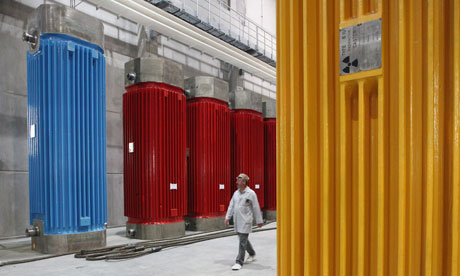
    Damian in Germany : highly radioactive industrial waste from decomissioned nuclear power plants

    Germany has chosen not to build new nuclear reactors, but is investing in renewable energy manufacturing and deployment (Zwischenlager Nord temporary nuclear waste storage facility in Lubmin, Germany. Photograph: Sean Gallup/Getty Images)

    “Too cheap to meter”: that was the infamous boast of the nuclear power industry in its heyday. It has been catastrophically discredited by history.

    Yet the phrase may yet see a new life – not of course for nuclear power – but for renewable energy. As the UK government publishes its draft energy bill on Tuesday, acknowledged by all but ministers themselves as primarily an arcane way of getting new nuclear power stations built, I am in Germany.

    Already, on one particularly windy weekend here, the surge of electricity drove the price down to zero. Very soon, due to the 25GW of solar capacity Germany has already installed, hot summer’s days will see the same effect: electricity too cheap to meter.

    Now hang on, I hear you say, free electricity is actually crazy as it means there’s no incentive to invest in new, clean generation capacity, which almost every country needs as the world seeks to cut the carbon emissions driving climate change. Germany’s renewable energy policy, which began with a feed-in-tariff in 1990, deals with this by continuing to pay the producer, even when the electricity is sold for nothing.

    Crazy again, right? No, says Andreas Kraemer, director of the Ecologic Institute, an energy research policy centre, because the tax benefit to the Germany, via 400,000 jobs in the €40bn-a-year renewables industry is outweighs than the cost of the subsidy. Furthermore, he says, the contribution of renewable energy in cutting peak prices mean the wholesale cost of electricity is 10% lower than it would be without them. “The money flowing out in FITs is less than the money saved by the end consumer,” he says. And all the while a clean, sustainable energy system is built.

    But real problems do exist, and will intensify as Germany approaches its goal of 100% renewable electricity, from its current 20%. As that comes closer, the policies will have to change. Energy storage, already incentivised in Germany today, will need to be available, as will high-voltage interconnectors to move power around the continent and a smart grid to cleverly match demand to supply. It’s an attractive vision: clean energy, securely supplied and coming down in price.

    Compare all this with the UK, where the nuclear industry is so embedded in government it supplies staff free-of-charge to work within the energy ministry. Perhaps it’s no wonder that even when half of the UK’s big six energy companies bale out of nuclear on cost grounds, ministers plough on regardless.

    The news that EDF, the French-state-owned giant that runs many of the UK’s nuclear plants, wants to extend the lifetimes of their ageing reactors confirms their attraction to the so-called carbon floor price. This leg of government energy policy puts a minimum price on carbon emissions, delivering large windfalls to existing nuclear plants. New nuclear plants will also have to be subsidised, more than onshore wind and possibly more than offshore wind, according to recent analyses, which is shameful for a 60 year-old technology.

    “In general in industry,” says Kraemer, “when the production of something doubles, the cost falls by about 15%. The only notable exception is the nuclear industry which gets more expensive the more you build.” Recent reports, not denied by EDF, put the cost of their new plants in the UK at £7bn each, 40% higher than previously stated.

    So while mass-produced renewable energy technologies are pushing the costs downwards, nuclear energy is completing the journey from “too cheap to meter” to “too expensive to count”. “It surprises me that something that is completely obvious to people in Germany is suppressed in the UK,” says Kraemer.

    A final note. I am here with half a dozen of the UK’s most senior energy policy academics. When I mention the guarantee repeatedly given by the coalition government that new nuclear plants in the UK will get “no public subsidy”, the only response are roars of incredulous laughter. Energy bill payers, who fund all the energy schemes, are unlikely to be similarly amused.

  • Protect Antarctic waters before it’s too late, says environment coalition

    Protect Antarctic waters before it’s too late, says environment coalition

    The Antarctic Ocean Alliance is urging the UK government to protect one of the last true frontier areas before it is damaged irreparably by human interference

    • guardian.co.uk, Tuesday 22 May 2012 12.34 BST
    • Comments (2)
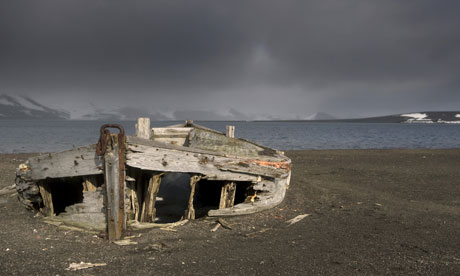
    • Fishing in Antarctic : remains of a whaling station on Deception Island

      The remains of a whaling station on Deception Island, Antarctica. Photograph: Martin Bureau/AFP/Getty

      A huge swath of the waters off Antarctica must be protected from fishing and other industries, environmental groups said on Monday.

      More than 40% of the region needs to be given protection before one of the world’s last true frontier areas is damaged irreparably by human activity, the Antarctic Ocean Alliance (AOA) said.

      The group, whose members include Greenpeace and WWF, has identified 19 “key Antarctic marine habitats” that it argues must be protected as part of the largest network of marine protected areas ever created. It is urging the UK government to throw its weight behind the proposals.

      Steve Campbell, the AOA’s co-ordinator, said the UK would be an ideal champion because it has already taken a lead in creating protected areas in the Southern Ocean, such as the Southern Orkney Islands Southern Shelf marine protected area.

      The alliance says Antarctic marine ecosystems are under increasing pressure, including the rising demands of the fishing industry, which threaten the health of animal populations such as penguins, whales, seals, fish and krill.

      The report, Antarctic Ocean Legacy: A Vision for Circumpolar Protection, noted that the Southern Ocean accounts for 10% of the world’s seas, yet less than 1% of it is “strictly protected” despite being home to vast numbers of animals, many of them vulnerable to interference.

      “Although often depicted as a frozen region dominated by breathtakingly beautiful but sterile glaciers, Antarctica is bursting with life – but mostly marine life. Below the icy ocean surface, bright-colored seastars, sponges and other bottom-dwelling creatures of all shapes and sizes blanket the seafloor.

      “Strange fish, with clear white blood and antifreeze in their bodies, lurk throughout the water column. On the surface, penguins, flying seabirds, seals and whales abound amidst the ice, foraging in krill-rich waters. The Antarctic truly remains one of the world’s last wild frontiers.”

      Protecting large areas of Antarctic waters should help prevent a repeat of the overfishing that since the 1960s has devastated several species, including marbled rockcod, which by the 1990s had declined in population by 95%. Patagonian toothfish, marketed as Chilean sea bass, were similarly targeted, and by the mid-1990s there were catches of more than 100,000 tonnes annually.

  • The tide of public opinion is turning against immigration

    The tide of public opinion is turning against immigration

    5
    Asylum seekers

    New asylum seeker boats arrive at Christmas Island yesterday. Source: The Daily Telegraph

    MORE than half of Australians want our borders closed and immigration ended.

    New research, provided exclusively to The Daily Telegraph, reveals a dramatic swing against border issues, with 51 per cent in favour of saying no to all migrants – a 10 per cent jump since 2005.

    Fears over falling job security and the burgeoning population putting more strain on infrastructure are two reasons for the shift in attitudes. The federal opposition said yesterday the anti-immigration sentiment was due to rising public anger about the number of asylum seekers attempting to enter the country.

    Just a third of the 2000 people questioned by Quantum Market Research for AustraliaSCAN believed overseas migration made Australia “a more interesting and exciting place”, down from almost half in 1995.

    Almost two thirds said they believed migrants should try to “adopt the Australian way of life” when they arrived.

    The number who believe the country has room to accommodate more people also plunged to less than a third, down from 42 per cent a decade ago.

    Monash University migration expert Bob Birrell said the results showed public opinion about immigration had moved into new territory.

    “I think they are right to be worried, we have record levels of immigration and as a consequence we are allowing 100,000 migrants to enter the workforce at a time when employment growth is at a level lower than that,” Dr Birrell said.

    “People are concerned that the present rate of population growth is not sustainable and is going to make Australia a poorer place to live rather than a better one.”

    The government’s immigration and refugee program for 2012-13 is expected to reach a record 203,000 people, similar to the mass migration intakes of the 1960s.

  • Toxic mercury, accumulating in the Arctic, springs from a hidden source

    Toxic mercury, accumulating in the Arctic, springs from a hidden source

    Posted: 21 May 2012 07:41 AM PDT

    Environmental scientists have discovered that the Arctic accumulation of mercury, a toxic element, is caused by both atmospheric forces and the flow of circumpolar rivers that carry the element north into the Arctic Ocean. While the atmospheric source was previously recognized, it now appears that twice as much mercury actually comes from the rivers. The revelation implies that concentrations of the toxin may further increase as climate change continues to modify the region’s hydrological cycle and release mercury from warming Arctic soils.
    You are subscribed to email updates from ScienceDaily: Oceanography News
    To stop receiving these emails, you may unsubscribe now.
    Email delivery powered by Google
    Google Inc., 20 West Kinzie, Chicago IL USA 60610
  • Latest Southern Ocean research shows continuing deep ocean change

    ScienceDaily: Earth Science News


    Stunning view of Lyrids and Earth at night

    Posted: 21 May 2012 12:33 PM PDT

    On the night of April 21, the 2012 Lyrid meteor shower peaked in the skies over Earth. While NASA allsky cameras were looking up at the night skies, astronaut Don Pettit aboard the International Space Station trained his camera on Earth. Video footage from that night is now revealing breathtaking images of Earth with meteors ablating — or burning up — in the atmosphere.

    Understanding Arctic Ocean’s carbon cycle

    Posted: 21 May 2012 10:28 AM PDT

    Scientists have conducted a new study to measure levels of carbon at various depths in the Arctic Ocean. The study provides data that will help researchers better understand the Arctic Ocean’s carbon cycle — the pathway through which carbon enters and is used by the marine ecosystem.

    Latest Southern Ocean research shows continuing deep ocean change

    Posted: 21 May 2012 07:46 AM PDT

    There has been a massive reduction in the amount of Antarctic bottom water found off the coast of Antarctica, new research shows.

    Dry lands getting drier, wet getting wetter: Earth’s water cycle intensifying with atmospheric warming

    Posted: 21 May 2012 07:46 AM PDT

    A clear change in salinity has been detected in the world’s oceans, signaling shifts and an acceleration in the global rainfall and evaporation cycle. The patterns are not uniform, with regional variations agreeing with the ‘rich get richer’ mechanism, where wet regions get wetter and dry regions drier.

    Toxic mercury, accumulating in the Arctic, springs from a hidden source

    Posted: 21 May 2012 07:41 AM PDT

    Environmental scientists have discovered that the Arctic accumulation of mercury, a toxic element, is caused by both atmospheric forces and the flow of circumpolar rivers that carry the element north into the Arctic Ocean. While the atmospheric source was previously recognized, it now appears that twice as much mercury actually comes from the rivers. The revelation implies that concentrations of the toxin may further increase as climate change continues to modify the region’s hydrological cycle and release mercury from warming Arctic soils.
    You are subscribed to email updates from ScienceDaily: Earth Science News
    To stop receiving these emails, you may unsubscribe now.
    Email delivery powered by Google
    Google Inc., 20 West Kinzie, Chicago IL USA 60610
    Reply
    Forward
    Click here to Reply or Forward
  • Kelvin Thomson’s budget reply speech

    Kelvin’s Budget Reply Speech

    Inbox
    x

    Hamilton, Tim (K. Thomson, MP) Tim.Hamilton@aph.gov.au
    4:20 PM (32 minutes ago)

    to Tim

    Dear All,
    Please see attached Kelvin’s Budget Reply speech which he delivered to the Parliament on the evening of May 21st.
    In it he speaks of his concerns regarding the increase in our skilled migration intake.
    Regards,
    Tim
    Tim Hamilton
    Electorate Officer
    Office of Kelvin Thomson MP
    Member for Wills
    (P) 9350 5777
    (M) 0424 138 558