Author: admin

  • The Death of Global Integration

    The Death of Global Integration

    Posted: 24 Apr 2012 02:16 PM PDT

    The world’s elites don’t want to admit it. But the kind of global village that they have insisted on building–a vast free-trade paradise run by an ever more complex and opaque system of logistics and finance–isn’t working, not even for many of them. The cost of maintaining this brittle, complex system and keeping the huge imbalances it creates at bay is becoming dizzyingly expensive.The consequences of those imbalances include heavily indebted countries such as Greece being driven into penury by the financial masters of Europe desperate to keep…

    Read more…

    Video Game Consoles left on Idle Waste

  • Iran won’t develop nukes: Israeli defence chief

    Iran won’t develop nukes: Israeli defence chief

    Posted April 26, 2012 08:34:21

    The head of Israel’s armed forces says he does not think Iran will develop nuclear weapons.

    In an interview with an Israeli newspaper, Lieutenant-General Benny Gantz says he thinks the current Iranian leadership is very rational.

    His public stance is unusual, especially as they run counter to the views of Israeli prime minister Benjamin Netanyahu.

    General Gantz said it would be a huge mistake for the Iranian government to go ahead with building a nuclear weapon and does not think it wants to go the extra mile.

    He also said he thought the international sanctions against Iran were starting to bear fruit.

    Topics:nuclear-issues, unrest-conflict-and-war, government-and-politics, world-politics, defence-and-national-security, israel

  • Ten-year wait for safe trains – long delay on Waterfall disaster reform

    Ten-year wait for safe trains – long delay on Waterfall disaster reform

    0
    Waterfall train crash

    Safety legacy … the crash scene at Waterfall in 2003 / Pic: Matt Turner Source: The Daily Telegraph

    IT will end up taking CityRail more than 10 years to fit its trains with emergency exits – one of the key safety recommendations of the Waterfall inquiry.

    Trials of the Internal Emergency Door Release (IEDR) system, which will allow passengers onboard a train to open the doors in an emergency, began in April 2010 but have been beset by problems.

    During the trials last month, the doors could be opened as the train travelled at 60km/h.

    In his 2005 report into the Waterfall tragedy, which claimed the lives of seven people, Justice Peter McInerney recommended that all passenger trains be fitted with an internal passenger emergency door release.

    During the Waterfall disaster in 2003 some passengers were trapped inside the overturned Tangara train for more than 40 minutes.

    TEN YEARS to fit trains with emergency exits? Have your say below

    The train driver had suffered a heart attack and the guard was incapacitated by the crash – meaning both were unable to open the doors.

    Despite two years of trials, RailCorp recently informed the Independent Transport Safety Regulator, which monitors the implementation of the Waterfall inquiry recommendations, that the rollout of the emergency exit system wouldn’t begin on Millennium and Oscar trains until next year.

    It won’t be completed until 2015 – a decade after the change was first recommended.

    Only a handful of Tangara trains, which were originally factory fitted with an internal emergency exit system as standard until it removed by CityRail before they entered service, have had the IEDR successfully retrofitted, while Waratah trains have the technology fitted as standard.

    When installed, the system will allow passengers to call the train’s guard if the train stops and the doors do not open automatically.

    If the guard does not answer, the call will be forwarded to the driver.

    If the driver does not answer, the doors will then open, allowing passengers to escape.

    A RailCorp spokesman said the opening of the doors during testing while the train was in motion was a deliberate test.

    “Passengers will never be able to replicate these kinds of tests,” he said.

    Despite the delays, the spokesman said RailCorp had made “steady” progress.

    “Since the release of the final report of the Waterfall Inquiry in 2005, RailCorp has completed extensive risk assessments on the IEDR system and design to progress the retrofitting of Millennium and Oscar fleets,” he said.

    “RailCorp has made continuous and steady progress on this passenger safety project.”

  • Restrict shale gas fracking to 600m from water supplies, says study

    Restrict shale gas fracking to 600m from water supplies, says study

    Researchers recommend ‘absolute minimum’ safe zone of 600m between fracking and aquifers to minimise odds of contamination

    • guardian.co.uk, Wednesday 25 April 2012 10.11 BST
    • Article history
    • A worker prepares a shale gas drill pipe in Mannington, West Virginia, US

      A study has said fracking at over 2km below the surface was ‘incredibly unlikely’ to lead to water contamination. Photograph: Bloomberg via Getty Images

      Controversial “fracking” for shale gas should only take place at least 600 metres down from aquifers used for water supplies, scientists said on Wednesday.

      A new study revealed the process, which uses high-pressure liquid pumped deep underground to split shale rock and release gas, caused fractures running upwards and downwards through the ground of up to 588 metres from their source.

      The research, published in the journal Marine and Petroleum Geology, found the chance of a fracture extending more than 600 metres upwards was exceptionally low, and the probability of fractures of more than 350 metres was 1%.

      Researchers said the study showed it was “incredibly unlikely” that fracking at depths of 2km to 3km below the surface would lead to the contamination of shallow aquifers which lie above the gas resources.

      Shale gas extraction has been controversial in the US because of claims that cancer-causing compounds used in the process have polluted water supplies, and that the flammable methane gas itself can pollute drinking water.

      But Prof Richard Davies, of Durham University, said it was more likely any contamination came from drilling down through rock containing methane and where the cement or steel well casing failed, rather than the separate fracking procedure carried out kilometres down where shale gas forms.

      Davies said: “What everyone’s interested in is: how far can fractures go upwards from that depth? Could they go far enough to intersect and contaminate aquifers with fracking fluids or create pathways for methane to contaminate aquifers.

      “There’s a lot of debate over contamination of water supplies and that could be the case if they are less than 600 metres above shale gas fracking.”

      He said that if the process was taking place 1km to 2km below aquifers it was very unlikely to be the source of pollution.

      In most cases fracking occurs around 2km to 3km below the surface, where geological conditions are right for shale gas to form, but in one case in Wyoming it took place at about 600 metres down and there is now evidence of chemicals in the water supply.

      Davies said there was “just reason to be cautious” and said regulators should set a distance limit, which should be well in excess of 600 metres when fracking in new areas where there was no existing data on possible fractures.

      He said the UK’s only shale gas exploration scheme near Blackpool, carrying out fracking 3km down, would not affect water supplies in the area, which are around 300 metres below the surface.

      The scheme was halted in 2011 after it caused two small earthquakes. But on 17 April, ministers were advised to allow fracking to be extended in Britain, despite the emergence of doubts over the safety of the wells that have already been drilled.

      The researchers from Durham University, Cardiff University and the University of Tromso, Norway, looked at thousands of natural and induced rock fractures in the US, Europe and Africa, and found none of the artificially caused ones were more than 600 metres.

      However, the largest measured fracture found naturally occurring in the world – created over millions of years – was 1.1km high, prompting the researchers to suggest the 600-metre limit should be an “absolute minimum guideline”.

      Davies added: “Based on our observations, we believe that it may be prudent to adopt a minimum vertical separation distance for stimulated fracturing in shale reservoirs. Such a distance should be set by regulators; our study shows that for new exploration areas where there is no existing data, it should be significantly in excess of 0.6km.”

  • Governments failing to avert catastrophic climate change, IEA warns

    Governments failing to avert catastrophic climate change, IEA warns

    Ministers attending clean energy summit in London to be gravely warned about continuing global addiction to fossil fuels

    • The Guardian, Wednesday 25 April 2012
    • Article history
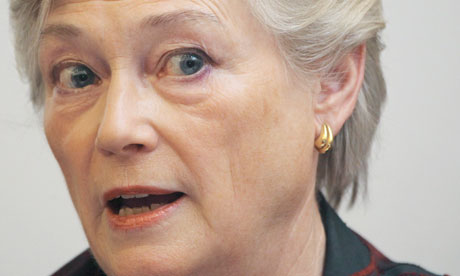
    • Maria van der Hoeven, executive director of the International Energy Agency, IEA

      Maria van der Hoeven, executive director of the International Energy Agency, whose latest report is damning of governments across the world. Photograph: Haruyoshi Yamaguchi/Getty Images

      Governments are falling badly behind on low-carbon energy, putting carbon reduction targets out of reach and pushing the world to the brink of catastrophic climate change, the world’s leading independent energy authority will warn on Wednesday.

      The stark judgment is being given at a key meeting of energy ministers from the world’s biggest economies and emitters taking place in London on Wednesday – a meeting already overshadowed by David Cameron’s last-minute withdrawal from a keynote speech planned for Thursday.

      “The world’s energy system is being pushed to breaking point,” Maria van der Hoeven, executive director of the International Energy Agency, writes in today’s Guardian. “Our addiction to fossil fuels grows stronger each year. Many clean energy technologies are available but they are not being deployed quickly enough to avert potentially disastrous consequences.”

      On current form, she warns, the world is on track for warming of 6C by the end of the century – a level that would create catastrophe, wiping out agriculture in many areas and rendering swathes of the globe uninhabitable, as well as raising sea levels and causing mass migration, according to scientists.

      Van der Hoeven, whose deputy will present the IEA’s findings to the Third Clean Energy Ministerial, put the blame squarely on policymakers, and challenged ministers to step up.

      She said: “The current state of affairs is unacceptable precisely because we have a responsibility and a golden opportunity to act. Energy-related CO2 emissions are at historic highs, and under current policies, we estimate that energy use and CO2 emissions would increase by a third by 2020, and almost double by 2050. This would be likely to send global temperatures at least 6C higher within this century.”

      The prime minister has caused controversy because a planned “keynote” speech for Thursday at the meeting – which would have been his first on green issues since being elected – has been scaled back to only a few introductory remarks at a round table meeting.

      “The speech was a planned and much-anticipated major intervention, so his decision not to deliver it is a massive failure of leadership,” said David Nussbaum, chief executive of WWF-UK, the group that took Cameron on his famous “husky-hugging” trip to the Arctic in 2006. “Now, with his government’s approach to climate and energy policy in disarray, people are asking where the prime minister stands on these key issues.”

      Energy experts speculated he was unwilling to make a long public appearance in front of the press during a what has been a torrid few weeks.

      In its report, Tracking Clean Energy Progress, the IEA, widely regarded as the gold standard for energy research, ranked progress on 11 key low-carbon indicators, including renewables, nuclear energy and carbon capture and storage. It found the world was on track to meet just one of these targets.

      Some technologies that governments have been relying on to reduce emissions – such as carbon capture and storage – were not even off the ground yet, despite years of development.

      To meet the carbon cuts that scientists calculate are needed by 2020, the IEA says, the world needs to generate 28% of its electricity from renewable sources and 47% by 2035. Yet renewables now make up just 16% of global electricity supply.

      On carbon capture and storage, the picture is even worse: the world needs nearly 40 power stations to be fitted with the technology within eight years, and so far none at all have been built.

      Plans for new nuclear plants have been affected by last year’s nuclear accident at Fukushima, Japan, and expectations for atomic energy capacity in 2025 have been scaled back by 15%.

      That shortfall will have to be made up elsewhere, such as by further increases in renewables, if the world is to avoid temperature increases of more than 2C above pre-industrial levels – the limit of safety, scientists say, beyond which climate change becomes catastrophic.

      There were some bright spots on the low-carbon energy scene, the IEA said – “mature” renewable technologies, such as onshore wind, hydro-electricity and solar panels, were broadly on track.

      However, the capacity for some of these technologies is limited – most of the best locations for hydroelectricity in many countries are already in use, for example. The world urgently needed to bring forward other technologies, such as offshore wind, if the targets were to be met, one of the report’s authors said.

      Energy efficiency is the most cost-effective way to cut emissions and increase energy security, but businesses and governments were failing to invest in it, the report found. Progress was also slow on electric vehicles and more efficient cars, while of the coal-fired power stations being built, about half continued to use old inefficient technology instead of more modern designs.

      The ministers meeting on Wednesday are expected to discuss international co-operation on low-carbon energy, and ways of encouraging businesses to invest in the infrastructure needed.

      Van der Hoeven said: “The ministers meeting this week in London have an incredible opportunity before them. It is my hope that they heed our warning of slow progress, and act to seize the security, economic and environmental benefits that the clean energy transition can bring.”

  • Major Volcano Eruptions Could Stymie Hurricanes

    Major Volcano Eruptions Could Stymie Hurricanes
    Our Amazing Planet
    Eruptions of very large volcanoes can reduce the number and intensity of hurricanes in the Atlantic Ocean for as long as the next three years, a study suggests. The study, published last month in the Journal of Geophysical Research, looked at the
    See all stories on this topic »