Author: admin

  • The Perils of Apocalyptic Thinking

    News 3 new results for PEAK-OIL
    Peak oil spells bad news for input costs
    Farm Weekly
    PEAK oil may force farmers to change the way they farm and where they export, according to Sydney University Agriculture and Environment senior lecturer Dr Lindsay Campbell. Mr Campbell believes farmers will face an increase in the price of chemicals,
    See all stories on this topic »
    Home Run for Peak Oil
    Raise the Hammer
    By Andrew McKillop Today, more than the recent past, the peak oil denial industry is making heroic efforts at sidelining peak oil by describing it as controversial. Calling it controversial is an effective way of discrediting the concept, and ignoring
    See all stories on this topic »
    The Perils of Apocalyptic Thinking
    The Atlantic
    Talking about climate change or peak oil through the rhetoric of apocalypse may make for good television and attention-grabbing editorials, but such apocalyptic framing hasn’t mobilized the world into action. Most of us are familiar with the platitude
    See all stories on this topic »
  • Small variations in magnetic fields can be environmental stresses

    ScienceDaily: Earth Science News


    Small variations in magnetic fields can be environmental stresses

    Posted: 23 Apr 2012 03:42 PM PDT

    We are surrounded by a constantly changing magnetic field, be it Earth’s or those emanating from devices, such as cell phones. Scientists are interested in understanding how these magnetic-field fluctuations change biochemical reactions inside us.

    Diversity aided mammals’ survival over deep time

    Posted: 23 Apr 2012 03:41 PM PDT

    The first study of how mammals in North America adapted to climate change in “deep time” found that families with greater diversity were more stable and maintained larger ranges than less diverse families.

    Climate change may create price volatility in the corn market

    Posted: 22 Apr 2012 10:49 AM PDT

    Corn, America’s No. 1 crop, could see its prime growing region shift to the Canadian border or its price volatility increase sharply within 30 years. A new study points to climate change as the cause.
    You are subscribed to email updates from ScienceDaily: Earth Science News
    To stop receiving these emails, you may unsubscribe now.
    Email delivery powered
  • Mechanism that gives plants ‘balance’ discovered

    Mechanism that gives plants ‘balance’ discovered

    Posted: 23 Apr 2012 01:24 PM PDT

    Researchers have figured out how plants are able to make the “decision” between growth and defense, a finding that could help them strike a balance — keep safe from harm while continuing to grow.
    You are subscribed to email updates from ScienceDaily: Severe Weather News
    To stop receiving these emails, you may unsubscribe now.
    Email delivery powered by Google
    Google Inc., 20 West Kinzie, Chicago IL USA 60610
  • Volcano behind Atlantis legend re-awakens

    Volcano behind Atlantis legend re-awakens
    msnbc.com
    The volcano that may have given rise to the legend of Atlantis has awakened, researchers say. The cataclysmic eruptions at the Greek isle of Santorini about 3600 years ago that spewed forth about 9.5 to 14.3 cubic miles of lava devastated the ancient
    See all stories on this topic »

  • First look at Sydney’s new six slice toaster

    The cult of ugliness.  Check out the comments on this. On the Telegraph website.

    First look at Sydney’s new six slice toaster

    4
    The Toaster

    Source: The Daily Telegraph

    The Toaster

    The original Toaster building at Circular Quay during construction. Picture: Bob Finlayson Source: The Daily Telegraph

    < Prev

    1 of 2

    Next >

    IT’S the last remaining site in Sydney’s iconic East Circular Quay precinct – now a storm is brewing over a proposal to build what has been dubbed by angry opponents as the “Toaster on steroids”.

    The proposal has been slammed by groups including the Heritage Council of NSW, which claims it could detract from the Opera House.

    The site, next to the Cahill Expressway, is owned by finance giant AMP, which now wants to knock down the existing building and replace it with 100 luxury apartments.

    Concept plans reveal AMP wants to take over public land to maximise the development’s size, and also make the complex up to seven storeys higher than is currently allowed for new buildings in East Circular Quay.

    The City of Sydney council has not objected to the proposal – despite the fact it breaches the council’s own planning controls.

    However the final decision will be made by the NSW Department of Planning, and not the council, due to its size.

    The site is metres from the Bennelong Apartments building – nicknamed the Toaster – which millions walk past every year on their way to the Opera House. Construction of the Toaster in the 1990s caused a massive stir because it was seen as an eyesore.

    Ian Walters, a 25-year Quay resident, is one of many upset locals: “The ordinary person’s view from The Rocks would show the proposed AMP building towers above neighbouring buildings like a sore thumb. It’s like the Toaster on steroids.”

    The Heritage Council is also worried, claiming the proposal could “have a detrimental impact on the setting of the Sydney Opera House”.

    It argued the development should be “limited to the permissible height limit” for East Circular Quay.

    AMP and building partner Mirvac justified the supersized proposal on the basis they would build a “colonnade” for pedestrians.

    The walkway would be built on council land, with AMP using the expanded airspace above the colonnade to build several floors of apartments.

    And, while City of Sydney rules restrict the height of any new building to about 44m, AMP’s concept plans propose a height of up to 20m taller.

    Town planner Briony Mitchell, who has been working with concerned residents, said AMP wanted to “have its cake and eat it too”.

    “AMP wants to construct a tower development well in excess of the height agreed to in the early 1990s by then prime minister Paul Keating in consultation with the community, Australia’s finest designers and all levels of government,” she said.

    “However, AMP is also trying to benefit from concessions made at the time to compensate companies for the height restrictions.”

    The mandatory height limits were hammered out when the Toaster was being built after Mr Keating took a personal interest in ensuring any new high-rise developments did not detract from views of the Opera House.

    A NSW Planning Department spokesperson said it was waiting on AMP’s response to submissions, adding: “Once this is received and the department has completed its assessment report, the application will be determined under delegation by either the department or independent Planning Assessment Commission.”

    An AMP spokeswoman said: “We are not proposing to build any higher than the existing building and so the development would not have any further impact on surrounding buildings.”

    The Toaster – opera or gothic horror?

    IT started with an ideas quest in the early 1990s by Sydney planning authorities who were looking to “guide the future development of all privately-owned land at East Circular Quay”.

    Not surprisingly, developers wanted buildings on the land to be as high as possible to capitalise on its spectacular location. If the developers had their way, the “Toaster” could have been seven storeys higher than it is today. Enter the then-PM Paul Keating, who was determined to ensure high-rise buildings did not compete with the architectural splendour of the Opera House

    Keating hammered out an 11th-hour agreement with everyone involved to lower the heights of any redeveloped buildings in East Circular Quay, in exchange for giving them more public land to allow them to widen. Although the Toaster became widely derided, Keating later said it could have been much worse. “You know that building today, with seven more storeys on it, would really be a shocker,” he said.

    The only building in East Circular Quay not redeveloped since was the Amatil building owned by AMP, now the subject of a new controversy amid claims it will simply be an enlarged Toaster.


    65 comments on this story

  • Shell Nigeria oil spill ’60 times bigger than it claimed’

    Shell Nigeria oil spill ’60 times bigger than it claimed’

    As the company faces a lawsuit by residents, an assessment by a US oil spill consultancy casts doubt on Shell’s estimate of the Nigerian leak

    • guardian.co.uk, Monday 23 April 2012 17.46 BST
    • Article history
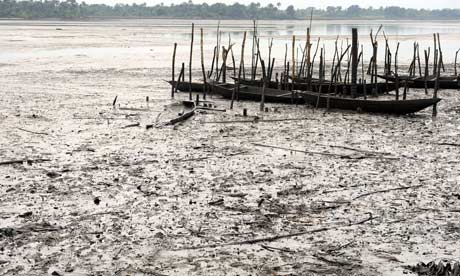
    • Fishing boats lie abandoned in oil-polluted water near Bodo, Nigeria.

      Several years on … fishing boats lie abandoned in oil-polluted water near Bodo, Nigeria. Photograph: Pius Utomi Ekpei/AFP/Getty

      A Shell oil spill on the Niger delta was at least 60 times greater than the company reported at the time, according to unpublished documents obtained by Amnesty International.

      According to Shell, the 2008 spill from a faulty weld on a pipeline resulted in 1,640 barrels of oil being spilt into the creeks near the town of Bodo in Ogoniland. The figure was based on an assessment agreed at the time by the company, the government oil spill agency, the Nigerian oil regulator and a representative of the community.

      But a previously unpublished assessment, carried out by independent US oil spill consultancy firm Accufacts, suggests that a total of between 103,000 barrels and 311,000 barrels of oil flooded into the Bodo creeks over the period of the leak. Accufacts arrived at the figure following analysis of video footage of the leak taken at the time by local people. This suggested that between one and three barrels of oil were leaking every minute. A similar method was used by spill assessors to gauge the scale of the BP Deepwater spill underwater in the gulf of Mexico in 2010.

      “The difference is staggering: even using the lower end of the Accufacts estimate, the volume of oil spilt at Bodo was more than 60 times the volume Shell has repeatedly claimed leaked,” said Audrey Gaughran, director of global issues at Amnesty International.

      “All oil spill incidents are investigated jointly by communities, regulators, operators and security agencies,” said a Shell spokeswoman in London. “The team visits the site of the incident, determines the cause and volume of spilled oil and impact on the environment, and signs off the findings in a report. This is an independent process – communities and regulators are all involved. This is the process that was employed with the two spills in question, and we stand by the findings [of 1,640 barrels].” Shell has argued the community prevented the company being allowed near the pipeline to repair it.

      The amount of oil spilled by Shell at Bodo will be key to a high court case expected to be heard in London later in 2012. Shell is being sued by nearly 11,000 Bodo inhabitants, who say their lives were devastated by the spill which destroyed their fishing grounds, caused long-lasting ill health and polluted fresh water sources. The community, represented by the London law firm Leigh Day, is thought to be seeking more than $150m (£93m) to clean up the creeks, which, even four years after the spill, remain coated in oil.

      Oil spill compensation in Nigeria is based largely on the amount of oil spilt. But negotiations over the Bodo spill broke down earlier in 2012 in London when the gap between what Shell was offering and what the community wanted could not be bridged. Neither party can agree on when the 40-year-old pipeline started to leak.

      In a letter to Amnesty International, Shell wrote: “The court will decide what the volume of the spill was. We suggest you might be better to wait for the authoritative view on the volume of the spill and publish at that stage rather than risk misleading the public with Accufacts estimate.”

      But this was dismissed by Amnesty’s Gaughran: “Even if we use the start date given by Shell, the volume of oil spilt is far greater than Shell recorded. More than three years after the Bodo oil spill, Shell has yet to conduct a proper cleanup or to pay any official compensation to the affected communities. After years of trying to seek justice in Nigeria, the people of Bodo have now taken their claim to the UK courts.”

      “The evidence of Shell’s bad practice in the Niger delta is mounting,” said Patrick Naagbanton, co-ordinator of the local oil watch group Centre for Environment, Human Rights and Development (CEHRD). “Shell seems more interested in conducting a PR operation than a cleanup operation. The problem is not going away; and sadly neither is the misery for the people of Bodo.”

      Amnesty and CEHRD have repeatedly called for an independent process to investigate oil spills in Nigeria, and an end to the system that allows oil companies to have such influence over the process.

      • This article was amended on 23 April 2012 to correct the reference to the amount of oil flooding into the Bodo creeks.