Author: admin

  • Italy floods prompt fears for future of farming

    Italy floods prompt fears for future of farming

    Experts blame warming ocean and climate change for rash of storms that farmers fear risk Italian signature crops

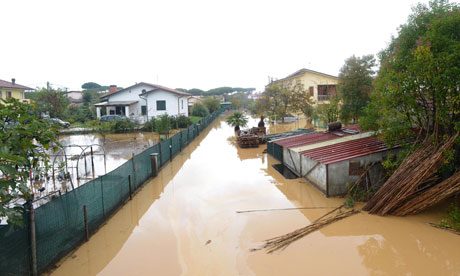
    Floods in Tuscany

    The floods reach Romagnano, Massa, Tuscany. Photograph: Riccardo Dalle Luche/EPA

    The floods that have devastated Italy over the past week could become even more severe in the future, threatening food production and destroying the country’s natural beauty, experts warn.

    Storms have battered ancient towns and left large swaths of farmland in Tuscany under water, prompting a warning from the region’s governor, Enrico Rossi, that “climate change is making us get used to ever more violent flooding“.

    Three people were found dead on Tuesday after their car fell from a collapsed bridge near Grosseto, while the town of Albinia was under two metres of water. As army units were called in to help locals evacuate, towns in neighbouring Umbria were also put on alert and sections of the main road linking north and south Italy were blocked by water. On Monday a 73-year-old man was drowned in his car by rising floodwaters near the walled town of Capalbio, with residents evacuated near Cortona, the setting for the novel Under the Tuscan Sun. Much of the rich farmland of the Maremma had become a lake of mud.

    In Venice water levels were receding after the city’s sixth-worst flooding since records began in 1872.

    Leading Italian meteorologist Mario Giuliacci said: “The Mediterranean has warmed up by 1C to 1.5C in the last 20 years, meaning that Atlantic weather fronts passing over it absorb more vapour and more heat, which means more energy. And that means ever more violent storms and more rain when the fronts hit Italy.

    “An average of 80mm of rain should fall in Italy in November. In the last 40 years it has gone over 100mm 11 times, seven of which are since 1999,” he added.

    Giuliacci said the lower pressure brought by the storms was producing stronger winds. “The Scirocco wind which blew north up the Adriatic this week prompted the unexpected high water which swamped Venice,” he said. The sea level rose by 149cm in Venice on Sunday, flooding 70% of the city.

    Italy is getting increasingly used to disastrous flooding. In 2010, 150,000 livestock were drowned by floods in the Veneto region. In 2009, 31 people were killed by floods and mudslides in Messina in Sicily, while six died last year when floods surged through Genoa.

    Floods have also been blamed on the number of illegally built homes in Italy which block water courses and prevent natural drainage.

    However, a clear pattern of climate change is emerging, and affecting Italy’s agricultural output, an official from Italy’s farmer’s lobby, Coldiretti, said.

    “This year Sicily produced its first crop of bananas, while oil is now being made from olives grown in the foothills of the Alps,” he said.

    “The Italian climate, with ever drier summers and violent rains in the winter, looks set to become more like north Africa than, say, France,” added Giuliacci.

    A hot, arid summer this year, followed by the floods, has ensured that more traditional Italian produce, which finds its way into kitchens around the world, is increasingly scarce, said Coldiretti.

    Italy’s wine harvest dropped 6% to a 40-year low, while the apple harvest was down by 22%, pears by 13%, chestnuts by 50% and honey by 25%. Production of flour destined for making pasta dropped by 12%.

    Said Coldiretti: “The risk is the increase of imports of ingredients pretending to be made in Italy, like Chinese tomato concentrate and Tunisian extra virgin olive oil.”

  • Abuse victims sceptical of Pell’s royal commission response

    Pells of ” POPULATE OR PERISH’ Fame, It has also been stated that the Catholic Church will hide behind its Confessional Box Privacy provisions in the Royal Commission when questioned.

    i

    Abuse victims sceptical of Pell’s royal commission response

    By Samantha Donovan and staff, ABCUpdated November 13, 2012, 8:36 pm

    Some of the victims of sexual abuse by the clergy do not believe the Archbishop of Sydney’s statement that the Catholic Church has learnt the error of its ways.

    In the wake of the Prime Minister’s decision to call a royal commission into institutionalised child abuse, Cardinal George Pell today said he believed many claims involving the church were .

    “We are not interested in denying the extent of misdoing in the Catholic Church. We object to it being exaggerated,” he said.

    “We object to it being described as the only cab on the rank.

    “We acknowledge simply with shame the extent of the problem and I want to assure you that we have been serious in attempting to eradicate it and deal with it.”

    The leader of Australia’s most powerful Roman Catholic diocese said he would cooperate with the nationwide inquiry, but told reporters the church had improved its processes in dealing with abuse allegations.

    “I have just been attempting to explain [over] the past 16 to 20 years, we have addressed [the issue], these are adequate procedures,” he said.

    “Nobody has written to me saying this procedure is inadequate or that procedure is inadequate.

    “What we have had is general smears like, with due respect, I suggest you are making that we are generally inefficient, that we’re covering up, we’re moving people around.

    “Where that is done it’s against the protocols.”

    The Melbourne response

    But in Victoria, some are still critical of the so-called Melbourne Response, which Cardinal Pell set up to handle complaints in the late 1990s.

    Cardinal Pell confirmed again today he had accompanied paedophile priest Gerald Ridsdale to his court hearings several years ago.

    But he said he did not realise at the time the impression this would give to victims.

    Ridsdale, from the Wimmera region in western Victoria, was jailed in 1993 after admitting he abused more than 20 children.

    In 2006, the priest was sentenced to an extra 13 years in prison after he pleaded guilty to further charges.

    Melbourne man Stephen Woods was 14 when he was raped by Ridsdale.

    Mr Woods listened to Cardinal Pell’s comments with interest and told ABC radio’s PM program: “He seems to be setting up a narrative that the Catholic Church is now the victim, that they are the ones who are just one of many assaulters in the society.

    “Yet I can’t think of any other organisation that has had so many, even though there are many clergy, but they have had so many paedophiles.

    “And of course, tens of thousands of victims.”

    ‘Failed systems’

    Cardinal Pell said the Melbourne Response had been “very well regarded” by many.

    But that is not Mr Woods’s impression.

    “Working for (support group) Broken Rites we’ve had cause to come across a lot of people who have said that the Melbourne Response, as well as the Towards Healing, are both very failed systems,” he said.

    “They offer very small amounts of compensation and they are very lawyer-intense and very legalistically concerned.

    “So people have very often come out of it just feeling far more assaulted.”

    Mr Woods believes the Catholic Church is not responding well to news of the royal commission.

    “They still don’t get it. They just still don’t get it because I think they are afraid because so many bishops over the years have been so culpable of so many crimes, particularly cover-ups, that I think they are afraid of what’s going to come out,” he said.

    ‘No smear campaign’

    Chrissie Foster’s two daughters were raped by their parish priest when they were in primary school.

    “(Cardinal Pell) was saying there was a smear campaign against the church and there’s not a smear campaign at all,” she said.

    “People are merely telling the truth and trying to be heard about their experience with the Catholic Church; the abuse in the first instance and then the treatment from the Catholic Church, and the hierarchy and the processes after that.”

    Ms Foster was particularly struck by Cardinal Pell’s insistence that the seal of confession is “inviolable”.

    She believes it is one of the big issues for the royal commission to consider.

    “I know he was insistent on it not being looked at, but I think there needs to be mandatory reporting within the confessional about child sexual assault,” she said.

    “This canon law is the law of a foreign state, the Vatican. How can a foreign state law overrule our civil laws in Australia to protect our Australian children?

    “My daughter suicided. My other daughter binge drunk and then got hit by a car.

    “She received 24 hours care. And all the care Emma had up until she died; the church didn’t pay for that.”

    The Federal Government has released information for those who want to provide information that may be considered by the royal commission, which is likely to begin in early 2013.

  • Undersea gas leaks off Israel’s coast discovered

    Undersea gas leaks off Israel’s coast discovered

    Posted: 12 Nov 2012 06:59 AM PST

    Most of the efforts in Israel’s energy field are being directed at gas buried deep under the Mediterranean seabed. Now a new geophysical study, the first of its kind in Israel, has uncovered a system of active gas springs in the Haifa Bay seabed, at relatively shallow depths, only a few dozen meters below the surface. The study describes the entire system, from its sources under the sea floor through the natural springs emerging from the seabed.

    Scientists unravel the mystery of marine methane oxidation

    Posted: 12 Nov 2012 06:05 AM PST

    Researchers have uncovered how microorganisms on the ocean floor protect the atmosphere from methane.
    You are subscribed to email updates from ScienceDaily: Oceanography News
    To stop receiving these emails, you may unsubscribe now.
    Email delivery powered b
  • Giant pandas threatened by climate change

    Giant pandas threatened by climate change

    Global warming will wipe out much of the bamboo on which the bears rely for food, according to a new study

    A giant panda lying in bamboo

    The research, published in the journal Nature Climate Change, focused on the Qinling Mountains in Shaanxi Province, which is home to around 275 wild pandas. Photograph: guardian.co.uk

    Giant pandas could be left hungry and struggling to survive by global warming, scientists have warned.

    A new study predicts that climate change is set to wipe out much of the bamboo on which the bears rely for food.

    Prime panda habitat in China could be completely lost by the end of the century, say the researchers.

    Human development adds to the threat by blocking the bears’ access to places where bamboo is less affected by rising temperatures, they point out.

    “We will need proactive actions to protect the current giant panda habitats,” said lead researcher Mao-Ning Tuanmu, from Yale University in the US.

    “We need time to look at areas that might become panda habitat in the future, and to think now about maintaining connectivity of areas of good panda habitat and habitat for other species.”

    The research, published in the journal Nature Climate Change, focused on the Qinling Mountains in Shaanxi province, which is home to around 275 wild pandas. The animals make up around 17% of the entire wild giant panda population.

    Qinling pandas have been isolated for thousands of years due to a long history of human habitation around the mountain range. Their restricted range makes them particularly vulnerable to the loss of food resources.

    Bamboo, which carpets the forest floor where the pandas live, is the sole item in the bears’ diet and also provides essential food and shelter for other animals.

    The plant’s unusual reproductive cycle limits its ability to adapt to climate change. One species studied by the scientists only flowers and reproduces every 30-35 years.

    Tuanmu’s team assessed how three dominant bamboo species were likely to fare in the Qinling Mountains as the climate warmed.

    Even the most optimistic forecasts predicted major bamboo die-offs by the turn of the century.

    Conservation efforts should now aim to protect areas that have a better chance of supplying pandas with food, despite climate change, said the scientists. Natural “bridges” could also be created to help the pandas escape from a bamboo famine.

    Co-author Jianguo Liu, from Michigan State University in the US, said: “Understanding impacts of climate change is an important way for science to assist in making good decisions.

    “Looking at the climate impact on the bamboo can help us prepare for the challenges that the panda will likely face in the future.”

  • Transport Minister Anthony Albanese flies through flak over second airprt

    Transport Minister Anthony Albanese flies through flak over second airprt

    2
    Airport event

    Source: The Daily Telegraph

    THE chief public servant in charge of Sydney aviation says Badgerys Creek is the best option for a new airport – contradicting the position of his boss, Transport Minister Anthony Albanese.

    While Mr Albanese has backed a new hub being built at Wilton, Brendan McRandle, the general manager of Sydney aviation capacity for the Department of Transport and Infrastructure, who helped pen the 3200-page study with the state government on Sydney Airport options, has voiced support for Badgerys.

    The revelation comes as NSW Treasurer Mike Baird was slapped down by Premier Barry O’Farrell and fellow Liberal MPs over his backing of a fourth and fifth runway on reclaimed land in Botany Bay.

    Cronulla MP Mark Speakman warned Mr Baird he faced “the mother of all battles” if he pressed ahead with the plan, which would affect Mr Speakman’s electorate and nearby Kurnell.

    Mr McRandle said his report had clearly shown Badgerys was the best option and indicated the Sydney Airport expansion would cost more than the $5.2 billion estimated.

    “At the end of the day Badgerys Creek was the best option but if the government wasn’t prepared to go to Badgerys, (they ought to) go to Wilton,” he said.

    Mr Albanese has rejected Badgerys, 40km west of Sydney, largely because it is near a number of marginal state and federal seats.

    Of the Sydney expansion proposal, Mr O’Farrell said he was not interested in paying for more runways and called on the federal government to lift the cap on movements at Kingsford Smith to make the most of existing infrastructure.

    Mr Baird’s comments set off a war of words with colleagues. In a letter to the Treasurer, Mr Speakman wrote: “The proposal is reminiscent of what your father Bruce Baird vigorously opposed when MP for Cook. Of course, location of airports is ultimately a federal decision. But have no doubt I will lead the mother of all battles against this if you attempt to promote this ridiculous idea.”

    Mr O’Farrell yesterday rejected the idea: “I understand the joint study looked at that matter, didn’t recommend it, but they’re ultimately matters for the Commonwealth. I don’t have dollars – either $5 billion or $11 billion – to build another runway, even if I wanted to. Any dollars I have will go to state infrastructure.”

    Mr O’Farrell also backed away from his previous support for expansion of Canberra Airport and the building of a high-speed rail link as a second Sydney Airport option.

    Instead he suggested the federal government could lift the restriction on 80 landings an hour at Kingsford Smith.

    “I’m saying … the state government policy on aviation infrastructure hasn’t changed. Let’s maximise Kingsford Smith, maintaining the curfew,” he said.

    “International aircraft in particular have reduced noise significantly and if that provides an opportunity to increase capacity, that’s a good thing. Having rules in place that pretend you’re driving a 1970s V8 and not a Toyota environmentally-friendly car today makes no sense.”

    But Mr Albanese refused to consider lifting the cap on flights, saying an increase of five an hour would only generate an extra year’s capacity at Sydney Airport.

    The Daily Telegraph understands Mr Albanese’s push for Wilton, 60km southwest of Sydney, is doomed to fail. State and federal sources yesterday said they expected a study on Wilton due to report next year would show major environmental problems.


    4 comments on this story

  • Pell accuses press of exaggerating Catholic abuse

    How could the seriousness of this be exaggerated.


    Pell accuses press of exaggerating Catholic abuse

    Ben Atherton, ABCUpdated November 13, 2012, 7:18 pm
    Not the principal culprits : Cardinal George Pell speaking in Sydney today

    ABC © Enlarge photo

    Archbishop of Sydney George Pell has accused the press of a “persistent campaign” against the Catholic Church in the wake of Julia Gillard’s decision to call a nationwide inquiry into institutionalised child abuse.

    Speaking to reporters in Sydney this afternoon, Cardinal Pell said the church would “of course” cooperate with the royal commission, which will look into cases of abuse in the church and in other bodies.

    But he said he looked forward to statistics showing what percentage of abuse cases the church was responsible for, saying it was not the “principal culprit”.

    “What is important for the press and the public to realise is that because there is a persistent press campaign against the Catholic Church’s adequacies and inadequacies in this area, that does not necessarily represent the percentage of the problem that we offer,” he said.

    “In other words, that because there is a press campaign focused largely on us, it does not mean that we are largely the principal culprits.

    “We are not interested in denying the extent of misdoing in the Catholic Church.

    “We object to [the extent of misdoing] being exaggerated, we object to being described as the only cab on the rank.”

    Cardinal Pell, Australia’s most senior Catholic cleric, said he would appear before the royal commission if summoned, saying he, like “every other Catholic priest or bishop”, would “comply with the law” because “we’ve got nothing to hide”.

    And he said he did not believe the public was cynical about the church’s moves to combat sexual abuse.

    “I don’t think there is widespread cynicism. I think it’s in the press. I think the general public certainly understand that we’re serious about this,” he said.

    He described claims that “the church is covering up, the church has done nothing” as “general smearing”.

    Asked if cover-ups were still going on within the church, he said: “I can’t be absolutely sure.

    “I would be very confident that it’s not general. One reason is because of our education programs, because we’ve been getting out into all our parishes and schools that these are the procedures to follow, that there is an obligation to inform police of allegations, and that people should do that.”

    Cardinal Pell showed reporters a booklet entitled Sexual Abuse which he said contained the church’s procedures for dealing with abuse cases.

    Yesterday, the Australian Catholic Bishops Conference said that “talk of a systemic problem of sexual abuse in the Catholic Church is ill-founded and inconsistent with the facts” and Cardinal Pell echoed that sentiment today.

    “The Catholic bishops of Australia have welcomed the royal commission which was announced by the Prime Minister last night,” he said.

    “We think it’s an opportunity to help the victims, it’s an opportunity to clear the air, to separate fact from fiction.”

    He said he had spoken to both Ms Gillard and to Opposition Leader Tony Abbott “over the last few days” but said he had not spoken to the Pope since the royal commission was announced.

    “[Ms Gillard] just called me up to tell me what she was going to do,” he said.

    “She said this wasn’t an anti-Catholic move, but more general, and I said I acknowledge that and I said I wasn’t surprised that it wasn’t anti-Catholic, and I was grateful for that.”

    Confession ‘inviolable’

    Cardinal Pell is at odds with NSW Premier Barry O’Farrell on the sanctity of the confessional box when it comes to admissions of child abuse.

    Cardinal Pell says the seal of confession is inviolable, but Mr O’Farrell has told State Parliament that was a position he personally found hard to support.

    “I heard Cardinal Pell today indicate that the bonds of the confessional will remain intact,” he said.

    “I understand that as a Catholic, not a particularly good Catholic, that is an important sacrament within my church.

    “But I struggle to understand that if a priest confesses to another priest that he’s been involved in paedophile activities, that that information should not be brought to police.”

    Mr O’Farrell has indicated NSW may drop its inquiry into clergy sex abuse in the Hunter Valley if the royal commission announced by the Prime Minister addresses the allegations raised by Detective Chief Inspector Fox.