Author: admin

  • Rising power prices prompt call for overhaul

    Rising power prices prompt calls for overhaul

    Updated April 08, 2012 16:29:31

    There are increasing calls to overhaul Australia’s electricity sector as electricity prices skyrocket and governments try to reduce carbon emissions.

    A massive $45 billion over five years is being spent to upgrade and maintain the network, and that cost is being passed onto the consumer.

    Because it is based on burning coal, the electricity network is Australia’s biggest polluter, producing one third of national carbon emissions.

    Experts say one of the problems is that power companies do not have a financial incentive to stop people using so much energy.

    RMIT Adjunct Professor Alan Pears says Australia has to reduce electricity demand at all times of the year.

    “The rules of the energy market need to change in a pretty serious way so that energy networks have a financial incentive to help people to save energy rather than to get them to use more,” he said.

    “We have examples in other parts of the world where energy networks are paid on a different basis and are paid to achieve societal outcomes rather than a very simplistic economic model.”

    One of those examples is what is known as an energy savings initiative.

    New South Wales, Victoria and South Australia have already introduced versions of this system and the Federal Government is investigating a national system.

    The system works by a government setting a yearly energy savings target for electricity retailers.

    Those retailers can then choose which way they will reduce the amount of electricity they sell.

    Erwin Jackson, the deputy head of the Climate Institute, supports the scheme.

    “Effectively what it is doing is giving an incentive for an AGL or an Origin to go out and work with a company like Harvey Norman to get energy efficiency appliances into someone’s house, whether they be a solar hot water system, a more efficient fridge, more insulation,” he said.

    For example, electricity retailers can organise a bulk buy of solar hot water heaters, and then sell them to customers cheaper than other outlets.

    Changing incentives

    Mr Jackson says a trading system is at the heart of energy savings initiatives. He says the best known example being used at a state level is replacing old inefficient light bulbs.

    Every company that sells low-energy light bulbs can earn a credit for every tonne of carbon they abate. Those credits are called white certificates, and they are worth money.

    A light bulb company can sell its white certificate to a big electricity retailer, so that retailer can meet its energy savings target.

    Mr Jackson said it changes the way electricity companies make money.

    “You’re trying to create value or a price around energy efficiency,” he said.

    “At the moment the incentive is for a company to go out and sell more electricity so they can actually go out and make more money.

    “What you’re trying to do with something like a white certificate scheme is create a financial value on energy efficiency so they have an incentive to go away and save energy.”

    If an electricity retailer fails to meet its target, it gets fined.

    “So there is a direct financial penalty if they don’t,” Mr Jackson said.

    Australia’s biggest infrastructure project

    Electricity sector reform could help reduce bills by cutting the amount power companies must spend on network maintenance and upgrades.

    By law, electricity companies must provide enough power to meet even the highest demand.

    Energy expert Chris Dunstan is a research director at the Institute for Sustainable Futures at the University of Technology, Sydney.

    He says more poles, wires and generation facilities are being built because of very short periods of very high demand, “typically on a hot summer’s day where there’s a lot of air conditioning running or on a cold winter’s day when people have got their electric heaters on.”

    He says three-quarters of everyone’s electricity bills are swallowed by what is now Australia’s biggest infrastructure project.

    “People focus on the National Broadband Network but that is only about $36 billion over an eight-year period,” he said.

    “So the electricity network infrastructure spending is much greater and over a short period of time than the NBN.”

    Jon Jutsen, who heads an energy consultancy called Energetics, calls it is a ridiculous situation.

    “Electricity consumption (for) maybe 40 hours in the year is driving a whole investment program to supply that need,” he said.

    Incorporating the customer

    Mr Justen said electricity companies need to work much harder to reduce the periods of peak demand.

    “What can be done in the future is to incorporate the customer into this whole equation,” he said.

    “We don’t have to have a system which says we will invest and supply every need that we perceive that the customer is going to have.

    “We can go back to the customer and say, how can we provide you with an incentive, or provide you with technological support, so that you can reduce your peak demand and improve your energy efficiency so we will have less infrastructure to build to supply you.”

    Some electricity companies are already paying big energy users to reduce their power needs at times of peak demand.

    “For example, rock-crushing businesses don’t need to crush 24 hours a day,” Mr Dunstan said.

    “Even simple things like having controllers on air conditioners that can keep the fan running but interrupted for a few minutes every hour the compressor that is providing the chilling function.

    “That can have a significant impact on reducing peak demand overall, but have a minimal impact of any impact on comfort.”

    But Mr Dunstan said governments also need to intervene, and put a target on the network to reduce peak demand, with regular reporting against those targets.

    Australian governments are now investigating a national energy saving scheme, incorporating the state systems.

    Federal Government modelling shows the drop in electricity demand under a national energy savings initiative could save $12 billion in infrastructure costs.

    But the Government has not yet committed to the scheme.

    Parliamentary secretary for energy efficiency Mark Dreyfus says the Government is consulting.

    “So often when you are dealing with state control matters it is impossible to put a clear end date or timeline,” he said.

    Listen to Di Martin’s full story on energy efficiency which aired on Radio National’s Background Briefing.

    Topics:electricity-energy-and-utilities, industry, business-economics-and-finance, environment, environmental-policy, australia

    First posted April 08, 2012 06:48:19

  • The Other Arab Spring

    Alert Name: CLIMATE CHANGE NEWS
    April 8, 2012 Compiled: 1:32 AM

    By THOMAS L. FRIEDMAN (NYT)

    Environmental pressures, not just political and economic ones, stirred change in the Mideast.

    About This E-mail


    You received this e-mail because you signed up for NYTimes.com’s My Alerts tool. As a member of the TRUSTe privacy program, we are committed to protecting your privacy.


  • Asbestos, the outlawed fibre with a licence to kill

    Asbestos, the outlawed fibre with a licence to kill

    April 08, 2012

    Bernie Banton

    TONNES of asbestos-contaminated materials are being illegally dumped across the state, exposing current and future generations to the deadly fibres.

    Rogue dumpers, commercial contractors and home renovators are putting lives at risk as they dodge costly disposal fees.

    An investigation by The Sun-Herald has established that 80 clean-up notices – a third of all the notices issued by the NSW Environmental Protection Authority in the past five years – have been for illegal or improper asbestos disposal.

    A group of professional waste transporters became so fed up with rogues in their industry that they organised undercover surveillance – shown above – to follow trucks working for a company they suspected of illegal dumping. Their investigator followed and filmed one truck until it illegally dumped waste at Maroota, north-west of Sydney.

    Their surveillance was handed to the Western Sydney Regional Illegal Dumping Squad – better known as the RID Squad – and resulted in the offenders being caught, fined and forced to clean it up. But many offenders are never caught.

    When broken down, asbestos dust fibres can be carried in the air and, if breathed in, can cause the deadly lung disease mesothelioma, asbestosis or lung cancer.

    More below

    “There are people who are not even born yet that will come down with asbestos-related diseases because of this,” warns Barry Robson, president of the Asbestos Diseases Foundation of Australia. “It should have stopped by now.”

    But it hasn’t, and Mr Robson calls it a “time bomb”.

    In the past year asbestos has been found in:

    • Garden mulch sold to residents by Bega Valley Shire Council
    • A thousand tonnes of contaminated sand that was spread across a sporting oval at Rockdale. The culprit could not be identified so it was cleaned up at the council’s expense;
    • Skip bins across Sydney;
    • Kerbside pick-ups for recycling;
    • Garden sheds and under homes;
    • A 30,000-tonne pile dumped on a private property at Mangrove Mountain on the Central Coast.
    • Stockpiled and buried on Norfolk Island properties because of a lack of funding to take it off the island.
    • Backyards, often rising to the surface. Asbestos removalists say this is a particular problem on the Central Coast, where waste from demolished asbestos homes is often buried on site. One 80-year old woman, who asked not to be named, told The Sun-Herald she had been pulling pieces of asbestos fibro out of her garden in Gosford for years.

    In an operation late last year, the RID Squad’s investigators and EPA officers covertly tracked vehicles dumping waste illegally in eight locations across Sydney’s west. Asbestos was found at three of the sites.

    The state government does not keep central records that can analyse or track asbestos dumping offences. The Sun-Herald manually trawled through the EPA’s clean-up notices to determine how many related to asbestos and found the number of dumpings on the increase, at least on private properties.

    There have been 35 notices issued since January last year. But there are no systems in place to tally dumpings on public land. However, the RID Squad, formed in 1999 by the state government and seven councils to fight illegal dumping, estimates it has investigated about 150 cases involving asbestos in the past year.

    More below

    “For the government not to have at hand the extent of illegal dumping is reckless,” says the Greens environment spokeswoman Cate Faehrmann.

    In the past five years the EPA has launched 11 prosecutions against seven defendants with $230,900 in fines issued and 450 hours of community service ordered. There are 16 charges of illegal dumping of asbestos currently before the Land and Environment Court.

    Criminal proceedings have also begun against a consultancy, Aargus Pty Ltd, which allegedly provided false reports claiming a property was asbestos-free. It is yet to enter a plea.

    Tony Khoury, from the Waste Contractors & Recyclers Association of NSW, said the single biggest factor behind the illegal dumping of asbestos – whether it is a home renovator or a rogue operator – is the high price of disposal. Tipping fees alone are between $200 and $400 a tonne, but removing an average asbestos roof can cost about $45 a square metre – amounting to as much as $5000. The state government needed to subsidise the cost so “price is not a disincentive to public safety”, Mr Khoury said.

    The Cancer Council’s spokesman, Terry Slevin, also called for incentives for people to do the right thing.

    The effects of asbestos have long haunted NSW, the first place in Australia to begin mining asbestos. In 2010 the NSW Ombudsman, Bruce Barbour, issued a report, “Responding to the asbestos problem; the need for significant reform in NSW”. He said the “amount of asbestos remaining in NSW is immense”.

    The Asbestos Diseases Research Institute, in its 2010/11 annual report, said 700 Australians were diagnosed that year with mesothelioma and 1500 with lung cancer caused by asbestos. It predicts the number will continue to rise, as the disease can take decades to develop. Mr Barbour estimated about 200,000 tonnes of asbestos-contaminated waste is being properly sent to landfill each year. But waste industry sources estimate that at least twice that amount is being illegally dumped.

    Last year a company owned by the Dial a Dump entrepreneur Ian Malouf’s wife, Larissa, was ordered to clean up a stockpile of 170,000 cubic metres of asbestos-contaminated waste at its Alexandria property.

    1 2 3 Next

  • Nuclear google alerts

    Google Alert – DANGER TO US NUCLEAR PLANTS

    Inbox
    x

    Google Alerts googlealerts-noreply@google.com
    10:19 AM (5 minutes ago)

    to me
    News 7 new results for DANGER TO US NUCLEAR PLANTS
    US Defines Its Demands for New Round of Talks With Iran
    New York Times
    WASHINGTON — The Obama administration and its European allies plan to open new negotiations with Iran by demanding the immediate closing and ultimate dismantling of a recently completed nuclear facility deep under a mountain, according to American and
    See all stories on this topic »
    US regulators promise thorough San Onofre nuclear plant review
    Times LIVE
    The head of the Nuclear Regulatory Commission promised a thorough review Friday of suspect tubing at the troubled San Onofre nuclear plant, but he left open the possibility that one of the twin reactors could be restarted more quickly.
    See all stories on this topic »

    Times LIVE
    Goodspeed Analysis: Middle East could collapse into full conflict if
    National Post
    An Israeli pre-emptive strike against Iran’s nuclear program will probably begin with a rain of Jericho missiles obliterating the heavy water plant in Arak and destroying four small nuclear research reactors at the Nuclear Technology Center in Isfahan.
    See all stories on this topic »

    National Post
    Could nuclear help birth the hydrogen economy?
    TG Daily
    New nuclear plants could be adapted to make hydrogen for fuel, an Austrian scientist told the world’s largest scientific society. At last month’s annual meeting of the American Chemical Society, Ibrahim Khamis, Ph.D., said that scientists and
    See all stories on this topic »
    Tepco’s Cheapskate Tactics Put World at Risk
    Dissident Voice
    4 An accident to the fuel pool could set off a chain of events involving “a total of 1760 metric tons of fresh and used nuclear fuel” among the six reactors at the disaster site. 5 According to Takao Yamada, Expert Senior Writer at the Mainichi Daily
    See all stories on this topic »
    Will Japan Follow Germany’s Path to Green Energy?
    Miller-McCune.com
    Depending on green energy will be harder for Japan than Germany, which currently generates 23 percent of its electricity with nuclear power. Japan was able to turn off its nuclear plants without blackouts due to emergency energy-saving programs and use
    See all stories on this topic »

    Miller-McCune.com
    Fish Off O.C. Coast May Have Ingested Radioactive Kelp After Fukushima, Study
    Patch.com
    The Fukushima Daiichi Nuclear Plant, damaged by an earthquake and tsunami on March 11, 2011, released large amounts of a radioactive iodine into the atmosphere, which was assimilated into the kelp canopy sampled from coastal California.
    See all stories on this topic »


    Tip: Use a minus sign (-) in front of terms in your query that you want to exclude. Learn more.

    Delete this alert.
    Create another alert.
    Manage your alerts.

  • North Sea gas leak” plug plan gets green light

    North Sea gas leak: plug plan gets green light

    Intervention given go-ahead after inspection of leak on Elgin platform, about 150 miles off Aberdeen

    • guardian.co.uk, Friday 6 April 2012 20.40 BST
    • Article history
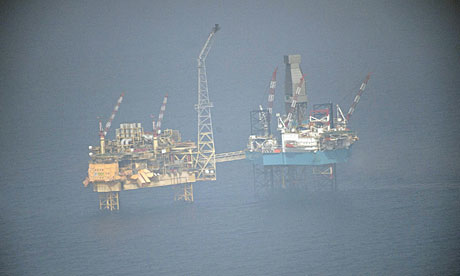
    • Total's Elgin platform in the North Sea

      Total’s Elgin platform in the North Sea, which was evacuated nearly two weeks ago. Photograph: Handout/Reuters

      Plans to “kill” a gas leak on an offshore platform by pumping mud into it can go ahead, experts said on Friday.

      A team inspected the leak on the Elgin platform about 150 miles off Aberdeen to decide how best to stop the leak. No one had been back to the platform since the leak forced its evacuation nearly two weeks ago.

      The inspection confirmed gas was leaking from the well head but not from underwater, so intervention could proceed as planned. A spokesman for Wild Well Control said: “Everything went as we would have hoped and the planned well intervention is achievable.

      The team of specialists flew out to the platform on Friday and spent four hours on the installation. They carried out a preliminary survey of the leak area, established zones which can be safely accessed and gathered data.

      Three Total employees and five specialists from Wild Well Control, a specialised well intervention company, took off from Aberdeen at 10.30am and landed on the platform before safely returning to Aberdeen shortly before 5pm.

      Plans are also still progressing for the drilling of a relief well, as well as a back-up relief well.

      Meanwhile, an environmental impact assessment of the gas leak has also got under way.

      The newly-established Environment Group, chaired by Marine Scotland, is to assess and monitor the impact of the leak. Marine Research Vessel Alba na Mara has begun work collecting and analysing environmental samples.

  • ATMOSPHERIC WATER GENERATOR (REPEATED)

    Atmospheric water generator

    From Wikipedia, the free encyclopedia

    An Atmospheric water generator (AWG), is a device that extracts water from humid ambient air. An AWG operates in a manner very similar to that of a refrigerated dehumidifier: air is passed over a cooled coil, causing water to condense. The rate of water production depends on the humidity, the volume of air passing over the coil, and the machine’s capacity to cool the coil.

    The device is very useful for locations where pure drinking water is difficult to obtain or impossible to have, as there is always water in the air. NB (Can be powered by solar or wind power)


    Variations of this device have been used by the US Army to provide fresh drinking water for troops because of of the cost of flying fresh water in. They were usually mounted on trailers and powered by diesel fuel.


    Collecting water from the air has been a practice for some 2,000 years, in the form of “air wells” in Middle Eastern deserts, and later in Europe. Around the 1400s, we see water-collecting Dew Ponds, and later the Fog Fences, which have for hundreds of years have been used in Europe to collect clean water from the air. In the early 1970s, Melvin Littrell began producing water from the air with a system that did not need a compressor. Through this development, the creation of the first real Atmospheric Water Generator was produced. In 1990, Littrell patented the system’s technology as an AWG or atmospheric water generator.

    They are available in various sizes and styles, ranging from domestic systems that produce 32 oz. a day to all-electronic units producing 75 liters per day with compressors, and finally to commercial applications that can produce from 35,000 to 109,000 gallons of water each day.

    [edit] Principle of operation

    The principle of operation remains similar for most manufacturers except the WPG. The AWG is essentially a conventional dehumidifier that condenses water from air. A compressor circulates refrigerant through a coil or chiller array. A controlled-speed fan pushes air over the water reaction area and condenses the water. This water is then passed into a holding tank.

    The rate at which water can be produced depends on relative humidity and ambient air temperature and altitude. Relative humidity is the amount of water vapor present in the air at a given temperature at a given time. AWGs become more effective as relative humidity and air temperature increase. As a rule of thumb, AWGs do not work efficiently when the temperature falls below (35°F), the relative humidity drops below 40%, or at high altitudes (above 4000 feet). If the ambient air has passed through an air conditioner, much of the water vapor has already been removed. In the winter, with a heater on, most of the humidity is lost, leaving little for the AWG to produce.

    [edit] Optional AWG features

    AWG features vary depending on the manufacturer. In order to meet stringent FDA standards and NSF, most systems are coupled to one or more advanced filter systems (including an UV light chamber) before being stored in stainless-steel holding tanks. A list of optional features typically found in AWG systems would include:

    • An air filter to help prevent dirt from accumulating on the surface of the coil
    • An automatic level switch placed in the generator’s holding tank to shut the machine off when the tank is full
    • Hot and cold stainless-steel storage tanks that allow water to be served heated or chilled
    • The so-called “split system” is a two-part system. Designed by Prof. James D. Vagarasoto in 1991, the two-part system allows the user to place the generator in a location of high humidity and serve as a tabletop unit that dispenses hot or cold water. These systems eliminate the adverse effects of most older-style atmospheric water generators, as they heat the area where the generator is placed. In the summer, air conditioning system remove most of the humidity, so the conventional AWGs don’t work very well because they are humidity-driven.


    Last Updated ( Thursday, 11 June 2009 12:20 )