Author: admin

  • Green News Roundup ( The guardian)

    Green news roundup: Drought-hit fish, carbon capture and Rick Perry

    The week’s top environment news stories and green events

    If you’re not already receiving this roundup, sign up here to get the briefing delivered to your inbox

    Fish rescue teams on the river Rye 3/4/12

    Fish rescue teams on the river Rye near Helmsley. Photograph: Mark Pinder

    Environment news

    New push for carbon capture and storage with £1bn competition
    David Cameron to make keynote environment speech
    Rescue squads sent in to save drought-hit fish
    Rick Perry criticises UK initiative to influence US climate sceptics
    Multinationals vow to boycott APP after outcry over illegal logging

    On the blogs

    Bike blog : Woman mountain biker cycling across extreme terrain in bright sunlight

    Is the UK right to invest in carbon capture technology?
    How women can stop cycling from being a pain in the arse
    The Arctic Sunrise plays a game of bluff and counter bluff
    Nuclear and gas blow outs show where the dumb money is

    Multimedia

    Carbon Trust Footprinting Gallery Exhibition

    The Carbon Trust’s footprinting exhibition – in pictures
    Satellite eye on Earth: March 2012 – in pictures
    Earth Hour plunges global landmarks into darkness – video
    A guide to carbon capture technologies – interactive
    • The week in wildlife – in pictures

    Features and comment

    Is the EU taking its over-fishing habits to west African waters?
    Photographing bees offers a great insight into their fascinating world
    Connie Hedegaard: ‘Polluter pays’ is the only principle that can limit aviation emissions
    Dustin Benton: New plans for carbon capture must not repeat mistakes of the past
    •  Andrew Simms: Cut the country some slack and introduce national gardening leave

    Best of the web

    Yale Environment 360: Bill McKibben on Keystone XL and the power of fossil fuel industry
    EurActiv: EU carbon target threatened by biomass ‘insanity’
    BusinessGreen: Ford Focus Electric will use ‘build-to-order’ sales model
    For more of the best environment comment and news from around the web, visit the Guardian Environment Network.

    …And finally

    Earth Hour watched over from space as the lights go out
    The event had live commentary from space as landmarks from the Eiffel Tower to the Sydney Opera House switched off their lights

    • SKY_Int_Dev_Awards_030512
    • Email Services


    You are receiving this email because you are a Green Light subscriber.

    Click here if you do not wish to receive Green Light emails from the Guardian News and Media.
    Click here to find out about other Email Services from the Guardian.

    Guardian News & Media Limited – a member of Guardian Media Group PLC. Registered Office: Kings Place, 90 York Way, London, N1 9GU. Registered in England No. 908396

  • The cost of blunting peak oil

    ws 2 new results for PEAK-OIL
    The cost of blunting peak oil
    SmartPlanet.com (blog)
    By Mark Halper | April 3, 2012, 12:41 PM PDT The notion of “peak oil” says that the world’s rate of oil production will hit a permanent decline, if it hasn’t already. It’s one compelling reason why we’re supposed to pursue alternative fuel sources,
    See all stories on this topic »
    Gulf in Oil Prices May Set Up Market for a Fall
    Wall Street Journal
    The theory of “peak oil“—that world oil production has topped and supply is steadily depleting— helped push the price of Brent crude to a record $147.50 a barrel in 2008. But many have abandoned the theory, as new technology, such as hydraulic
    See all stories on this topic »


    Tip: Use a minus sign (-) in front of terms in your query that you want to exclude. Learn more.

    Delete this alert.
    Create another alert.
    Manage your alerts.

    Reply
    Forward
  • EU carbon target threatened by biomass ‘insanity’

    EU carbon target threatened by biomass ‘insanity’

    Renewable energy targets are driving tree-cutting for biomass energy – and may cause Europe to miss its 2020 carbon target

    • guardian.co.uk, Monday 2 April 2012 13.43 BST
    • Article history
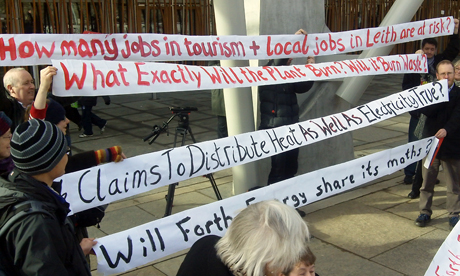
    • Leith's anti-biomass campaigners outside the Scottish Parliament | picture: Michael MacLeod, guardian.co.uk

      Anti-biomass campaigners in Scotland. A rush to biomass energy to meet renewable energy targets could actually increase carbon emissions, EU officials warn. Michael MacLeod, guardian.co.uk

      The EU’s emissions reduction target for 2020 could be facing an unlikely but grave obstacle, according to a growing number of scientists, EU officials and NGOs: the contribution of biomass to the EU’s renewable energy objectives for 2020.

      On 29 March, a call was launched at the European Parliament for Brussels to reconsider its carbon accounting rules for biomass emissions, and EurActiv has learned that the issue is provoking widespread alarm in policy-making circles.

      “We’re paying people to cut their forests down in the name of reducing greenhouse gas emissions, and yet we are actually increasing them. No-one is apparently bothering to do any analysis about this,” one Brussels insider told EurActiv.

      “They’re just sleepwalking into this insanity,” he added.

      Around half of the EU’s target for providing 20% of energy from renewable sources by 2020 will be made up by biomass energy from sources such as wood, waste and agricultural crops and residues, according to EU member states’ national action plans.

      Wood makes up the bulk of this target and is counted by the EU as ‘carbon neutral’, giving it access to subsidies, feed-in tariffs and electricity premiums at national level.

      But because there is a time lag between the carbon debt that is created when a tree is cut down, transported and combusted – and the carbon credit that occurs when a new tree has grown to absorb as much carbon as the old one – biomass will increase atmospheric CO2 concentrations in the interim.

      “It is wrong to assume that bio-energy is ‘carbon neutral’ by definition, it depends what you replace it with” Professor Detlef Sprinz, a scientist with the European Environmental Agency (EEA) told EurActiv.

      “If you replace a growing forest by energy crops under the current accounting rules of the EU, you may very well increase greenhouse gas emissions.”

      A report last September by the EEA, argued that “legislation that encourages substitution of fossil fuels by bioenergy, irrespective of the biomass source, may even result in increased carbon emissions – thereby accelerating global warming.”

      The Intergovernmental Panel on Climate Change (IPCC) also says that biomass can only be considered carbon neutral if all land use impacts have been considered first.

      The EU is aware of the issue and a proposal that could impose binding criteria for biomass for energy production, delayed many times, had been expected later this year but may be delayed again.

      Forest-rich Scandinavian countries oppose binding biomass criteria – Finland and Sweden produce 20% and 16% of their energy from biomass – while industrial interests tend to support criteria that ignore combustion emissions and carbon stock losses from burning wood.

      Sustainability criteria are one climate area in which the US leads Europe. The Environmental Protection Agency there has already conducted a public consultation on how to account for emissions from biomass burning, and submitted a legislative proposal.

      Several EU officials spoken to by EurActiv expressed despair at the lack of enthusiasm for tougher accounting rules by the EU’s energy directorate, which holds the biomass portfolio.

      “I don’t think they have any intention of considering the carbon emissions from wood combustion. They are not convinced that it’s an important enough issue,” one said.

      Asked whether the current pattern of biomass production and use would prevent a 20% reduction of carbon emissions by 2020, he replied “the certainty is 100% because there is hardly any [wood-based] biomass that wouldn’t increase emissions. The question is for how long?”

      There are no reliable accounting figures measuring the length of time that Europe will suffer a ‘carbon deficit’ caused by the use of biomass for energy, in particular harvesting timber for that.

      But “the risk of having emissions for too long I think is very high,” the official said. “I see a very significant risk that we will increase emissions for several decades to come.”

      There is consensus that when a carbon deficit extends beyond 30-50 years, it is no longer of use in the EU’s present strategy to decarbonise Europe by 2050.

      One report last month by the US-based Southern Environmental Law Center using woody biomass for a modelled expansion of power generation, found that it would take 35-50 years to provide an ongoing carbon reduction benefit.

      Biomass from composted waste or agricultural residues is a highly efficient way of reducing carbon emissions, but critics say that the EU has vague and ill-conceived definitions of what constitutes residue in many cases.

      It does not, for instance, take into account the impact that removing crop residues such as straw can have in depleting the soil’s carbon stock, with resulting increases in fertiliser and irrigation use, and lower yields.

      Equally, a felled tree instantly produces wood with a higher carbon footprint than coal because burning a 100-year-old tree will release all the carbon it has absorbed into the atmosphere, and it its replacement will take 100 years to reabsorb the same amount of carbon.

      The EU’s current accounting rules do not distinguish between residues or woods used in this way, and more sustainable biomass, terming them both ‘carbon neutral’ without consideration of bio-recovery times .

      “These calculations have just not been done,” an EU source told EurActiv. “No one has looked at this in sufficient seriousness.”

      Positions

      The debate around biomass has split the environmental movement along unexpected lines. Claude Turmes, the vice-chair of the Green Party in the European Parliament, was instrumental in negotiating the original Renewable Energy Directive, which included biomass. He told EurActiv that the debate around carbon accounting rules was “not black and white”.

      “If you don’t take trees out of a forest at a certain moment, the carbon balance will stabilise and even become negative so removing some trees does not damage the overall capacity of the forest to capture CO2. Of course we are also promoting cascade-using, so we should use stems for furniture and paper and pulp and use the byproducts of tehse for production and energy. That is already the case today and should be improved.”

      “You have to bear in mind that if wood is replacing coal then it can have a more positive CO2 contribution because new trees fix carbon again,” he went on. “Burning stems should however stay the exception. Cascade use of biomass is where the EU has to go to.”

      But another Green MEP, Bas Eickhout, had a different take. “There are good scientific reasons to distinguish between infinite renewable sources – like wind and solar and hydro on the one hand – and biomass, which is like fossil fuels but on a shorter rotation time,” he told EurActiv. “It makes good sense to distinguish between the two and with the renewables target, we’re dedicating half to biomass which isn’t thought through.”

      But Filip de Jaeger, the secretary general of the European Confederation of Woodworking Industries echoed many of Turmes points. “We have a principle of cascade use, where you first use the wood for products and then have a reuse or recycling phase because you can use old wood material for biomass,” he said. “It is only at the end of their lifecycle that the energy is then released so the timespan of use is much longer.”

      “I wouldn’t argue that you always have a strong carbon debt risk,” he continued. “It also depends on the soil and the way that the logging is being done. In some cases we have a situation where growing [older] trees that no longer continue storing carbon [is less effective] that growing new ones in younger plantations that will pick up more carbon from the atmosphere. So it is not a black and white situation.”

      Ariel Brunner, the head of EU policy for Birdlife, a conservation organisation disputed Turmes and de Jaeger’s arguments head on. It was “partially true” that mature forests became saturated and stopped absorbing carbon, he said. “But it is beside the point. If you’re moving carbon into the atmosphere faster than you take it out, you’re causing more climate change. Young forests capture carbon at a faster rate than older ones, but older forests have more carbon locked into them. That’s what matters.”

      The EU was not properly promoting cascade use either he said. “We think that cascade use is absolutely crucial but it is only happening very, very partially through EU legislation which is poorly implemented,” he explained. “We are seeing a lot of energy production from virgin forests and a lot of paper or wood waste is not being recovered or recycled. There has actually been a decrease in separate collections of organic waste and more going into incineration and landfill.”

      Replacing coal with wood caused a problem in terms of “the length of the carbon debt,” he added. “We all agree that if you replace coal with bio-energy, you’ll get a benefit in the long term – but how long is the long term? If it is five years it is a good idea. If its 500 years, it is making things worse. If it is 30 years, we can have a discussion, but we have to reduce emissions in the coming three to four decades, anything more than that is a big problem.”

  • Shifting foundations threaten to undermine China’s cities

    Shifting foundations threaten to undermine China’s cities

    Urban growth and depletion of groundwater blamed for land subsidence in Shanghai and elsewhere

    • Guardian Weekly, Tuesday 3 April 2012 13.59 BST
    • Article history
    • China financial district

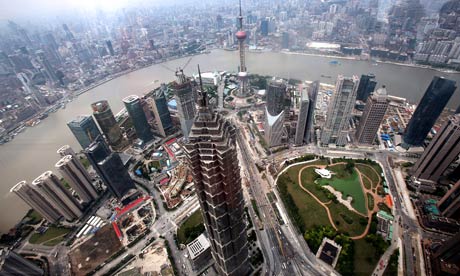
      Sinking feeling … a view from the the Shanghai World Financial Centre in 2008. The 492-metre tower will be dwarfed by the 632-metre Shanghai Tower, due for completion in 2014. Photograph: STR/Getty

      A crack in the tarmac on a road in the middle of the Pudong business district told Shanghai residents that the subsoil of their city was shifting. It was not so much the size of the rift – about eight metres long and only a few centimetres across – more its location that caused concern. It was at the foot of the Shanghai Tower project.

      Due for completion in 2014, the tower will stand 632 metres high, and is just next to two other giants, the World Financial Centre and Jinmao Tower, rising, respectively, 492 and 420 metres into the air.

      The appearance of cracks in the ground and the publication of photographs on blogs have fuelled questions in recent weeks. “The surface cracks, which were caused by a usual settlement of the foundation ditch, are in a controlled and safe state,” the Shanghai Tower Construction and Development Company said in a statement to the China Daily.

      The problem of subsidence in Chinese cities is nevertheless very real. “The pressure exerted by skyscrapers is a minor cause,” says Li Qinfen, a researcher at the Shanghai Institute of Geological Survey. Excessive pumping of groundwater to service new urban developments is the key factor.

      The crack in the road has rekindled an old story, which claims that Shanghai is gradually sinking. The centre of China’s business capital has subsided by 2.6 metres since 1921, when the first surveys were carried out. The city stands on the Yangtze river delta, which rests on a layer of sediment, consisting mainly of clay and about 300 metres thick. After studying data from various surveys Dr Jin-Chun Chai, a professor at Saga University in Japan, concluded in a scientific journal: “The field data shows that there is a strong correlation between the rate of net groundwater pumping and the rate of land subsidence.”

      Shanghai’s average annual subsidence from 1921 to 1949 was 2.5cm, according to official data. With increasing depletion of groundwater reserves the rate rose to 10cm a year in 1957-61. From 1966 onwards measures to restrict underground pumping slowed this trend. But in the 1980s, as the economy was opened up, water depletion and subsidence resumed, according to Li.

      Last October, a hole appeared suddenly on a street near the main railway station. Then on 9 March, a 7km stretch of high-speed rail line collapsed in Hubei province. The line was due to open to passenger traffic in May and trials were already under way. A director of the provincial railway construction bureau, Wang Zujian, blamed the “unique local geological structure”.

      According to a recent study by the Institute of Geology and Geophysics, 50 fast-expanding cities are affected by this type of subsidence, mainly due to excessive use of groundwater. The rise in demand is due to people migrating to the cities, to changing patterns of consumption and industrial growth.

      Since the People’s Republic was established in 1949, 79,000 sq km of land has subsided by more than 20cm, above all on the north China plain, in the central mining provinces (Shanxi and Shaanxi), and on the Yangtze delta, according to the authorities. A plan presented in February by the land and resources ministry aims to halt subsidence in all three critical areas by 2015 by limiting water withdrawal. The plan will be applied to the whole country in 2020.

      Shanghai – doomed, according to some observers, to suffer a similar fate to Atlantis – has in fact already taken action to reverse the trend, injecting about 60,000 tonnes of water a year into its aquifers, according to the city council.

      This story originally appeared in Le Monde

  • ScenceDaily: Oceanography News

    ScienceDaily: Oceanography News


    New report on the state of polar regions

    Posted: 03 Apr 2012 04:37 PM PDT

    A new synthesis of reports from thousands of scientists in 60 countries who took part in the International Polar Year (IPY) 2007-08, is the first in over 50 years to offer a benchmark for environmental conditions and new discoveries in the polar regions.

    Amount of coldest Antarctic water near ocean floor decreasing for decades

    Posted: 03 Apr 2012 12:38 PM PDT

    Scientists have found a large reduction in the amount of the coldest deep ocean water, called Antarctic Bottom Water, all around the Southern Ocean using data collected from 1980 to 2011.

    Coral links ice sheet collapse to ancient ‘mega flood’

    Posted: 03 Apr 2012 10:55 AM PDT

    Coral off Tahiti has linked the collapse of massive ice sheets 14,600 years ago to a dramatic and rapid rise in global sea-levels of around 14 meters.
    You are subscribed to email updates from ScienceDaily: Oceanography News
    To stop receiving these emails, you may unsubscribe now.
    Email delivery powered by Google
    Google Inc., 20 West Kinzie, Chicago IL USA 60610
  • ScienceDaily: Severe Weather News

    ScienceDaily: Severe Weather News


    U. S. Temperatures hit record highs in March

    Posted: 03 Apr 2012 12:35 PM PDT

    Compared to seasonal norms, March 2012 was the warmest month on record in the 48 contiguous U.S. states. Temperatures over the U.S. averaged 2.82 C (almost 5.1 degrees Fahrenheit) warmer than normal in March.
    You are subscribed to email updates from ScienceDaily: Severe Weather News
    To stop receiving these emails, you may unsubscribe now.
    Email delivery powered by Google