Author: admin

  • On Arctic Sea ice melt and coal mine canaries

    On Arctic Sea ice melt and coal mine canaries

    Despite peak global temperatures in 2005 and 2010 (unprecedented in the instrumental record), a recent sharp plunge in volume of the Arctic Sea ice and a spate of extreme weather events, coal mining, coal exports and carbon emissions continue to grow, overwhelming any mitigation attempted by schemes…

    Author

    Disclosure Statement

    Andrew Glikson is Honorary Professor at the Geothermal Energy Centre of Excellence, The University of Queensland, and a Visiting Fellow at the Australian National University.

    The Conversation

    The Conversation is an independent source of information, analysis and commentary from the university and research sector—written by acknowledged experts, curated by professional editors and delivered direct to the public. read more

    Articles by This Author

    24 February 2012 Is another mass extinction event on the way?30 January 2012 We do need drastic action on climate change: a response to the Wall Street Journal18 January 2012 As emissions rise, we may be heading for an ice-free planet 8 December 2011 Last chance at Durban? The geological dimension of climate change23 September 2011 An Orwellian climate

    Kv97mq2h-1332378179 Melting Arctic Sea ice should be the warning we need about expanding coal exports. Michael Sonnabend

    Despite peak global temperatures in 2005 and 2010 (unprecedented in the instrumental record), a recent sharp plunge in volume of the Arctic Sea ice and a spate of extreme weather events, coal mining, coal exports and carbon emissions continue to grow, overwhelming any mitigation attempted by schemes such as the Australian carbon price.

    And although both – local emissions and emissions from exported Australian coal – are vented into the same atmosphere, in political terms it appears as if they occur on different planets.

    Following the peak El-Niño event of 1998, when mean global temperatures reached +0.45 degrees Celsius above pre-1975 levels, a decline of temperatures during 1999-2000 was heralded as “global cooling”, reversing the rise in mean temperature of about +0.8C since early in the 20th century (see figure 1).

    Unfortunately from 2001 temperatures continued to rise. There were peak temperatures of +0.46C (2005) and +0.47C (2010) in the instrumental record (see figure 1). The 2011 La-Niña year saw the peak temperature of 0.4C higher than all previously recorded La-Niña years.

    The rise in mean global temperature would be about double the above figures, had it not been for the transient masking effects of short-lived sulphur aerosols emitted from fossil fuel combustion. However, with the onset of clean air policies in the 1980s, SO₂ emissions began to decline (see figure 2), which in part explains the sharp rise in temperatures from about 1975-1976 (see figure 1).

    Figure 1: NASA, the US National Climatic Data Centre, and the UK Hadley Centre have each produced global temperature datasets. The graph shows the annual means calculated from the three datasets. Years beginning with an El Niño (orange) and La Niña (blue) are shown. http://www.csiro.au/Outcomes/Climate/Understanding/State-of-the-Climate-2012.aspx

    Click to enlarge

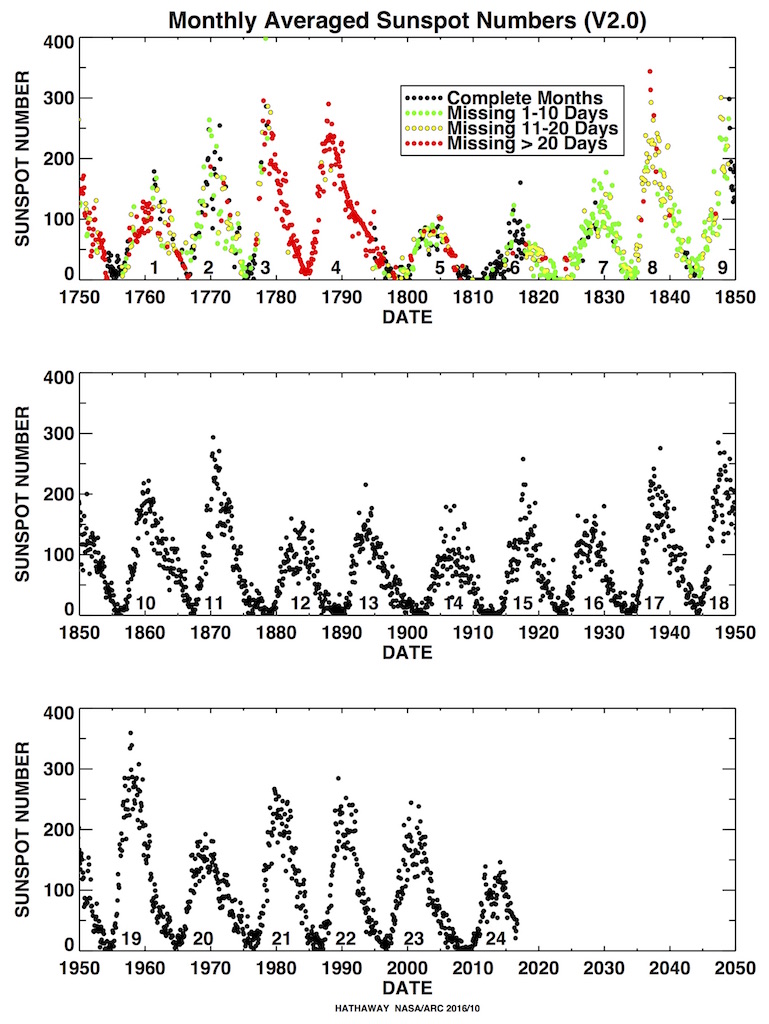
    Factors underlying lower temperatures about 1999-2000 include the resurgence of sulphur emission from industry, in particular in growing economies (China, Middle East, Africa) (see figure 2). The role of the 11 years sun spot cycle is minor, contributing to temperature rise from the mid-1980s (1365.6 to 1366.5 Watt/m2) and to the relatively cool La-Niña dominated period during 2008 (see figure 3).

    Typically the rise in global temperature is amplified in the polar regions by factors up to 4 and 5. Thus, of the parameters reflecting global warming, the state of the Arctic Sea ice is one of the most sensitive, often referred to as the “canary in the coal mine”.

    Figure 2: Global industrial sulphur emissions during 1850 – 2010. www.atmos-chem-phys.net/11/1101/2011/acp-11-1101-2011.pdf

    Click to enlarge

    The opening of a summer open-water ocean in the Arctic, absorbing infrared radiation where the electromagnetic spectrum was previously reflected back to space, is bound to have major implications for the global climate patterns. Since 2009, abrupt steepening of Arctic Sea ice melt rate (see figure 4), has led a group of UK scientists to call for urgent geo-engineering to cool the Arctic.

    Such measures would likely hinge on stratospheric injection of sulphur dioxide from jet planes flying high over the Arctic, increasing atmospheric albedo for relatively short periods on time scales of weeks to months. Sulphur will need to be re-injected over the long term unless and until levels of atmospheric greenhouse gases decline.

    Figure 3: Sun spot numbers between 1950 and 2011. http://solarscience.msfc.nasa.gov/images/Zurich_Color_Small.jpg

    Click to enlarge

    So far as the carbon emissions are concerned, however, business as usual goes on and infrastructure of fossil fuel exploitation continues to be expanded in several parts of the world, including Australia’s coal mining and coal export industry. According to ABARE’s report “Australian coal exports outlook to 2025 and the role of infrastructure” (Table 8 of the report), Australia’s coal exports are due to grow from a total of 306 Million ton coal (MtCoal) in 2012 to 394 MtCoal in 2025. For an average grade of ~80% carbon in high-quality coal, this translates to between 245 MtCarbon in 2012 to 315 MtCarbon in 2025.

    Annual emissions from Australian coal exports were near double the Australian annual carbon emissions during 1990-2008 (~420 to 550 MtCO₂-equivalent per year = 114 to 150 MtCarbon per year) (see figure 2.1 in Australian Greenhouse Emissions Information System).

    Figure 4: Arctic sea ice volume anomaly from PIOMAS updated once a month. Daily Sea Ice volume anomalies for each day are computed relative to the 1979 to 2011 average for that day of the year. Tick marks on time axis refer to 1st day of year. The trend for the period 1979-present is shown in blue. Shaded areas show one and two standard deviations from the trend. Error bars indicate the uncertainty of the monthly anomaly. http://psc.apl.washington.edu/wordpress/research/projects/arctic-sea-ice-volume-anomaly/#

    Click to enlarge

    If local emissions for 2007 (540 MtCO₂ = 147 MtCarbon) (excluding land use-related carbon loss) are combined with 2007 emissions from Australian coal exports (262*0.8 = 210 MtCarbon) (Table 8), the total of ~357 MtCarbon constitutes ~4.5 percent of 2007 global emission of ~7900 MtCarbon. Quadrupling Australia’s coal exports would increase Australia’s total direct and indirect emissions to over 1 billion tons (1 GtCarbon).

    Figure 5: Mouna Loa 1970 – 2012 trends in (A) CO2; (B) Methane; (C) 18O/16O (decreasing – representing relative increase in 16O and thereby rising temperatures), and (D) N2O. http://www.esrl.noaa.gov/gmd/ccgg/trends/

    Click to enlarge

    Compared to total emissions from local combustion and exported coal, Australia’s carbon price – planned to reduce emissions by 5-25% by 2020 relative to 2000 emissions (2000 emissions – 500 MtCO₂ = 136 MtCarbon) – would bring emissions down to 129 or 102 MtC per year, respectively. Such reduction would be cancelled out by the growth in coal exports.

    Global emissions since 1750, totalling 352,000 MtCarbon from combustion and 152,000 MtCarbon from land clearing, have driven atmospheric CO₂ levels to 393 ppm (see figure 5), the highest it has been since the Pliocene some 3 million years ago. Current CO₂ rise rates near 2 ppm CO₂/year are unprecedented in the last 65 million years of geological history.


  • World Nuclear News

    27 March 2012

    NUCLEAR POLICIES: World leaders renew nuclear pledges
    The synergies between nuclear safety and security were highlighted at the 2012 Nuclear Security Summit in Seoul, where world leaders concluded that the right to develop and use nuclear energy for peaceful purposes must not be hampered by measures to strengthen nuclear security.

    NEW NUCLEAR: Sanmen 1 connected to offsite power
    Unit 1 of China’s Sanmen nuclear power plant has been connected to a nearby substation to provide offsite power for testing electrical systems. The reactor is set to begin operating next year.

    CORPORATE: Westinghouse reorganizes its nuclear business
    Westinghouse will split its nuclear power plant business unit into two distinct organizations – one to focus on the delivery of new plant projects to existing customers and the other to develop new plant opportunities globally.

    Copyright © 2012 World Nuclear Association, All rights reserved.
    Our mailing address is:
  • Peak Oil News

    News 4 new results for PEAK-OIL
    Spread Reckoning: US Suburbs Face Twin Perils of Climate Change and Peak Oil
    Infoshop News
    Sprawling metropolitan areas like Merriam, Kans., face fundamental challenges from global warming and the end of easy oil. Most people reading this would probably find Merriam, Kansas, very familiar. Not because they’ve been there, but because it’s a
    See all stories on this topic »
    Less oil from Kharyaga Than Planned – Total
    Oil and Gas Industry Latest News
    Peak oil will be smaller and come later than planned in the Kharyaga project, field operator Total confirms. The French oil major has adjusted its prognosis for the Kharaga field, the company’s asset in the north Russian Timan Pechora province.
    See all stories on this topic »
    Benefiting From $200 Oil
    Seeking Alpha
    Today we are concerned about peak oil because global demand in oil and gas is increasing 3% a year, while production is decreasing 3% a year. There have been tensions with Iran trying to shut down the Strait of Hormuz, which will affect 35% of seaborne
    See all stories on this topic »
    A Closer Look at Portland’s Local Food System
    Neighborhood Notes
    “It looks about as good as you can have it after spreading three yards of compost,” says O’Leary, a Multnomah County employee who is involved with Transition PDX and also helped the City of Portland develop its Peak Oil plan.
    See all stories on this topic »
  • Analyst sees nighmare scenario for labor

    Analyst sees nightmare scenario for Labor

    Peter Martin

    March 27, 2012

    Federal Labor sinks with Queensland

    Julia Gillard is out of the country but she can’t ignore an opinion poll putting Labor’s primary vote barely one point above its state election result

    Labor would be left without a single seat in Queensland if the state voted federally the way it did on Saturday night.

    The ABC’s election analyst, Antony Green, said the numbers point to a federal wipeout for Labor in Queensland, with no seats remaining – not even those of the Deputy Prime Minister, Wayne Swan, the Trade Minister, Craig Emerson, or the former leader Kevin Rudd.

    But he says there is no reason to believe Queenslanders will vote the same way.

    .

    ”People still vote on habit” … Antony Green. Photo: Jacky Ghossein

    “You only need to look at 2001 and 2004. In 2004 Labor got smashed in Queensland federally when Mark Latham was leader, absolutely smashed. Yet earlier that year Peter Beattie won the state election for Labor with a massive landslide.

    “The same people who were giving John Howard huge majorities federally were voting for Bob Carr in NSW and Peter Beattie in Queensland.”

    Green believes Australians increasingly treat state and federal elections differently, with the federal voting intentions much more stable.

    “People still vote on habit, but more and more that’s only evident at federal elections. At state polls you see massive swings.

    “I suspect that’s because state government is about managing things – making sure the trains run on time and roads are built. State governments are rewarded or punished for performance, whereas at the federal level it’s along more ideological lines.”

    The Macquarie University election specialist Murray Goot agrees but says the importance of the Queensland vote is that it shows Labor is not gaining any votes.

    “If one or two independents lose their seats at the next election Labor will need to gain seats in order to survive. It is now extraordinarily difficult to see that happening,” he said.

    Green said if the swing against Labor in Queensland was to be repeated at the federal election Labor would have much more to worry about than Queensland.

    “In 2010 Labor had a swing against it in NSW that didn’t cost it any seats, it had a swing to it in Victoria. If it did lose another 7 or 8 per cent in Queensland at the next federal election it would lose its remaining eight seats, but it would get slaughtered in NSW where many more are held by thin margins.

    “People keep saying the next election could be lost in Queensland. My view is that if it is lost in Queensland it is not going to be lost in Queensland alone.”

    twitter Follow the National Times on Twitter: @NationalTimesAU
    Read more: http://www.smh.com.au/opinion/political-news/analyst-sees-nightmare-scenario-for-labor-20120326-1vupf.html#ixzz1qJlvPEYV

  • Victoria winds back its carbon reduction target

    Victoria winds back its carbon reduction target

    Updated March 27, 2012 20:03:40

    New power stations built in Victoria will not be subject to carbon emissions limits after the State Government decided to scrap the restrictions.

    The former Brumby Government legislated to allow a limit on carbon emissions produced by new power stations and the then Opposition said it would cap emissions at 0.8 tonnes per megawatt hour.

    But the Government has scrapped the restriction after the Commonwealth decided not to go ahead with national standards.

    The Energy Minister Michael O’Brien says the decision will reduce uncertainty for “stakeholders”, including the controversial HRL plant planned for the Latrobe Valley.

    Mark Wakeham of Environment Victoria says the Government has broken an election promise.

    “They’ve torn up every one of their commitments on climate change,” he said.

    The Government has also abandoned its 20 per cent carbon emissions reduction target after a review found it would cost more than $2 billion.

    Labor’s spokeswoman Lily D’Ambrosio says it could pave the way for dirty new power stations in Victoria.

    “The Baillieu Government must explain why they are doing this, why are they now saying that Victoria is open slather for new coal fired power stations no matter how dirty they might be,” she said.

    Topics:environment, environmental-impact, state-parliament, melbourne-3000

    First posted March 27, 2012 18:54:51

  • Nuclear terror threat remains, Obama tells world leaders

    Nuclear terror threat remains, Obama tells world leaders

    Julianna Goldman in Seoul

    March 27, 2012 – 4:56PM

    Barack Obama speaks at the first plenary session of the 2012 Nuclear Security Summit in Seoul.

    Barack Obama speaks at the first plenary session of the 2012 Nuclear Security Summit in Seoul. Photo: AFP/Saul Loeb

    The US President, Barack Obama, has warned global leaders that there are “still too many bad actors” in the world trying to get their hands on nuclear material, which could result in a terror attack that kills large numbers of people.

    “These dangerous materials are still vulnerable in too many places,” Mr Obama said at the opening session of the Nuclear Security Summit in Seoul, which has drawn more than 40 world leaders, including the Prime Minister, Julia Gillard. “It would not take much, just a handful or so of these materials, to kill hundreds of thousands of innocent people and that’s not an exaggeration, that’s the reality that we face.”

    Mr Obama, who inaugurated the first nuclear security summit in Washington DC in 2010, warned against “complacency” in preventing loose nuclear material from getting into the hands of terrorist groups. The legacy of the Soviet Union’s breakup, inadequate atomic stockpile controls and the proliferation of nuclear-fuel technology mean the world has lost precise count of atomic material, which could be used to make a weapon.

    There are at least two million kilograms of stockpiled weapons-grade nuclear material left over from decommissioned bombs and atomic-fuel plants, according to the International Panel on Fissile Materials, a nonprofit Princeton, New Jersey, research institute that tracks nuclear material. That’s enough to make at least 100,000 new nuclear weapons on top of the 20,000 bombs already in weapon-state stockpiles.

    Because a terrorist needs only about 25 kilograms of highly enriched uranium or eight kilograms of plutonium to improvise a bomb, the margin of error for material accounting is small.

    “There is no effective way to deter terrorist groups from using nuclear materials once they have it,” South Korean President Lee Myung-bak said at the opening session. “The most optimal way to prevent nuclear terrorism is to promptly minimise and eventually eliminate excess nuclear materials, which can be used as ingredients for nuclear weapons.”

    A nuclear-armed terrorist attack on the US port in Long Beach, California, would kill 60,000 people and cost as much as $US1 trillion in damage and cleanup, according to a 2006 Rand study commissioned by the Department of Homeland Security. Even a low-level radiological or dirty-bomb attack on Washington, while causing a limited number of deaths, would lead to damages of $US100 billion, according to Igor Khripunov, the Soviet Union’s former arms-control envoy to the US. He is now at the Athens, Georgi, Centre for International Trade and Security. Leaders may pledge tighter controls over nuclear materials to keep them out of the hands of terrorists, according to the draft of a communique to be released today at the end of the meeting. Securing vulnerable nuclear material before the next Nuclear Security Summit in 2014 is the top priority, according to a copy of the six-page working document.

    “The threat remains,” Mr Obama said today. “That’s why what’s required continues to be a serious and sustained effort.”

    Read more: http://www.smh.com.au/world/nuclear-terror-threat-remains-obama-tells-world-leaders-20120327-1vw3r.html#ixzz1qJC7W4FW