Author: admin

  • Queensland Labor in crisis, says Beattie

    Queensland Labor in crisis, says Beattie

    By Paul Osborne, AAP Senior Political Writer, AAPUpdated March 25, 2012, 4:30 pm
    Deposed Qld premier Anna Bligh has called on Labor to pay closer attention to the electorate.

    AAP © Enlarge photo

    Labor stalwart Peter Beattie has declared the 120-year-old party is in “crisis”, as ministers talked down the federal impact of the Queensland election landslide.

    Liberal National Party leader Campbell Newman’s juggernaut reduced the 51-strong Labor team in the Queensland parliament to as few as seven MPs at Saturday’s poll, with former premier Anna Bligh taking the blame and quitting her seat.

    The historic 16 per cent statewide swing to the conservatives has many in the party concerned about the federal poll in 16 months.

    Mr Beattie said rebuilding voter confidence in Queensland, where Labor holds only eight of 30 federal seats, would be critical to Prime Minister Julia Gillard winning the 2013 election.

    “The reality is, the Labor Party’s in crisis,” Mr Beattie told ABC television.

    “We need to have federal ministers pouring through Queensland, we have to spend time selling our policies, Julia needs to buy a house here … or we will face a similar wipe-out.”

    Ms Bligh said Labor nationally needed to heed the message from the election, which followed losses for Labor in NSW, Victoria and Western Australia in the past four years.

    “We simply can’t walk away from the fact that we’ve seen results similar to this in other states of Australia,” she told reporters.

    “It’s tough times for Labor.

    “I do think we have to turn our minds and listen to the electorate and understand that they want us to change.”

    Federal Labor frontbencher Bill Shorten talked down the wider implications, saying it was the Queensland ALP that needed to do the soul-searching.

    “I’ll leave that to the Queensland Labor Party to do,” he told reporters in Melbourne on Sunday.

    “Nationally, I do think it’s important that the government just gets on with the job of governing, that we govern in the interests of all, not just a few.”

    Fellow frontbencher Anthony Albanese dismissed suggestions of federal implications as “spin”, saying Labor had governed in Queensland for 20 out of the past 22 years.

    “Eventually in our political cycles it catches up with you as it did in NSW after 16 consecutive years of government last year,” Mr Albanese told Network Ten.

    Opposition Leader Tony Abbott said it was clear the Labor brand was “toxic”.

    “The only way for the Labor party to recover is to have a good long hard look at itself, to rediscover what it believes in, what it stands for, who it represents and also to regain a bit of political integrity,” Mr Abbott said.

    Former Bligh government minister Stephen Robertson sheeted home part of the blame to Kevin Rudd’s unsuccessful leadership tilt against Ms Gillard, which dominated the first week of the state campaign.

    “The self-indulgence of what Rudd did, knowing that there was an election campaign going on in his home state, in my mind, is unforgivable,” Mr Robertson told ABC Radio.

    Mr Shorten said the federal leadership battle would not have helped Ms Bligh’s chances.

    “I don’t think leadership instability is ever a good look, be it a football club or a political party,” he said.

  • Beijing pollution will take ‘decades’ to clear

    Beijing pollution will take ‘decades’ to clear

    Posted March 25, 2012 14:02:32

    Authorities in Beijing say it will be at least two decades before they can get air pollution under control, after the Chinese capital almost topped a recent list of the world’s most polluted cities.

    The city authorities in Beijing have been stung by a wave of criticism of the accuracy of their pollution figures.

    They are now trying to convince a sceptical public that they have a credible plan to tackle the problem.

    Vice-mayor Hong Feng said the best the city could hope for was to have air pollution under control within the next 20 years.

    He said that would include one of the biggest threats to health – the tiny particles in the air – that until a recent controversy were not even measured by the Beijing authorities.

    The city has released a three-stage plan that includes the removal from the streets of hundreds and thousands of old taxis and new restrictions on the burning of coal.

    BBC

  • Spread Reckoning: US Suburbs Face Twin Perils of Climate change-Peak Oil

    News 3 new results for PEAK-OIL
    Oil Prices In A ‘Peak Oil‘ Environment
    Forex Pros
    By Andrew MacKillop | Commodities | Mar 23, 2012 05:47AM GMT | Add a Comment Peak Oil can be defined at least 4 ways but one way is simple: Peak Oil is when supplies and stocks are enduringly tight relative to demand, and price slides are short but
    See all stories on this topic »
    Spread Reckoning: US Suburbs Face Twin Perils of Climate Change and Peak Oil
    Democratic Underground
    METROPOLITAN WOES: Climate change and peak oil will pose fundamental challenges for metropolitan communities, such as Merriam, a suburb of Kansas City. Image: Flickr / ThirdHandArt Most people reading this would probably find Merriam, Kansas,
    See all stories on this topic »
    We Don’t Consume Resources, We Create Them
    Forbes
    This has implications for huge swathes of the environmental movement and also for certain parts of the Peak Oil theory. Please note that I’m not trying to state, as no economist is, that we do not live on a finite Earth. That there isn’t some limit to
    See all stories on this topic »


    Tip: Use site restrict in your query to search within a site (site:nytimes.com or site:.edu). Learn more.

    Delete this alert.
    Create another alert.

  • Oil firm given go-ahead for Canary Islands drilling

    Oil firm given go-ahead for Canary Islands drilling

    Anger at Spanish government’s decision to allow drilling 60km from Lanzarote and Fuerteventura

    • guardian.co.uk, Tuesday 20 March 2012 13.36 GMT
    • Article history
    • Lanzarote

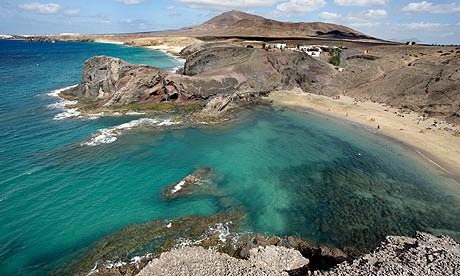
      Playa Papagayo beach in Lanzarote. Opponents of the drilling warn an oil spill would wreck beaches on the islands and drive away tourists. Photograph: B.A.E. Inc./Alamy

      One of Britain’s best-loved holiday destinations is under threat from oil prospectors who have been given permission to drill for offshore fields, according to local authorities and hoteliers in the Canary Islands.

      The area’s authorities have reacted angrily to a Spanish government decision that allows the giant Repsol company to look for oil 60km (37 miles) off the coasts of Lanzarote and Fuerteventura, warning that a spill would wreck beaches and drive tourists away.

      “This is not compatible with the kind of sustainable tourism we want,” said regional prime minister Paulino Rivero, of the Canary Coalition party. “It only benefits Repsol.”

      TUI, owner of Thomson and First Choice holiday brands, has already expressed worries that an oil spill might permanently damage the Canary Islands’ reputation as a holiday spot.

      “A tragedy of this kind would not just ruin a single tourist season, but would see the Canary Islands forever associated with oil,” TUI’s head of sustainability, Harald Zeiss, said in a letter to the island government of Fuerteventura.

      But Spain‘s new conservative government, which gave the go-ahead for drilling, hopes oil and gas fields hidden under the Atlantic seabed will allow it to reduce oil imports.

      “Apart from reducing our almost total dependency on imported gas and petrol, it also has great potential to create highly qualified jobs and benefit the islands’ economy,” a government statement said.

      Repsol would be expected to pay for any clean-up operation caused by an accident, and extraction licences would have to be approved separately. The company claims it would create up to 5,000 jobs.

      Local environmentalists said the only jobs would be for specialists from abroad.

      “This is a threat to the islands’ economy, which is based on tourism, and to a rich source of maritime biodiversity,” said Iván Darias of the Ecologists in Action group. “Both the technology and the depth of the fields they seek are similar to those used in Louisiana in 2010.” Fears over oil spills have increased since the explosion on BP’s Deepwater Horizon rig off the Louisiana coast in 2010 which killed 11 people and released millions of barrels of crude into the Gulf of Mexico.

      “The government is creating the same sort of risks that can lead to accidents like the one seen in the Gulf of Mexico,” agreed Greenpeace spokesman Mario Rodríguez.

      Around 2.6 million British holidaymakers visit the Canary Islands every year.

  • David Attenborough urges business to protect nature from population boom

    David Attenborough urges business to protect nature from population boom

    Corporations have a leading role to play to make sure ‘mankind doesn’t spread willy nilly over every square yard of the globe’, says naturalist

    • guardian.co.uk, Wednesday 18 January 2012 12.16 GMT
    • Article history
    • Crowded beach by the East Pier in Brighton

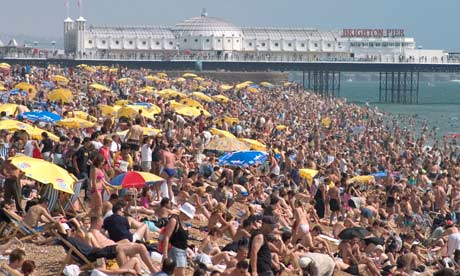
      A crowded beach in Brighton … the earth’s population is expected to reach 9 billion by 2050. Photograph: Paul Carstairs/Alamy

      Sir David Attenborough has called on big businesses to protect the natural world from the rapidly expanding human population.

      The broadcaster and naturalist said the population increase is unstoppable and that action must be taken to stop the natural world from being concreted over.

      Distancing himself from conservationists who regard big businesses as the enemy, he said companies and corporations, as the holders of much of the world’s wealth, have a vital and leading role to play.

      “It’s not a mystery. Wealth empowers,” he said. “And businesses have by no means been slow in helping. We’ve [conservationists] gone to multinationals over and over again.”

      He said there were exceptions, but that for the most part businesses that defiled the natural world in the 19th and to an extent the 20th century, such as by dumping waste in the sea, usually did so out of ignorance. “They didn’t know any better,” he said.

      But he warned: “We’ve got to such a situation and dense population that we can no longer make these mistakes. The warning is clear and the job of people in the media like me is to make sure the warning is understood.”

      The human population is calculated to have reached 7 billion last year, a decade after it reached 6 billion, and is forecast to continue to grow throughout the 21st century. By 2050, it is expected to have passed 9 billion.

      Rising population puts additional pressure on resources, especially food production, and the increased demand has contributed to higher prices.

      Attenborough, speaking at an event in London hosted by law firm Charles Russell for the World Land Trust, a charity for which he is patron, said the UK has already used up all its land and must make effective use of what it has got, such as by redeveloping brownfield sites.

      In other parts of the world, however, he believes there are large tracts of the natural world that can still be protected from development, such as tropical forests, mangrove swamps, bogs and high mountains.

      He said: “Without the natural world, mankind is doomed. We are dependent on the natural world for the very air we breathe and every particle of food we eat. Many people, including me, would say we are dependent on it for our very sanity.

      “We can accommodate that by looking after the natural world and making sure mankind doesn’t spread willy nilly over every square yard of the globe.”

      To save many of these areas from development that would destroy the natural ecosystem and wipe out many species of animals and plants, he called on businesses to help buy the land.

      To avoid criticisms of “neo-colonialism”, he called on them to hand the land over to local organisations that will protect it while providing jobs for people living in the area.

      Attenborough told an audience of lawyers, city investors and business people: “Since I became involved in conservation the population of the world has tripled. Nothing we can do will stop that increase. We may be able to slow it, but stop it in our lifetimes we cannot.”

      He added that in the past the attitude has been simply to move on when a resource is used up: “We’ve been grossly extravagant. We’ve been brought up in the time when if one bit of land is ruined we get another.

      “I think it’s about time we dealt with this in a sensible way and we don’t waste land.”

      • Get the Guardian’s environment news on your iPhone with our new app. You can also join us on Twitter, Facebook and Google+

  • Ireland oil strike raises hopes for exploration boom

    Ireland oil strike raises hopes for exploration boom

    Providence Resources boss Tony O’Reilly Junior said: ‘I think this discovery also creates a reappraisal in the minds of global oil corporations about coming back to Irish waters to drill for oil’

    • guardian.co.uk, Thursday 15 March 2012 15.51 GMT
    • Article history
    • Providence Resources oil rig operating in Barryroe, off County Cork

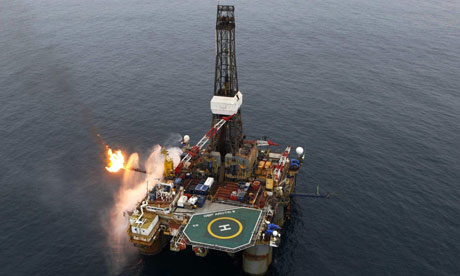
      Providence Resources oil rig operating in Barryroe, off County Cork. The company’s oil is expected to trigger an oil exploration boom in the Republic. Photograph: Finbarr O’Rourke/Providence Reso/PA

      Oil has been struck off the County Cork coast in a potentially multibillion-pound discovery that could help to drag Ireland‘s recession-stricken economy out of the mire.

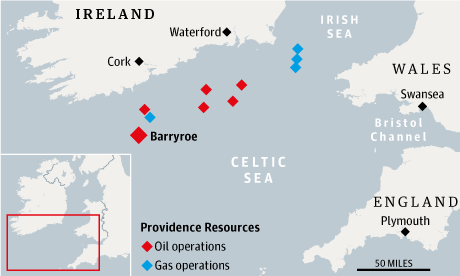
      Dublin-based Providence Resources announced on Thursday that oil has successfully started to flow from its Barryroe well in the first big find in Irish territorial waters.

      The oilfield, which is about 50 kilometres off the Cork coast, has a flow of more than 3,500 barrels a day, a number which exceeds the company’s original projections of 1,800 barrels.

      One recent audit of the area found that it might contain the potential to produce almost 1bn barrels of oil, making the field worth billions at today’s crude prices of well over $100 a barrel.

      The test area off the Cork coast covered 300 sq km, which according to Providence is equivalent to a medium-to-large North Sea oil field. The oil was discovered at a depth of about 100 metres in the sea bed.

      Successful drilling at the Barryroe well will increase pressure on the Irish government to grant permission for oil exploration at five further sites in Irish waters. These include the most controversial site, at Dalkey Island in Dublin Bay, close to an exclusive stretch of the capital’s coastline which is home to Irish rock stars such as Bono and Enya.

      If an oil rig were constructed near the uninhabited island it would be in the line of sight of homes belonging to celebrities on Dublin’s so-called “gold coast”. An alliance of community groups in one of the richest parts of Ireland as well as conservation groups such as Birdwatch Ireland and An Taisce, the republic’s National Trust, are understood to be planning a campaign against the drilling project. The island is home to a seal colony and the waters around it are used for fishing pollock and mackerel as well sea diving.

      Providence Resources, whose chief executive is Tony O’Reilly Jr, the son of the former boss of Independent News and Media, said it was pleased the flow rates from Barryroe were higher than the pre-drilling target.

      O’Reilly said the discovery was a “seminal day for Ireland, especially in the runup to St Patrick’s Day”. Of the higher than expected oil flows he said: “As the Americans say, ‘We didn’t hit a home run, we knocked the ball out of the park’. I think this discovery also creates a reappraisal in the minds of global oil corporations about coming back to Irish waters to drill for oil. Irish territorial waters are massively under-explored.” The oil was of good quality, described as “light but waxy crude”.

      O’Reilly said the company was exploring for oil in Northern Ireland near Rathlin Island and he hoped the Barryroe find would lead to the creation of an onshore oil industry in Ireland.

      “We’ve always said as an Irish company we want to use as much Irish infrastructure and resources as we can. We don’t have an oil industry in Ireland at present but I hope something like Barryroe and the success we are getting in that will thrive more interest in creating more of an infrastructure in Ireland.”

      While the find is small by the standards of the Middle East or even the North Sea it could reduce the republic’s national energy bill and have a significant spinoff for the entire economy.

      Ireland is heavily dependent on imported oil and gas. The Irish Offshore Operators’ Association points out that more than 90% of Irish gas is imported while oil accounts for nearly 60% of overall Irish energy consumption.

      Fergus Cahill of the Irish Offshore Operators’ Association said: “It’s very encouraging and positive. First of all it’s the first discovery in Irish waters that looks to be declared commercial. The flow rates are encouraging. Secondly, it will encourage other explorers because one of the problems that have dogged Ireland has been the explorations in the past. Almost all of these discoveries were of gas, not oil. If it gets developed, which we hope it will, it will reduce our dependency on imports, increase taxation revenue and create jobs.”

      The Irish exchequer will benefit from the potential oil boom as the republic’s department of finance gains a 25% tax take from any oil or gas revenues.

      Celtic Sea Oil