Author: admin

  • London air pollution at record high

    London air pollution at record high

    Traffic fumes, weather and dirty air from northern England and France add up to worst air pollution since 2008’s more stringent monitoring

    • guardian.co.uk, Thursday 15 March 2012 16.36 GMT
    • Article history
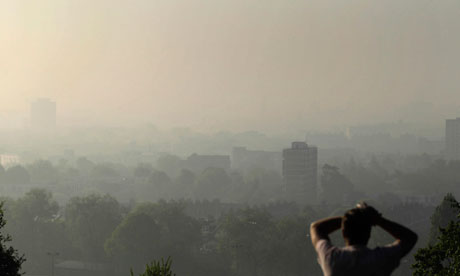
    • The view of smog covering central London from Hampstead Heath in April 2011.

      The view of smog covering central London from Hampstead Heath in April 2011. Photograph: Matt Dunham/AP

      Air pollution in London hit record levels on Thursday due to a combination of traffic fumes, relatively still weather and an influx of dirty air from the north of England and northern France. Poor conditions are affecting a swath of the country as far north as Leeds and York.

      Official monitoring stations in the capital show that particles, nitrogen dioxide, sulphur dioxide and other pollutants have reached levels not recorded since stringent new measurements were introduced in 2008. Pollution levels in London are even higher than last Easter, when the government was forced to issue a smog alert. The record high will worry officials preparing for the arrival of the world’s best athletes and hundreds of thousands of spectators for the Olympics in four months time.

      Health advice from the Department for Environment, Food and Rural Affairs (Defra) says that adults and children with lung problems, adults with heart problems and all older people should not take any “strenuous physical activity” while pollution is at the recorded levels. The general population is advised to reduce exercise too.

      Recirculated dirty air from Europe and the north of England is partly to blame, along with a lack of wind, said Gary Fuller, senior lecturer in air quality measurement at King’s College London. “Still conditions mean that the pollution from the cars and lorries on the roads today is simply not blowing away. On top of this, the air over England today was in northern France yesterday and in northern England on Tuesday where it picked up a lot of air pollution from coal burning industries, domestic heating and traffic.”

      He added that poor air quality was affecting as far north as Leeds and York, and his forecasts suggested the high levels of pollution would continue into tomorrow.

      The Met Office said that winds would be light on Friday morning but would be picking up by lunchtime with gusty winds of 25mph, followed by further winds on Saturday which should bring pollution levels down.

      Simon Birkett, director of the Clean Air in London campaign, said: “The failure by the mayor to warn Londoners about five smog episodes in a row proves he is desperate to avoid the air pollution issue ahead of the mayoral election.

      “It’s clear the mayor, who would rather suppress pollution in front of official air quality monitoring stations than save lives, is more concerned about getting re-elected than he is about those he represents. This may be the biggest public health fraud for a generation.”

      This month, a report suggested that the 2012 Olympics would have no significant impact on air quality in London. Changes to road management during the Games are likely to have “broadly neutral impact on air quality”, Transport for London said.

      Since December 2008, air quality stations in London have been monitoring smaller particles called PM2.5s, which are able to enter the bloodstream more easily and cause more respiratory damage than larger particles, such as PM10s. Fuller said the levels on Thursday were the highest since the new regime was introduced.

      A Defra spokeswoman said: “We want to keep improving air quality and reduce the impact it can have on human health and the environment. Our air quality has improved significantly in recent decades and is now generally very good, and almost all of the UK meets EU air quality limits for all pollutants.

      “There are some limited areas where air pollution remains an issue, but that’s being dealt with by the air quality plans, which set out all the important work being done at national, regional and local levels to make sure we meet EU limits as soon as we can.”

      Last month, the environment secretary, Caroline Spelman, was criticised by an influential group of MPs for rejecting their recommendations to cut pollution on the grounds that it was too costly. Poor air quality has been linked to nearly one in five deaths a year in London. The capital’s poor air quality, caused largely by traffic, has seen the UK facing £300m in fines for breaching EU targets. The government has successfully lobbied Europe to push back the deadline for meeting the targets.

  • Scientists fear climate confusion after wet summer

    Scientists fear climate confusion after wet summer

    Updated March 15, 2012 12:57:08

    Climate scientists are concerned that Australia’s cool and wet summer could lead to confusion about whether climate change is real.

    The last few months have seen floods in New South Wales, Queensland and Victoria, with river systems overflowing and dams filled to the brim, and temperatures in the 20s rather than the 30s in many parts of Australia’s south-east.


    The weather conditions appear to contrast with the Climate Commission’s latest report, which says global average temperatures have continued to rise over the last decade.

    The six-page report, written by Professor Matthew England from the University of New South Wales, Professor Will Steffen from the ANU and Professor David Karoly from the University of Melbourne, says 2011 was the warmest La Nina year on record, and warmer than all but one year of the 20th century.

    Professor England, the co-director of UNSW’s Climate Change Research Centre and chair of the Science Advisory Panel for the Climate Commission, says there is a lot of misinformation about.

    “There’s a lot of misinformation out there and a lot of commentary that climate change is over and this is just not the case,” he said.

    “The long-term trend is still one of drying actually over south-eastern Australia, even taking into account the last couple of wet years.

    “The fact that we have a couple of heavy rainfall events, that’s actually in line with our expectations under climate change of more extreme rainfall events when they do occur.”

    Short memories

    He says people have short memories when it comes to their experiences of weather conditions.

    “You have a cold snap and you suddenly think, I want global warming to come now, not in 20 years or 10 years’ time,” he said.

    “You have a heat wave and suddenly people are talking again about climate change.”

    He says people cannot personally detect the kind of warming trend that comes with climate change.

    “People can’t personally detect a long-term sensory scale warming trend; it’s just impossible,” he said.

    “We know from the measurement records the planet is warming and that our climate is changing, it’s just that we have a very difficult job explaining that when day-to-day weather varies by such a large amount.”

    But Professor England says he has not detected much change in the political will to tackle climate change.

    “Great politicians like Malcolm Turnbull [are] forever good on this topic. He understands the science well, he’s been briefed well,” he said.

    “In the Government there’s obviously a move towards putting in a carbon tax and putting in an incentive to business to go to low carbon technologies and so on.

    “So the right moves are being made but I would agree that basically the response globally and also within Australia it’s way too slow [compared to what] we should be having given the scale of the problem we’re facing.”

  • O.E.C.D. warns of Ever-higher Greenhouse gas emissions

    My Alerts

    ADVERTISEMENT

    Alert Name: CLIMATE CHANGE NEWS
    March 16, 2012 Compiled: 1:07 AM

    By REUTERS (NYT)

    In its environmental outlook to 2050, the Organization for Economic Cooperation and Development said urgent action was needed to replace fossil fuels, which continue to dominate global energy.

    About This E-mail

    You received this e-mail because you signed up for NYTimes.com’s My Alerts tool. As a member of the TRUSTe privacy program, we are committed to protecting your privacy.

  • SEA LEVEL RISE IPCC 2007

    Should Hansen et al’s  research prove to be correct. The situation will be worse than shown

    in this article. If the Greenland ice melts, the sea level rise could be 5-7 metres.


    SEA LEVEL RISE
    Sea level rise can be defined as an increase in sea level caused by global warming through two main processes: the thermal expansion of sea water and the rapid melting of land ice.
    Sea level rise is also expected to make coastal cities more vulnerable to extreme weather (such as hurricanes) as well as to destroy important ecosystems such as wetlands and mangroves. Rising sea level inundates low-lying lands, erodes shorelines, exacerbates flooding, and increases the salinity of estuaries and aquifers. Islands are particularly exposed as many are gradually facing the loss of their fresh water supply due to salt-water intrusion. Low-lying coastal areas and deltas (the land where rivers feed into the ocean) house at least 300 million people and are particularly threatened by sea level rise.
    Some developing countries are especially exposed to sea level rise due to their low- lying nature and limited financial resources to respond. Among the most vulnerable are countries with large populations in deltaic coastal regions such as Bangladesh, Vietnam, China and Egypt.
    The Fourth Assessment Report of the Intergovernmental Panel on Climate Change (IPCC 2007) projects an increase of temperature ranging between 1.1 and 6.40 C over the next century, necessarily entailing a reduction of the amount of ice. As a result, sea levels could rise 10 to 23 inches by 2100.
    Two populous island nations, the Philippines and Indonesia, have millions who face displacement from their homes from sea level rise. Several small island state nations including the Maldives in the Indian Ocean and the Marshall Islands and Tuvalu in the Pacific could face extinction within this century if rates of sea level rise accelerate.

  • Nuclear alerts.

    News 10 new results for DANGER TO US NUCLEAR PLANTS
    Nuclear Regulatory Commission Chairman Jaczko to Speak at GovSec on Critical
    MarketWatch (press release)
    FAIRFAX, Va., Mar 15, 2012 (BUSINESS WIRE) — GovSec — the Government Security Conference & Expo featuring the US Law Enforcement Conference & Expo — announced that US Nuclear Regulatory Commission Chairman Dr. Gregory B. Jaczko will be the featured
    See all stories on this topic »
    OPINION: Emerging ‘hybrid’ option needs a wider understanding
    Business Day
    Meanwhile, China is continuing with a large programme of nuclear-reactor construction and Turkey has re committed to building its first nuclear power plant. SA is also reportedly soon to announce an expansion of its nuclear power programme. A danger in
    See all stories on this topic »
    Tubes Fail Pressure Test at San Onofre Nuclear Plant
    VoiceofOC
    Three tubes failed a pressure test Wednesday at the San Onofre Nuclear Generating Station’s closed Unit 3, prompting the US Nuclear Regulatory Commission to send a special team from its Maryland headquarters to find out why, officials said Thursday.
    See all stories on this topic »
    Feds probe equipment failure at Calif. nuke plant
    The Associated Press
    Underscoring concern over the test findings, the NRC dispatched a special team to the Unit 3 reactor at the San Onofre Nuclear Generating Station, located about 45 miles north of San Diego. The plant was shut down as a precaution on Jan.
    See all stories on this topic »
    US probes equipment failure at nuclear plant
    CanadianBusiness.com
    By AP | March 15, 2012 LOS ANGELES (AP) — A nuclear reactor on the California coast will remain shut down indefinitely while a team of US inspectors determines why several relatively new tubes became so frail that tests found they could rupture and
    See all stories on this topic »
    San Onofre’s Unit 3 reactor shut indefinitely while US regulators probe tube
    Washington Post (blog)
    Traces of radiation escaped, but officials say there was no danger to workers or neighbors. Since then, investigators have been looking into excessive wear found on steam generator tubes in the seaside plant and its twin, Unit 2, which has been off
    See all stories on this topic »
    The future of nuclear industry-dependent towns is now
    Mainichi Daily News
    There are 14 nuclear reactors on the shores of Wakasa Bay in Fukui Prefecture, the largest concentration in the country. Until Feb. 21, when the last of the 14 reactors still running was shut down for regular maintenance, this clutch of reactors
    See all stories on this topic »

    Mainichi Daily News
    Tsunami debris threat prompts West Coast agreement
    CBC.ca
    She said too much time has passed since the tsunami and most of the debris that washed away wasn’t from the area around the damaged nuclear plant. For most debris, local authorities are being urged to clean it up as they would any other wreckage that
    See all stories on this topic »

    CBC.ca
    Pilgrim station focus of forum March 27: Opponents question relicensing
    Wicked Local
    Last year’s disaster at the Fukushima plant in Japan has stoked opposition to the renewal. Brewster Ladies’ Library will be the site a forum Tuesday, March 27, at 7 pm on “The Dangers of Pilgrim Nuclear Station” and related issues.
    See all stories on this topic »
    Nuclear Regulatory Commission Chairman Jaczko to Speak at GovSec on Critical
    Virtual-Strategy Magazine
    GovSec – the Government Security Conference & Expo featuring the US Law Enforcement Conference & Expo – announced that US Nuclear Regulatory Commission Chairman Dr. Gregory B. Jaczko will be the featured speaker at a general session during the annual
    See all stories on this topic »


    This once a day Google Alert is brought to you by Google.

  • Air pollution ‘will become bigger global killer than dirty water’

    Air pollution ‘will become bigger global killer than dirty water’

    OECD report says pollution will become biggest cause of premature death, killing an estimated 3.6 million people a year by 2050

    • guardian.co.uk, Thursday 15 March 2012 17.44 GMT
    • Article history
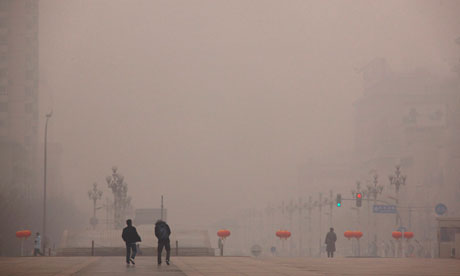
    • A hazy day in Beijing, China.

      Beijing, China, which is one of the countries likely to be worst hit by pollution-triggered deaths in coming decades. Photograph: David Gray/Reuters

      Urban air pollution is set to become the biggest environmental cause of premature death in the coming decades, overtaking even such mass killers as poor sanitation and a lack of clean drinking water, according to a new report.

      Both developed and developing countries will be hit, and by 2050, there could be 3.6 million premature deaths a year from exposure to particulate matter, most of them in China and India. But rich countries will suffer worse effects from exposure to ground-level ozone, because of their ageing populations – older people are more susceptible.

      The warning comes in a new report from the Organisation for Economic Cooperation and Development (OECD), which is a study of the global environmental outlook until 2050. The report found four key areas that are of most concern – climate change, loss of biodiversity, water and the health impacts of pollution.

      If current policies are allowed to carry on, the world will far exceed the levels of greenhouse gas emissions that scientists say are safe, the report found. “I call it the surrender scenario – where we would be if governments do nothing more than what they have pledged already?” said Simon Upton, environment director at the OECD. “But it could be even worse than that, we’ve found.”

      The report said that global greenhouse gas emissions could increase by as much as half, as energy demand rises strongly, if countries fail to use cleaner forms of energy. Water demand is also likely to rise by more than half, and by 2050 as much as 40% of the global population is likely to be living in areas under severe water stress. Groundwater depletion would become the biggest threat to agriculture and to urban water supplies, while pollution from sewage and waste water – including chemicals used in cleaning – will put further strain on supplies.

      However, the OECD study alsos said that there are some actions that governments can take quickly to tackle some of the key problems. For instance, many governments treat diesel fuel for vehicles differently than petrol for tax purposes, with tax breaks that encourage the take-up of diesel. But although diesel vehicle fuel produces lower greenhouse gas emissions than petrol, it is far worse for spewing out small particulate matter, which is bad for urban pollution. “In environmental terms, there is no reason to give diesel tax breaks over petrol,” said Upton.

      Governments could also remove other environmentally harmful subsidies, such as fossil fuel subsidies and subsidies for water that encourage irresponsible use of the resource. Biofuels are another potential danger area, because although they can emit less carbon than conventional fossil fuels, they also contribute to reducing biodiversity and put further strains on water use, so governments should consider carefully whether to go down the biofuels road, Upton warned.

      Upton said that if governments took action now, and developed long-term views of these environmental problems, it would give them a much greater chance of avoiding the worst outcomes. “The key thing is that these four biggest problems are interconnnected – biodiversity is affected by climate change and land use, water is linked to health problems, for instance. You can’t solve any one of these in isolation. So to be effective, governments have to focus on all of these four and look very closely at the connections between them,” he said.