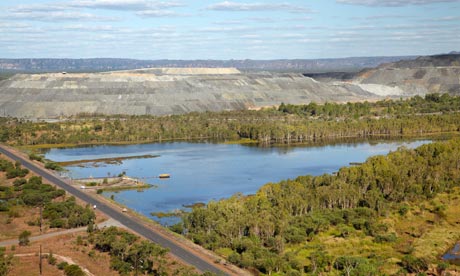
An environment group says the health of the New South Wales Snowy River is being compromised by financial incentives.
The State Office of Water will not bring forward this year’s environmental flows program in light of the recent rain, but Snowy Hydro says the downpour provides an opportunity to improve the health of the system.
The Alliance’s Chairman, John Gallard, says the dispute has created tensions between the environment and the well-being of Murray River irrigators.
He says stakeholders are too focused on the financial bottom line.
“I think it comes at a loss of profit for Snowy Hydro in hedging the environmental benefits, or the irrigation benefits of water that they can keep and store in their reservoirs for future releases to irrigators,” Mr Gallard said.
Climate change still a reality despite soggy summer, warns report
David Wroe
March 15, 2012
AUSTRALIA’S top climate advisory panel has warned strongly against letting the recent mild and wet weather encourage complacency about climate change, insisting the long-term trend remains as alarming as ever.
Following yesterday’s CSIRO report that warned greenhouse gas levels were the highest in 800,000 years, the Climate Commission – a scientific agency set up to inform Australians about global warming – expressed concern in a discussion paper that people were confusing weather patterns with long-term climate change.
The climate commissioner and Australian National University academic Will Steffen said 2011 had been dominated by La Nina, the weather effects produced by cool ocean surface temperatures around the equator in the eastern Pacific.
Advertisement: Story continues below
”After a couple of years, the dams are full, everything is green around you, the soil moisture is topped up,” Professor Steffen said. ”And you say, ‘This is looking pretty good. What happened to all the droughts and dry periods that we thought were associated with climate change? That’s a very common perception you hear. But these things are superimposed on a longer, underlying trend.”
La Nina produces cooler average temperatures and higher rainfall in Australia, particularly the east. Last year was the warmest La Nina year on record, even though the La Nina effect was particularly strong, the Climate Commission’s report states.
Although 2011 was cooler than all but two of the years between 2000 and 2010, it was still warmer than all but one of the years in the 20th century.
”It shows how rapidly things are actually warming,” Professor Steffen said. ”Last year was something we now consider cool. Yet just a decade ago … this would’ve been the second warmest year for 100 years.”
The effect of global warming on average rainfall was more difficult to predict, the commission’s report stated.
The two years of 2010 and 2011 set a record of 1409 millimetres of rain averaged over the whole country.
Even still, the two-year wet period has made up for only about a third of the rainfall deficit since 1997. ”We still require many years of wetter than average conditions before we can fully eliminate the rainfall deficit of the big dry,” it states.
The paper came as a separate report from the Climate Institute, an independently funded think tank, argued Australia could get more out of its carbon pricing scheme – including cheaper emissions cuts and greater environmental benefit – by focusing its carbon trading efforts on neighbours such as Indonesia rather than Europe.
The institute’s deputy chief executive, Erwin Jackson, said Australia should be using bilateral or regional trade deals as a model to set up carbon trading links with individual countries, especially developing countries in the Asia-Pacific region.
Trading carbon with Indonesia’s energy sector, for example, would deliver Australia cheaper carbon abatement because Indonesia could cut its emissions relatively easily. At the same time, Australia would be leveraging more global action compared with linking to Europe, which already has a carbon scheme.
”By providing export opportunities to Indonesia, it would leverage even more significant action than is currently being contemplated while at the same time providing opportunities to Australian businesses to reduce emissions at lower cost.
”The key challenge for Australia is leveraging greater global ambition because we are very vulnerable to the effects of climate change. Just linking with the EU, while important, doesn’t deliver that.”
Goulburn … the swollen Mulwaree River as seen on March 2 / Pic: Getty Images Source: The Daily Telegraph
THE nation’s largest insurer has admitted wrongly blaming a council for its decision to slug a flood-prone customer with an increase of more than 200 per cent.
Another at-risk customer – whose premium rose nearly 700 per cent – tells the same story. NRMA Insurance denies wrongdoing in that case. More on that later.
First, to Goulburn, where Maree Burns’s premium on $80,000 of contents has gone from $265 to $864. That’s a 226 per cent jump.
When an NRMA Insurance representative called Ms Burns he said the jump was due to a new council survey.
But Goulburn Mulwaree Council general manger Chris Berry told Public Defender it had not changed flood mapping for at least two years and the most recent survey was in 2005.
An NRMA Insurance spokeswoman conceded: “It’s human error. We placed far too much emphasis on a council flood study.”
She added that the flood insurance call centre team would be counselled over Ms Burns’ case.
Ms Burns said: “It’s a rort.”
She is looking for a new insurer, with Public Defender’s assistance.
AAMI said it could provide a higher level of cover for less than half NRMA’s charge.
Mr Berry said Goulburn experienced a one-in-50-years flood earlier this month.
It didn’t come anywhere near Ms Burns’s place.
Adrian Byrnes not only has a similar surname to Ms Burns, he has a similar story.
The difference is, the size of the increase Mr Byrnes faces is even bigger – a staggering 680 per cent.
And in his case, NRMA claims it really did receive fresh council information.
Mr Byrnes had been paying about $540 a year to cover $110,000 of contents at his Windsor property. That is set to rise to more than $3600.
“We are in a one-in-100-year flood area. We knew that when we bought here in 2010,” Mr Byrnes said.
“We told NRMA. They said it was no issue.”
Then, a week ago, an NRMA rep called to reveal the hike and claimed it was due to new flood data from Hawkesbury Council. The NRMA spokeswoman yesterday backed the rep, saying Hawkesbury Council had supplied fresh information.
Council general manager Peter Jackson said it had not.
As with Ms Burns, recent persistent heavy rains did not imperil Mr Byrnes’s home.
A quick Google search revealed NRMA has also sprung steep increases on supposedly flood-prone customers in Canberra, Penrith and Coffs Harbour. Three weeks ago the owner of the NRMA Insurance brand, IAG, revealed its premium revenue had grown faster than investors expected – and would keep doing so. Since then its shares have risen 18 per cent, adding about $1 billion to company’s worth.
You are receiving this email because you are a Green Light subscriber.
Click here if you do not wish to receive Green Light emails from the Guardian News and Media. Click here to find out about other Email Services from the Guardian.
Guardian News & Media Limited – a member of Guardian Media Group PLC. Registered Office: Kings Place, 90 York Way, London, N1 9GU. Registered in England No. 908396
A uranium ore stockpile in Kakadu National Park, Northern Territory. Australia has the largest uranium store in the world. Photograph: David Wall/Alamy
The Australian government has passed legislation that will create the country’s first nuclear waste dump, despite fierce opposition from environmental and Aboriginal groups.
The passage of the National Radioactive Waste Management Bill 2010 through the Senate paves the way for a highly controversial plan to store nuclear waste in Muckaty Station, a remote Aboriginal community in the arid central region of the Northern Territory.
The ruling Labor party received support from the conservative coalition opposition to approve the bill, despite an ongoing federal court case over the legality of using the Muckaty site to store radioactive material.
Currently, nuclear waste from the medical and mining industries is stored in more than 100 “temporary” sites in universities, hospitals, offices and laboratories across Australia.
Anti-nuclear protesters disrupted proceedings in the Senate as the legislation was debated earlier on Tuesday, with the group heckling lawmakers from the public gallery over their support for the bill.
A recent medical study warned that transporting nuclear waste over long distances to such an isolated location, which is 75 miles north of the Tennant Creek township, could endanger public health.
“The site is in an earthquake zone, it floods regularly, there are very long transport corridors, there are no jobs being applied and it’s opposed from people on the ground, on the front line from Tennant (Creek) all the way up to the NT government and people around the country,” said senator Scott Ludlam of the Greens, which successfully added an amendment to the bill that bans the importing of foreign nuclear waste to the site.
Aboriginal groups launched legal action after claiming that traditional owners of the land around Muckaty do not approve of the dump, despite the government maintaining that the local Ngapa indigenous community supports the plan.
Under Australian Native Title law, indigenous groups recognised as the traditional owners of land must be consulted and compensated for any major new infrastructure.
Although the Australian government insists that it has not decided on a site for the dump, Muckaty is the only option under consideration and the Northern Territory government has already been offered AUS$10m if it accepts the facility.
Finding a location for a national nuclear waste dump has proved a major headache for successive Australian governments, with former prime minister John Howard rebuffed in his attempt to situate the facility in South Australia in 2004.
The Northern Territory government has complained that it is being strong-armed into taking the dump due to it being a “constitutional weak link” and not having the same rights as full Australian states.