Author: admin

  • Running hot and cold in the deep sea: Scientists explore rare environmeny

    Running hot and cold in the deep sea: Scientists explore rare environment

    Posted: 06 Mar 2012 04:57 PM PST

    It’s extremely rare to find hot hydrothermal vents and cold methane seeps intersecting in one place, but that’s what researchers found and explored during an expedition in 2010. A description of the scientists’ findings, including a large number of mysterious, undescribed species, has just been published.

    Listening to the 9. 0-magnitude Japanese earthquake: Seismic waves converted to audio to study quake’s traits

    Posted: 06 Mar 2012 11:25 AM PST

    A professor has converted the seismic waves from last year’s historic Japanese earthquake into audio files. The results allow experts and general audiences to “hear” what the quake sounded like as it moved through the earth and around the globe.
    You are subscribed to email updates from ScienceDaily: Earth Science News
    To stop receiving these emails, you may unsubscribe now.
    Email delivery powered by Google
    Google Inc., 20 West Kinzie, Chicago IL USA 60610
    Reply
    Forward
    Click here to Reply or Forward
  • Cyclones: Get the facts


    Home : Get The Facts : Cyclones

    Cyclones – Get the Facts

    Tropical Cyclones are formed over the ocean in the area around the equator, between the Tropic of Cancer and the Tropic of Capricorn.

    In order for a cyclone to form, the ocean waters need to be warm, at least 26°C. Above the warm ocean, water evaporates and form clouds. If there is low air pressure where the clouds are formed, it pulls them in and they begin to rotate. It is the Earth’s rotation and spinning on its axis that causes the cyclone’s clouds to rotate. Clouds will continue to form and begin spinning more.

    This is the stage when it can develop into a mature cyclone, or lose its momentum. Even if it has developed into a mature cyclone, it can still grow in size and increase its wind speed.

    In order for it to be categorised as a cyclone, its average sustained wind speed needs to exceed 63 kilometres per hour. To be classified as severe, the average sustained wind speed needs to exceed 118 kilometres per hour.

    Once they arrive over land, their strength weakens and they begin to fade out. This is due to the lack of moisture and heat compared to the ocean over which it was formed.

    How often do they occur?

    Cyclone season in Australia is between November and April, but cyclones can still occur in the month of May.

    The season for Hurricanes and Typhoons in the Northern Hemisphere is between June and November.

    According to the Bureau of Meteorology, Australia has, on average, 13 cyclones a year. Half of these occur in the western regions.

    Severity and Categories

    Cyclones are categorised according to their strength. There are 5 categories: Category 1 is the weakest and Category 5 is the strongest.

    Category Wind Gusts Ocean Swells Damage
    1 Up to 125km/hr
    Gales
    1.2 – 1.6m Slight damage
    Trees and farmland damaged.
    2 126 – 169km/hr
    Destructive
    1.7 – 2.5m Significant Damage
    Minor house damage. Severe damage to signs and trees. Heavy damage to crops
    3 170 – 224km/hr
    Very Destructive
    2.6 – 3.7m Structural damage
    House roofs and most likely power failures
    4 225 – 279km/hr
    Very Destructive
    3.8 – 5.4m Significant roofing and structural damage
    Airborne debris, widespread power failure
    5 Winds above 280km/hr
    Very Destructive
    More than 5.5m Almost total destruction and extremely dangerous
    Houses flattened, cars over turned

    Every cyclone has an ‘eye’

    The eye of a swirling cycloneThe eye of a swirling cyclone
    The eye of a swirling cyclone.

    The eye is in the centre of the cyclone and can vary in size, from 10 kilometres to 100 kilometres, depending on the severity of the storm.

    Do not be fooled by the eye!

    Due to the least amount of air pressure in the eye, it produces clear weather with light wind, no clouds, no rain and some sunshine. But, the storm is not over yet.

    This is only the middle of the storm. Depending on the wind gusts, the eye may pass in a few minutes or in a few hours.

    You are always advised to stay indoors during the passing of the eye of the storm, because the cyclone will continue. Always listen for the official word that the cyclone has passed and when it is safe to leave your shelter.

    When going outside, be aware of fallen powerlines, debris and damage left behind after the cyclone.

    Did you know?

    1. The average life of a cyclone is 1 week.
    2. After the eye passes, and the other side of the cyclone hits, the wind blows with equal strength but in the opposite direction.
    3. Tropical Cyclones, from the Southern Hemisphere spin clockwise, and Hurricanes and Typhoons in the Northern Hemisphere spin anti-clockwise.
    4. Cyclone Tracy was Australia’s most destructive cyclone.
    5. Cyclones are assigned names, which are picked from a list.

    Names of cyclones

    Each cyclone is named from one of the names in the below table. The names start from the top of the list and take it in turns to be a male or female name. Once the end of the list is reached it begins again.

    Australian Region Names

    A Anika Anthony Alessia Alfred Ann
    B Billy Bianca Bruce Blanche Blake
    C Charlotte Carlos Cathy* Caleb Claudia
    D Dominic Dianne Dylan Debbie Damien
    E Ellie Errol Edna Ernie Esther
    F Freddy Fina Fletcher Frances Ferdinand
    G Gabrielle Grant Gillian Greg Gretel
    H Hamish* Heidi Hadi Hilda Harold
    I Ilsa Iggy Ita Ira Imogen
    J Jasper Jasmine Jack Joyce Joshua
    K Kirrily Koji Kate Kelvin Kimi
    L Laurence Lua Lam Linda Lucas
    M Magda Mitchell Marcia Marcus Marian
    N Neville Narelle Nathan Nora Noah
    O Olga Oswald Olwyn Owen Odette
    PQ Paul Peta Quang Penny Paddy
    R Robyn Rusty Raquel Riley Ruby
    S Sean Sandra Stan Savannah Seth
    T Tasha Tim Tatjana Trevor Tiffany
    UV Vince Victoria Uriah Veronica Verdun
    WXYZ Zelia Zane Yvette Wallace

    * Cyclone names marked for replacement.

    Could a cyclone be named after you?

    Is your name on the list?

    Top of Page

  • Volcano Alerts

    News 10 new results for volcanoes
    My Turn: Sliding down a volcano is a trip
    Daily Breeze
    Volcano what? Every person I told about my recent Nicaraguan adventure asked me the same question about “volcano boarding.” I myself had never heard the term until I started planning for my trip. I have seen some YouTube videos of daring folks doing it
    See all stories on this topic »
    NZ Scientists Introduce Volcano Life-saving Monitoring Devices To Vanuatu
    Bernama
    WELLINGTON, March 6 (Bernama) — New Zealand scientists have begun installing potentially life-saving monitoring devices around volcanoes on an eruption-prone island in Vanuatu. The five-year project, funded by the New Zealand government aid programme,
    See all stories on this topic »
    A close encounter with volcanoes in Tengchong
    China Daily
    The main sightseeing spot in the county is Tengchong National Geological Park nicknamed “a museum of geological features” for its diversified landforms created by frequent volcano eruptions hundreds of years ago. As Tengchong county is located in an
    See all stories on this topic »
    Marapi volcano (West-Sumatra, Indonesia), activity update: continuing ash
    VolcanoDiscovery (press release) (blog)
    The volcano is currently closed for climbers and a 3 km exclusion zone is in place. Bukittinggi’s Volcanology and Geological Hazard Mitigation Agency (PVMBG) officer Suparmo is quoted that “the activity on Sunday was Marapi’s strongest in recent days,
    See all stories on this topic »
    Ethiopia rebels say freed two German tourists
    Reuters
    Foreigners who venture out into the area usually include researchers, aid workers and about 500 adventure tourists each year, visiting geographical wonders such as the Danakil Depression, with ancient salt mines and volcanoes.
    See all stories on this topic »
    Ethiopia rebels free 2 Germans
    The Nation, Pakistan
    Hungarian survivors of the attack told how they were woken by gunshots in their campsite in the shadow of the Erta Ale volcano before being hauled from their tents and beaten with clubs. University researcher Zoltan Winter told a news conference after
    See all stories on this topic »

    The Nation, Pakistan
    Undersea Eruption Emergency Ends in Spanish Island
    Prensa Latina
    06 de marzo de 2012, 16:31Madrid, Mar 6 (Prensa Latina) The authorities in the Canary Islands decreed on Tuesday the end of the emergency phase in the underwater volcano eruption area started in October last year at El Hierro Island, as informed by
    See all stories on this topic »
    Volcano fun for school children
    Rochdale Online
    The ‘Volcano Show’ was the children’s idea; year three and year four have been learning about volcanoes and wanted to put on a show for the school and their families. Year four played out ‘The Courage at Pompeii’ and the year three children acted as
    See all stories on this topic »
    Clear the air
    Airport World Online
    As a result of this and other incidents, ICAO set up nine regulated, Volcanic Ash Advisory Centres (VAACs) around the world to give advice to the aviation community on the advection and dispersion of ash clouds when a volcano erupts.
    See all stories on this topic »

    Airport World Online
    Mankind is not necessarily doomed – Cambridge scientist
    Cambridge First
    A Cambridge geographer will examine various potential volcanoes which could effectively grind the planet to a halt. By Hugh Morris Tuesday, March 6, 2012 A CAMBRIDGE scientist has forecast a near-apocalyptic scene in which man will have to fight to
    See all stories on this topic »


    Tip: Use a minus sign (-) in front of terms in your query that you want to exclude. Learn more.

    Delete this alert.
    Create another alert.
    Manage your alerts.

  • O’Farrell puts brakes on Moore’s bicycle vision

    O’Farrell puts brakes on Moore’s bicycle vision

    Updated March 07, 2012 13:27:07

    The New South Wales Government is introducing changes that could curtail the Sydney Lord Mayor’s plans to make the city more bicycle and pedestrian friendly.

    Premier Barry O’Farrell has announced a joint planning committee to manage the city’s transport issues.

    The committee will include four representatives of the State Government and three from the City of Sydney.

    “What this is about is using a model that’s been shown for almost a generation to work for building developments in the CBD,” Mr O’Farrell has told 702 ABC Sydney.

    “What it’s based on is just the bleeding obvious, which is that Sydney’s CBD is important to everyone.

    “Not just those who live in the city but those who work there every day, many of whom don’t for instance have opportunities to ride their bikes from Penrith or Campbelltown and other places into the city.”

    But the Lord Mayor, Clover Moore, says she is surprised by the announcement, because council’s powers are already limited.

    “It’s important that the Premier arms himself with the facts, rather than tabloid headlines,” Ms Moore said.

    “We don’t really have any power that we’re not given by the state, for example there is a traffic committee which is dominated by state representatives now and any decision we make about transport or traffic in the city has to go through that committee.”

    Topics:states-and-territories, urban-development-and-planning, local-government, sydney-2000

    First posted March 07, 2012 13:21:18

  • CSG companies under growing pressure

    CSG companies under growing pressure

    ‘Pilot production’ wells and water treatment dams in Bibblewindi State Forest, north-west of Tamworth. Photo taken in May 2010 by The Hunter Action Group

    As the high-profile Senate inquiry into coal-seam gas continues, Queensland has announced new restrictions on drilling close to towns and a New South Wales parliamentary probe has opened for submissions.

    With industry and its supporters in government strongly defending the safety of the drilling process known as fracking, cracks are beginning to appear in the campaign to sell the booming industry as a clean green alternative to traditional coal mining.

    Could impact aquifers

    The National Water Commission last week restated its warnings there was an important lack of information surrounding the long-term impacts of coal-seam gas extraction and its risks to water systems.

    In December last year the Commission had previously reported that massive water use and the ‘dramatic de-pressurisation of coal seams’ could affect water availability, that waste water could pollute streams, and that fracking had the ‘potential to induce connection and cross-contamination between aquifers, with impacts on groundwater quality.’

    Two weeks ago, a senior figure representing the industry confirmed to a public meeting that drilling could impact on aquifers to varying degrees.

    He reportedly told the Sydney Morning Herald after the meeting: ‘I’m wanting to ensure that we are not seen as saying there won’t be any impacts during the process.

    ‘It is a matter of monitoring and managing those impacts.’

    The Australian Petroleum Production and Exploration Association does not concede that extraction will inevitably contaminate aquifers, but says coal-seam gas drilling ‘will reduce water pressure’, and the ‘extent to which this process affects other aquifers – if at all – is determined by geological separation…’

    Meanwhile, as farmers and others have shared their concerns at the Senate inquiry hearings across Australia, companies are expressing differing views about whether they would move onto land against the wishes of landowners.

    Gov owns minerals beneath top soil

    By law, governments own the resources beneath the topsoil, and mining companies can force entry to property if a court grants permission.

    Two weeks ago Opposition leader Tony Abbott backed the right of farmers to say no, but later retreated, saying his comments only applied to prime agricultural land.

    Here in the Byron Shire, the company controlling vast exploration rights told The Echo earlier this year it would not explore on land without the owner’s agreement, but the company now says it won’t rule out resorting to court action if needed.

    In a statement sent to The Echo last week, Arrow Energy said: ‘Our aim is to always negotiate voluntary land access agreements with landholders… however, we support both landholder and the CGS companies retaining the right to access legal processes, in the interests of both parties.’

    Offshore company has 15 wells locally

    Arrow, which has already drilled 15 exploration wells in this region, is jointly owned by PetroChina and the Dutch company Shell, currently facing criticisms of its own over a major oil leak still flowing in the North Sea near Scotland.

    While gas is increasingly promoted as a clean alternative to help fight climate change, in recent days the Greens leadership has very publicly questioned widely used assertions that gas produces only half the emissions of dirty coal.

    Changing science

    The science surrounding these estimates is complex, uncertain and changing, and the calculations depend very much of the way the resource is extracted, transported and delivered.

    But if gas is not as green as previously believed, and coal can clean up its act, the differences between the two energy forms will start to shrink, and the comparison with renewable energy will look even starker.

    As an example of the changing science, the United States government very recently revised upwards its estimates of highly polluting methane emissions associated with some forms of gas extraction.

    While leaks from wells using fracking were a key culprit, important caveats include the fact that gas has been more commonly extracted from shale in the US rather than coal seams, and that technology may be more modern and regulations tighter in Australia.

    Tighter regulations

    In Queensland those regulations were tightened last week, as the government announced new restrictions on companies exploring within two kilometres of towns with 1000 or more people.

    In New South Wales the parliamentary inquiry is briefly taking submissions, though they close in the first week of September.

    And nationally, the activist group GetUp is collecting a petition to stop coal-seam gas mining, visiting northern New South Wales recently as part of its intelligence gathering for the campaign.

    While an informal alliance of farmers and environmentalists is driving much of the community protest, it’s unclear what impact an increase in compensation to landholders – or improvement in regulation – will have on the strength of opposition.

    View PDF from issue

  • Australia’s mining boom placing Great Barrier Reef at risk, UN warns

    Australia’s mining boom placing Great Barrier Reef at risk, UN warns

    Environmental team is assessing the reef amid concerns over rapid escalation in coal exports and gas exploration

    • guardian.co.uk, Tuesday 6 March 2012 13.19 GMT
    • Article history
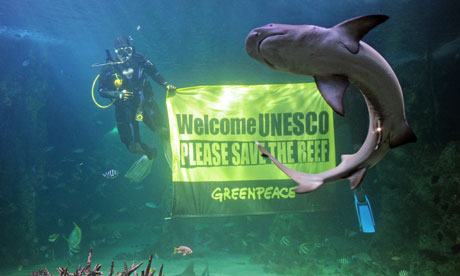
    • Greenpeace banner urging UNESCO to save the Great Barrier Reef, at the Sydney Aquarium , Australia

      Divers unveil a Greenpeace banner at Sydney Aquarium urging Unesco to protect Australia’s Great Barrier Reef. Photograph: Greg Wood/AFP/Getty Images

      A UN environmental team has arrived in Australia for a crunch 10-day assessment of the Great Barrier Reef, warning that the coral ecosystem is at a “crossroads” due to the soaring activity of the mining industry in the World Heritage Area.

      The United Nations Educational, Scientific and Cultural Organisation (Unesco) visit comes amid fears that the reef’s world heritage listing, which it has held since 1981, could be placed in jeopardy after rapid escalation in coal exports and gas exploration.

      “The Great Barrier Reef is definitely at a crossroad and decisions that will be taken over the next one, two, three years might potentially be crucial for the long-term conservation [of the reef],” said Fanny Douvere, from Unesco’s World Heritage marine programme.

      Australia’s coal boom is set to open up the previously undeveloped Galilee Basin in central Queensland, greatly increasing the number of developments along the state’s coast, where the 1,800-mile reef stretches.

      The proposed infrastructure includes Abbott Point, which would become the largest coal export port in the world.

      At full capacity, the expansion would see more than 10,000 coal-laden ships a year cross the Great Barrier Reef by the end of the decade – a sizeable increase on the 1,722 vessels that entered the World Heritage Area in 2011.

      Environmentalists are concerned that ships navigating reef passageways – many of which are narrower than the English Channel – will run aground, as a Chinese vessel did in 2010, tearing a two-mile gash into the coral and spilling several tonnes of oil.

      There are also warnings that the reef’s six species of turtle, including the endangered loggerhead and Olive Ridley turtles, and the snubfin dolphin, Australia’s only endemic dolphin, would be affected by any mass industrialisation of the Queensland coast.

      Any reduction in visitor numbers to a region that generates AUS$6bn a year from tourists would also be keenly felt by local businesses and the Australian economy at large.

      Douvere and Tim Badman from the International Union for Conservation of Nature are set to meet with government ministers and NGOs, as well as visit the reef to assess the impact of new developments.

      The specially arranged trip follows a minor diplomatic incident last year when Unesco’s World Heritage Committee said it was “extremely concerned” that the Australian government had not informed it of the approval of a major liquefied natural gas hub on Curtis Island, off the Queensland coast.

      The expansion of the hub at Gladstone has been blamed for a sharp drop in water quality and widespread disease of marine creatures.

      More than 45m cubic metres of sea floor is to be dredged in the World Heritage Area to accommodate the boom in shipping, with the government warning that it will penalise mining companies that dump accumulated waste on the corals.

      Douvere said: “When it comes to dredging issues I think that a big part of our discussions need to focus on what the alternatives are.”

      Speaking to the Guardian from Paris, prior to her departure to Australia, Douvere said that there were multiple threats to the reef’s wellbeing.

      “We won’t just be looking at the increase in shipping, but also issues such as how climate change and the recent cyclone and extreme weather has affected the reef,” she said.

      “We will look at the overall impact of these things. We don’t regularly make these kind of trips but it was asked for by the World Heritage Committee after issues were raised last year.”

      Environmental groups have claimed that Unesco’s visit is an embarrassment for the Australian government.

      Greenpeace Australia spokesman James Lorenz said: “We are looking at an enormous, unprecedented increase in coal, oil and gas exploitation here.”

      “Unesco is clearly very worried about this and if they decide the reef is in danger, that places it at the same level as sites in places such as Afghanistan, which is deeply embarrassing for Australia.”

      “The Great Barrier Reef is priceless but it is being treated like it’s a worthless. It has been mismanaged for years and we are now at a tipping point.”

      Both the federal Australian and state Queensland governments have launched their own 18-month assessments of the reef, although ministers have come under fire for considering several large developments, including Abbott Point, during the review.

      Tony Burke, Australia’s environment minister, has defended his handling of the issue, telling ABC Radio: “Let’s not forget, with Abbot Point, there is already a significant level of industry that occurs there.”

      “One of the largest levels of concern here is shipping, as the vessels move through the reef area. So those shipping movement issues are issues that really have to be front of mind throughout all of this.”