Author: admin

  • UK nuclear sites at risk of flooding, report says

    UK nuclear sites at risk of flooding, report shows

    Rising sea levels because of climate change put 12 of 19 sites at risk, unpublished government analysis shows

    • Map: sites at risk of flooding

    • guardian.co.uk, Wednesday 7 March 2012 12.28 GMT
    • Article history
    • nuclear sites risk of flooding and coastal erosion : Sizewell nuclear power plant Southwold Suffolk

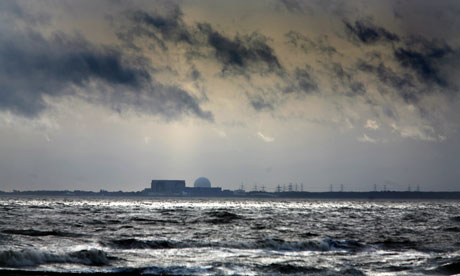
      Sizewell nuclear power plant, seen from across the sea at Southwold, Suffolk. Unpublished government analysis shows sites are at risk from flooding due to climate change. Photograph: Graham Turner for the Guardian

      As many as 12 of Britain’s 19 civil nuclear sites are at risk of flooding and coastal erosion because of climate change, according to an unpublished government analysis obtained by the Guardian.

      Nine of the sites have been assessed by the Department for Environment, Food and Rural Affairs (Defra) as being vulnerable now, while others are in danger from rising sea levels and storms in the future.

      The sites include all of the eight proposed for new nuclear power stations around the coast, as well as numerous radioactive waste stores, operating reactors and defunct nuclear facilities. Two of the sites for the new stations – Sizewell in Suffolk and Hartlepool in County Durham, where there are also operating reactors – are said to have a current high risk of flooding. Closed and running reactors at Dungeness, Kent, are also classed as currently at high risk.

      Another of the sites at risk is Hinkley Point in Somerset, where the first of the new nuclear stations is planned and where there are reactors in operation and being decommissioned.

      According to Defra, Hinkley Point already has a low risk of flooding, and by the 2080s will face a high risk of both flooding and erosion.

      Other new reactor sites that face some risk now and high risk by the 2080s are Oldbury in Gloucestershire and Bradwell, Essex.

      The huge old nuclear complex at Sellafield, Cumbria, is said to face a medium risk of flooding now and later.

      The analysis was conducted by officials from Defra’s floods and coastal erosion team as part of a major investigation into the impact of climate change on the UK. But when the results were published in January only summary numbers for the 2080s were mentioned and no individual sites were named.

      Defra has now, however, released its full analysis in response to a request under freedom of information legislation. As a result, the department’s assessments of the risks for individual sites can be disclosed for the first time.

      Many of the sites date back to the 1950s and 1960s, and are unlikely to be fully decommissioned for many decades. Seven of those containing radioactive waste stores are judged to be at some risk of flooding now, with a further three at risk of erosion by the 2080s.

      Experts suggested the main concern was of inundation causing nuclear waste leaks.

      Sea level rise, especially in the south-east of England, will mean some of these sites will be under water within 100 years,” said David Crichton, a flood specialist and honorary professor at the hazard research centre at University College London. “This will make decommissioning expensive and difficult, not to mention the recovery and movement of nuclear waste to higher ground.”

      The French nuclear company EDF Energy was confident that all its nuclear sites in Britain were adequately protected against storms and floods. “Without these arrangements in place the regulator would have the authority to close us down,” said an EDF spokeswoman.

      Reports by the government’s Office for Nuclear Regulation since the Fukushima nuclear accident a year ago had confirmed the “fundamental safety” of Britain’s nuclear plants, the spokeswoman said. “Protection from flooding has also been factored into our new-build plans and will be covered by a robust regulatory regime, should consent be granted.”

      The Nuclear Decommissioning Authority, the government body responsible for dismantling old nuclear plants, said flood risk at every site was reviewed at least every 10 years.

      New climate change hazards were likely to emerge slowly giving “time to develop and implement credible solutions”, said an NDA spokesman.

      He continued: “Existing power stations are designed with flood protection measures to protect against a one-in-10,000-year flood event and planning requirements state that new nuclear plants are also designed to take account of climate change impacts.”

      But Greenpeace accused the government and nuclear industry of covering up the real extent of flood and erosion risk. “It makes you wonder what other important information about the safety of our nuclear plants the government and EDF might be hiding,” said the group’s chief scientist, Doug Parr.

      A Defra spokesperson said: “As the nuclear regulator has said the UK’s nuclear sites are fundamentally safe with protection against current and future flood risk built in. The Climate Change Risk Assessment analyses possible outcomes by 2080 if no actions were taken to protect against the effects of climate change. This is clearly not the case – nuclear operators are already well aware of the risk of flooding, now and in the future, and are taking the action necessary to protect sites.”‬‪

  • Volcano Alerts

    News 9 new results for volcanoes
    Russia Volcano Bezymianny put on Code Red for imminent eruption
    The Weather Space
    (TheWeatherSpace.com) – One of the most active volcanoes in the world has been put on aviation color code red, the highest alert given by the Kamchatka Volcanic Eruption Response Team. KVERT assigned the code on Tuesday and warns of an imminent
    See all stories on this topic »

    The Weather Space
    Mabuhay to Manila
    Malaysia Star
    By MELINDA LOOI From visiting a shoe museum to a volcano, our columnist had an eventful time in the Philippines. THE minute you land in Manila, you are enveloped in its warm embrace. No visitor can leave this city, no matter how short the stay,
    See all stories on this topic »

    Malaysia Star
    Last Resident of Hawaii Subdivision Evicted by Lava
    Our Amazing Planet
    by Brett Israel, OurAmazingPlanet Staff Writer – Mar 07, 2012 04:42 PM ET Hawaii’s Kilauea volcano produces breathtaking images of oozing lava, but for one subdivision, the beauty has been devastating. Lava has burned down the last home at one unlucky
    See all stories on this topic »

    Our Amazing Planet
    Fruit volcanoes: a science project you can bake
    HeraldNet (blog)
    By Reshma Seetharam Gently melt the butter on low heat. When it’s all liquid, set aside. Sift the flour, baking powder and salt together, set aside. In a medium bowl, add the eggs, sugar and vanilla. Beat until light and fluffy, adding in melted butter
    See all stories on this topic »
    CANARY ISLANDS: NATIONAL PARKS OFFER REMARKABLE EXPERIENCE
    Tourism Review
    Although today Timanfaya is the only active volcano the surface temperature is still very high at places ranging between 100 °C and 600 °C. Tourists thus can enjoy views of geysers of steam. Parque Nacional de la Teide is located on the island of
    See all stories on this topic »

    Tourism Review
    House Hunting in … Costa Rica
    New York Times
    A FIVE-BEDROOM MOUNTAINSIDE ESTATE OVERLOOKING SAN JOSÉ $1.69 MILLION This mountainside estate overlooks the city of San José and the volcanoes beyond. The house covers 8100 square feet over two stories; it was built of local volcanic stone in 1995 and
    See all stories on this topic »

    New York Times
    House Hunting in … Costa Rica
    Pittsburgh Post Gazette
    By VIRGINIA C. McGUIRE, The New York Times This mountainside estate overlooks the city of San José and the volcanoes beyond. The house covers 8100 square feet over two stories; it was built of local volcanic stone in 1995 and refurbished in 2009.
    See all stories on this topic »
    Sakurajima volcano (Kyushu, Japan) activity update: increased numer and size
    VolcanoDiscovery (press release) (blog)
    Sakurajima volcano appears to be at higher levels of activity, as the last week has seen an increased average number and size of eruptions. According to the latest USGS / Smithsonian report “explosions during the past week “often” produced plumes that
    See all stories on this topic »
    Mélange et Trois: A Trip Across Subduction Zone Madness
    Scientific American (blog)
    Where I grew up on the Colorado Plateau, the geology’s like a lovely layer cake: nice horizontal slabs of schist and sandstone and sediments from ancient seas stacked neatly one after the other, with a volcano on top. Washington state is also like a
    See all stories on this topic »

    Scientific American (blog)


    Tip: Use site restrict in your query to search within a site (site:nytimes.com or site:.edu). Learn more.

    Delete this alert.

  • Ocean Warming, salinity and frequency of cyclones

    Neville,

    I recommend you read the enclosed reports.

    Regarding your specific comments:

    1. The oceans continue to warm, as in figure 3 in Steffen’s report but warming is not homogeneous, i.e. Greenland and Antarctic ice melt results in regions of cold ice melt water. Salinity increases not only due to ocean warming but also consequent on ocean currents from warm regions reaching colder high latitudes. I am not clear therefore on what basis you write “Cyclones could feasibly reduce in frequency since the oceans may be less warm?”

    2. Warming of ocean water decreases their capacity to sequester CO2.

    Among other Steffen’s report states:

    Ocean temperature

    Although there is a very strong focus on air and sea

    surface temperature in both the climate research

    community and the general public, ocean temperature

    is a better measure of changes in the climate system.

    More tha n 85% of the

    additi onal heat due to the

    ener gy imbala nce at the

    Earth ’s surface is absorbed

    by the ocea n (IPCC 2007a).

    Since the 1960s measurements of the heat content of the

    upper 700 m of the ocean have been available, and since

    2004, measurements to lower depths (up to 2 km) have

    become widely available with the deployment of Argo

    floats (Gould and the Argo Science Team 2004).

    Figure 3 shows the record of ocean thermal expansion

    from 1950 through 2008, showing the clear long-term

    trend of warming (Domingues et al. 2008, and updates).

    The Domingues et al. updated curve in this figure, which

    uses the carefully checked and corrected Argo data of

    Barker et al. (2011), indicates that multi-decadal warming

    has continued to the end of the record in December 2008

    (Church et al. 2011). This record is quantitatively

    consistent with the observed rate of sea-level rise over

    the past half-century. Although most of the additional

    heat stored in the ocean is found in the upper 700 m,

    recent observations show that warming of the deeper

    ocean waters in both the Southern and Atlantic Oceans

    is now occurring (Purkey and Johnson 2010)

    From: Neville Gillmore [mailto:nevilleg729@gmail.com]
    Sent: Thursday, March 08, 2012 1:18 PM
    To: Andrew Glikson

    Subject: Ocean warming, salinity and frequency of cyclones.


    Andrew.

    Since our oceans need be warm for cyclones to form, and we are seeing
    scientific reports on Ocean Salinity increase. Cyclones could feasibly
    reduce in frequency since the oceans may be less warm?

    Will the carbon dioxide currently absorbed by our oceans decrease,
    leaving more carbon pollution in the atmosphere?

    Regards
    Neville Gillmore

    EXTRACT
    In order for a cyclone to form, the ocean waters need to be warm, at least 26°C. Above the warm ocean, water evaporates and form clouds. If there is low air pressure where the clouds are formed, it pulls them in and they begin to rotate. It is the Earth’s rotation and spinning on its axis that causes the cyclone’s clouds to rotate. Clouds will continue to form and begin spinning more.

    2 attachments — Download all attachments
    STEFFEN_THE CRITICAL DECADE 2011.pdf STEFFEN_THE CRITICAL DECADE 2011.pdf
    7935K   View Download
    THE SCIENCE OF CLIMATE CHANGE_2009.pdf THE SCIENCE OF CLIMATE CHANGE_2009.pdf
    2573K   View Download
  • Nuclear alerts.

    News 10 new results for DANGER TO US NUCLEAR PLANTS
    Choosing Fukushima’s Legacy
    Wall Street Journal
    With strong leadership and collaboration with the United States, the Japanese government could reassure the public about the safety of nuclear power plants and secure the nation’s energy supply. Before the accident at Fukushima, Japan’s 54 operating
    See all stories on this topic »
    It’s Time to Get Realistic About the Dangers of the San Onofre Nuclear Plant
    CounterPunch
    Carl Ginsburg on how Charles Murray of the American Enterprise Institute sings for his supper. by RUSSELL D. HOFFMAN Both units of the San Onofre Nuclear Plant are currently shut down. Let’s keep them that way, to prevent a Fukushima USA from happening
    See all stories on this topic »
    Greenpeace Calls on World Leaders to End Nuclear Power
    PanOrient News
    Tokyo- (PanOrient News) Greenpeace today issued an open letter to world leaders calling for an end of the Threat of nuclear power. Amsterdam, March 7, 2012 – Just days before Japan marks the anniversary of March 11, 2011 tsunami and the nuclear
    See all stories on this topic »

    PanOrient News
    One year after Fukushima – Reassessing nuclear safety and the ability to avoid
    Enformable
    Prime Minister Nato Kan while still in office after the disaster is quoted saying that the combined situation of the earthquake, tsunami, and nuclear plants has presented “in a manner of speaking, the worst crisis in the past 65 years since World War
    See all stories on this topic »
    An Israeli-Iranian War That Seemed So Possible Until Recently Is Averted
    Daily Beast
    Israel and the US have agreed to stick with sanctions as the only leverage against Iran for now, while Iran, bowing to international pressure, agrees to talks and perhaps the presence of UN inspectors at its nuclear fuel sites.
    See all stories on this topic »

    Daily Beast
    Phuket Gazette: Earthquake threat for Japanese nuclear plant
    Phuket Gazette
    PHUKET (News Wires): A fault under the reactors of a nuclear power plant in southwestern Japan could trigger a powerful earthquake with a magnitude of up to 7.4 on the Richter scale, experts warned yesterday. The Urasoko fault runs under the No.
    See all stories on this topic »
    One year after disaster at Fukushima nuclear plant, town remains frozen in time
    msnbc.com
    A lot of people worked as engineers and technicians at the nearby nuclear plant. The radiation levels are high in Okuma, but I learned that the real danger is the dust. Don’t touch your eyes in the exclusion zone. Don’t rub your mouth.
    See all stories on this topic »
    France says Iran ‘two-faced’, sceptical talks can succeed
    Reuters
    * France’s Juppe: sanctions on Iran remain a must * Says Israel must be warned of dangers of military option * Washington says must see action, not words, from Iran * Israel warily welcomes new talks between Iran, 6 powers * Election results signal
    See all stories on this topic »
    UK nuclear sites at risk of flooding, report shows
    The Guardian
    They include all of the eight sites proposed for new nuclear power stations around the coast, as well as numerous radioactive waste stores, operating reactors and defunct nuclear facilities. Two of the sites for new nuclear stations are said to have a
    See all stories on this topic »
    Future flood threat to British nuclear reactors
    GlobalPost (blog)
    It isn’t fire that is a threat to some British nuclear plants like Sizewell, it’s flooding from rising sea levels. (Oli Scarff/AFP/Getty Images) A year ago, the world was watching Japan wrestle with the flooded reactors at Fukushima nuclear plant.
    See all stories on this topic »


    This once a day Google Alert is brought to you by Google.

    Delete this alert.
    Create another alert.
    Manage your alerts.

    Reply
    Forward
    Click here to Reply or Forward
  • Oil Price Daily News Update

    Oil Price Daily News Update

    Inbox
    x

    OilPrice.com Daily News Update admin@oilprice.com via google.com
    10:45 AM (47 minutes ago)

    to me
    Images are not displayed. Display images below – Always display images from admin@oilprice.com

    Oil Price Daily News Update


    Mozambique Goes Green, Blindsides International Mining Interests

    Posted: 06 Mar 2012 04:12 PM PST

    It’s hard not to be downcast when reading much of the news from Africa, ravaged as it is by wars, hunger, poverty, famine and rapacious Western companies intent on exploiting the governments’ desperation for foreign revenue. But, just occasionally, an uplifting story breaks through the gloom and pessimism.One such tale comes from Mozambique, where the country’s Ministry for Coordination of Environmental Affairs (MICOA), has canceled 146 investment projects in various economic activities because they failed to meet the requirements…

    Read more…

    Zimbabwe’s Ongoing Energy Nightmare

    Posted: 06 Mar 2012 03:38 PM PST

    In the 32 years of his benighted rule, Zimbabwe’s President Robert Gabriel Mugabe has done more damage to the country than its white-led minority government ever did. With the exception of the smuggling of “blood diamonds” the country’s economy, once the “breadbasket of Africa,” resembles nothing so much as a slow motion train wreck. One of the foundations of modern nations’ economic prosperity are reliable sources of power and here too, Mugabe and his Zimbabwe African National Union cronies have managed…

    Read more…

    Nigerian Energy Sector Next Big Market Concern

    Posted: 06 Mar 2012 03:33 PM PST

    Nigeria’s main rebel group announced recently that it killed four police officers and was considering taking on more hostages in a renewed offensive. With the U.S. State Department issuing a travel warning for Nigeria, and the country’s president still coping with Islamic militancy, the oil-rich nation has remained a lingering national security concern. Chevron, meanwhile, just announced that a fire burning at a natural gas rig off the Nigerian coast finally went out, some 45 days after the blaze erupted. Considering the myriad of problems the…

    Read more…

    Why Europe is Experiencing Higher Oil Prices than the US

    Posted: 06 Mar 2012 03:29 PM PST

    The world is presently sharing a limited supply of oil. When oil prices rise, oil production doesn’t rise very much, if at all. Figure 1. Brent oil spot price and world oil supply (broadly defined), based on EIA data. The issues then become: Which buyers get the oil? What uses get priced out of the market?  Which countries are disproportionately affected? It seems to me that this time around, Europe, and in particular the Eurozone, is the area of the world getting hit the hardest by high oil prices. Part of this has to do with the relative…

    Read more…

    What the Greek Debt Crisis Tells us about Governance and Public Finances

    Posted: 06 Mar 2012 03:05 PM PST

    The Greek sovereign debt crisis has captured the attention of the world, both for what it says about the viability of the Euro and the EU integration project, but also for the warning signs it sends to governments around the world about governance and public finances. In the U.S., politicians both on the right and the left are using Greece as an example of how bad management of public finances can lead to economic catastrophe. In particular, for the right, Greece is at the edge of the abyss because of the bloated government bureaucracy, unreasonably…

    Read more…

    Brazil Look to Benefit from US Renewable Fuel Standard Mandates

    Posted: 06 Mar 2012 03:02 PM PST

    US rules on ethanol usage will favour Brazilian cane sugar producers and could lead to a surge in imports in the coming years, according to a research note from Rabobank International. However, if Brazilian imports do surge, US legislators will likely act to change the rules, the analysts warned. The 2010 update of the US Renewable Fuels Standard (RFS2) mandates that a steadily rising quantity of renewable fuels be used in transportation, with particular emphasis on expanding ‘advanced’ biofuels, such as cellulosic ethanol and other…

    Read more…

    Israeli Scientists Hope to Develop New Type Seaweed for Biofuel Production

    Posted: 06 Mar 2012 02:58 PM PST

    While they are cleaner and safer than fossil fuels, bioethanol production’s ever-increasing need of valuable farmland for crops – like corn and sugarcane – could result to possible food shortages and price increases. To answer this dilemma, a group of scientists from various universities in Israel have been looking at marine macroalgae, or seaweed. They have found that it can be grown more quickly than land-based crops and harvested as fuel without sacrificing usable land. Avigdor Abelson, a professor of Tel Aviv University’s Department of Zoology…

    Read more…

    You are subscribed to email updates from OilPrice.com Daily News Update
    To stop receiving these emails, you may unsubscribe now.
    Email delivery powered by Google
    Google Inc., 20 West Kinzie, Chicago IL USA 60610
  • Speaker blasts rowdy MPs

    How not to run a parliament

    Speaker blasts rowdy MPS

    ABCMarch 8, 2012, 8:56 am

    Parliamentary Speaker Michael Polley has put politicians on notice after almost ejecting three MPs and threatening to walk out himself during a rowdy session of Parliament.

    Michael Polley was already rattled when the Deputy Premier, Bryan Green, produced a poster-sized copy of a newspaper photograph of the Liberal MP Michael Ferguson.

    The photograph showed Mr Ferguson being helped over the finish line at a recent fun run in Launceston.

    When the Deputy Premier began making references to a Liberal pledge to be self reliant, the House erupted and Mr Polley threatened to leave.

    “Now I warn the House if this continues, I’ll leave the chair.”

    “Order, quite clearly that’s a personal attack on the member for Bass. Order, order. I ask the House come to order or I’ll leave the Chamber.”

    The Speaker says he has only ever used the tactic once before and it is a resort.

    “You can’t have people attacking each other on a personal basis. They ought to be concentrating on what the issues are.”

    Mr Polley says he will not hesitate to eject MPs who misbehave today.

    Deputy Opposition leader Jeremy Rockliff says he was appalled by Mr Green’s behaviour.

    “This was going just that one or two steps too far.”

    Greens MP Kim Booth says Tasmanians expect a better standard from their politicians.