Author: admin

  • Nuclear News

    Google Alert – DANGER TO US NUCLEAR PLANTS

    Inbox
    x

    Google Alerts googlealerts-noreply@google.com
    11:19 AM (30 minutes ago)

    to me
    News 6 new results for DANGER TO US NUCLEAR PLANTS
    Palisades Nuclear Plant Not a Danger
    WKZO
    SOUTH HAVEN (WKZO) — About 100 concerned neighbors turned out for a community meeting held by The Nuclear Regulatory Commission in South Haven. Their aim was to calm fears about the safety of the Palisades Nuclear Plant. The NRC is partly responsible.
    See all stories on this topic »
    New Study Says Japan ‘Lucky’ to Avoid Wider Disaster
    Voice of America
    But they warn that dangers remain because of the way Japan’s nuclear industry is managed and regulated and how plants in the country were built. The 420-page report says the crisis at the Fukushima nuclear plant was made worse because the plant’s
    See all stories on this topic »
    Tritium leak: Post-quake radiation plume stokes concern
    The Hook
    Dominion Virginia Power has revealed that an elevated level of a radioactive substance called tritium has been found in groundwater near the plant, and the discover has nuclear watchdogs scoffing at the company’s efforts to downplay potential danger to
    See all stories on this topic »

    The Hook
    Nuclear Regulatory Commission tells public Palisades nuclear power plant is safe
    Kalamazoo Gazette – MLive.com
    By Fritz Klug | fklug@mlive.com Citizens listen as the Nuclear Regulatory Commission discusses the Palisades nuclear power plant during a meeting Wednesday in South Haven. SOUTH HAVEN — Living between two nuclear power plants, Bette Pierman has some
    See all stories on this topic »

    Kalamazoo Gazette – MLive.com
    Frontline’s Fukushima “Meltdown” Perpetuates Industry Lie That Tsunami, Not
    truthout
    Add to that the technical nature of the information, the global impact of the disaster, the still-extant dangers in and around the crippled plant, the contentious politics around nuclear issues, and the refusal of the Tokyo Electric Power Company
    See all stories on this topic »
    57 percent of local gov’ts near nuke plants favor conditional reactor restarts
    Mainichi Daily News
    2 Nuclear Power Plant, below, and No. 1 plant are pictured in this aerial photo taken from a Mainichi helicopter. (Mainichi) The majority of leaders of local governments located within a 30-kilometer radius from a nuclear power plant approve of the
    See all stories on this topic »

    Mainichi Daily News


    This once a day Google Alert is brought to you by Google.

    Delete this alert.
    Create another alert.
    Manage your alerts.

  • Oil Price News Update

    Oil Price Daily News Update


    American Energy Company to Invest $1 billion in Egypt

    Posted: 01 Mar 2012 10:54 AM PST

    The Arab Spring, which began early last year and swept eastwards across Africa’s Magreb, has completely upended the region’s politics. Responses range from the relatively benign outcome in Tunisia, where it all began, to Egypt, where President Hosni Mubarak was forced from office and now faces trial by the military government that succeed him, to Libya, where former leader Muammar Gadhaffi was killed following his capture. The final result in Syria has yet to emerge. Seeing opportunity where others see risk, Houston-based oil and…

    Read more…

    GOP Should Claim Victory on Keystone XL

    Posted: 29 Feb 2012 03:52 PM PST

    Canadian pipeline company TransCanada announced it was building a stand-alone section of the controversial Keystone XL oil pipeline to the southern coast of Texas. This in part addresses one of the primary aims of the project, which is to add pipeline capacity to the refining market along the southern U.S. coast. The White House welcomed the measure, but President Obama’s critics continued to complain. With TransCanada acknowledging Obama isn’t opposing the overall merits of the project, however, it’s odd that White House critics aren’t taking…

    Read more…

    Thailand Moves Into Burma’s Energy Market

    Posted: 29 Feb 2012 03:48 PM PST

    Just when it seems that China has bought every energy asset on the planet, along comes Thailand’s PTT Exploration and Production Plc (PTTEP) to contest Beijing’s presence in one of Southeast Asia’s “final frontiers” – Burma, or, as its rulers prefer, Myanmar. PTTEP expects soon to sign an agreement with Burma to explore for oil and gas in its PSC-G and EP2 onshore petroleum blocks. In January PTTEP, a subsidiary of PTT Plc, Thailand’s largest energy conglomerate, was awarded licenses for the two blocs, which…

    Read more…

    5 Interesting Revelations from the Stratfor Memos

    Posted: 29 Feb 2012 03:43 PM PST

    Wikileaks is publishing internal memos of the Stratfor security analysis firm. A few tidbits have emerged in these very early days, to wit: 1. Up to 12 Pakistani active-duty and retired officers from the Inter-Services Intelligence agency knew that Osama Bin Laden was in Abbottabad and were in regular contact with him. The Pakistani chief of staff is denying the report. 2. Dow Chemicals hired Stratfor to spy on activists in Agra who continue to protest over the Bhopal environmental disaster that blinded many workers and destroyed their health.…

    Read more…

    Hopes Build for Thorium Nuclear Energy

    Posted: 29 Feb 2012 03:37 PM PST

    There is much written to the effect that thorium might prove a more viable nuclear fuel, and an energy industry based upon it, than the current uranium-based process which serves to provide both energy and weapons – including “depleted uranium” for armaments and missiles. There are different ways in which energy might be extracted from thorium, one of which is the accelerator-driven system (ADS). Such accelerators need massive amounts of electricity to run them, as all particle accelerators do, but these are required to produce a beam of protons…

    Read more…

    Some Valuable Remarks About Oil and Speculation

    Posted: 29 Feb 2012 03:32 PM PST

    Several nights ago I participated in a debate (arranged by Russia Today TV – 24-7 –  CrossTalk, and transmitted internationally in English) in which I pointed out – on several occasions – that the aggregate (though unweighted) Brent-WTI (West Texas Intermediate)  price of oil was about 112 dollars a barrel (= $112/b), and I claimed that if this price reaches $130, we could be facing a clear and impending economic danger. Early the next morning, when I checked this aggregate price on the important sites OilPrice.Com…

    Read more…

    Mongolia to Build its First Wind Farm

    Posted: 29 Feb 2012 03:29 PM PST

    Mongolia is an East Asian country about the size of Alaska, with vast potential for wind energy due to the large unpopulated plains that make up most of the land, and the wind corridor of the Gobi desert. The south Gobi region is predicted to contain 300 gigawatts of wind energy potential which Mongolia are now looking to take advantage of based upon the expectation that its electricity demand will double within 15 years due to the fact that it has one of the fastest growing economies of the world, fuelled by its rich natural resources such as…

    Read more…

    You are subscribed to email updates from OilPrice.com Daily News Update
    To stop receiving these emails, you may unsubscribe now.
    Email delivery powered by Google
    Google Inc., 20 West Kinzie, Chicago IL USA 60610
  • State governments hands are in the cookie jar over school bank accounts

    State government’s hands are in the cookie jar over school bank accounts

    0
    Blacktown South Public School

    Ambushed … Geoff Scott, principal of Blacktown South Public School with his students (L-R) Ebonee Annabel, Kaitlyn Nash, Jessica Nash, Pavitraa Hathi, Abhinav Hathi, Ishan Puri and Deklyn Nash / Pic: Craig Greenhill Source: The Daily Telegraph

    MILLIONS of dollars of interest will be snatched from state school bank accounts by the cash-strapped state government under a radical restructure of education department finances, principals and parents fear.

    More than 2200 primary and secondary school accounts could be replaced with a centralised banking system by 2014.

    Click here for a full list of NSW public school bank accounts

    The move, part of the Learning Management Business Reform program, would deliver a single finance, human resource and student management system across the department but would take finances out of the hands of principals.

    Despite being told the overhaul would save money, teachers are concerned they would no longer be able to keep tens of thousands of dollars in interest payments which go towards stationery, books and uniform subsidies.

    “We’re running pretty tight to the bone anyway and if there is a proposal to take away any money from the school budget then it’s going to cause problems,” Blacktown South Primary School principal Geoff Scott said.

    A Department of Education and Communities spokesman said the reform aimed to improve school finances: “The Learning Management Business Reform program is currently in the design phase and the Department of Education and Communities is working with principals and school communities to design a system which best suits their local needs.”

    Former primary school head and Primary Schools Principals Forum spokesman Brian Chudleigh said the group did not believe assurances that schools would not lose the interest.

    “Principals are absolutely aghast about losing control of their finances – it will reduce us to the level of a McDonald’s franchise,” he said.

    “We were assured there was no intention that interest money could be taken back under these changes.

    “What is being done will give them (the government) the capacity to do it.

    “We don’t believe (the assurances) because the NSW Treasury is so strapped for cash they will do anything to get that money.

    “The fear is that principals won’t have control (of their bank accounts) and will have to seek the approval of a grade one clerk to do anything.”

    Education sources said bureaucrats in the department had been “eyeing off” interest monies in school bank accounts for years, claiming they could make better use of it.

    Primary Principals Association president and Albion Park Public School principal Jim Cooper said students could be worse off.

    “If it means a reduction in resources given to schools then it usually means a reduction of things given to students,” he said.

    Secondary Principals’ Council president Chris Cawsey said an average high school would lose $25,000 a year if interest were withheld.


  • New Device heralds potential to turn sewage plants into power stations

    New device heralds potential to turn sewage plants into power stations

    Breakthrough that combines fuel cell with other technologies could provide power for entire water grids, scientists say

    • guardian.co.uk, Thursday 1 March 2012 19.00 GMT
    • Article history
    • Damian blog : Biodigesters at sewage treatment plant : production of biogas or methane

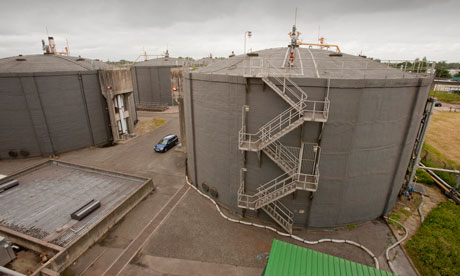
      Biodigesters at United Utilities Daveyhulme plant which processes 714m litres of sewage from Manchester each day. Photograph: Ashley Cooper/Corbis

      Sewage can be used to generate electricity using a new device revealed by scientists on Thursday. It combines a fuel cell with other technologies to convert waste water treatment stations into power plants, which the researchers believe could provide the power for entire water grids.

      “We certainly could take care of the whole water system: the treating and pumping of water, which currently requires substantial amounts of power,” said Prof Bruce Logan at Pennsylvania State University in the US. “We also treated the organic matter much faster.”

      His team’s work is published in the journal Science and is “the proof of concept”, Logan said. “Our hope now is to optimise the electricity generation as much as possible.”

      Switching sewage plants from users to generators of electricity would be especially useful in developing countries, said Logan, an environmental engineer specialising in water systems. “There are 2 billion people in the world who need sanitation, including 1 billion who need access to clean water,” he said. “If you go into a country and give them a waste treatment system – the World Bank and others have done this – they do not keep it going, as it needs power and maintenance. It is a drain on the community. But if you can also provide electricity for lighting, or charging mobile phones, that’s a game-changer.”

      The new device combines two types of energy-producing technology: a microbial fuel cell, in which bacteria consume organic matter to produce a current, and a reverse electrodialysis system, in which positive and negative ions are separated by a series of membranes, also creating a current. Microbial fuel cells are relatively inefficient while reverse electrodialysis requires many specialised membranes, making it expensive.

      “By combining the two technologies, we overcame the limitations of the fuel cell and synergistically generated energy for the reverse electrodialysis system,” said Logan. A crucial factor was using ammonium bicarbonate as the fuel for reverse electrodialysis, which performs better than the seawater typically used. Lastly, said Logan, the combination of technologies meant it was possible to use just five membrane pairs rather than the 20 pairs typically needed to generate electricity.

      The device produced 0.9 kilowatt-hours of electricity per kilogram of organic waste. In contrast, sewage treatment usually consumes 1.2kWh per kilogram.

      “There were a lot of people looking at fuel cells and a completely different group looking at reverse electrodialysis,” said Logan. “We brought the technologies together.”

      The scientists said broths of other organic material, such as crop waste or other sources of cellulose, could be used to generate power in their device. They also said it could be used to produce electricity from the 7-17% of energy used in the US that is lost as waste heat.

      In 2011, British water company Thames Water said it would produce 16% of its electricity by burning sewage flakes. Another company, Wessex Water, has launched a trial running a car on methane gas derived from the sewage treatment process at its Bristol works.

  • Sydney water war- Labors desalination plant is a tap we can’t turn off

    Sydney water war – Labor’s desalination plant is a tap we can’t turn off

    0

    THE decision was made – Sydney would get a desal plant “drought or no drought”.

    Before the 2007 election, premier Morris Iemma promised it would be built when dam levels hit 33 per cent.

    The current government is now railing about a “stupid contract” that means the plant will stay in operation for two years regardless of the state of Sydney‘s water supply.

    But an engineer who was involved in designing the Kurnell plant said this was playing politics over sense.

    “It was an insurance policy,” Brett Miller from the UNSW Water Research centre said.

    “Sydney at the time was in a drought. A large proportion of our water was coming from the Shoalhaven. I really don’t see that you could have made any different decision.”

    Mr Miller said Sydney runs through a wet/dry cycle – meaning it was likely that in a few years pouring rain would give way to drought.

    Mr Iemma said the then government decided to build the plant based on advice Sydney’s water supply was disappearing at an alarming rate.

    “The advice was that (dam levels) were going to hit 27 per cent in a very short period of time. We just needed to provide certainty,” he said.

    The 2006 metropolitan water plan, which supported the decision to build the plant, noted that the probability of dam levels reaching 30 per cent was “very low” but building the plant was “vital to ensure that Sydney’s water needs can still be met should this situation occur”.

    The desalination plant announced on Wednesday that, following heavy rain, it would reduce the volume of water it supplied to 45 megalitres a day.

    Finance Minister Greg Pearce said he welcomed the decision to cut the volume of water produced. The two-year “proving period” for the plant expires on June 15, and Mr Pearce said it was not viable to shut the plant before then.


  • Peak Oil News

    News 4 new results for PEAK-OIL
    The Peak Oil Crisis: A Breakthrough?
    Falls Church News Press
    By Tom Whipple For many months, US Energy Secretary Chu, the guy with the Nobel Prize in physics, has been running around the country telling audiences that big breakthroughs were coming for electric vehicles. Well, this week the other shoe dropped
    See all stories on this topic »
    Has the ‘Peak Oil‘ Tipping Point Arrived?
    U.S. News & World Report (blog)
    Peak oil” is one of those ideas that used to be the province of commodity speculators and zanier environmentalists, but is now entering the mainstream of the energy policy debate. The idea is simple on its face: For one reason or another (which one
    See all stories on this topic »
    Peak oil could upset global transition of power
    Straight.com
    The contemporary transition from the American to Chinese hegemony is taking place in the closing decades of the carbon age. The pattern of the power transitions of the past may not be faithful harbingers of the future due to peak oil and climate
    See all stories on this topic »
    Slide in America’s oil production to be stopped by technology and algae
    Torque News
    By Frank Sherosky on Wed, 02/29/2012 – 21:31 for Torque News Peak Oil; American dependence on foreign supplies. Is it possible that the energy crisis is not as bad as America’s politics would have us believe? Yes, worldwide demand for crude oil is
    See all stories on this topic »