Author: admin

  • The Climate Change Controversy Continues

    Oil Price Daily News Update


    New Oil Field in the Gulf of Mexico Could be Huge

    Posted: 22 Feb 2012 03:51 PM PST

    The BP blowout reaction a couple years ago put a lid on oil and gas development in the Gulf of Mexico that has yet to be fully lifted.  With oil over $100 today and the projections on prices looking scary for the economy and average Americans, a little good news is very welcome. A midsize oil explorer and developer company called McMoRan has been working in shallow Gulf of Mexico waters, close to shore, but drilling very deep.  For years McMoRan has been ignored.  Until:Chevron, the Big Oil Giant out of California caught on to the…

    Read more…

    Big Oil’s Generosity and the Cloak of Social Responsibility

    Posted: 22 Feb 2012 03:46 PM PST

    U.S. supermajor Exxon Mobil said it invited 50 school girls to its headquarters in Texas for its 9th annual program meant to encourage more women to pursue engineering. The company said that while women make up about half of the U.S. workforce, only around 14 percent of those jobs were in the field of engineering. The program, Exxon explained, was part of a multi-million dollar effort launched through its philanthropic arm, the Exxon Mobil Foundation. The initiative, Exxon officials explain, is meant to show school girls that engineering was…

    Read more…

    The Vital Strategic Debate: Who – in the West – Lost Africa?

    Posted: 22 Feb 2012 03:43 PM PST

    The debate in the West over “who lost China” resonated in 1949 as the Nationalist forces of Generalissimo Chiang Kai-shek began their withdrawal to Taiwan from the Chinese mainland, and Mao’s forces — who had allowed Chiang’s Kuomintang forces to bleed dry in the war against Japan — consolidated control of the bulk of the coun-try. Now, of equal importance, is the strategic debate which should be held: who, in the West, lost Africa? Western media focuses on the drama of the Middle East, which, for the US, is…

    Read more…

    What do the Recent Oil Price Highs Mean for Consumers at the Pump

    Posted: 22 Feb 2012 03:39 PM PST

    Crude oil prices this week reached their highest level since last April. What will that mean for U.S. consumers at the gas pump? The first question to be clear on is which crude oil price we’re talking about. Two of the popular benchmarks are West Texas Intermediate, traded in Oklahoma, and North Sea Brent. Historically these two prices were quite close, and it didn’t matter which one you referenced. But due to a lack of adequate transportation infrastructure in the United States, the two prices have diverged significantly over the last year. My…

    Read more…

    Belarus Considers Selling Oil Pipelines – Deputy Premier

    Posted: 22 Feb 2012 03:31 PM PST

    In the bad old days of the “evil empire” the USSR functioned as largely autarkic economic state, dealing with the outside world on its own terms. But seduced by Western “hard currency,” in the early 1970s the USSR, despite Washington’s distress, began energy exports to Europe despite the objections of successive U.S. administrations. The situation has continued to now, but the Russian Federation does not own and subsequently control, its most valuable transit assets, the skein of Soviet-era pipelines across…

    Read more…

    Overcoming High Oil Prices – Time to Stop Playing the Energy Victim

    Posted: 22 Feb 2012 03:29 PM PST

    Our world is a ‘funk’—again over global oil price spikes caused by concerns about conflict between Iran and Israel drawing the US into a war, the continuing agony of Greek debt and its euro contagion, worries that China may have deeper economic problems than thought that will drag the global economy back into recession.  In other words, situation normal. But the situation is not normal in the US since we are in the midst of the primary election season and spiking oil prices is seen as a perfect excuse to hammer the president…

    Read more…

    The Climate Change Controversy Continues

    Posted: 22 Feb 2012 03:19 PM PST

    There are a couple of controversial items that have made it into the mainstream press recently that seem to have stirred a little controversy, and which are worth at least a mention. The first was the Opinion piece in the WSJ back in Januuary in which 16 scientists wrote that there was no need to panic over Global Warming. They note, in their letter: Alarmism over climate is of great benefit to many, providing government funding for academic research and a reason for government bureaucracies to grow. Alarmism also offers an excuse for governments…

    Read more…

  • EU tar sands pollution vote ends in deadlock

    EU tar sands pollution vote ends in deadlock

    Decision on whether to label oil produced from tar sands as highly polluting is delayed as key vote fails to find majority

    • guardian.co.uk, Thursday 23 February 2012 13.45 GMT
    • Article history
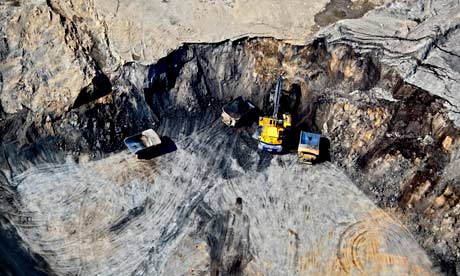
    • Tar Sands pit in Fort McMurray, Alberta

      Tar sands excavation mine in Fort McMurray, Alberta. Photograph: Orjan F Ellingvag/Dagens Nar

      The European Union failed to label oil produced from tar sands as highly polluting on Thursday, with a key vote by member states ending in deadlock.

      The issue is seen as a key test of the EU’s ability to implement its climate change policies while under heavy pressure from the Canadian government and oil companies who want to prevent billions of barrels of tar sands oil from being designated as especially harmful to the environment. The lobbying has been intense, with Canada secretly threatening a trade war with Europe if the proposal is passed, while the Nasa climate scientist James Hansen has said full development of the tar sands would mean it was “game over” for the climate.

      Darek Urbaniak at Friends of the Earth Europe said: “Some European governments have given in to Canadian and oil lobby pressure, instead of saying no to climate-hostile tar sands. High-polluting sources of fuels, such as tar sands, must be cleaned up or kept out of Europe – they are the dirtiest source of transport fuels, and will undermine Europe’s ability to reach its climate ambitions.”

      Joe Oliver, Canada‘s minister of natural resources, said he was pleased with the result and warned: “If the EU moves ahead in implementing these discriminatory measures, Canada will not hesitate to defend its interests.” He said Canada would continue to promote the oil sands as a “secure and responsible” source of energy.

      The vote by officials needed a majority of about three-quarters to be approved, which would have led to the proposal passing quickly into law. In the event, there were 89 votes for the proposal, 128 against and 128 abstentions, including the UK. The impasse means the decision will be referred to ministers, who will send a proposal to the European parliament for passing into law. The decision should have been made more than a year ago.

      The proposal came from the European commission and Connie Hedegaard, the EU commissioner for climate action, said: “With all the lobbying against the proposal, I feared member states would reject the proposal. I am glad that this was not the case. I hope ministers will realise that unconventional fuels need to account for their considerably higher emissions through separate values.”

      The issue has drawn fire on to the UK’s transport minister, Norman Baker, whose Liberal Democrat colleagues have likened tar sands to “land mines, blood diamonds and cluster bombs”, but whose coalition government was revealed as giving secret help to Canada by the Guardian.

      Baker defended the UK’s abstention. “We recognise there are big issues with tar sands but equally we did not feel the proposal met the requirement of dealing with other highly polluting crude oils. It was not an all encompassing solution,” he told the Guardian.

      He denied that the deadlocked vote would delay action. “It is the idea of dealing with tar sands now and dealing with the rest later, like Angolan and Venezuelan crudes, that is in fact kicking it into the long grass. Our advice is that we could have something up and running in 6-12 months.”

      Baker said there was an “open invitation” for Hedegaard to work with abstaining nations like the UK, Germany and France to find a solution: “Connie only has the tiddlers with her: 89 votes for and 128 against is not a position she is going to win from.”

      The senior Greenpeace campaigner Joss Garman said: “Baker should be congratulated. It’s obvious that he’s reacted positively to pressure from the clean energy lobby. But if we’re going to keep tar sands out of Europe we now need Nick Clegg to step in and ensure that when ministers meet in June the result is a European ban on tar sands.”

      Canada’s vast tar sands are the second largest reserve of oil after Saudi Arabia and many of Europe’s largest oil companies have major interests in the fields, including BP, Shell, Total and Statoil. The EU proposal is to label tar sands oil as causing 22% more greenhouse gas emissions than conventional oil on average, because of the extra energy needed to blast the bitumen from the bedrock and refine it. This would make it unattractive to Europe’s fuel suppliers who have to cut the impact of their products on global warming and would also set a very unwelcome international precedent for Canada.

      The Canadian government argues it is unfair to single out tar sands when some other crude oils are also highly polluting but its opponents, including Hedegaard, argue those can be dealt with in due course and that the scientific case against tars sands is clear. Canada convened a high-level private summit in 2011 to discuss winning the tar sands argument in the EU, to protect the “huge investments from the likes of Shell, BP, Total and Statoil”.

      The UK proposed an alternative “banded” approach to ascribing carbon emissions to different fuel types, which does not single out tar sands. Opponents dismiss the proposal as a delaying tactic and the Guardian understands that the UK has failed to present its proposal formally. In January, the Guardian revealed another compromise plan that would weaken the impact on tar sands oil, this time from the Netherlands.

      Colin Baines, toxic fuels campaigns manager at the Co-operative, said: “The oil industry must play its fair part in Europe’s efforts to address climate change: to give it a free pass to make things worse by ignoring tar sands emissions would be a scandal. It is a positive sign that the UK and France abstained when they had been the subject of such intense lobbying from the oil industry and Canadian government. We hope they’ll move further and support the fair and common sense proposal at the next vote.”

      Vote on proposal to label tar sands oil as highly polluting, by nation

      For: Austria, Denmark, Finland, Greece, Ireland, Latvia, Luxembourg, Malta, Romania, Slovakia, Slovenia, Sweden

      Against: Spain, Italy, Poland, Bulgaria, Czech Republic, Estonia, Lithuania, Hungary

      Abstained: UK, Germany, France, Netherlands, Portugal, Belgium, Cyprus

  • Higher wetland methane emissions caused by climate warming 40,000 years ago

    24. June 2010: Higher wetland methane emissions caused by climate warming 40,000 years ago

    No clathrate gun

    Bern/Bremerhaven, June 24th, 2010. 40,000 years ago rapid warming led to an increase in methane concentration. The culprit for this increase has now been identified. Mainly wetlands in high northern latitudes caused the methane increase, as discovered by a research team from the University of Bern and the German Alfred Wegener Institute for Polar and Marine Research in the Helmholtz Association. This result refutes an alternative theory discussed amongst experts, the so-called “clathrate gun hypothesis”. The latter assumed that large amounts of methane were released from the ocean sediment and led to higher atmospheric methane concentrations and thus to rapid climate warming.

    Earlier measurements on ice cores showed that the atmospheric methane concentration changed drastically in parallel to rapid climate changes occurring during the last ice age. Those climate changes –so-called Dansgaard-Oeschger events – were characterised by a sudden warming and an increase in methane concentration. However, it was not yet clear to what extent the climate changes 40,000 years ago led to the methane increase or vice versa. Climate researchers from the Universities in Bern and Copenhagen and from the Alfred Wegener Institute for Polar and Marine Research in Bremerhaven now conclude that the methane increase at that time was largely due to higher methane emissions from wetlands. As published by the researchers in the current issue of the magazine “Science“, these natural methane sources produced more methane especially in high northern latitudes in response to the warming. Through their study the researchers also refute another controversial hypothesis, which claimed that large amounts of methane stored as clathrate in the ocean sediment along the continental margins was released and triggered the rapid warming.

    The scientists stress, however, that the climate conditions 40,000 years ago are not comparable to the current climate evolution. “Our results do not imply that methane or other greenhouse gases play no role for climate change. Our study reflects natural climate conditions during the last ice age, long before mankind affected global climate by emitting greenhouse gases. At that time climate warming caused an increase in methane concentration, generating in turn a more substantial greenhouse effect. Nowadays, additional methane and carbon dioxide are artificially emitted into the atmosphere by human activities and are the main driver of the observed climate warming.“
    Ongoing studies of the Alfred Wegener Institute in Arctic permafrost regions take on greater importance in view of these research results.

    Novel analytical method: Clear isotopic “fingerprints”
    In nature a few methane molecules (CH4) have one more neutron in the carbon and hydrogen atoms they are made of and are therefore a little heavier. Methane from wetland sources has fewer molecules with the heavier hydrogen atom than methane produced in the ocean. Accordingly, the marine and terrestrial methane sources have unique “isotopic fingerprints“. Using these fingerprints, it is possible to quantify the emission of both sources. Developing a novel analytical method at the University of Bern and the Alfred Wegener Institute to take these “fingerprints“ allowed the international team of scientists to come up with the unambiguous results now published in “Science”.


    Source:

    Bock, M.; Schmitt, J.; Möller, L.; Spahni, R.; Blunier, T. & Fischer, H. (2010), Hydrogen isotopes preclude marine hydrate CH4 emissions at the onset of Dansgaard-Oeschger events, published in the scientific journal “Science” on 25th of June, 2010.

    Notes for editorial offices:
    Your contact is Prof. Hubertus Fischer from the division of climate and environmental physics of the University of Bern (Tel: +41 (0)31 631 85 03; E-Mail: hubertus.fischer@climate.unibe.ch.
    Your contact in the Communications Department of the Alfred Wegener Institute is Ralf Röchert (Tel: +49 (0)471 4831-1680; E-Mail: Ralf.Roechert@awi.de).

    Printable Images

    Aerial View of the Lena Delta

    Arctic permafrost regions have a crucial impact on the earths climate system and play an important role in the research work of the Alfred Wegener Institute. The photo shows typical permafrost wetlands in the Lena Delta. (Photo: Hans-W. Hubberten)
    webprint

    Trapped methane bubbles

    Methane bubbles from the bottom of a pond, trapped in surface ice. (Photo: G. Stoof)
    webprint

    Ice-wedge Polygons, Lena Delta

    Wetlands in high northern latitudes were the main cause for an atmospheric methane increase 40,000 yrs. ago. Reticular structures of ice-wedge polygons give Siberian permafrost landscape a characteristic appearance. (Photo: K. Piel)
    webprint

  • Research offers glimmer of hope for threatened coral

    Research offers glimmer of hope for threatened coral

    Updated February 24, 2012 01:33:40

    Grim forecasts for the world’s dying coral reefs have just become a little brighter with the release of new research from the United States.

    The study, published in the Biological Sciences journal, has found coral may be able to survive better than previously thought in warming sea temperatures.

    The researchers used a new, more in-depth method to examine the genetic make-up of 39 coral species.

    They discovered that all of those species can in fact host at least two different forms of algae – or what is scientifically referred to as a clade – including one that is associated with higher thermal tolerance.

    But while Australian experts have acknowledged the findings as significant, they say it merely “buys us time”.

    Marine scientist Dr Ross Hill from the University of New South Wales explains the research:

    “Previously it had been thought that a lot of coral species could only harbour one type of clade,” he said.

    “But what I was really surprised to see was that all the coral species that they studied had more than one clade in at least one replicate… so each species looks to have the potential to have more than one, which is a new finding.”

    Clades are the algae that live inside corals and provide them with nutrients.

    Clade D, which the researchers detected a background element of in every coral species they examined, can tolerate higher levels of heat.

    “Without a mechanism to cope with rapid environmental change, coral bleaching will likely continue to result in widespread declines in coral cover,” the study concludes.

    “Symbiotic flexibility may provide one mechanism by which corals can respond to changing environments, and data shown here suggests that this mechanism may be more widespread among diverse coral species than previously assumed.”

    Dr Ross says many of the species they examined are found around Australia, but he says the study really only provides a glimmer of hope.

    “The hope is that these clade D background amounts, if they’re in a high enough density, they could remain in the coral, remain healthy and provide some energy to prevent the coral from dying if the sea temperatures rise,” he said.

    “So if they have more clade D they will hopefully be less susceptible to bleaching.

    “There is the potential that it could give some corals a bit more tolerance to rising temperatures, but only for a limited time.

    “The reason is because sea temperatures are continuing to rise and even this thermo-tolerant clade D – it might be half a degree, maybe one degree more tolerant – but at the rate sea temperatures are rising eventually we will still reach the limit of clade D.”

    And there are other dampeners.

    The presence of clade D in coral can make them more susceptible to diseases and limit the rate at which they grow.

    Nonetheless, Dr Hill says it is a significant finding.

    “It is an important finding simply because we didn’t know that all these coral species had the potential to harbour this kind of algae.”

    Topics:climate-change, environment, oceans-and-reefs, great-barrier-reef, australia, united-states

    First posted February 24, 2012 01:28:22

  • Who killed the electric car? you, perhaps, if you didn’t charge it

    Who killed the electric car? You, perhaps, if you didn’t charge it

    Electric cars

    It’s a red-hot car, but leave your Tesla switched off for too long and it’s going to cost you. Picture: Tesla Source: Supplied

    • Battery replacement could cost $40,000+
    • Leaving car switched off on low battery could kill it
    • Tesla warns customers about re-charging

    DON’T leave your electric car parked for too long – by the time you get back it could have turned into a $200,000 brick.

    Electric car maker Tesla is defending claims its cars become immobilised if the battery ever becomes completely discharged. This results in a battery replacement cost of about one-fifth the car’s $206,000 sticker price.

    Tesla owners in the US who have parked their vehicles with low battery power remaining – for as little as a week – have found their cars had become “bricks” that could not be re-charged.

    Tesla Australia national sales and marketing manager Jay McCormack said the battery maintenance was explained as part of the company’s customer handover and the car emitted a number of warnings about requiring recharging.

    “We explain through our customer ownership experience the recommendations for maintaining the battery,” he said.

    “Like all cars, they require some level of care – for us, electric vehicles should be plugged in and charging when not in use, that’s for maximum performance and all batteries are subject damage when at low levels for a long period of time, anything longer than a week for a charge to be kept at zero.”

    While there is only one EV on sale in Australia at the moment, Mitsubishi’s tiny i-Miev, several new models arrive this year, a trickle that will soon become a steady flow.

    The i-MiEV and it is covered by the company’s 10 year or 100,000km powertrain warranty but what the company calls “the Main Power (Traction) Battery” is only covered for five years or 100,000km.

    Mitsubishi’s EV product manager Ashley Sanders said the i MiEV would be unlikely to experience the Tesla’s problems.

    “We’ve got a fundamentally-different design to the Tesla, our understanding is that they don’t have the same 12-volt system as we do in our car, with our car all the ancillary devices from the 12-volt battery.”

    “As far as the main traction battery goes, in terms of the lithium-ion batteries if you let it go completely to zero it becomes a brick effectively, we have systems in place that doesn’t allow that to happen, except in really long time periods, years rather than weeks or months,” he said.

    ‘Sequence of warnings’

    Nissan’s Leaf electric vehicle has a clause within its US warranty that details what is not covered – damage or failures resulting from “leaving your vehicle for over 14 days where the lithium-ion battery reaches a zero or near-zero state of charge.”

    Nissan Australia spokesman Jeff Fisher said there had been no experiences of battery problems with the Leaf.

    “We had a situation where the 12-volt battery went down and the lithium-ion battery was low, we replaced the 12-volt and it brought the system back on-line,” he said.

    “There are a sequence of warnings before the main drive battery gets too low, then it goes into limp-home mode, you have to be pretty careless to get into that situation – the production cars will have a series of warnings as well,” he said.

    Holden’s incoming Volt uses a battery-powered electric motor to drive the wheels but has a petrol engine on board purely capable of charging the battery and extending the range.
    Holden spokesperson Emily Perry said the Volt’s drivetrain will not suffer from such an issue.

    “The battery has a buffer at the lower end of the state of charge to prevent it ever being fully discharged,” she said.

    In the US Tesla has countered that “all automobiles require some level of owner care.”

    The all-electric car company also said its cars had low-charge (below five per cent) warnings but that electric vehicles should be plugged in and charging when not in use for maximum performance.

    “Tesla batteries can remain unplugged for weeks (even months), without reaching zero state of charge,” the company said in a statement.

  • Agenda gridlock blocks revamp of Parramatta Rd

    Agenda gridlock blocks revamp of Parramatta Rd

    0
    Menolascina

    Not the same … father and son upholsterers Michele and Vince Menolascina and their dog Milo in front of their shop on Parramatta Road, Sta Show More Source: The Daily Telegraph

    Parramatta Rd

    Bottleneck … typical traffic on Parramatta Rd during peak hour / Pic: John Grainger Source: The Daily Telegraph

    < Prev

    1 of 2

    Next >

    HOTCH-POTCH planning has left Parramatta Rd business owners on struggle street – and there is no unified plan to fix the mess.

    Despite Sydney’s oldest road becoming best known for its traffic snarls and wasteland of empty shops, five of the nine councils that govern it want to revamp their section. But they all have a different wish list.

    Strathfield wants gourmet food and apartments, Burwood wants car yards and Leichhardt hopes to save the old buildings.

    “No one is thinking in a unified fashion,” Urban Taskforce CEO Chris Johnston said.

    “We are at the edge of nine different council areas. If we saw it as the centre, I think you would get a very different form of development. It could be a real boom.”

    Clover Moore’s keys to her bike network

    Mr Johnson called for an urban land delivery authority to change the environment of the road dramatically.

    “Parramatta Rd is the perfect example of how we manage to get growth along corridors like that. Retail, jobs, gyms, coffee shops and good public transport can really give a fabulous environment,” he said.

    “This is where there needs to be state government leadership. This needs a big picture look in a holistic manner, so we can get something of real value.”

    Strathfield, Burwood and Canada Bay councils are reviewing local environment plans, with Strathfield proposing a food hub at Sydney Markets and dedicating the east section to apartments and commerce.

    “Strathfield Council has a clear vision … surrounding Sydney Markets will be zoned to support food-related businesses and create a ‘food hub’ around the world’s largest fresh food markets,” a spokeswoman said.

    Burwood wants car yards, hotels, hardware shops, nurseries and timber yards.

    “Activities that need to be provided for in the Burwood Council area, including sex services premises, can be loc- ated here with minimal dis- ruption,” Burwood draft LEP documents state.

    Canada Bay is undertaking a socio-economic study into Five Dock‘s industrial zoning, Ashfield Council wants a business precinct, and Marrickville and Leichhardt councils want to maintain the road’s heritage.

    A NSW Planning spokesman said the department was working closely with all councils.