Author: admin

  • Further noise restrictions could halt development

    Further noise restrictions could halt development

    Jacob Saulwick, Matthew Moore

    February 22, 2012

    alt

    “Planning major new greenfield residential developments directly under flight paths doesn’t make sense” … federal Transport Minister, Anthony Albanese. Photo: Alex Ellinghausen

    Big new Sydney apartment developments could be threatened by a federal government push to restrict building near airports.

    The federal Transport Minister, Anthony Albanese, has written to state governments advising them of proposed guidelines to limit residential developments across Australia in areas that could be affected by aircraft noise.

    But developers say it is ridiculous to impose restrictions on building housing developments when people are already used to constraints due to aircraft noise.

    Central to the plan is an additional way of measuring aircraft noise, called N70, which refers to a noise level of 70 decibels (dB) outside a dwelling and 60 dBs inside. It is designed to measure noise frequency and maximum noise levels to guide planners on where to allow development.

    This extra measure will be imposed on top of the existing way of measuring noise, called the Aircraft Noise Exposure Forecast (ANEF), where aircraft operators estimate average noise levels from aircraft over a year.

    Mr Albanese said the guidelines had come out of the aviation white paper which flagged the need for a clear national framework for land use planning for aviation operators and the public.

    ”Planning major new greenfield residential developments directly under flight paths doesn’t make sense,” he said.

    However, adding an additional noise measure is a move developers believe could dramatically restrict the amount of new residential development close to Sydney flight paths and even devalue people’s properties.

    ”If these new standards are incorporated massive areas of existing housing would be affected,” said Chris Johnson, chief executive of the developer lobby group the Urban Taskforce.

    ”Why invest in a new measure when it tells a whole lot of people they are worse off?”

    While the draft guidelines are largely designed for new airports and housing developments in greenfields areas, they envisage having some impact on new developments around existing airports.

    ”Where there is no major existing or approved development, there is an opportunity to plan ahead to minimise noise disturbance for future uses, especially to minimise residential development,” the guidelines say.

    ”This guideline does not prevent further development of existing areas as for urban consolidation and infill and redevelopment of brownfield areas but rather informs the appropriate nature of that development.”

    How the guidelines would ”inform” development is not clear. The guidelines say developments in areas affected by aircraft noise would need to be considered case by case and use construction techniques to minimise the impact of noise.

    The guidelines recommend refusing zoning for noise-sensitive developments where it is expected there will be more than 20 daily events of more than 70 dB, 50 or more daily events of 65 dB, 100 or more daily events greater than 60dB or six or more events greater than 60dB between 11pm and 6am.

    But Mr Johnson said it was often very difficult to separate greenfields developments from developments in existing urban areas, and the guidelines would have an unknown impact on developments like Green Square, which is just three kilometres from Sydney Airport.

    ”Acoustic engineers have played me the sound you can hear from 60dB and you can hardly hear it,” Mr Johnson said.

    Source: National Times

  • Woolies and Coles ring up half of all food bills

    Gone are the corner mixed grocery shops of yesteryear


    Woolies and Coles ring up half of all food bills

    Rachel Wells

    February 24, 2012

    Vice-like grip ... Coles and Woolworths control 80 per cent of our supermarket spend.

    Vice-like grip … Coles and Woolworths control 80 per cent of our supermarket spend. Photo: Louie Douvis

    MORE than half of all the money Australian households spend on food each year, including groceries, restaurant and takeaway meals, goes into the coffers of the supermarket giants Coles and Woolworths, a new report reveals.

    The FOODmap report, released yesterday by the Department of Agriculture, Fisheries and Forestry, shows supermarkets now account for 63 per cent of all food sales in Australia – 80 per cent of which is controlled by Coles and Woolworths.

    The report says a reduction in discretionary spending by consumers since the global financial crisis in 2008 has led to more meals being eaten in the home and has led to supermarkets receiving a greater share of the $130 billion spent on food and beverages in 2010-11.

    Coles and Woolworths have been the major winners, the report says, by capitalising on the ”value-sensitivity” of consumers by promising lower prices and expanding their ranges of private-label products.

    However, the report highlights the detrimental impact the price wars between the two majors is having on local producers and food processors – by slashing profit margins and driving an increase in cheap food imports.

    Private label food products ”are estimated to currently represent about a quarter of all supermarket sales”, the report says. The value of imported food increased by more than 20 per cent to a record $10 billion since the last report was released in 2007.

    The Australian Food and Grocery Council’s chief executive, Kate Carnell, said the report reinforced the need for the federal government to set up a supermarket ombudsman to oversee a new ”code of fair trading”.

    ”This just reinforces the absolute market failure caused by the enormous market power of Coles and Woolworths,” she said.

    ”As the report highlights, the more supermarket shelf being used for private labels the less shelf space there is available for Australian manufacturers. And if you do get on the shelf, the downward price pressure of these private labels makes it almost impossible for Australian producers and manufacturers to make a decent profit.”

    Read more: http://www.smh.com.au/business/woolies-and-coles-ring-up-half-of-all-food-bills-20120223-1tqlb.html#ixzz1nF6aTCyY

  • Eye on the needle: Gauging oil’s future

    News 4 new results for PEAK-OIL
    Peak Oil Leads to 30% Increase in Green Energy Investments in 2011, Reports
    PR Web (press release)
    Danny Esposito, co-editor for financial newsletter and web site Penny Stock Detectives, believes that we could see peak oil in the near future. According to Esposito, nations understand the fact of peak oil (the end of the line for oil extraction) and
    See all stories on this topic »

    PR Web (press release)
    Eye on the Needle: Gauging Oil’s Futures
    Pacific Free Press
    This comes alongside the phenomenon often referred to as “peak oil“, something that energy experts often explain as a point in history when the maximum production capacity for oil is reached. “Peak oil is the time when the world’s production reaches
    See all stories on this topic »
    Calendar: What’s happening this week
    Albany Times Union
    “Energy Depletion — Peak Oil,” Hudson Valley Community College Bulmer Telecommunications Center Auditorium, 80 Vandenburgh Ave., Troy When: Noon Tuesday Cost: Free Contact: 629-8071 or http://www.hvcc.edu/culture Notes: Sharon Astyk, a board member of
    See all stories on this topic »
    Comics take on Wall Street at Aspen Laff Festival
    Aspen Times
    Other areas that have been central to his routine in recent years are peak oil, religion and the Israel-Palestine conflict. “In my comedy, I like to do the bigger-picture stuff. I think, ‘What would Carlin have done? What would Kinison have done?
    See all stories on this topic »


    Tip: Use site restrict in your query to search within a site (site:nytimes.com or site:.edu). Learn more.

    Delete this alert.
    Create another alert.
    Manage your alerts.

    Reply
    Forward
    Click here to Reply or Forward
  • EU tar sand vote looms

    EU tar sands vote looms

    The decision whether Europe will officially label oil produced from tar sands as highly polluting will be made on Thursday

    • guardian.co.uk, Thursday 23 February 2012 06.45 GMT
    • Article history
    • Tar sands

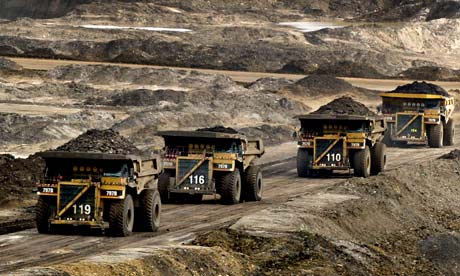
      Mining trucks carry loads of oil-laden sand in Alberta, Canada. Photograph: Jeff Mcintosh/AP

      A fierce battle over whether the European Union will officially label oil produced from tar sands as highly polluting comes to a head on Thursday with a crucial vote.

      The issue is seen as a key test of the EU’s ability to implement its climate change policies amid pressure from the Canadian government and oil companies’ ability to prevent billions of barrels of tar sands oil being designated as especially harmful to the environment. The lobbying has been intense, with Canada secretly threatening a trade war with Europe if the proposal is passed. The Nasa climate scientist James Hansen has said full development of the tar sands would mean it was “game over” for the climate.

      The issue has also drawn fire on to the UK’s transport minister, Norman Baker, whose Liberal Democrat colleagues have likened tar sands to “land mines, blood diamonds and cluster bombs”, but whose coalition government was revealed as giving secret help to Canada.

      Colin Baines, campaigns manager at the Co-operative, said: “Today is crunch time for the UK and other European governments. After years of aggressive lobbying by the Canadian government and oil industry it must now decide whether it supports their interests or Europe‘s ambition to reduce transport emissions. A vote against would threaten this globally important climate change legislation, giving the oil industry a free pass to increase the carbon intensity of its products and sending all the wrong signals to Canada about its unsustainable expansion plans.”

      The UK’s shadow transport secretary, Maria Eagle, said: “The UK government should be showing leadership, not ducking the opportunity to take an important stand over tougher labelling of highly polluting fuels. Considering the stance taken by his party before the election, it is disappointing to see Baker fail to stand up to vested interests on this issue.” The UK and Canadian governments declined to comment before the vote.

      Canada’s vast tar sands are the second largest reserve of oil after Saudi Arabia and many of Europe’s largest oil companies have major interests in the fields, including BP, Shell, Total and Statoil. The EU proposal is to label tar sands oil as causing 22% more greenhouse gas emissions than conventional oil on average, because of the extra energy needed to blast the bitumen from the bedrock and refine it. This would make it unattractive to Europe’s fuel suppliers who have to cut the impact of their products on global warming and would also set a very unwelcome international precedent for Canada.

      The Canadian government argues it is unfair to single out tar sands when some other crude oils are also highly polluting but its opponents, including Europe’s climate action commissioner, Connie Hedegaard, argue those can be dealt with in due course and that the scientific case against tars sands is clear. Canada convened a high-level private summit in 2011 to discuss winning the tar sands argument in the EU, to protect the “huge investments from the likes of Shell, BP, Total and Statoil”.

      The UK proposed an alternative “banded” approach to ascribing carbon emissions to different fuel types, which does not single out tar sands. But opponents dismiss it as a delaying tactic and the Guardian understands that the UK has failed to present its proposal formally or provide supporting evidence. In January, the Guardian revealed another compromise plan that would weaken the impact on tar sands oil, this time from the Netherlands.

      The proposal to label oil from tar sands as highly polluting will be voted on in Brussels by officials from member states, part of the delayed implementation of an EU fuel quality directive adopted in 2009. If passed by the required majority of about three-quarters, it would then go to the European parliament, where it would be expected to pass quickly into law. If there is no majority, either for or against, as appears most likely, the decision is referred up from the officials to their ministers, who then have two months to send a proposal to the parliament. If the proposal is rejected by a three-quarters majority, it goes back to the European commission for possible amendment but would face an uncertain future.

      Darek Urbaniak, at Friends of the Earth Europe, said: “European governments must defy pressure from Canada, and say no to tar sands, which will undermine Europe’s ability to reach its climate ambitions.”

      The senior Greenpeace campaigner Joss Garman said: “For a Liberal Democrat party looking to burnish its environmental credentials this vote is a key moment. In a stroke Nick Clegg and Norman Baker could make an impact on the global stage by changing the economics of investment in the dirtiest oil on Earth.”

  • From Bass Strait to the Indian Ocean: Tracking a Current

    For disaster debris arriving from Japan, radiation least of the concerns

    Posted: 22 Feb 2012 10:37 AM PST

    Later this year debris from the earthquake and tsunami that devastated Japan should begin to wash up on US shores — and one question many have asked is whether that will pose a radiation risk. The simple answer is, no.

    From Bass Strait to the Indian Ocean: Tracking a current

    Posted: 22 Feb 2012 06:42 AM PST

    Deep-diving ocean “gliders” have revealed the journey of Bass Strait water from the Tasman Sea to the Indian Ocean.
    You are subscribed to email updates from ScienceDaily: Oceanography News
    To stop receiving these emails, you may unsubscribe now.
    Email delivery powered by Google
    Google Inc., 20 West Kinzie, Chicago IL USA 60610
  • Earth’s clouds are getting lower, NASA satellite finds

    ScienceDaily: Earth Science News


    Low levels of fallout from Fukushima, U.S. study finds

    Posted: 22 Feb 2012 10:37 AM PST

    Fallout from the 2011 Fukushima Dai-ichi nuclear power facility in Japan was measured in minimal amounts in precipitation in the United States in about 20 percent of 167 sites sampled in a nationwide U.S. study.

    Earth’s clouds are getting lower, NASA satellite finds

    Posted: 22 Feb 2012 08:43 AM PST

    Earth’s clouds got a little lower — about one percent on average — during the first decade of this century, finds a new NASA-funded university study based on NASA satellite data. The results have potential implications for future global climate.
    You are subscribed to email updates from ScienceDaily: Earth Science News
    To stop receiving these emails, you may unsubscribe now.
    Email delivery powe