Author: admin

  • Labor MP Kelvin Thomson: address on Population Growth

    From Labor MP Kelvin Thomson, Population
    Growth issue protagonist. He has campaigned
    solidly against population growth.

    ———- Forwarded message ———-
    From: Hamilton, Tim (K. Thomson, MP) <Tim.Hamilton@aph.gov.au>
    Date: Wed, Feb 22, 2012 at 4:20 PM
    Subject: Is Bigger Better?
    To: “Hamilton, Tim (K. Thomson, MP)” <Tim.Hamilton@aph.gov.au>

    Tim Hamilton
    Electorate Officer
    Office of Kelvin Thomson MP
    Member for Wills
    (P) 9350 5777
    (M) 0424 138 558

  • Nuclear Alerts

    News 8 new results for DANGER TO US NUCLEAR PLANTS
    From Rocky Flats to Fukushima: our nuclear folly
    The Guardian
    The US is soon to start construction on several new reactors for the first time in three decades. Iversen, a softspoken woman with a laid-back western vibe, wearing jeans and lavender scarf, seems an unlikely prophet of nuclear catastrophe.
    See all stories on this topic »

    The Guardian
    How the Yakuza went nuclear
    Telegraph.co.uk
    Of the three reactors that melted down, one was nearly 40 years old and should have been decommissioned two decades ago. The cooling pipes, “the veins and arteries of the old nuclear reactors”, which circulated fluid to keep the core temperature down,
    See all stories on this topic »

    Telegraph.co.uk
    20 yrs nuclear plant exposure = 1 X-ray shot
    Deccan Chronicle
    By Sangeetha Nair The radiation exposure for those residing around a nuclear plant for 20 years is equal to a dose of radiation from a single x-ray! This needs to be stated because of the negative publicity attached to the Koodankulam Nuclear Power
    See all stories on this topic »
    Transcripts show NRC officials debated chairman’s claim on spent-fuel pools in
    Washington Post
    WASHINGTON — Top Nuclear Regulatory Commission officials debated the accuracy of public statements made by the agency’s chairman about a pool holding spent fuel rods at a crippled Japan nuclear plant, newly released transcripts show.
    See all stories on this topic »
    Rethinking the Nuclear Energy Renaissance
    Energy Collective
    The Nuclear Regulatory Commission recently approved a license for what is to become the first nuclear power reactor built in the US in over 30 years. The reactors, scheduled to go online sometime in 2016, would be the first nuclear reactors in the US
    See all stories on this topic »
    Importance of the Seoul Nuclear Security Summit 2012
    Korea IT Times (press release)
    The Seoul Nuclear Security Summit will be held on March 26 th -27 th , and will be the largest summit that shares international cooperative ideas to protect nuclear plants and materials from falling into the hands of terrorists.
    See all stories on this topic »
    Encryption question raised following USB stick data losses
    Security Park
    Latest news report a USB stick containing a safety assessment of a nuclear power plant in North-East England going walkabout from the Office for Nuclear Regulation (ONR). The unencrypted USB stick contained a ‘stress test’ safety assessment of the
    See all stories on this topic »
    UN nuclear inspectors now back in Tehran
    Worcester Telegram
    A currency exchange bureau worker counts US dollars, as Iranian bank notes are seen at right. Sanctions have had an effect on Iranian currency. (THE ASSOCIATED PRESS) By Alan Cowell THE NEW YORK TIMES LONDON — A team of UN inspectors arrived in Iran
    See all stories on this topic »


    Tip: Use a minus sign (-) in front of terms in your query that you want to exclude. Learn more.

    Delete this alert.
    Create another alert.
    Manage your alerts.

  • Oil Price Daily News Update

    Oil Price Daily News Update


    Falklands Flare Up – Could a New Oil Find Re-Ignite an Old Conflict?

    Posted: 20 Feb 2012 03:52 PM PST

    The Falkland Islands, a British windswept archipelago in the southern Atlantic off the coast of Argentina, last had its moment in the media spotlight two decades ago, when the two nations fought a brief but vicious conflict after Buenos Aires invaded the islands, providing a PR boost to Argentina’s ruling junta. But, Argentina lost, and the 11-week conflict claimed more than 900 lives, leaving Britain in control of the islands. UK analytical firm Edison Investment Research is now reporting that the Falklands’ oil industry…

    Read more…

    10 Ways in which Iran is Defying the US and EU Oil Sanctions

    Posted: 20 Feb 2012 03:48 PM PST

    It wasn’t supposed to be like this, the Neocons assured us. Iran would soon be on its knees because of ever more stringent US sanctions on Iran. But Iran just cheekily sent two warships through the Suez Canal to dock at the Syrian port of Tartous. The old Mubarak government in Egypt might not have allowed such a thing, but the Arab Spring has brought to power an Egyptian government eager to demonstrate its independence from Washington. Brent crude just hit $121 dollars a barrel, the highest in 8 months and a remarkable figure in the absence…

    Read more…

    Is Hush Money Coming Out of Canadian Crude Oil Debate?

    Posted: 20 Feb 2012 03:40 PM PST

    Concerns over the safety of tar sands oil from Canada is at the forefront of the political debate in the United States. President Obama’s critics accuse him of being a “job killer” for stating initial opposition to the planned $7 billion Keystone XL pipeline while his allies on the opposite side of the aisle don’t believe much of what the Republicans say about the pipeline anyway. But across the border, it seems the imbroglio is much worse. There, it seems, pipeline company Enbridge is throwing money at aboriginal groups along the country’s western…

    Read more…

    Rwanda Seeks $1 Billion Geothermal Energy Investment

    Posted: 20 Feb 2012 03:37 PM PST

    Among African nations, foreign observers can only cheer on Rwanda’s progress as it recovers from Africa’s most brutal civil conflict after the Democratic Republic of Congo (DROC). A vicious civil war erupted in 1990, led by the Tutsi Rwandan Patriotic front (RPF), which led in turn to a murderous genocidal 1994 conflict, in which Hutu extremists killed an estimated 500,000 to one million Tutsi and moderate Hutus before the RPF ended the killings with a military victory. Now, time to recover, and one of the population’s pressing…

    Read more…

    German Solar Power Covers Energy Deficit of France’s Nuclear Sector

    Posted: 20 Feb 2012 03:35 PM PST

    Remember last year when Germany decided to speed up its phasing out of nuclear power and switch to clean energy and everyone (not in the clean energy industry) got freaked out about how German electricity prices would rise and the country would just start importing electricity from France’s nuclear power plants? Well, as I just wrote, it seems pretty clear that solar photovoltaics are bringing down the cost of electricity in Germany. Additionally, German electricity exports to France have been increasing!“Because France has so much…

    Read more…

    The Future of Aviation Biofuels

    Posted: 20 Feb 2012 03:30 PM PST

    In New York, Bloomberg New Energy Finance said that jatropha-based fuels were the near-term candidate as sustainable aviation fuels available at prices competitive with conventional jet fuel. The BNEF research unit said that it expected jatropha-based jet fuel to be available at $0.86-a-litre ($3.25 per gallon) by 2018. The Bloomberg report Following the emergence of jatropha-based fuels, BNEF said that aviation fuel made from pyrolysis of woody biomass represented the next most affordable category of aviation biofuels, projecting that jet…

    Read more…

    You are subscribed to email updates from OilPrice.com Daily News Update
    To stop receiving these emails, you may unsubscribe now.
    Email delivery powered by Google
    Google Inc., 20 West Kinzie, Chicago IL USA 60610
  • WHEN OCEAN FLOOR AND CONTINENTS COLLIDE


    WHEN OCEAN FLOOR AND CONTINENTS COLLIDE


    Did you ever wonder what caused volcanoes like Mount St. Helens and Mt. Fuji to form?

    In a word — Subduction. Shishaldin
    Unimak Island, Alaska
    June 4, 1997
    Summit EL.: 9373 ft.

    Photo by U.S. Navy

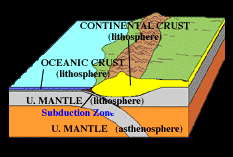
    Continents float like giant icebergs atop the upper mantle. The uppermost mantle is composed of a rigid lithosphere and below it is a molten asthenosphere. The mantle lies so deep that there are very few places on earth where we can glimpse upthrust pieces of it, although some attempts have been made to drill into it from locations where earth’s crust is very thin.

    The upper lithosphere is also known as the earth’s crust— the cool, outer surface that we see.

    There are two types of crust:

    • 1)_oceanic crust (dark, heavy basaltic rock)
    • 2)_continental crust (relatively lighter-colored and lighter-weight granitic rock).

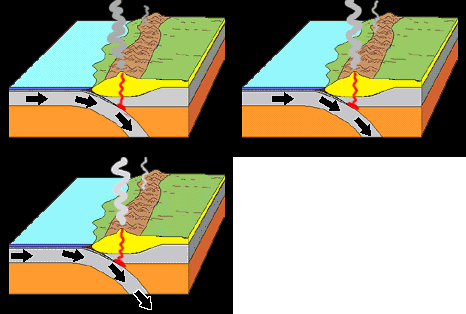
    Broken up into a number of distinct, moving tectonic plates, the lithosphere slides in constant slow- motion, driven by convection currents originating deep inside the earth which in turn causes lateral flow in the asthenosphere to drag the overlying lithosphere laterally with it. Where plate boundaries converge, this motion causes the lithosphere from one plate to be dragged beneath another, where it is melted and recycled. This process is called subduction.

    This occurs generally in one of two ways:

    When oceanic crust collides with continental crust, continental crust being less dense will usually ride up over the oceanic crust. As a result oceanic crust and the upper mantle lithosphere sink deep beneath the continent, becoming melted at some depth by the tremendous heat and pressure. Some of this molten rock or magma returns to the surface, melting some continental crust in the process, sometimes reaching the surface as volcanoes and lava flows. Mountain ranges are created from the formation of these deep magmas and the effects of volcano-building.
    When continental crust collides with continental crust, however, something different happens. Because of their equal densities they simply smash into each other, bunching up. The highest mountain ranges on Earth are created when continents collide with continents, not so much from any resultant volcanic activity, but rather from direct crustal deformation resulting from the collision. Follow the link to see this in action.

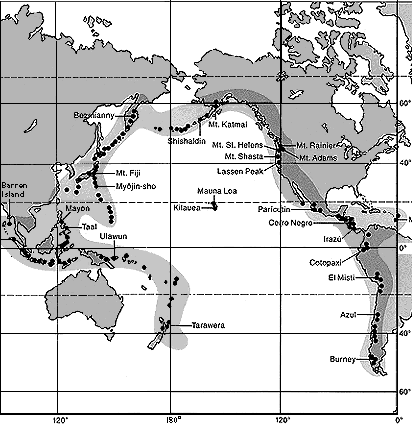
    Subduction and the forces associated with it can create spectacular mountain ranges. This is how the continuous mountain chain around the Pacific Ocean known as the “Ring of Fire” came to be– a subduction zone creating magma chambers in the upper mantle, from the tip of South America north to the Cascade Mountains and the Aleutian Islands of Alaska, then running south through Japan, Southeast Asia, and continuing as far south as New Zealand.

    The Pacific Ocean “Ring of Fire”

    Source: U.S. Department of the Interior, U.S. Geological Survey.

    Volcanoes can also form by other mechanisms besides subduction. There are spots on earth where stationary magma plumes burn like a welder’s torch at plates moving over them, creating a string of volcanoes lined up in the direction of plate motion. The Hawaiian Islands were created this way.


    || Moving Continents || Articles || Table of Contents || Next ||

    Narrative and animation by:

    Monte Hieb and Nancy Hieb
    mhieb@geocraft.com

  • Warath’s slow train to China

    The on-going saga of of the Waratah Trains. What a debacle.

    Waratah’s slow train to China – more cost-effective than going to Newcastle

    0
    waratah train

    Chinese takeway … an artist’s impression of Downer EDI’s Waratah train. Source: The Daily Telegraph

    IT was meant to be a short shunt up the track to Newcastle to have seats fitted.

    But instead, the first two Waratah trains used in Sydney are making an 18,000km round trip to China because the company that makes them said it was “more sensible and cost effective”.

    The trains – which have been used for the past two years to test the $3.6 billion project – need to be fitted out to carry passengers.

    They were to be sent from the Waratah facility at Auburn to Downer EDI’s manufacturing facility at Cardiff, near Newcastle, where the Chinese-built trains receive their final touches before hitting the rails.

    But Downer EDI yesterday admitted it had decided to send both test trains back to Changchun Railway Vehicles Company (CRC) in China.

    The two eight-car trains don’t have seats, airconditioning or other fittings required to carry passengers, Downer’s Waratah project director Ross Spicer said yesterday while announcing the company’s half-year profit result.

    “They were built very early in the stage of the design. We will return these to CRC for retro fit. We were previously going to rework these in Cardiff, but it is more cost-effective and more sensible to send them back to China CRC to re-work them and again we will be delivering them to RailCorp in 2013.”

    The first Waratah test train came on a ship to Newcastle in 2009. The test vehicles were then moved to the Cardiff rail manufacturing facility and fitted with technical testing equipment, traction inverters and electrical auxiliary power supply. In 2010 they were moved to Sydney and run as test vehicles.

    The company yesterday also said it had increased its forecast liquidated damages by $20 million to $170 million because of delays surrounding the delivery of the Waratah trains to Railcorp.

    With costs escalating to $200,000 per month for each train not in service, the total projected liquidated damages for the project has blown out further with delays of 13 months behind the original timetable, it said.

    The company yesterday said its profit in the six-month period to December 31, 2011, was $85 million, compared with a $103.8 million loss in the prior comparable period.

    Earlier this week Downer EDI said that it had received completion approval from RailCorp for its seventh Waratah Train, having earlier in the month agreed on a bail-out deal with the state government in return for 100 per cent equity in the project.


  • Victorian energy companies to turn coal into oil

    May provide fuel, but will also increase emissions. The coal barons will be the winners with this. Martin Ferguson, Minister for Energy, has been touting this technology.


    Victorian energy companies to turn coal into oil

    Jess Hill reported this story on Friday, July 10, 2009 18:46:00

    MARK COLVIN: There’s a new project proposed for Victoria’s Latrobe Valley.

    The idea is to take one of Australia’s dirtiest energy resources, brown coal, and turn it into oil.

    Converting coal into oil produces more CO2 emissions than regular petrol.

    Energy consultants and environmentalists are critical of this new plant as a retrograde move away from alternative fuels.

    But supporters say the technology could eventually produce nine per cent of Australia’s fuel requirements and add $15 billion to the national economy every year.

    Jess Hill prepared this report.

    (music plays: ‘Miner’s Prayer’ by Dwight Yoakam)

    JESS HILL: Victoria sits on top of 25 per cent of the planet’s brown coal.

    LEN HUMPHREYS: Our technology can turn one wet tonne of brown coal into one barrel of oil. So you’re turning an abandoned orphan resource into a mainstream energy product that could lead to national fuel security, you know just from what’s in the Latrobe Valley.

    JESS HILL: That was Len Humphreys, the chief executive of Ignite Energy Resources.

    Earlier this week, Ignite announced a partnership with mining company TRUEnergy to turn brown coal from Victoria’s Latrobe Valley into oil.

    From 2010, the companies plan to produce 60,000 barrels of oil a year. But according to Len Humphreys, the potential is far greater than that. He says Victoria has enough coal to produce more oil than all of the Middle East put together.

    But using coal to produce oil is controversial. According to the science journal Nature, the conventional process of extracting the oil produces 98 per cent more CO2 emissions than conventional petrol.

    Bob Gordon is the executive director of Renewable Fuels Australia.

    BOB GORDON: How are they going to successfully handle the emissions? It’s just difficult to come to grips with even why we’re going down this path.

    JESS HILL: The proponents say the new plant employs a different process which reduces the CO2 emissions produced.

    Victoria’s Energy and Resources Minister Peter Batchelor is enthusiastic about the project.

    PETER BATCHELOR: We’re very keen to make sure that there is new investment in the Latrobe Valley. It’s going to be an area that’s going to be impacted by the introduction of the Carbon Pollution Reduction Scheme, and for its economic future we need to see the continued use of brown coal in a much more environmentally friendly way.

    JESS HILL: A spokesman for the Federal Minister for Resources and Energy, Martin Ferguson, told PM that the proposal seemed to be driven by an interest in raising share prices, and that the slick PR campaign did not provide sufficient detail on its methods.

    Advocates of liquefied coal point to carbon capture and storage as a way to minimise the greenhouse gas emissions produced during the conversion process. This technology however is still being developed.

    Critics say it will be difficult for the Victorian Government to reduce its carbon footprint and support projects like this at the same time.

    Dr Hugh Saddler is the managing director of Energy Strategies, a consulting firm that provides energy advice and analysis to government.

    HUGH SADDLER: On the one hand they’re always talking about reducing their emissions. If they start burning more brown coal for these sort of things it will be extremely difficult to do that.

    Really, if we’re serious about cutting greenhouse gas emissions, we can’t afford to use this stuff. We’ve got to think about what our low emission energy system is going to look like, and what role the Latrobe Valley with all those skilled workers and the infrastructure can be used for in the context of the energy system we need to move towards.

    MARK COLVIN: Hugh Saddler, managing director of Energy Strategies, ending Jess Hill’s report.