Author: admin

  • Coastal planning controls removed


    Last week the government touted the heritage protection given to parts of the town as a decision aimed at quelling opposition to the development.

    Now it has emerged that the state environment planning policy No. 71, which overrides all coastal planning controls to ensure public access to beaches, limits to overshadowing and ensuring the scenic quality of the coast, will not apply to the proposed development.

    In the environmental planning policy put forward for Catherine Hill Bay, it is stated that neither state environmental planning policy No. 1, which relates to development standards, or No. 71, which relates to coastal protection, will apply.

    The proposed development has been mired in controversy, with the Land and Environment Court rejecting the initial plans last year due to a claimed unlawful land swap by Rosecorp for as many as 800 dwellings at Catherine Hill Bay.

    ”It means the developer can build on the headland and right on Moonee beach,” Sue Whyte, a resident, said.

    ”We’re terribly upset about it. An approval would exceed the plans approved originally by [the former planning minister] Frank Sartor. This is paving the way for an outrageous development.”

    The opposition planning spokesman, Brad Hazzard, said the government ”appears to be falling over itself to steamroll” coastal protection planning policy. ”The question has to be asked: why? The draft SEPP for the development purports to switch off the SEPP 71 coastal protection,” he said.

    ”Despite the fact that this policy cannot be switched off, since SEPP 71 incorporates … all future legislation and policies … At best, perhaps it is sloppy drafting. At worst, it would appear state Labor has some very questionable intent to switch off what everybody has said is a good policy to protect our coast.”

    A spokesman for the Planning Minister, Tony Kelly, said the state environmental planning policy drawn up for the Catherine Hill Bay development was stronger than SEPP 71 and provided greater protection.

    ”The proposed SEPP includes specific provisions relating to development in coastal areas, which deliver stronger coastal protection outcomes than SEPP 71,” he said.

    ”Similarly, the proposed SEPP also does retain the key elements of SEPP 1 … These changes are in line with a Department of Planning policy to make planning instruments easier to understand, by including relevant planning provisions applying to the land within the one instrument.”

    There are also concerns the government may be seeking to expedite development approvals.

    ”The problem with the government’s approach is worse than it first appears, since they’re dealing with the rezoning even before the development application has been lodged,” one source who has analysed the proposal said.
     

  • Decision tipped tomorrow on electoral challenge.


    The advocacy group GetUp! has put forward the cases of two young Australians who will not be able to vote in the upcoming federal election because they missed enrolment deadlines.

    But the Commonwealth’s Solicitor-General told the court that even if people are given longer to enrol there will always be citizens who miss out on voting.

    GetUp! says the laws could have potentially excluded more than 100,000 people from voting in this month’s federal election.

    Tags: government-and-politics, elections, federal-government, law-crime-and-justice, courts-and-trials, australia


  • Capital city folk pessimistic on infrastructure


    Both parties are trying to distance themselves from the idea of a big Australia, with the Liberals pledging to put a cap on annual immigration and Labor insisting the high levels of recent years are already coming down.

    The research shows that people in Australia’s biggest cities understand population growth cannot be avoided and that 27 per cent of respondents overall feel their their quality of life will get worse as a result.

    But there are significant regional differences, with 36 per cent of Sydneysiders feeling pessimistic about this compared with 23 per cent in Brisbane and 21 per cent in Melbourne.

    In contrast, only 22 per cent of Sydneysiders believe their quality of life will improve compared with 40 per cent of Brisbane residents.

    The issue of population growth combined with inadequate services is particularly controversial in western Sydney, with Prime Minister Julia Gillard repeatedly suggesting there is not enough room to fit all these people without making any commitments on new infrastructure.

    “The community resents being treated as fools,” GA Research head Sue Vercoe said. “They want governments to make the hard calls and be prepared to explain the rationale behind their thinking but not to delay these important decisions for the sake of short-term political advantage.”

    But the focus group work in Sydney, Brisbane and Melbourne also reveals a lack of understanding of where the money would come from to fund significant new infrastructure, with most people assuming the government should be able to pay for what is required.

    While Labor has promoted its increased investment in infrastructure over the past few years, the massive funding required means it is essential to involve the private sector even though neither major party is talking about this.

    “Very few (respondents) know what public-private partnerships are and misunderstandings about them are rife,” the researchers said.

    The study shows that people are willing to change their own behaviour, particularly in relation to water and power use, although they acknowledge this might require extra charges or more regulation.

    As well as better public transport, people want a more decentralised approach to living and working and a greater focus on renewable energy.


  • NSW to scrap Area Health Services


    The State Government says the establishment of the networks will de-centralise public hospital management, increasing local accountability to drive improvements in performance.

    The Premier says the changes will deliver an extra $1.2 billion in funding to the state’s health system.

    The government is asking for submissions on the new proposal.

    Tags: government-and-politics, federal-state-issues, parliament, state-parliament, states-and-territories, health, health-administration, australia, nsw

    First posted 3 hours 1 minute ago

  • Stop beating about the bush and talk about Big Australia


    Illustration: Kerrie Leishman

    John Howard used his harsh treatment of boat people to divert attention from his rapidly growing immigration program. Kevin Rudd continued the high immigration, but without the camouflage.

    Growing punter angst about the return of the boat people collided with Rudd’s announcement of Treasury’s latest projection that, given various assumptions, the population could reach 36 million by 2050 and his happy confession to believing in a Big Australia. The punter reaction was negative. Rudd never used the phrase again, but appointed a minister for population whose main job was to repeat that the 36-million figure was merely a Treasury projection, not a policy or a target.

    Fanned by the shock jocks and an opportunist opposition, the angst about boat people grew. In her efforts to neutralise the asylum-seeker issue – and, no doubt, informed by focus-group research – Julia Gillard judged it necessary to say she did not believe in a Big Australia. She wanted an Australia that was sustainable, and had added that word to the population minister’s title.

    But then she claimed population had nothing to do with either natural increase or immigration, which suggests her intention was to make soothing noises rather than change policy. Not to be outdone, Tony Abbott popped up with a policy to get immigration to levels ”we believe are economically, environmentally, and politically, if you like, sustainable”. He planned to rename the Productivity Commission the productivity and sustainability commission and get it to advise which population growth path it considered sustainable.

    Gillard and Abbott have attracted criticism from commentators wedded to the old way of doing things, but the end of the conspiracy of silence is a good thing. Whatever the public’s reasons for frowning on immigration, it does have disadvantages as well as advantages and the two ought to be weighed and debated openly.

    The two leaders’ adoption of the term ”sustainable” has been attacked as vacuous – who, after all, would want any policy that was unsustainable? – but we do need to be sure the population policy we’re pursuing is sustainable. That, in Abbott’s words, it does not ”rob future generations of the quality of life and opportunities we currently enjoy”.

    It’s true politicians and economists have used the term to mean whatever they’ve wanted it to mean, but that’s why it needs to be held up to the light. I suspect those scientists who argue we’re close to the limits of our natural environment’s ”carrying capacity” are right, and the economists’ airy argument that technological advance will solve all problems is wrong.

    So let’s get both sides out of their corners to debate the issue in front of us. We can’t continue treating the economy like it exists in splendid isolation from the natural environment. Even when you ignore the environmental consequences, the proposition that population growth makes us better off materially isn’t as self-evident as most business people, economists and politicians want us to accept. Business people like high immigration because it gives them an ever-growing market to sell to and profit from. But what’s convenient for business is not necessarily good for the economy.

    Since self-interest is no crime in conventional economics, the advocates of immigration need to answer the question: what’s in it for us? A bigger population undoubtedly leads to a bigger economy (as measured by the nation’s production of goods and services, which is also the nation’s income), but it leaves people better off in narrow material terms only if it leads to higher national income per person.

    So does it? The most recent study by the Productivity Commission found an increase in skilled migration led to only a minor increase in income per person, far less than could be gained from measures to increase the productivity of the workforce.

    What’s more, it found the gains actually went to the immigrants, leaving the original inhabitants a fraction worse off. So among business people, economists and politicians there is much blind faith in population growth, a belief in growth for its own sake, not because it makes you and me better off.

    Why doesn’t immigration lead to higher living standards? To shortcut the explanation, because each extra immigrant family requires more capital investment to put them at the same standard as the rest of us: homes to live in, machines to work with, hospitals and schools, public transport and so forth.

    Little of that extra physical capital and infrastructure is paid for by the immigrants themselves. The rest is paid for by businesses and, particularly, governments. When the infrastructure is provided, taxes and public debt levels rise. When it isn’t provided, the result is declining standards, rising house prices, overcrowding and congestion.

    I suspect the punters’ heightened resentment of immigration arises from governments’ failure to keep up with the housing, transport and other infrastructure needs of the much higher numbers of immigrants in recent years.

    This failure is explained partly by the rise of Costelloism – the belief all public debt is bad – but mainly because the federal hand has increased immigration while the state hand has failed to increase housing and infrastructure.

    At its best, the message to the elite from the unwashed of the outer suburbs is: if you want more migrants, first get your act together.

    Ross Gittins is economics editor.

  • Climate deal loopholes ‘Make farce’ of rich nations’ pledges


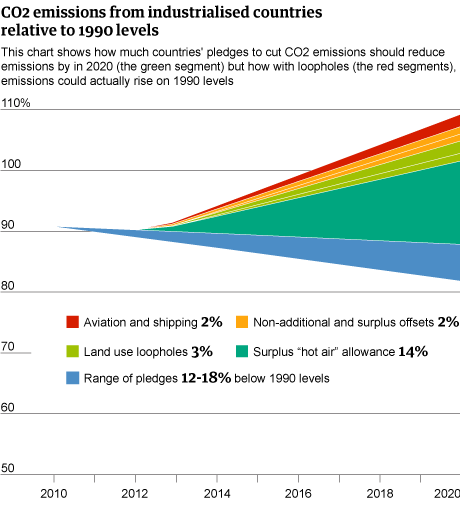
    The research factored in four separate loopholes that are known to exist, but which countries have so far failed to address in the negotiations. These include land use and forestry credits, carbon offset credits gained from UN Clean Development Mechanism schemes, surplus carbon allowances accumulated by former Soviet countries and international aviation and shipping emissions, which are not currently included in emission reduction schemes proposed by countries.

    “Industrialised countries pledged a modest reduction in their emissions at the Copenhagen talks last year, but the these loopholes would actually allow them to grow them substantially well into the future,” said Sivan Kartha, senior scientist at the Stockholm Institute.

    “This means they [rich nations] need not do anything to hold emissions. They could accumulate huge amounts of credits to continue business as usual,” he said.

    “The more we look into the loopholes the worse it gets. The whole thing begins to look like a farce”, said Lim Li Lin, a legal specialist with TWN.

    In a separate submission to governments, Pablo Solon, Bolivia’s ambassador to the UN, claimed that industrialised countries were filling all the available atmosphere with carbon pollution, and preventing poor countries from developing. Solon quoted peer-reviewed research by leading Nasa scientist Jim Hansen and the German government’s Advisory Council on Global Change which, he said, showed that the world had a “budget” of 750 gigatonnes of CO2 over the next 40 years if it sought a 66% chance of holding temperature rises to under 2C. The world had a smaller budget of just 420GT of CO2 if it wanted to stay below 1.5C, as more than 100 countries have so far demanded.

    “With the current pledges on the table, we have calculated that the Annex 1 (industrialised) nations are going to spend the whole [carbon] budget of the next 40 years in the next 10 years,” Solon said. “What is on the table has no relation to any target that [rich countries] have established. It is like a salary. If you spend it all in the first week then you have nothing left for the rest of the month.”

    “Copenhagen demonstrated disastrously low levels of ambition and rich countries are trying shamelessly to wriggle out of even the weak commitments they have made,” said Asad Rehman, international climate change campaigner at Friends of the Earth. “The science is clear. Developed countries must stop trying to hide behind technicalities hidden in the negotiations,” he said.

    CO2CHART.gif