Author: admin

  • Gunns abandons legal chase

    Gunns abandons legal chase

    ABC January 30, 2010, 2:26 pm


    Tasmanian timber company Gunns has dropped legal action against a group of conservationists.

    The company took action in 2004 against 17 environmentalists and three organisations, claiming they had hurt its business by protesting, trespassing and damaging machinery.

    Now Gunns has announced it will pay $155,000 towards the legal costs of the four remaining defendants to end the proceedings.

    One of the individuals being sued Adam Burling, who works for the Huon Valley Environment Centre, says it is a win for free speech.

    “The case had the potential to set a dangerous precedent where anyone who spoke out against any development in Australia could potentially be sued,” Mr Burling said.

    “Gunns pursued us for more than five years and has spent millions of dollars hounding us through the courts … it’s an embarrassing backdown.”

    Australian Greens Senator Bob Brown says the Government should introduce legislation to discourage corporations from pursuing dissenting individuals.

    “We need governments to legislate, as the Australian Capital Territory has done and many states in the US, to prevent actions like this against citizens who are taking a reasonable and opposite point of view to developers in the great debates about the environment,” Senator Brown explained.

    Gunns says the settlement is a commercial decision.

  • Greenpeace calls for a ban on Arctic oil drilling

    Greenpeace calls for a ban on Arctic oil drilling

    Ecologist

    25th January, 2010

    Immediate moratorium on all activity by oil and gas industries would help safeguard the local community and ecosystem as well as reduce potential carbon emissions

    Plans by the EU, US and China to exploit oil and gas reserves in the Arctic have been criticised by Greenpeace as ‘unsustainable’ and a threat to the region’s ecosystem.

    Countries have rushed to lay claim to areas of the Arctic Ocean during the past few years, following predictions such as those made by the US Geological Survey that as much as 22 per cent of the world’s undiscovered fossil fuel resources could lie there.

    Boom and bust

    Speaking at the annual Arctic Frontiers conference, Greenpeace’s Nordic Executive Director, Mads Flarup Christensen, said oil and gas drilling would bring ecological boom-and-bust to the Arctic.

    ‘In the shorter term there is economic development and jobs, but they do not come with a guarantee that the ecosystem won’t be affected and in turn, negatively affect communities.’

    He called for an immediate ban on industrial oil and gas exploration to protect ecosystems and the communities that depend on them for their survival.

    ‘We see the moratorium as an immediate measure to address the current governance gap in the Arctic Ocean, and something that will remain in place until a more permanent, overarching treaty or agreement is established to protect this part of the Arctic Ocean from additional damage,’ said Christensen.

    No whaling or sealing ban

    Christensen added that Greenpeace was not seeking a ban on traditional or subsistence activities like whaling, sealing or fishing but only industrial activities.

    ‘It’s the oil and gas activities, industrial fishing, shipping, mining and other industrial activities that pose threats to the ecosystem. If such industrial activities are allowed without a proper governance system for the Arctic Ocean as a whole, and even before the environmental values hidden under the sea ice have been mapped or understood, it will be another tragic example of our human inability to respect the precautionary principle.’

    Christensen also criticised claims that the oil and gas extraction could be sustainable and said it was not possible because of the, ‘routine spills, leaks, emissions to air and waster, vessel and air traffic, industrial noise and all manner of disturbance that takes place during the exploration, extraction and transportation of oil and gas’.

    Shell opposition

    Meanwhile, an alliance of conservation and Alaskan indigenous groups have issued a legal challenge in the US in an attempt to block drilling plans by the oil giant Shell.

    The alliance accuses the minerals management service (MMS), part of the federal Department of the Interior, of waving through permission to allow Shell to invest £1.3 billion in Alaskan exploration, disregarding the environmental dangers.

    The executive director of Pacific Environment, one of the plaintiff organisations, David Gordon, said:
    ‘Shell’s plan for the Arctic is too much, too soon, too fast, especially in light of community concerns and the effects of climate change that we are already seeing in the Arctic.’

    Useful links

    Arctic Frontiers conference

  • Car makers ‘failing consumers’ on emission data


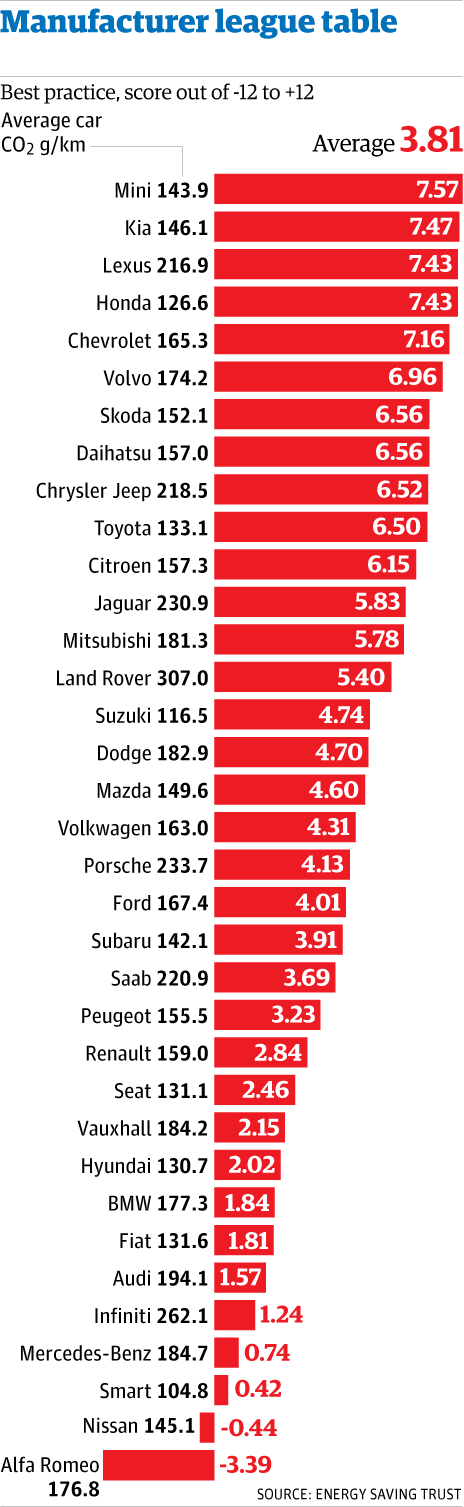
    The online survey involving members of the public found that only half (52% of attempts by consumers to find CO2 figures for specific UK cars were successful. Less than 5% of the 363 people who took part came across the widely recognised A-G energy efficiency label while attempting to look up emissions data.

    Mini, Kia, Lexus and Honda were lauded for the ease of use and accessibility of finding CO2 data on their sites, while the worst – ranked by user experience criteria – were Alfa Romeo, Nissan, Smart, and Mercedes-Benz.

    The consultancy Ecolane, which carried out the survey, rated the websites on five “design principles” including site navigation; providing CO2 data alongside core data such as performance; how clearly individual models and different “trims” are described; whether comparative emissions information was provided (such as the A-G label); and whether the sites relied on large downloads of PDF files. The report also evaluated how long it took survey respondents to find the data.

    car league table

    The average time taken to find CO2 figures for cars ranged from 74 seconds for Lexus to nearly eight minutes for Alfa Romeo, whose site came bottom of the overall usability table. Other sites coming in for criticism included the low ranking Smart site – “very slow and difficult to find correct model. CO2 not given high importance compared to other car features such as equipment and style” and the Seat site which received the ultimate condemnation “about as easy as dealing with the civil service”. At the opposite end of the spectrum was Peugeot. One tester said: “Very easy to find the emissions data, all sites should be like this.”

    Car makers must display a car’s fuel consumption and CO2 data in their showrooms but are not legally required to do so on their sites. Marian Spain, the director of strategy at the Energy Saving Trust, said: “Nowadays most people do initial online research when looking into buying a new car. Our research shows that in many cases, finding out the running costs of cars and their impact on the environment from the car manufacturer website is like looking for a needle in a haystack.”

    Blake Ludwig, managing director for the We Are Futureproof group, said: “More and more people want to choose greener, more efficient cars, but our study shows that some car makers expect them to spend time hunting around confusing websites for information. Other car markers have got it right, putting the data upfront and easy to find, and we think all companies should have to follow this model.”

    A spokesperson for the Society of Motor Industry Manufacturers and Traders said: “Vehicle manufacturers are highly aware of the important role driver information can play in reducing road transport emissions and the significant influence this data has on a person’s purchasing decision.”

    A Department for Transport spokesperson said the government recognised that people wanted “clear information on the environmental credentials of new cars” and pointed to the requirements to show figures for new cars in showrooms and government’s voluntary scheme for used cars. But they said the government was not looking to mandate car makers to improve CO2 data on their own websites.

    Consumers can also find CO2 figures elsewhere online, such as on the government’s Act On CO2 site and the VCA website.

  • ‘Disastergate’ is an excuse tor IPCC critics to dig up old academic rows.


    The controversy centres on why the cost of repairs after hurricanes, floods and other natural disasters, has risen from $75.5bn (£46.7bn) in the 1960s to $659.9bn in the 1990s.

    Roger Pielke Junior, a professor of environmental studies at the University of Colorado, has attacked the IPCC for including in one of its reports a reference to an abstract in 2006 that indicated economic losses from disasters, even after “normalisation” to take account of inflation and growth in the number of buildings in high-risk areas, increased between 1970 and 2005. The authors of that study, led by Robert Muir-Wood (who works for my former employer, Risk Management Solutions), concluded that “we find evidence of an annual upward trend for normalised losses of 2% per year that corresponds with a period of rising global temperatures”.

    The authors offered many caveats about their results, not the least of which was the fact that the rising trend was strongly dependent on economic losses caused by hurricanes in the United States, particularly the nine that hit in 2004 and 2005.

    The six-page abstract, taken from a workshop presentation, was cited both in the review of the economics of climate change by Nicholas Stern in 2006 and in Chapter 1 of the volume by working group II in the IPCC Fourth Assessment Report in 2007, which stated: “Global losses reveal rapidly rising costs due to extreme weather-related events since the 1970s”. It pointed out “one study” found that an underlying rising trend in losses still remains, even after adjustments for inflation and increases in the numbers of exposed buildings.

    Pielke has several times on his blog since 2006 attacked both the Stern Review and the IPCC report for referring to the work by Muir-Wood. He argues that the abstract from the workshop, which Pielke organised with the company Munich Re (which also funds research at London School of Economics and Political Science on the implications of climate change for the insurance industry), was not peer-reviewed.

    Therefore, Pielke insists, the reports should have relied on other papers, such as those that he has written about hurricane losses, which conclude that the upward trend can be explained away completely by economic factors and that there is no evidence for the impact of climate change.

    The trouble with Pielke’s argument is that the work of Muir-Wood and his colleagues was eventually published as a peer-reviewed paper in 2008 (and included as chapter 12 of the book Climate Extremes of Society) and included the same conclusion. It remains the only paper to assess global economic losses from all types of extreme weather events, not just a single source of hazard in one region.

    Pielke is right that an increase in the number of valuable properties in high-risk areas is overwhelmingly the primary cause of increased financial losses from extreme weather events over the past few decades. That in itself is a worrying conclusion given that climate change is expected to lead to changes in the occurrence and severity of such events. Indeed, only last week a paper in the journal Science by researchers at the United States National Oceanic and Atmospheric Administration projected nearly a doubling in the frequency of the most severe hurricanes in the Atlantic by the end of this century.

    But it is difficult to tell to what extent, if any, climate change has also already affected past disaster losses around the world. Extreme weather events are rare, so identifying small trends is difficult when losses vary so much from year to year, creating a lot of “noise” in the dataset, and many competing factors contribute to the overall pattern.

    The absence of a “statistically significant” trend may indicate that no trend exists, or instead that a trend exists but cannot be definitively detected until a longer period of losses is available.

    What is clear is that it would be wrong to think of this as another mistake by climate researchers. In fact it looks more like a blatant attempt to dig up an old academic row in order to create the impression of an IPCC under siege.

    • Bob Ward is policy and communications director at the Grantham Research Institute on Climate Change and the Environment at London School of Economics and Political Science.

  • Wator vapour caused one-third of global warming in 1990s, study shows


    The experts say their research does not undermine the scientific consensus that emissions of greenhouse gases from human activity drive global warming, but they call for “closer examination” of the way climate computer models consider water vapour.

    The new research comes at a difficult time for climate scientists, who have been forced to defend their predictions in the face of an embarrassing mistake in the 2007 report of the Intergovernmental Panel on Climate Change (IPCC), which included false claims that Himalayan glaciers could melt away by 2035. There has also been heavy criticism over the way climate scientists at the University of East Anglia apparently tried to prevent the release of data requested under Freedom of Information laws.

    The new research, led by Susan Solomon, at the US National Oceanic and Atmospheric Administration, who co-chaired the 2007 IPCC report on the science of global warming, is published today in the journal Science, one of the most respected in the world.

    Solomon said the new finding does not challenge the conclusion that human activity drives climate change. “Not to my mind it doesn’t,” she said. “It shows that we shouldn’t over-interpret the results from a few years one way or another.”

    She would not comment on the mistake in the IPCC report – which was published in a separate section on likely impacts – or on calls for Rajendra Pachauri, the IPCC chairman, to step down.

    “What I will say, is that this [new study] shows there are climate scientists round the world who are trying very hard to understand and to explain to people openly and honestly what has happened over the last decade.”

    The new study analysed water vapour in the stratosphere, about 10 miles up, where it acts as a potent greenhouse gas and traps heat at the Earth’s surface.

    Satellite measurements were used to show that water vapour levels in the stratosphere have dropped about 10% since 2000. When the scientists fed this change into a climate model, they found it could have reduced, by about 25% over the last decade, the amount of warming expected to be caused by carbon dioxide and other greenhouse gases.

    They conclude: “The decline in stratospheric water vapour after 2000 should be expected to have significantly contributed to the flattening of the global warming trend in the last decade.”

    Solomon said: “We call this the 10, 10, 10 problem. A 10% drop in water vapour, 10 miles up has had an effect on global warming over the last 10 years.” Until now, scientists have struggled to explain the temperature slowdown in the years since 2000, a problem climate sceptics have exploited.

    The scientists also looked at the earlier period, from 1980 to 2000, though cautioned this was based on observations of the atmosphere made by a single weather balloon. They found likely increases in water vapour in the stratosphere, enough to enhance the rate of global warming by about 30% above what would have been expected.

    “These findings show that stratospheric water vapour represents an important driver of decadal global surface climate change,” the scientists say. They say it should lead to a “closer examination of the representation of stratospheric water vapour changes in climate models”.

    Solomon said it was not clear why the water vapour levels had swung up and down, but suggested it could be down to changes in sea surface temperature, which drives convection currents and can move air around in the high atmosphere.

    She said it was not clear if the water vapour decrease after 2000 reflects a natural shift, or if it was a consequence of a warming world. If the latter is true, then more warming could see greater decreases in water vapour, acting as a negative feedback to apply the brakes on future temperature rise.

  • The game has changed and so should the PM


    He could also alleviate the subterranean angst in his own ranks among Labor MPs who are feeling the heat on an ETS in electorates concerned about jobs, and head off industry-funded advertising campaigns that have already had an impact in some areas.

    Yet Rudd, like Climate Change Minister Penny Wong, can’t bring himself to face political reality and dump a dud, at least until there are signs of real international progress that doesn’t make Australia look like it’s tilting at windmills (or coal-fired generators) without effect and at great cost.

    Rudd’s attachment looks dangerously like an ideological commitment to a scheme that is opposed from both ends of the political spectrum and unlikely to find any validating action from the world’s biggest producers of greenhouse gases.

    In part, this reluctance to show any hint of a policy shift is a product of Labor’s successful three-year campaign to equate action on climate change with an ETS, and, specifically, the Carbon Pollution Reduction Scheme. This will be defiantly put to parliament next week by Wong without any real hope of passing the Senate.

    Of course, Rudd’s not going to abandon his overall position on climate change or his commitment to market-based solutions to cutting greenhouse gas emissions by putting a price on carbon. But he doesn’t have to keep an emissions trading scheme front and centre of his political campaign.

    If he doesn’t take stock of the domestic and international political conditions and adjust accordingly, he runs the risk of appearing to be as ideologically driven and politically blind to the dangers as John Howard was to the obvious dangers of the Work Choices industrial relations changes.

    The facts have changed dramatically since the 2007 election campaign, when the central point of difference between the Coalition and the ALP was the ratification of the Kyoto Protocol. Rudd ratified the Kyoto agreement, with little practical effect other than slightly lifting Australia’s carbon emissions reduction target, which we are still on track to meet without an ETS.

    The failure of the UN’s Copenhagen climate change conference to forge any sort of agreement out of discussions in which Rudd and Wong were central characters also demonstrates that claims ratification of the Kyoto Protocol would give Australia a world voice and put us “at the table” amounted to little.

    The Liberal Party’s change of leadership and change of heart over supporting a modified ETS completely changed the expectations and possibility of a carbon emissions scheme because the Abbott-led Coalition and the Senate independents believed the CPRS went too far in its objectives and the Greens felt it didn’t go nearly far enough.

    The bill failed in such a manner that the double-dissolution election trigger it delivered was useless even if the government wanted to go to an early election.

    In between times the Copenhagen failure has demonstrated three things: that the world’s biggest carbon emitters, China, the US and India, were not going to agree to any binding or verifiable reduction targets; that the developing world is demanding compensation from the developed world; and that the global emphasis, as demonstrated by US President Barack Obama in his State of the Union speech yesterday, is shifting away from emissions trading to clean energy, such as nuclear power, and technological development.

    As for reducing greenhouse gas emissions, the Greens were quite right to claim yesterday that Wong wouldn’t guarantee that the proposed CPRS would cut carbon emissions, because she couldn’t.

    Not only has carbon emissions trading failed to realistically cut emissions in Europe or assist most European Union nations in meeting their Kyoto targets, but the only target Wong was able to adopt this week was an unconditional cut of 5 per cent by 2020.

    That’s less than a third of the minimum reduction target the government’s climate change adviser Ross Garnaut has advocated, and it’s less than a fifth of the minimum the Greens want. It happens to be the same target Abbott committed to last year, standing under a tree outside his parliamentary office. It’s also a target Coalition climate change spokesman Greg Hunt says can be easily achieved without resorting to a costly ETS.

    As for “business certainty” – the mantra that it’s better for business to know what costs it will face and what demands will be placed on it by providing a firm target and price for carbon per tonne – Wong was unable to provide that in adopting the Copenhagen Accord. When asked about business certainty, Wong said on Thursday: “What we’re saying is: in the absence of those conditions [overseas commitments], the target is 5 per cent.

    “And if those conditions are met, then obviously we’ll be altering the target consistent with the conditions we previously put out.” And that decision, or not, will be taken some time, perhaps, in 2011.

    Rudd really wanted to lead the world on climate change, he wanted to found an ETS and he wanted to do it before Christmas last year so that it could be up and running by 2011.

    He’s been frustrated by political opposition, international intransigence and economic reality.

    Rudd should regroup, refashion his political campaign for an election year and move on to the broader issues of health, tax reform and economic management. Such a step has been made harder by his own rhetoric and political gamesmanship but the facts and political atmosphere have changed, and so should he.