Author: admin

  • Alaskan senator seeks to block EPA’s power to regulate greenhouse gases


    “We cannot turn a blind eye to the EPA’s efforts to impose back-door climate regulations,” Lisa Murkowski told the Senate in prepared remarks. Murkowski’s motion of disapproval, though unlikely to become law, is widely seen as a barometer for the chances of getting a climate change bill through the Senate this year.

    In an ominous sign for supporters of a climate law, she had the support of three Democratic Senators, further underscoring the unease in Obama’s own party in enacting legislation to tackle global warming.

    Delivering new laws to tackle global warming was not just a key pledge of Obama’s, but is being closely watched around the world as global climate change negotiations struggle to recover from the disappointment of the UN summit in Copenhagen. An environment official in the European Union said: “It’s clearly a setback.”

    Murkowski’s move, brought under the Congressional Review Act, would remove the Obama administration‘s “Plan B” for dealing with climate change, resorting to the EPA to curb greenhouse gas emissions if Congress fails to act.

    The motion of disapproval, called the “nuclear option” by environmentalists, would also ban the administration from drafting any new regulation that would be substantially the same. That would make it even more difficult for any US government to regulate power plants and other big emitters.

    Environmentalists say the proposal is unlikely to pass, but ensuring its defeat could require a new round of partisan warfare that could be damaging for Democrats and Obama’s agenda.

    In her speech, Murkowski argued that giving the EPA the authority to act on global warming would cost jobs and hurt the economy: “Under the guise of protecting the environment, it’s set to unleash a wave of damaging new regulations that will wash over and further submerge our struggling economy.”

    She said she supported efforts to get a climate change law, but said: “This command-and-control approach is our worst option for reducing the emissions.”

    Murkowski has tried to cast herself as a moderate Republican who would be prepared to act on climate change. But she has voted against such legislation in the past, and has been criticised this week by environmentalists for her links to the energy industry.

    According to the Centre for Responsive Politics, Murkowski, from the oil-rich state of Alaska, has received $244,000 (£151,205) in campaign funds from oil and gas companies since 2005, and consulted two energy industry lobbyists before launching today’s proposal.

    Even before the upset in Massachusetts, Democrats in the industrial heartland and from oil and coal states were wary – or in some cases flatly opposed – to action on climate change.

    Murkowski was joined today by Mary Landrieu, a Democratic Senator from Louisiana who has repeatedly expressed concern for her state’s oil refining business; Senator Blanche Lincoln of Arkansas; and Senator Ben Nelson of Nebraska. Murkowski also claimed support from governors of her home state of Alaska, Mississippi and West Virginia as well as business organisations. Jim Webb, a Democrat from Virginia, has also expressed support for Murkowski.

    But there has also been a strong push back against Murkowski from environmental organisations and other business groups. A coalition of 80 companies from Virgin America to eBay wrote to Obama today urging action on climate change.

    The Alaskan’s resolution would overturn the EPA’s finding last month that greenhouse gas emissions were a public health threat. The so-called endangerment finding compelled the agency under the Clean Air Act to introduce regulations for the pollutant.

    Murkowski’s strategy hinges on using the Congressional Review Act, a law used for the first time in the early days of the George Bush era to throw out new ergonomic standards for workplaces passed under Bill Clinton. The measure would require only 51 votes for passage and the Senator is confident of signing up all 40 Republicans as well as some Democrats.

    The White House, the EPA, and even the Democratic leadership in Congress have all said they would prefer to have climate change legislation from Congress rather than resorting to the agency’s regulatory powers. But the prospect of EPA regulation had been seen as an important nudge to get the Senate to act.

    The House of Representatives passed a climate change bill last June, but progress in the Senate has stalled. An effort led by Democrat John Kerry to craft a bill that could pull in Republican support has yet to produce a draft proposal.

    The move by Murkowski brought a furious response from Democratic leaders and a coalition of environmental, business and religious organisations. Barbara Boxer, the California Democrat said blocking the EPA was a radical move that would expose Americans to public health risks from global warming. The Union of Concerned Scientists said it was an assault on science, and California’s governor, Arnold Schwarzenegger, wrote a letter asking his fellow Republicans to let the EPA do its work.

  • The electric car revolution will soon take to the streets


    The North American International Auto Show in Detroit is the domestic auto industry’s biggest annual showcase, and the new models have traditionally been brought out in a son et lumière of dancing girls, deafening music, and dry ice smoke. The few green cars that made it this far were usually for display only — very few actually made it to showrooms.

    But not this year. It’s become a race to market for green cars, and soon you’ll be able to buy many of the electric vehicles that were on display last week in Detroit. The auto show featured one hybrid and battery electric car introduction after another. Although the only truly road-worthy, plug-in electric vehicle you can buy today is the $109,000 Tesla Roadster, by the end of 2010 it will be joined by such contenders as the Nissan Leaf, Coda sedan, and the Think City.

    Indeed, the entire auto industry — from giants such as Ford, GM, and Renault-Nissan to startups such as Fisker Automotive — has joined the movement to build and market affordable electric vehicles.

    There’s a reason the automakers in Detroit are finally plugging in as something more than a greenwashing exercise. Spurring them forward is a historic confluence of events. Chief among them are Obama administration green initiatives, including Department of Energy (DOE) loans and grants, as well as economic stimulus funds that provide $30 billion for green energy programs, tax credits for companies that invest in advanced batteries, and $2.4 billion in strategic grants to speed the adoption of new batteries. (Much of that money is going to Michigan, which despite record unemployment is emerging as something of a green jobs center.)

    Other factors behind the push to manufacture electric vehicles are a federal mandate to improve fuel efficiency to an average of 35.5 miles per gallon by 2016, concerns about global warming and peak oil, and sheer technological progress building better batteries.

    Even without federal largesse, some companies are moving aggressively into the electric vehicle market. A prime example: Coda Automotive, a southern California start-up, has raised an impressive $74 million in three rounds of private funding. CEO and President Kevin Czinger is a former Goldman Sachs executive, as is co-chairman Steven Heller. Among the company’s investors are Henry M. Paulson, who was Goldman Sachs’ chairman and Treasury Secretary under the second President Bush. Clearly, these former investment bankers see electric cars as a good bet.

    A key factor in making today’s electric vehicles possible is the rapid development of the energy-dense lithium-ion battery. William Clay Ford Jr., the executive chairman of the company that bears his name, told me in Detroit, “Five years ago, battery development had hit a wall, and we were pushing hydrogen hard. But now so much money and brainpower has been thrown at electrification that we’re starting to see significant improvements in batteries in a way we hadn’t anticipated. Now we have the confidence that the customer can have a good experience with batteries.”

    Drawing a huge crowd, Tesla Motors Chairman and CEO Elon Musk showed off his company’s 1,000th electric Roadster at the auto show. “For a little company, it’s a huge milestone,” he told me. “A year ago, we had built only 150 cars. We had two stores then, and now it’s a dozen.”

    For a major automaker, 1,000 cars would not be much to show for a year, but electric vehicles are still in their infancy. And since the electric car’s first swan song in the 1920s — when the widespread availability of petroleum ushered in the era of the gasoline-powered car — very few start-up companies have reached the milestone of making green vehicles, especially battery-powered ones.

    Here’s a look at some of the prime contenders bringing battery cars and plug-in hybrids to market:

    * Renault-Nissan Alliance. This is the one automaker with a truly global plug-in strategy and the means to carry it out. Under the Nissan banner, the company will deploy the Leaf battery sedan, with 100-mile, all-electric range. Nissan isn’t just dumping its sleek entry into the market — it’s also building a home charger with new partner AeroVironment and partnering with local, state and federal governments — both in the U.S. and abroad — on public charging stations. In partnership with Better Place, the company will deploy a second Renault electric vehicle as part of its plan to wire up Israel with charging stations for electric cars. Renault-Nissan chief Carlos Ghosn predicts that electric vehicles could constitute 10 percent of world car sales by 2020.

    * Ford Motor Company. Ford’s green strategy includes a plug-in version of the new Focus for 2011 and a “next-generation” hybrid — based on its global compact-car platform, or C-platform — in 2012. The company announced in Detroit that it would invest $450 million in Michigan as part of its electrification strategy. Michigan Governor Jennifer Granholm told me at the auto show that until recently the state “wasn’t sure it had a viable auto industry.” Today, she said, the state is enjoying $1 billion in new auto-related investment, much of it jump-started by a combination of federal funding and state tax credits.

    * General Motors. GM’s big news is the Chevrolet Volt, which has definitely helped the company’s image. The Volt, which uses a small gas engine to generate electricity for its electric motor, is a lot of fun to drive if the version I drove recently in Michigan is any indication. Until now, GM has stumbled in its hybrid strategy, and it really needs this car — which will go on sale at the end of the year for a hefty $40,000 — to be a hit. But success may be more a matter of perception than actual sales. “In terms of numbers, the Volt will be pretty small for the first couple of years,” says product chief Bob Lutz. A Cadillac version of the Volt is also a possibility.

    * Tesla Motors. This California start-up launched at the top of the market with its $109,000 Roadster, which combines sexy looks with supercar performance (zero to 60 in 3.9 seconds). The company is on something of a roll, having sold 10 percent of itself to Daimler for $50 million, and landed $465 million in DOE funding for its forthcoming Model S sedan — a Maserati-like, more practical version of the Roadster. Tesla’s Musk says that the company’s strategy has always been to use its sale of performance cars to finance its third vehicle, a mass-market electric vehicle. The company is currently looking at California locations for a Model S factory.

    * Fisker Automotive. Perhaps Tesla’s closest competitor when it comes to glamour electric vehicles, Fisker – whose CEO is Danish-born automotive designer Henrik Fisker — is preparing to debut a high-performance plug-in hybrid (zero to 60 in 5.8 seconds, with 67 mpg fuel efficiency) known as the Karma at the end of the year. Al Gore is on the waiting list. Fisker also has a lower-cost car in the wings, called Project Nina. Fisker won $528 million from the DOE to build the Nina in a former GM factory in Delaware.

    * Coda Automotive. This start-up will deliver, in late 2010, a small battery-powered sedan with batteries from its own joint venture in China. The car is based on the Saibao, a Chinese car, but Coda has put a host of western companies to work honing an electric drivetrain for it. “A large part of our mission is to accelerate adoption of all-electric vehicles,” Coda CEO Kevin Czinger told me. “We have put together a core group of auto and battery engineers, and are leveraging specialty automotive firms that we think can get us to the right price point.” Coda will launch with an Internet marketing strategy in California only, but it will have the capacity to produce 20,000 cars a year.

    * Think Global. Think is a survivor, with perhaps the longest and most colorful history among green automakers. It is a Norwegian company that attracted Ford Motor Company investment in the late 1990s with its plastic-bodied City commuter car. Ford sold the company in 2003 and it went through bankruptcy proceedings in late 2008. It has since emerged under the partial ownership of U.S. battery company Ener1, which snagged $118 million in DOE funding to expand its battery production in Indiana. Think electric vehicles will also be built there starting in 2011, in hard-hit Elkhart — once proudly known as the “RV Capital of the World” — and now suffering the effects of the recession. The two-seat Think City (with approximately 100-mile range on lithium-ion batteries) will sell for less than $20,000 in the U.S., but that price does not include the leased battery pack and includes the $7,500 federal tax credit for electric vehicles.

    The list of players in the electric vehicle race goes on. Toyota is building plug-in hybrids and fuel-cell vehicles, and showed off a small cousin of the Prius in Detroit. Chrysler has an ambitious electric vehicle rollout that’s been stalled by the company’s bankruptcy and merger with Fiat. Honda continues to deploy clever hybrid cars, including the upcoming two-seat CR-Z it showed in Detroit. BMW has electrified the Mini for a test program, and has similar intentions for the Concept ActiveE, a plug-in version of the Series 1 BMW coupe. And Audi has shown sudden interest in this segment, debuting the second of its electric e-tron vehicles.

    By this time next year, electric cars will no longer be just on auto show stands, but will have arrived in showrooms at last.

  • The open-source hydrogen car set to change the industry

    The open-source hydrogen car set to change the industry

    Alex McDonald

    20th January, 2010

    Cars are evil, right? But what if they ran on hydrogen, did 300 miles per gallon, were leased rather than owned, and were produced under an open source business model…

    We have often been introduced to the car of tomorrow, but one company has now created a car with the future in mind. But it is about far more than just a car, it’s about a business model that is challenging the very architecture of the auto industry.

    Riversimple’s network electric car is a hydrogen fuel cell powered car, with unique technologies that enable it to run on a 6kW fuel cell, with a fuel consumption equivalent to 300 miles per gallon and greenhouse gas emissions at 30g per km, well-to-wheel – less than a third of that from the most efficient petrol-engine cars currently available. 

    It also has the potential to be 10 times cleaner still if the hydrogen is produced from renewable energy.

    Open source

    But what is extraordinary about Riversimple is that their business model is trying to move away from the current auto industry practice that has left us with the inefficient, one-size-fits-all car.

    The first departure from the conventional business plan is that the designs of the car will be released under an open source licence. This allows people to freely build on ideas and designs, speeding up innovation and enabling technologies to be quickly improved, meeting the needs of people rather than markets.

    ‘There is such a yawning gap between the environmental performance of cars and what is sustainable, that I don’t believe a purely competitive world can ever get us there,’ says Hugo Spowers, the brains behind Riversimple.

    ‘[open source] really does produce this constant and very rapid drive toward absolute excellence, which I think is needed in the current circumstances. I have precious little faith in regulation ever pushing us in that direction.’

    Shared learning

    To aid the development of the open source hardware community, Riversimple has set up the 40 Fires Foundation, an open-source hardware group that anyone can join to share expertise and develop technologies.

    Before any official launch, the foundation has already registered over 300 people with expertise in various areas, showing the huge potential for an open-source technology community.

    And this potential can be far reaching:

    ‘Open source allows [developing] countries to build their own technological capacity without having to be liable for any cash fees to the first world,’ says Spowers. The foundation can also take briefs from other countries, adapting technologies as required.

    Small-scale production

    Complementing the open source philosophy, the manufacturing requirements of the car mean that the size of production plant will be greatly scaled down.

    The low component count of the cars and their carbon composite bodies, means that smaller plants will be needed. Riversimple expect one plant to manufacture around 5,000 cars a year, unlike the production of the conventional pressed steel bodies, where a factory will spit out about 300,000 a year of the same model – necessary for the economies of scale.

    ‘When you are doing it at that scale,’ says Spowers, ‘the breakeven volume at which a model becomes commercially viable is 100 times lower. So you can genuinely build cars that suit people’s needs, rather than the opposite extreme which is the lunacy of the “world car”.’

    As a result, the industry can become more distributed: it will be possible to have smaller plants in different places, making different models that are more suitable for different geographies or cultural needs.

    Cars will not be sold

    Another significant departure from the conventional business model is that the cars will be leased, not sold. The leasing will include the maintenance of the car, the fuel and the recycling of the car at the end of its life.

    The idea behind leasing the cars is primarily to bring the incentive of making the cars more sustainable in their production, maintenance and use, back to the manufacturer.

    ‘There’s no driver for resource efficiency if we sell the car,’ says Spowers. ‘If we sell the cars… we have a direct incentive to sell as many cars as possible, so there’s absolutely no commercial sense to build in longevity, low running cost or fuel efficiency – the opposite in fact.’

    In providing the opportunity to produce niche specific cars, Riversimple will also be paving the way for a wider cultural shift in car use. The leasing of the cars will undermine the ‘commodity value’ of the car, leaving drivers only with the use value of the car and, as designs develop and specialised cars are produced, people will – in theory – lease the right car for the right job, rather than the right car for their image.

    Car clubs

    With this in mind, Riversimple expects car clubs to be major customers.
    ‘Car clubs tease apart the functionality of cars,’ says Spowers.

    For most people, he says, ’95 per cent of their [car] requirements will be covered by a certain set of needs, but they buy a car to meet 100 per cent of their needs, and that’s dictated by the last 5 per cent. If 95 per cent of their requirements is on their own, commuting a 20 mile distance and then every couple of weeks they’ll go away with the family, they’ll buy an estate car for that one journey every couple of weeks. …

    ‘If you have car clubs – and they really have mushroomed recently – it means that people can buy the car for 95 per cent of their needs and rely on the car club for the 5 per cent. I think that is a really crucial element in moving towards much more niche, specific, appropriate vehicles for appropriate uses.’

    Riversimple cars are expected to be on trial in the UK from 2012. Around 50 cars will be leased in one or two cities, supported by the local authority.

    Several local authorities have expressed interest including Oxford and Leicester.

    Hydrogen fuel

    One of the major challenges for the Riversimple concept is getting the hydrogen to the cars. In partnership with BOC and participating Local Authorities, Riversimple hopes to overcome this by starting small and building the infrastructure as demand grows.

    Hydrogen refuelling stations will be built in the participating cities, and, as the cars and their hybrids become more popular, the network will build and eventually become extensive enough to support intercity travel.

    The efficiency of the Riversimple car is expected to make the transportation of enough hydrogen to fuel stations feasible.

    Opportunity

    Spowers himself conveys an infectious sense of urgency.
    ‘There’s a window of opportunity of about ten years in which I think we’ve got a chance of establishing this,’ he says. ‘In about 10 years time, people will have a steel bodied fuel cell car with probably a 60 KW fuel cell system in a commercially viable, ordinary five-seater family car.

    ‘The problem with that is that it will require about four times as much fuel than a car built on the principles we are advocating. And once fuel cell cars are available in the conventional steel bodied platform, then it will be very much harder to ever go back and re-address the fundamental architecture. I don’t think you’ll be able to do it.’

    If the opportunity is missed, says Spowers, cars will be made for the mass market, people will depend on one-size-fits-all and innovation will remain slow.

  • iCING OVER THE FACTS


    The error, apparently based on a misreading of the year 2350 as 2035 in a decade-old research study, was in fact fairly well known among glaciologists. The story had been ”discovered” and publicly discussed at least four times in the three years before The Sunday Times published its exclusive, including a long piece by the BBC last December.

    That the error was uncovered by the correct application of the peer-review process, and the consensus view among the experts was shown to be right, made little difference to the media coverage, which focused on the flaws in the IPCC. Amid the uproar, the panel issued a statement on Wednesday conceding that: ”In drafting the paragraph in question, the clear and well-established standards of evidence, required by the IPCC procedures, were not applied properly.”

    So, if a dumb mistake like this can slip through, what other errors are lurking in the 3000 pages of the Nobel Prize-winning document?

    The only way to check is to comb through the archive of reviewers’ comments. It makes for weird and wonderful reading. The offending passage lies nestled among earnest discussion of the flowering times of Japanese apricot trees and the potential for a grass-skiing industry in Asia.

    The review process for the IPCC’s published work is extensive. Authors develop draft chapters on a particular topic and send them out for checking by a wide variety of other scientists. Reviewers examine the chapters line by line and their comments are chronologically recorded and preserved for public scrutiny like a fossil record of a very long and wandering debate.

    Contrary to the view of many climate sceptics, the review process is transparent and open to a wide range of scientists, and some non-scientists. Climate sceptics are, if anything, over-represented in the fact-checking process. Among the hundreds of independent ”expert reviewers” is the Australian meteorologist William Kininmonth, a sceptic who has been fighting the idea of man-made climate change for many years.

    Another reviewer is the prominent British sceptic Christopher Walter Monckton, the Third Viscount Monckton of Brenchley, who arrives in Australia on Monday on a lecture tour with the support of business and mining industry figures, with the purpose of undermining public support for carbon emissions cuts.

    Monckton, incidentally, still claims to have won a Nobel Peace Prize for his contribution to the IPCC report, though the Nobel Committee has no record of this.

    But if there were a real prize awarded for sceptic diligence, it would surely go to Vincent Gray, a chemist associated with the New Zealand Coal Research Association. Gray logged almost 1900 comments and complaints on the latest report alone, largely on matters of grammar and presentation.

    Despite the exquisite pedantry of some of the reviewers, the flawed reference to the imminent retreat of Himalayan glaciers that appeared on page 493 of the working group report was picked up during the review process by several scientists with expertise that touched on the field.

    It is worth looking in a little more detail at the reviewers’ discussion because it hints at the reason for the mistake. Dr David Saltz, a desert researcher at Ben Gurion University in Israel, noticed the discrepancy between a claim that Himalayan glaciers could shrink in size from 500,000 to 100,000 square kilometres in the next three decades, and a later sentence saying that they could disappear. ”100,000? You just said it will disappear,” he wrote. ”Missed to clarify this one,” was the author’s terse reply.

    Another reviewer, the water and climate change specialist Dr Hayley Fowler, of Newcastle University in Britain, logged a lengthy objection beginning ”I am not sure that this is true” and citing more recent research. ”Was unable to get hold of the suggested references will consider in the final version,” was the author’s response.

    Associate Professor Poh Poh Wong, of the National University of Singapore, asked that examples of retreating glaciers from around the world be included if the claim that ”Himalayan glaciers are indeed receding faster” was to stand. None of the reviewers could be contacted by the Herald to discuss their doubts, but it is clear that red flags were raised over the Himalayan glacier question when the document was being reviewed in August 2006. The review comments make it clear inclusion of the passage in the working group report was an editing error that the authors were given every excuse to delete.

    In fact, doubts had already been raised about the claim, first made in 1999 in New Scientist magazine, that the Himalayan glaciers could be gone by 2035. Given that the Himalayas contain trillions of tonnes of compressed ice, it could take almost until 2035 to melt it at room temperature, let alone the freezing conditions at altitude, as several eminent glaciologists have pointed out over the past three years.

    It was revisited and dismissed by a report prepared for the Indian Government, and released in charged circumstances late last year, as the nation came under pressure to cut greenhouse gas emissions. The report concluded that, while measurements showed most glaciers had been in retreat for several decades, there was not enough data to draw a conclusive opinion on the cause. This report has since been attacked and contradicted in part by the work of other glaciologists.

    The mistaken Himalayan claim did not make the cut in the IPCC’s synthesis report, or the ”summary for policymakers” document which was presented to governments in 2007 as a basis for deciding how to cope with climate change. It was also contradicted by glacier research elsewhere in the IPCC’s report, which has not been challenged during the review process or subsequently. That establishes, by verifiable observations made by dozens of agencies and hundreds of research teams, that the ice is indeed melting.

    ”The general picture is one of widespread retreat, notably in Alaska, Franz-Josef Land, Asia, the Alps, Indonesia and Africa, and tropical and subtropical regions of South America,” the synthesis report says.

    Nevertheless, the IPCC announced this week that it would again review its editing procedure.

  • One quarter of US grain crops fed to cars- not people. new figures show


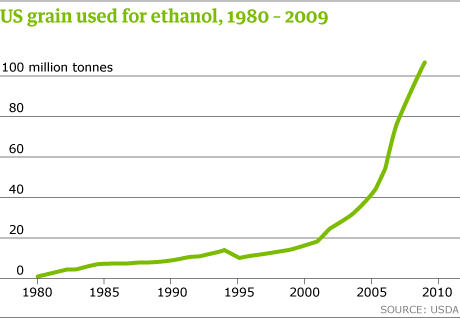
    “The grain grown to produce fuel in the US [in 2009] was enough to feed 330 million people for one year at average world consumption levels,” said Lester Brown, the director of the Earth Policy Institute, a Washington thinktank ithat conducted the analysis.

    Last year 107m tonnes of grain, mostly corn, was grown by US farmers to be blended with petrol. This was nearly twice as much as in 2007, when Bush challenged farmers to increase production by 500% by 2017 to save cut oil imports and reduce carbon emissions.

    Graph - US grain used to make ethanol

    More than 80 new ethanol plants have been built since then, with more expected by 2015, by which time the US will need to produce a further 5bn gallons of ethanol if it is to meet its renewable fuel standard.

    According to Brown, the growing demand for US ethanol derived from grains helped to push world grain prices to record highs between late 2006 and 2008. In 2008, the Guardian revealed a secret World Bank report that concluded that the drive for biofuels by American and European governments had pushed up food prices by 75%, in stark contrast to US claims that prices had risen only 2-3% as a result.

    Since then, the number of hungry people in the world has increased to over 1 billion people, according to the UN’s World Food programme.

    “Continuing to divert more food to fuel, as is now mandated by the US federal government in its renewable fuel standard, will likely only reinforce the disturbing rise in world hunger. By subsidising the production of ethanol to the tune of some $6bn each year, US taxpayers are in effect subsidising rising food bills at home and around the world,” said Brown.

    “The worst economic crisis since the great depression has recently brought food prices down from their peak, but they still remain well above their long-term average levels.”

    The US is by far the world’s leading grain exporter, exporting more than Argentina, Australia, Canada, and Russia combined. In 2008, the UN called for a comprehensive review of biofuel production from food crops.

    “There is a direct link between biofuels and food prices. The needs of the hungry must come before the needs of cars,” said Meredith Alexander, biofuels campaigner at ActionAid in London. As well as the effect on food, campaigners also argue that many scientists question whether biofuels made from food crops actually save any greenhouse gas emissions.

    But ethanol producers deny that their record production means less food. “Continued innovation in ethanol production and agricultural technology means that we don’t have to make a false choice between food and fuel. We can more than meet the demand for food and livestock feed while reducing our dependence on foreign oil through the production of homegrown renewable ethanol,” said Tom Buis, the chief executive of industry group Growth Energy.

  • Asian ozone raising levels of smog in Western United States, study shows


    “The important aspect of this study for North America is that we have a strong indication that baseline ozone is increasing,” said Cooper. “We still don’t know how much is coming down to the surface. If the surface ozone is increasing along with the free tropospheric ozone, that could make it more difficult for the US to meet its ozone air quality standard.”

    The study is the first link between atmospheric ozone over the US and Asian pollution, said Dan Jaffe, a University of Washington-Bothell professor of atmospheric and environmental chemistry.

    He contributed data from his observatory on top of Mount Bachelor in Oregon to the study.

    The US Environmental Protection Agency is considering lowering the current limit on ozone in the atmosphere by as much as 20%, and has been working with China to lower its emissions of the chemicals that turn into ozone.

    Ozone is harmful to people’s respiratory systems and plants. It is created when compounds produced by burning fossil fuels are hit by sunlight and break down. Ozone also contributes to the greenhouse effect, ranking behind carbon dioxide and methane in importance.

    Ozone is only one of many pollutants from Asia that reach the United States. Instruments regularly detect mercury, soot, and cancer-causing PCBs.

    Jaffe said it was logical to conclude that the increasing ozone was the result of burning more coal and oil as part of the Asia’s booming economic growth.

    The next step is to track the amounts of Asian ozone reaching ground levels on the west coast, said Cooper.

    Work will start in May and end in June, when air currents produce the greatest amounts of Asian ozone detected in the US weather balloons and research aircraft will be launched daily to measure ozone closer to ground, where it affects the air people breathe, Cooper said.

    The study to be published in Nature looked at thousands of air samples collected between 1995 and 2008 and found a 14% increase in the amount of background ozone at middle altitudes in spring. When data from 1984 were factored in, the rate of increase was similar, and the overall increase was 29.

    When ozone from local sources was removed from the data, the trend became stronger, Cooper said. Using a computer model based on weather patterns, the ozone was traced back to south-eastern Asia, including the countries of India, China, Vietnam, Laos and Cambodia.

    The ozone increases were strongest when winds prevailed from south-eastern Asian, Cooper said.

    In a commentary also published in Nature, atmospheric chemist Kathy Law of the Université de Paris in France said the study was “the most conclusive evidence so far” of increasing ozone over the western United States.

    Law noted that natural sources of ozone could contribute to the increases, and there were limitations to the computer model used to trace the sources of the increases, but the study remained a “vital benchmark” that could be used to test climate change models, which have been unable to reproduce increases in ozone.

    William Sprigg, a research professor at the University of Arizona who studies the global movement of airborne dust, said he agreed with Law’s comments, adding that studies like this one make it possible to control air quality.

    “Part of the solution to controlling emissions from abroad is to show the negative consequences and our own efforts to lower emissions,” he wrote.